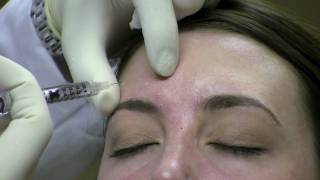
Dr. Shervin Naderi demonstrates Botox injection technique for the forehead, glabella, and crow's feet. Botox arrives as powder and is mixed with saline, with effects lasting 90 to 120 days. The goal is a natural relaxed look, not a frozen face, with injections timed about three times per year.
Questions this video answers
Approximately 100 units per vial.
About 90 to 120 days.
About three times a year.
Allergan (Botox, onabotulinumtoxinA).
Chapters
What we're going to do now is a little bit of Botox for her. If you take a look at the muscles here, frown for me. You can see that she's able to move the mouth rest. You'll see that the muscles here are working. She's had Botox in the past and we're basically getting it before the next treatment is completely worn off. The last treatment is completely worn off. Ideally, you want to do Botox about three times a year. The substance lasts about 90 to 120 days. You don't want to wait for the effects to completely wear off before you do it again. One, because if you keep the muscles weak, it has a more additive effect over time. Secondly, if you maintain a certain look, your co workers, friends and family won't suspect that you're getting anything done. So a little bit about anatomy of the forehead. When you see a patient frowning and creating these movements, there are several muscles that are leading to that. So Botox can vary from patient to patient depending on what you're trying to achieve. In this area here, the procerus muscle wrinkles the nose. And you see some patients that have very strong horizontal lines in this part of the nose. And this is from the procerus muscle that you can inject and relax. The typical lines are the 11 that you see in some older patients. And again, what we're doing here is getting started at a younger age to prevent getting lines and wrinkles. But the 11 mark that a lot of patients eventually get if they don't do Botox and it creates this kind of fold was created by the corrugator muscle, which is two muscles that go in this direction, up and down this way. So the injection of Botox is not into the lines but into the muscles that create those lines. You can create a brow lift with Botox by relaxing the muscles that pull the brow down and allowing the muscles to pull the brow up to be able to function. And people can get a chemical brow lift. What you can do, you can open up the brow in this position by relaxing the supercilious depressor muscle, which is in this area and pulls the head of the brow down. So there's a lot of different things that can be done. And then in the forehead area, you can relax the forehead muscles so you don't get the transverse wrinkles in the brow in the forehead area, and finally around the crow's feet and the lower eyelid area. If you smile from here aggressively enough, you'll see this bunching up that creates eventually, crow's feet and you can relax. And what we try to do with Botox, again, starting at a young age, is preventing the formation of these crow's feet lines, because then as they become permanent, then you have to use different modalities, such as CO2, laser Fraxel or chemical peels with phenol deep peels to get rid of them. And you can even bring the Botox a little bit more medially towards the lower eyelid area. Because what I've noticed is patients that come in with a relaxed forehead and a relaxed crowsuit area, but they can still smile, obviously what happens, they get wrinkling now of the lower eyelid area. The goal is not to paralyze the face completely. The goal is not to create a plastic or fake look. That should never be the goal of any cosmetic surgery procedure. The goal is to create a relaxed look where involuntary movement is subsided. If I ask her to frown, if I ask her to smile, she'll still be able to do so, and she'll still look natural and nobody would suspect anything, but she will not be able to form the lines and wrinkles and maintain the youthful look. So what we're going to do is now start, as we've discussed before, is made from allergan. That's the only substance that's available in the United States for what we're going to be doing. Basically, it's botched lime toxin. It comes in a vial with a ring of powder at the bottom of the vial. That's the Botox. It's about 100 units per vial. What we do is, once we get that, we inject saline or injectable salt water into it, and we constitute it. So it comes in a powder form. You have to mix it. Now, different doctors have different formulas. You can do 1 1/2, 2, 4, 5, even more cc's of saline into this. The more saline you have, the more dilute the Botox is. And what's going to happen is you have to use more volume to inject. And then what happens is that the Botox can travel up to an inch. So you may be thinking that you're injecting one muscle and then inadvertently paralyze another muscle next to it. And that's when you hear people's eyelids dropping or their eyebrows dropping and getting really adverse side effect of Botox, which should never happen in proper trained hands. So we're going to demonstrate this technique. First to the glabella, which is this area, and a little bit to the forehead, and then we're going to go around the cross. Fetal Botox injection technique. What I like to do is I initially start with injection of the procerus muscle, and I'm going to do that with one little injection right in this area. Just a few units of Botox, that's all that muscle needs. And that prevents that scrunching up of the tissue at the root of the nose. And it makes the area look much more open and natural. I go along the depressor superciliae inner head of the corrugator all the way to the outer head of the corrugator muscle. I get a little bit of the outer portion of the orbicularis muscle. The lateral or outer part of the eyelid muscle, the orbicularis, actually contributes to formation of lines between the eyebrow. You don't want to be too aggressive out there because that will drop the position of the brow. Then I go to the other side, repeat the same way. There's usually very little bleeding. With Botox, bruising is rare. If it does happen, there may be a couple of little tiny purple spots that are easy to cover with makeup and go away on their own. Next, I get the central part, the frontalis muscle, and what this does, it allows the outer part of the frontalis muscle to activate and raise the eyebrows. The patients get a nice chemical brow lift, which they like. So this pretty much is all that you need for this part of the brow. Next, we're going to go to the crow's feet, the injection technique to the crow's feet area. My technique is a little bit different than most people because I like to go a little bit more medially and get the lower eyelid area as well. Never had a problem with it. Patients like the results, and they say that it looks different than most of the other injections I've had before. It's a very natural look. The entire area gets relaxed without creating extra lines at the lower eyelid area, which can happen if you just inject the crow's feet area. Again, everybody's a little bit different. Sometimes they're a little bit more involved, and I get even the upper cheek area, depending on how aggressive the crows feet is In a young patient. We're just basically trying to avoid creation of lines and maintain the look of the skin so we don't need to be that aggressive. Clean the skin, and we're going to zoom in and really show you the details of injection around the crow's feet. It's very different than injection in the glabella on the forehead. Because in those areas you actually penetrate the belly of the muscle. In this area, you definitely do not want to penetrate the muscle. You create more bleeding and bruising and you also can create drooping of the lower eyelid. These injections are done right underneath the skin and you create a little blood which goes away in about 10 to 15 to 20 minutes. This is the importance of the variation injection technique. Okay, I'm going to show you my technique. I like to stabilize my hand right under the skin, like create a little small blood. So this is typically what most people do with the crow's area. Three injections and that's it. What I like to do is go a little bit more medially with the lower eyelid area as well and come out a little bit more. And that's it. What I do is I have them hold a little pressure here. Patients can hold the pressure with their entire hand themselves. And then I go to the other side.