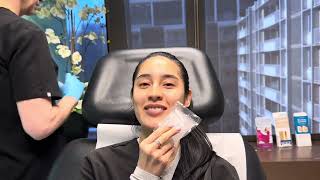
Dr. Shervin Naderi demonstrates tear trough filler injection, starting with patient selection: assess whether the problem is upper lid, lower lid, or midface, and consider whether the patient needs blepharoplasty or fat grafting instead. He injects supraperiosteal (down to bone), bevel down, avoiding the infraorbital foramen, depositing vertically to build the V3 shelf. The key is undercorrection: minimal product prevents the swollen Tyndale effect that happens with too much filler in thin skin.
Chapters
Look, my head is chopped up. I can see myself. Okay?
You just look gray in the iPhone one. And then the color looks good on.
The one on the left. What are you, like gritty type right now?
Yeah, maybe cut it out where I called you gray.
So take two. I have to go turn off music. So we have a beautiful young female who's one of our staff. She just wants to look more rested. So the question is first we have to evaluate it. What does that mean? Is it the upper lids? Is it the lower lids? Is it the mid face? What's happening? So when you look at her face, if she looks straight ahead, there's a little bit of shadow right there. And classically, there's a few things contributing to this. There's a lower lid fat pad right there where you could do a blepharoplasty with my partner Dorothy Kulak tightening this up. Or you can do fat injections in this area or you could do a combination of two. Or in somebody who's a good candidate, you can actually do a little bit of tear trough injections and build up the midface a little bit. We have stepped away from tear trough injections in people with extremely thin skin and people that don't have much of a fat pad. Those patients, over 20 years of doing this, we have learned that they end up getting this tyndale effect, this swollen look. So we basically at those times say, listen, you either gotta do nanofat or. Or you have to do PRF. Nanofab with Dr. Kulak, PRF with Dr. Snodgrass. But if you're an ideal candidate for tear trough injections, it still works really nicely. So check out the technique. Keep recording. We're gonna do this. You don't have to record this.
You said keep recording. A little before, Mommy.
It'll never look up.
Like, let's look right ahead. Ms. Carolina, look up.
Okay, carolina, There we go. Relax yourself. Rest her head. Point on and back. Do the other side. Cool. You want to stay over here so you can see.
Slimming one.
I'm going the right side. So you stare. Cool. And go back a little bit. Not too close.
I have it zoomed out.
What are you looking at? Close your eyes. So we'll go right down to the bone. Right down through the bone. Feeling the periosteum. Right down to the bone. I'm not going in this direction. I'm not going this direction. You, you can see with her eyes closed. Do you see that? Sarah, come over right in front. Right in front. You can actually see A difference. See how this side's dark? On this side the darkness is dark. See that? Does the camera show that? A little. Let's zoom in.
I just don't have hands to do it.
Move it over this way. You can totally see how the left side just with our eyes closed. Now open your eyes for me. Look straight ahead and if you actually look at it you kind of see on the left side we have this shadow here. On this side it's gone. It's much improved already. You can see it on both sides again. The shadow exists over here but there's no more shadow over this side. That's how easy it was. That's how simple it was. Now we're going to go to the other side. Close your eyes again to right down to the bone. Don't feel your perioster. Bevel is down. I am cognizant of where the infraorbital foramen is going to be. If you're doing the injection the right way, you're avoiding the infraorbial foramen in that area. You're going to be a little bit more superficial. There's no need for ultrasound. There's no need for drawing back. Book. Perfectly smooth. It's literally perfect. Yeah, See that? Now I'm going to build up the shelf. So the shelf is actually below a little bit. So the shelf is actually going to help us support the tear trough area which is the upper part of V3. So if you take the cheek according to Adler Ginn's nomenclature, when it came out with the Luma V1, V2, V3, V4, by building up V3 it really supports this area nicely. That's all it takes. It doesn't take much. You can put the ice on the other side. Gentle. Cool. Finishing up. Come back here. Building up the shelf again. Straight down. I have seen a lot of injectors. I've talked about this many times before. Where in this area. They're coming in these weird angles. You don't want to do that. I might do short notes on there. You really want to be supraparyossi. You want to deposit the filler on top of the bone. You want to be vertical, don't skive it. I've seen a lot of so called experts doing these videos and they're coming at the wrong levels. You have to go straight down because you have to treat this like a malar implant. Just like you would put a malar implant during surgery as plastic surgeons. We put it on the, on the bone. This is what you're going to do, if you do it in the soft tissue, you get a different look. Perfect. Looks good. Now do a little bit more on this side. That'll wrap it up. Cool. Holding a little bit of pressure. Open your eyes for a second. Let's see. So with the eyes open, I look straight ahead. Look up for me. Look straight down for me. Perfect. So what we don't want to do, Hold a little bit of ice right there. What we don't want to do, Pull down the needle me your bones. So what we don't want to do in this area is over. Correct. Because when you look up, you're always going to roll out your lower lip fat pads, which will always look worse. By the way. Have you seen a lot of injectors on their websites or Instagram? They show them before with the eyes rolled up, then they show the after eyes looking straight. That's trick. That's trickery. Believe that. Because whenever you roll your eyes up, it always looks 10 times worse. So if you're going to show before and afters, those better be at the same level. If you're going to roll them up, they better be at the same level. If you're going to look straight, they better be at the same level before and after. So do not post a rolled up eye before making it 10 times worse and then straightforward afterwards. That's just not honest. So what we're going to do here is make sure that when she's looking straight, straight or even down, we don't end up with too much swelling. So you want to have a little bit of undercorrection. Do not overcorrect in this area. Overcorrection is a bad thing. Close your eyes. One more drop right here. You can see it, sir. Perfect. One last drop. Perfectionist. Cool. Done. How about. Is that.