Dr. Mehra Interviews Dr. Naderi | Part 2
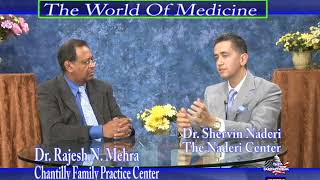
Dr. Rajesh Mehra and Dr. Shervin Naderi discuss facial plastic surgery approaches to the aging face, including facelifts, volume replenishment, and laser treatments.
Chapters
Coming our way next, we have the world of medicine here. The host is Dr. Rajeshnandan Mehra of Chantilly Family Practice center located in Chantilly, Virginia. Dr. Mehra's guest is a renowned surgeon from the Naderi Center, Dr. Sharvan Naderi. Together, these two doctors are found engaged in a medical dialogue pertaining to the aging face. Let's join these two physicians. Good morning. This is Dr. Rajesh Mehra from the Capital Forum bringing you the world of medicine. This is where we talk about new ideas, new inventions, new topics, and all the exciting things that are going in the huge world of medicine. The last few weeks we've been talking about facial plastics. And I'm honored to have with me a very prominent, well renowned facial plastic surgeon, not only of the metro D.C. area, but all over the world. He has operated and has patients from England, France, Russia. And we're honored to have him in our studios. Dr. Shervin Nadiri. Welcome, sir.
Thank you. Thanks for having me back.
Well, we've covered a few topics over the last few weeks. We've talked about, yes, yes, I'd love you and I can just sit here and do this all day.
They're going to kick us out.
They're going to kick us out after a few minutes. But we've talked about rhinoplasties and fillers and today we want to talk about the aging face. You have such a baby face. Have you had plastics done?
I've had a nose job.
Oh, see, now that's not right. And you said your professor did it, meaning your mentor.
Right, my mentor. The person, Steve Perkins, who I trained with. And you know, the fellowship program is the number one fellowship in the country and he's world famous. He operates in Europe and elsewhere. And you know, he does a fantastic job. And people can't believe that it's actually an operator knows and we did talk about that. But you know, the other part of facial plastics is the rest of the face. I mean, the nose.
Yeah, it's not just the nose. Even though the nose is kind of the central point, as we all age, we obviously want to look younger, Right? When we're younger, we want to look older, we grow a beard. I've had a beard all my life except the last 20 years. Now, when you get older, you want to look younger and our faces get old. So tell us about sort of the aging face.
So I guess the most important thing is getting a few misconceptions out of the way. You know, people think about it's all gravity, gravity, gravity. Well, Gravity is important. That's what's keeping us in these chairs right now. But really, it's the first thing that happens is the loss of elasticity of the skin and the loss of volume. Those two things are important now. For decades, we didn't really have much choice when it came to elasticity or the volume. But in the last 10 to 15 years, we actually have options of treating those. So the first thing that happens is you start losing elasticity of the skin. The skin gets a little bit looser, it stretches more. And the second thing is you're losing not only volume of your skin thickness, skin is getting thinner. Muscle of the face is atrophying, just like muscle everywhere else. Fat is getting less. You'll see. Basically, people lose the fat in their cheeks and they start getting hollowed. But even the bone, the jawbone, the mid face, everything, the bone shrinks. So all this stuff that's basically shrunken in now, gravity sets in and just does the final, you know, puts the final punch in and pulls everything down. So in the old days, rejuvenating the aging face was about a facelift. And you'll see these people, I mean, the Burt Reynolds and, you know, some of the celebrities with these really tight pulled faces. What surgeons would do is they would just pull, cut, pull, cut and pull and cut. And yes, you didn't have jowls and maybe your neck was tighter, but you didn't look good. He didn't look younger. You just looked.
I knew something was wrong. There's a person, 70, who has a face over a 50 year old, and that's just not. It doesn't compute.
But it looked hollow and tight. And what now we do is we replenish volume. And the volume can come in the form of fat injections from elsewhere. You can take fat from around the belly or thighs and put them into places belongs in or fillers. We talked about.
Yeah, last week.
Exactly. You know, Restylane Juvederm, the liquid facelifts, which we'll talk about at some point, basically replenishing volume to the temples, around the eyes, around the jawline. You can actually make somebody look better without ever going through surgery. But if they're gonna go through surgery, they still need the volume. And then the elasticity is the last part of the equation. And that can be improved with topical compounds like retin A, which is important, or lasers and chemical peels and dermabrasions, things that basically take the surface of the skin, resurface it, reshape it, right. And then you establish some more collagen and some more of that elasticity. So you got to really look at it from multiple different.
Yeah, I'm going to come back to those topics in a little bit, but I also want to sort of touch on, I call it Invogue or sort of all these other. And I don't want to name all of them because there's so many. There are too many to name. I call them luncheon facelift. Right. The marketing ads say, during your lunch hour, come to us and we'll reshape your face. What's your opinion about that and how do you see that?
You know, this is a topic that you and I can talk about for hours again, because some of it is good. One of the most famous companies out there that markets more than anybody else out there is Lifestyle Lift. And it's a fine procedure. It's essentially, it's nothing new. It's basically a mini cheek lift. That's all it is. They claim to have invented it, but it's been around for 100 years and they just now basically market it with a different name. However, it's good for certain people. If you have a thin person in their 40s and they're starting to form a little bit of jowls, doing this mini cheek lift is fantastic. But if you have somebody who's got heavy neck, obese, lots of adipose tissue, heavy jowls, a lifestyle lift isn't going to do that. You need a much more extreme type of surgery. So some of them are good, some of them should be avoided. Feather lift or the thread lifts you may have heard of. The thread lifts are procedures that really became well known or in vogue, as you say, a few years ago, where doctors would take these barbed wires, it looks like a barbed wire, and they would put them through the skin, tunnel them down through the skin, grab the skin from underneath with these wires and pull it up. Well, complications can, can be numerous. I mean, I saw patients that had facial nerve paralysis because these wires are not under guidance, they're blind. And you can rip through a nerve of the face and get paralysis of the face. That's the worst case scenario. It can actually stick out through the skin. That can be a bad scenario as well. But at the best, this whole gimmicky procedure would give you results that lasted maybe three months, six months to a year. A year later you're back to normal. So some of them you avoid and some are perfectly fine in the right patient population.
I think the take home message here and I think you agree with that is that in and of themselves, they may not be horrible things, but you've got to tailor it to the patient and look at all these other things. Medicine is not a cookbook. If I can share with you guys one thing, whether it's taking Tylenol or aspirin or facial procedure that a good doctor is going to customize to your face, to your health, to your heart problem, the right medicine, the right procedure. Now that we've got that out of the way, let's go back to. So it's no more just like doing a facelift. That's kind of what I want to talk about. There's like this whole constellation of things that one can do.
So first of all, what is a facelift? I mean, people think, well, that's one of those terms that most people don't understand. And they think a facelift is essentially the entire face. Facelift truly is just something that addresses the neckline, the jawline, the jowls and the neck. That's what it is. If you need a sagging brow, that's a brow lift. If you've got extra eyelid skin, that's an eyelid lift.
If you look fat under the eye.
Then you have a mid face lift. So there's a lot of different types of lift. But a facelift truly just addresses the lower face. Now, even that surgery, if you just look at a facelift, almost no two surgeons do it exactly the same. The incisions are different. For example, you've seen incisions in front of the ears. They're visible. I don't like those. I've seen incisions in front of the hairline. Again, I don't like those. I've always liked to place incisions in hidden places inside the ear. Right. I mean, you can have a very long incision and afterwards the only person who may be able to see it is probably your hairdresser. And even those situations, after a few months when it's healed, even the hairdressers have a tough time seeing those. So the incisions are different then the plane that it's lifted. Going back to Burt Reynolds. Poor guy used to be one of my favorite actors until I can't look at him anymore. The face, the type of lift that he's had is called the skin only lift, where only the skin is lifted and pulled back. It looks very fake, right? But the better facelifts are the composite lift where the skin is muscles and everything. Exactly. The muscles adjusted and the skin just casually Drapes over everything.
Now, you mentioned lasers. Now, we think of lasers as hair removals and tattoos removal. How do lasers work with the face?
So a laser, all a laser is, is basically something that emits one wavelength of light. That's all it is for the people out there to understand. I mean, a laser pointer is also a laser, but it doesn't make anybody younger. There's different types of lasers in facial plastic surgery. The strongest laser for resurfacing is the carbon dioxide laser, otherwise known as the CO2 laser. Now, traditionally it was just one type of CO2 laser, but now we have four fractionated CO2 laser, or a form of a fraxel that you may have heard of. What that does is it targets water as its molecule. All these lasers go after some kind of a target and CO2 laser goes after water. So it essentially is burning the skin, but in a controlled way. When a plastic surgeon, facial plastic surgeon, a cosmetic dermatologist uses the CO2 laser very precisely, we're basically burning the skin taken off the top layer, taking off the layers down to the area that we wanted to get dead skin, the bad skin, even the precancerous skin can go. The new, healthy, tighter, more useful skin can replace it. Then there's erbium laser. Erbium is another type of a resurfacing laser. It's not as deep as a CO2 laser, but that also helps with some of the pigmentation on the face. And there's other forms. There's pulsed dye lasers, YAG lasers. So multiple lasers, multiple lasers, each one does something different. So when you go see somebody, just like surgery, just like anything else, you want to make sure they have all the options. If all they do is one thing, it's like a carpenter with a hammer. They don't have anything else. You have to be able to have various tools because each thing is going to be treated differently. And unfortunately, these lasers cost so much money. So some surgeons and some doctors buy these expensive lasers can cost 100 to $200,000. And they just want to use that laser on everybody.
And it's not the right indication.
Exactly.
Right indication for it. Well said. Well, again, it's been quite a learning experience. I'm sure that our audience benefited from that. We'd love to have you back. Perhaps we will get your. You have an associate, I believe, that specializes in this aging face type thing.
So my practice, we basically split it up. We're Washington D.C. truly most specialized practice. And actually, if you look around the entire country, the entire United States, there's not a single practice that specializes the way we do. I focus purely in my office on injections and in surgery on rhinoplasty. I stopped doing facelift, stop doing brow lift, even though I've taught it. I was an associate professor at Indiana University, teaching residents. I've written textbooks on revision, facelift. I just stopped doing it. And Dr. Kulak, who's joined me, she is a facelift expert. She does facelifts and eyelid lifts and she doesn't neurontoplasty. So we basically split, divide up and we truly are specialists and it works very nicely.
Well, I respect that because this way you're going to be very good at what you do rather than sort of jack of all trades, even though certainly there's nothing wrong with that if you're comfortable doing it. I'm a family doctor. I do a little bit of everything, but I'm not the expert on much of anything. So thank you so much. And we'll talk more in the future about some very other interesting topics regarding facial rejuvenation, aging face and facial plastic surgery. Thanks again.
Thank you.
More from Dr.

#DeepPlaneFacelift vs. #SMASLifting. Here are the actual differences and similarities

Preparation before and recovery after your deep plane facelift surgery with Dr. Naderi

Deep Plane Facelift vs SMAS Face Lift. Understand the difference and make the right decision.

How to expertly analyze the upper face for Botox injections to prevent complications #botox

Naderi 11-Fill™ Filler Technique for Deep Wrinkles Between the Eyebrows (Glabellar lines, 11 lines)

Master injector teaches safe botox & filler injection to 11 lines, crows feet & liquid rhinoplasty


What is the best age for a plastic surgeon? Does the age of your surgeon matter? #plasticsurgery


Buccal fat pad excision (Bichat’s fat pad removal) is a quick and easy way to slim the face.
