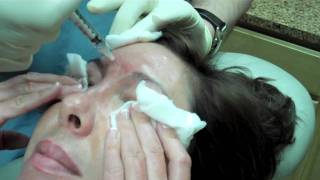
A short instructional/demo video by Dr. Shervin Naderi explaining and demonstrating Dysport (a Botox alternative) for preventing and treating dynamic facial lines: nose "bunny" lines, crow's feet and lower lid lines, glabella and forehead lines. The video covers product background (formerly Raloxin in Europe), reconstitution/dosing (300‑unit vial; author uses 2 cc saline giving ~3:1 Dysport:Botox ratio), practical injection technique (shallow injections, bleb formation, caution about spread), and expected onset/duration (may work sooner than Botox; typically ~3–4 months).
Chapters
Hi. Today we're going to talk about Dysport. We've done some videos on Botox before. Dysport is actually very similar to Botox, but it's made by the manufacturers that create Restylane, whereas Botox is made by Allergan, the people that make Juvederm. This port was in Europe for a long time under the name Raloxin and it came to the US about a year to year and a half ago. And it's a nice alternative to Botox. Very similar, slight little differences. Some people notice that it works a little bit quicker. So, for example, if you wanted to get Botox, but it's a Tuesday and you've got a party on Thursday and you want it to start showing some effects, you may want to try this port because it kicks in a little bit faster. They both can take up to two weeks to work. However, this port may start working even in a day or two. As far as longevity depends on the dose, both last somewhere between three to four to five months. The higher dose that you use, the little bit longer longevity you get out of it. If you skimp out on the dose, it'll wear out quicker. But really it doesn't last more than four months or so, although some people claim that it lasts up to five months most of the time. That's because you've forgotten how to make the movement. And it takes about a month or so for those muscle memory to come back again. Finally, some people say that this work hurts less at the end of the day. The pain is patient dependent. Each patient is different. The same level of pain that hurts somebody barely hurts anybody else. And injection technique is important. Size of the needle is important, and the location that you're injected. So today we're going to do a little bit of Dysport. If we actually look at our volunteer patient today, we can take a look at where she smiles on her nose. Give me a big, big smile. Bigger, bigger smile like you. And let me have you kind of do your typical frowning. See what happens as she frowns. She gets these bunny lines and they actually kind of wrinkle where right now she's nice and young and the skin is elastic and is not an issue. But if she keeps smiling with these bunny lines, what's going to happen? In about five or ten years these lines will form permanently. And the fact that she has a little bit darker skin tones prohibits us from doing aggressive lasers or chemical peels or dermabrasion. So the best answer is to prevent these lines from forming. We're also going to do the crow's feet and the central forehead a little bit as well. So we've got this port. It comes in a smaller looking bottle, but the reconstitution, again, depends on how much saline you put in. Just like Botox, it comes as a powder, and you add saline to it to mix it. You draw it up depending on how many units you like to get out of it. Typically it comes in a 300 unit vial. I like to add two cc's of saline to it, and then it gives me a three to one relationship to Botox. So, for example, if I was going to do 20 units of Botox, I would do 60 units of Dysport. So my typical dose for the glabella is 20 units of Botox. And for Dysport, it's about 60 units of Dysport. And the thing about Dysport is that it travels a little bit more. So you want to be careful where you inject it. So we're going to get started. I'm going to have you close your eyes. I've already prepped your face with alcohol. We're going to start from the nose and work outwards. Ready? Okay. A couple of little injections. Very tiny, Very tiny doses. The nose is very sensitive. This will give you a really nice result when it kicks in. So these should not bruise. She did really well there. Now I'd like to go and actually take care of the crow's fetal lower lids for her. The injection is right under the skin. You can see the blep forming. You do not want to be deep. If you're deep, you get into the muscle. And if you get into the muscle, you get the bruising and bleeding very gently right under the skin. And you want to see the bleb forming. These blebs go away in about 15, 20 minutes. Now, typically, most people do this three injections. I do an extra one underneath the eyelids. Because what happens is if you just do the crow's feet and not do the eyelids, this area smooths out. And then when you smile, the lower eyelid lines actually stand out more. So I'm gonna have you hold this for me while I go to the other side. So switch hands. Perfect. Great. So we're gonna repeat again. Same thing. I'm gonna go right under the skin. Barely penetrate. You see the blood form. I pull the eyebrow up because you want to go underneath the eyebrow, but outside of the orbital ring. Okay. Mm. That's it. That takes care of the crow's feet and lower lids now we're going to go up to the glabella and the forehead. So we did the root of the nose there. This one we're getting the procerus muscle. This one gets the depressor of the medial head of the brow, so the medial head does not drop down. It's called the depressor supercili muscle. Here we're going to get the corrugator. Now, she forms a few little lines above her eyebrow. She doesn't like those. So we're going to do a very light dose there, not a heavy dose, because that's the muscle that's actually pulling the eyebrow up. And if you do a heavy dose there, the brow position drops down. So if people have extra heavy arches, you can actually bring their arch down. But that's a rare situation. Most people actually like to have an extra arch in their brow. So very light dose there, and then again to keep the central forehead very light. The nice thing about Dysport is that it's a very soft relaxation. It travels, so all you need is a few little points in the forehead. If you actually get a little bleeder, you just hold a little pressure and it stops. Then finally, I like to go back and just get a nice little dose right in between. Get the procerus and corrugated complex right there. Hold a little bit of pressure out of all those injection spots. They do ooze, but if you don't hit a big blood vessel, which we didn't, none of these should really bruise. And that's it. That's pretty much a dysport injection. Sam.