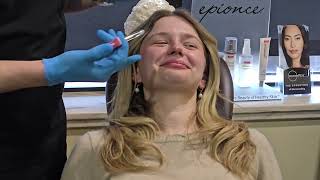
A short YouTube video by Dr. Shervin Naderi explaining how much hyaluronic acid filler is typically needed in different facial areas to achieve a natural look. He emphasizes that small volumes (often <1 syringe) are sufficient for lips and nose, while chin, cheeks, and liquid facelift-type contouring require multiple syringes; correct placement (on bone, not in soft-tissue fat) is crucial. He demonstrates filler consistency, explains why fillers don't migrate, and advises professional consultation rather than DIY or informal advice.
Chapters
Her face is honestly a minute too. Okay. All right. Hi, guys. It's video time. It's been a while. I used to make a ton of videos. It's been a while. So I want to talk about volume of filler. A lot of times people come in here for consultation. They've done their research and talked to their girlfriend or talked to their sister. They got the chat, GPT consultation, whatever it may be, and they think, I want to come in and do one syringe or two syringes. Let's talk about volume. So there's certain areas that's going to take more. There's certain areas that's going to take less. We don't want to overfill anybody. We don't want anybody to be unnatural. I don't want anybody to know that you had anything done. I want people to come up to you and be like, you look good. What are you doing? What's your facial? What's your cream? Did you go on vacation? What's going on? Did you look really good? Are you going to zempic? What did you do? You look good. But we don't want it to look overdone, overfilled, unnatural. Now, there are certain areas you can get away with less, get away with less lips. You don't need more than one syringe to the lips. Honestly, most of the time it takes less than one syringe. The nose, most of the time you need one syringe, maybe a little bit less. But there are certain areas, chin, cheeks, mid face. If you're trying to do a liquid facelift or you're trying to really contour somebody's face, it's going to take more. One syringe is most of the time not going to do it. Now I have a whole bunch of filler that's actually expired. So what we're going to do is we're going to have some fun with it. I'm going to show you that five of these five syringes is equal to one teaspoon. You heard right. One teaspoon, Not a tablespoon, a teaspoon. So if you're in your 40s and 50s and you're looking to kind of get a pick me up and a liquid facelift, one or two syringes most of the time isn't going to do it. So this is where volume comes in. Now watch this. So we're going to zoom in. I'm going to first start doing a little bit to the nose and do a little bit to the lips. Okay, so we're not injecting it. I am placing it. Now are you zooming in? Can you see your face really good? This is going to be a lot of fun. So, so the filler material, first of all, as you squish it, this is the material. Can you zoom in really tight? Zoom in tight. So you can really see this material. You kind of see that's basically hyaluronic acid. It's a clear gel. Right? You see it, you see the consistency, the molecular structure, the bonding. This is why fillers don't migrate. They want to hold each other, they want to coalesce sometimes they want to clump up. They don't get up and move somewhere else. That's not what happens. I've talked about this until I'm blue in the face, fillers do not migrate. But if you overfill, it can spill over. It can spill over to the next zone. You see it well, right? Yes, you can see that, basically. So if you do the border of the lips and if you overdo it, it spills over to the white lip. It's not migrating. It just looks like it did, but it spilled over because it was overfilled or the needle tip was actually placed in the wrong place. So it was filled in the wrong place. Now look at what happens when I, when I'm not injecting. There's no needle on this, but I'm placing this material here. So when we're doing noses, the filler is going right. Can you zoom in really good. You're going to enter your seed. We may put a little drop right there or may put a whole layer. And this is actually really good for your skin afterwards because you're going to hydrate the skin. This is a hyaluronic acid. Look, this injection patient's laughing her head up. This injection right there feels tickling, right? A little bit, yeah. Right. So can you see it really well? Yes. So this is going underneath the skin. I don't need more than a syringe to do this. In fact, we have made videos of my patient who happens to be one of our amazing staff. She's actually had the non surgical. Right. And there's filler in here, but that's where it goes. Now this is going right underneath the skin. If we need lips, for example, if we did, I don't know if you can see on that side, but then you may have to come on this side. But if we did, like a little syringe to the lips, this is like a really, really expensive Hyaluronic acid moisturizer. Right. Now, lips like that. If we did that, it's going to go right, basically. See, now, if it was a needle, she wouldn't be laughing, right? But basically it's right underneath the skin. So a little goes a far distance. However, you've seen these videos, I've seen some tik Tok videos where they put it to their cheeks, right? They put a drop right there. The problem is, if you come in and let's say we do one syringe to the cheeks, the filler has to go down all the way to the bone. It has to act like an implant, like a cheek implant, like a mid face implant. If you're. And I've seen people inject in these directions, that is incorrect. That's the wrong technique. It has to be down to the bone. Because you don't want to put the filler in the meat of the face. You don't want to put it in the skin and the muscle and the fat layer. You want to put it on top of the bone, lift it up. That's how it looks natural to do that. This material is going way down here. So you're trying to build up this entire fat pad from down here. So it takes more. Let's have more fun. Hang tight, keep videoing. Let's do chin. Lana, go around that side so you can see the chin projection come all the way down here. I want you to go wrap around chin projection. Let's say she needed more to the chin. This is one syringe. Again, the chin is not going to be. If I put an entire syringe here, if it looks like that, it just looks weird. It looks pointy, right? So when you're doing the chin, you're kind of feathering it all throughout here. This is. You got to do this. You got to do the pre jowl sulcus, which is basically these areas. When you do a chin implant, the implant has a wing and goes here, but you could put more in the central part. Now, again, this looks like a lot, but it's because it's on the surface, right? It's on the surface. That is not how the filler goes. The filler goes all the way down. So when you layer it, the first syringe, the second syringe, the third syringe, that's when you start to see its effect. Does that make sense? Right? So that's where we. That's where we see it. Now, this is going to be great lotion, but you can see it wants to look, it just came right off. It doesn't. It coalesces together. I just did that. The entire filler came off. So the beauty of these fillers look, if you move your face, it just came right off. It wants to stick to each other, it wants to coalesce. Now this was a product that is very hydrophilic. It sucks in 20 times its weight in water. So it gets filled, hydrates, does a really nice job, but it just will not migrate. It, it has nowhere to go. It just wants. It likes its own molecules better than anything else. That's what the filler tends to do. You see that? And that was two syringes just demonstrating it. But I have done six, seven, eight, up to 11 syringes on patients faces that looked hundred percent natural. Nobody could tell anything was done. But if you take just one syringe and put it in the wrong place, you can make somebody look weird. So the right amount in the right place looks perfectly fine. In the wrong place it could look really weird. I've seen a lot of injections done in the wrong places where it makes people just look artificial. Too wide. If you put in the right place, the goal is to make you look more rested, more balanced, more harmonious. That is the goal. So come in here, see myself, Dr. Snodgrass, Dr. Kulak. We do all of our own injections. We'll talk to you about it. You may come in here asking for something because you've done months of research, maybe years of research, thinking that's what you want, and we may turn the table on you and say no, that's not what you need. Don't spend thousands of dollars on that. Just do a little bit over here. That's what you need. And that's why it's almost best to come in here for an actual consultation. Asking our receptionists, asking Chatgpt, asking your girlfriends, that doesn't matter. Come in here, talk to us. We'll tell you what's going to make you look your best. Thanks, Eric.