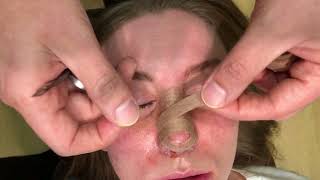
Video demonstration by Dr. Shervin Naderi explaining step-by-step how to tape the nose after rhinoplasty once the cast is removed. Covers purpose (control swelling and scar tissue), technique (small overlapping pieces, 30–50% overlap; create a U-shape under the tip to pinch/swallow tip area while avoiding direct pressure on the tip), recommended tape (3M Micropore), typical timing (cast about one week; taping for several days to up to a week, often at night), and precautions (sleep with head elevated, avoid flying, exercise, heat, and ripping tape off).
Questions this video answers
3M Micropore tape
About one week
Often for about 3–4 days, up to a week (nighttime taping or when at home)
About 30–50% overlap
Chapters
So we have some patients who could benefit really from taping their nose after rhinoplasty after the cast comes off. And they often ask, how do I do this? Well, what's the purpose of taping? Once the skin is lifted off of the cartilage and bone, there's a space underneath the skin that gets filled with swelling and scar tissue. And you know, you wear a cast for about a week, but that's it. And when the cast comes off, the swelling tends to increase. So people who can tolerate taping, meaning they don't have to go to work and meet clients or do anything, you know, that crucial and can tolerate taping, this is how we do it. It's small pieces of tape. Little by little. You start off at the very top and you start overlapping about 30 to 50%, getting longer and longer, but overlapping as we go. And as you're doing it, you're pressing down to push the skin down back on top of the cartilage and bone. Now here's where it gets a little tricky. You want to take a longer piece of tape, wrap around underneath and pull the tip up and create a U. As you do this, you're basically pinching off this tip and you're creating if there's going to be any swelling right at the tip defining point. And that's perfectly fine. That area can be swollen. It's okay, we just don't want swelling around it. So then you go and place another piece of tape and you're occluding the swelling everywhere other than at the actual tip itself. The super tip is going to have less swelling, the side walls are going to have less swelling. Everything is going to be less swollen. And it's usually one to two layers of tape. You can see how I do it. But the very important part is really at the very base again. Here is it again. And I'd like to do two layers to make sure we got enough support comes around. And I'm pulling it up, pulling it up, pulling it up. There's a little bit of tenderness putting it down and then I am crimping it here. Now one thing that's important, there is no pressure on the tip. I'm not pushing the tip down whatsoever. What I'm doing is making sure there is no swelling around the tip itself. So that's pretty much it. And that's the re taping. Now it's a 3M micropore tape. It's a very nice tape, almost skin colored. You can certainly walk around with it if you want. But you know, obviously you can't be in any important meetings or social events with it, but if you can tolerate taping a little bit longer, we can do it now. The way we do this is I have the tape on for about a.
Few days, and once the cast comes off, I tell patients, let's tape it.
Again for maybe another three, four days.
If they allow me to tape it for a week. That's great. Sometimes they tape it themselves at home at nighttime. Now, I want them to see how this is done. That's why we're making this video, so you can see how the taping is done. I'll give you a roll of tape. Take it home with you. At nighttime when you go to sleep, put the tape on.
Still.
Sleep with your head elevated. Those two things are very important. Avoid flying excessively. Avoid any kind of exercise. Yoga, heat, gym. Those things create more swelling and scar tissue. But the nighttime taping, or when you're at home on the weekends, taping really helps. The important thing is don't rip it off, because then it acts like a biore strip.
The tape is stuck to the skin.
And it lifts the skin up as you're ripping it off, and it creates more swelling counterintuitively. So when you take it off, you get it wet in the shower and just gently, gently peel it off. And then the next day you re tape it again, and now you know how to do it.