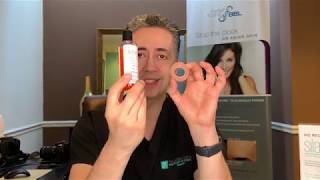
Dr. Shervin Naderi (surgeon) demonstrates how and why to tape the nose after rhinoplasty, with emphasis on patients who have thick skin. He contrasts thick versus thin skin behavior after surgery, lists precautions to reduce swelling (avoid flying, hot/steam rooms, heavy exertion), and gives a step-by-step taping method using 3M Micropore tape (brown/skin-colored) plus scissors. He shows overlapping strips from the bridge to just above the tip, a U-shaped sling under the nose to support the tip, and a second layered pass. He also demonstrates careful removal using a glue remover (Detachol) or warm shower and Q-tips, warns against rapid peeling (causes swelling/scar tissue), and recommends taping mainly at night for about 6–10 hours. Taping is important during the first year after surgery, especially the first 3–6 months.
Questions this video answers
3M Micropore tape (brown/skin-colored).
Detachol (skin glue remover) used with Q-tips.
During the first year, especially the first 3–6 months after rhinoplasty.
About 6–10 hours (typically at night).
Chapters
Hi, good morning. I want to demonstrate taping of the nose after surgery and also removal of the tape after surgery. This is an important concept. I use taping for people that have revision with thicker skin or even primary rhinoplasty with thicker skin. If you have thin skin most of the time, you don't have to worry about taping the nose. Thin skin is like a wet rice paper. It just basically falls down, hugs the new cartilages, hugs the new shape of the bone. Usually heals pretty quickly, sometimes over heals where you see some edges as things are healing. Thick skin is the opposite. Thick skin just doesn't bend and you want to force it to bend to the new shape. So thick skin rhinoplasty versus thin skin. Rhinoplasty is very different during surgery, but also post operative care is different. If you can avoid things like flying, avoid hot areas, steam rooms, Florida, things like that. Avoid laying flat, avoid going to the gym, raising your blood pressure, heart rate, all that stuff prevents extra swelling. Anything that creates extra swelling will create extra scar tissue because it expands the skin. Then you form scar tissue below it. And yes, scar tissue does go away eventually, most of it. But the more you create in the beginning, the more it stays in the long term. It doesn't all go away 100%. And the more you create in the beginning, you're preventing that skin from shrink wrapping and grabbing those cartilages and getting a nice defined nose. So post op care is important. We have tons of instructions for pre op care on our website. We have tons of videos showing the surgery, but now this is also showing post op care. I have also videos of me taping patients, but I'm going to show you myself. I had a rhinoplasty probably 20 years ago, I can't remember, but it was a long time ago and I don't need to tape, but I'm going to tape myself just to show you. Taping is really important in the first year after surgery, especially in the first three to six months after surgery. So the concept I'm going to demonstrate includes use of a 3M micropore tape. We have a link from this on our website. I'm going to show you this again. And a scissor, that's all you need. Any pair of scissors. And that tape to tape the nose. Now to remove the tape is also as important as placing the tape on. If you just go ahead and peel the tape off, you're going to create more swelling because that tape stops, sticks to the skin, lifts the skin up and then you Form a space underneath the skin that immediately fills up with more swelling and scar tissue. So tape the nose. Spend a minute or two or three to place the tape on. But then when you take it off, spend even longer to take it off very, very slowly. There's a product called Detachol. It's a glue remover for the skin. We have a link on it again on our website. I'm going to show you this. They're both on Amazon, and you can use that with some just regular Q tips. These are long Q tips, but regular Q tips are fine. And you can slowly tease the tape off. Don't rip it off. We tell patients not to use Biore strips, for example, because Biore strips, as you lift it off, it clears the pores, but it's pulling the skin with it. It creates more swelling. So I'm going to demonstrate now. You're going to start with the brown tape. I set up a little mirror for myself and do this in front of the mirror. Don't do it blind. You're going to start with a small piece of tape, about less than an inch. And you start at the very bridge up here. And as you're placing it, you're pushing it down. You're not just gently laying it on there, you're pushing it down. You take another piece a little bit longer, and the next one overlaps about 50%. And you put that down. And as you do it, you're gonna feel some pressure because now you're occluding the space again, 50% down. And I'm pressing it. I'm pushing it down to make sure that you're pressing the skin down and getting rid of any space for swelling and scar tissue. And I'm slowly getting a little bit longer, working my way down to the area just above the tip. And I'll show you as I'm coming down now. When do you tape? Well, the best time to tape is have it on all the time. But most people after the cast comes off in a week, they want to get back to work, back to social activities, back to their life. So I tell them, have the tape off during the day, but at nighttime when you get home, as soon as you get home, tape the nose. Have the tape on for 6, 8, 10 hours, and then take it off in the morning again. Now, this last one comes right above the tip, and I'm pressing it down. Look at the area. It's coming right above the tip. You don't need to tape the tip itself. That's the area where you stop and it's important to come right to the super tip. Then you take another long piece. And this is really important as well. This is the sling underneath. So you go underneath the nose. You don't have to cover your nostrils. It's basically going right here. It's coming up in a U shape and you can see it's a U shape. You can see what it does. And then you crimp this area. So what I've done is basically occluded any area for scar tissue up top. I've occluded the tip and I've just left a little tiny piece at the tip. And if this area fills with scar tissue, it's fine. That's the most projected area of the tip. It's perfectly fine. Now for good measure, I do a second row. So I do a second layer underneath. And again as I'm putting this one, I'm lifting the tip up. It's supporting the tip. It's a U shaped piece of tape and I'm basically crimping it down. And then I walk backwards. So I take long tape and I go over it. And you can see it's going along the nostrils. And this area of the tip is still open. I get a little bit shorter. So it's two layers. Go back up. Stand in front of a large bathroom mirror so you see what you're doing. Now if your skin is oily and these parts out here, roll up a little bit. If you have the tape on for a day or two, it's okay. You just want this part, this area to be really kind of stuck down to the skin. So that's it, that's basically the taping. Now how do you take it off? Let's demonstrate that. So to take it off, take your detach all, dip the Q tip in it and start to wet it a little bit, especially in this area around the tip. And then start sliding it underneath. Start sliding it underneath. Take your time, don't rush it, don't peel it off all in one shot. Slowly work your way under it slowly. I'm trying to not lock the view of the camera, but basically you're just taking the edges of the tape and you're working the Q tip under it ever so slowly, starting to take it off. I can just peel it off, but that's going to create more swelling, which is not what we want. We want less swelling. So slowly you're just getting under there little by little by taking it off. Watch how much time I take. And as I'm doing this. I'm rolling the Q tip. The Q tip is rolling my fingers. If you look at my fingers, I'm rolling the Q tip in my fingers. While I'm pushing a little bit, I'm mostly rolling and it's just slowly coming off. And you can see now the other way of doing this is in the shower. If you don't want to use this, detach all. You can do this in the shower. And slowly, slowly, slowly take it off. Take whatever it gives you. Slowly. Don't peel it off. Take your time. The best time to do this is get in the shower, get the nose soaking wet and then start to take it off. So get in the shower, soak your face under the water and really hot water will create more swelling as well. So avoid using really, really hot water. And then grab an edge. Use the Q tip, slowly start taking it off. It's a little easier if you have the little nails. If not, you can use a little tweezer. Once it's wet, once it's been in the shower, it definitely helps the process. Now up here, if you create a little bit of swelling, I don't mind it. It's really down around the tip. So the whole purpose of this taping is to occlude pressure around the tip so you get a nice defined tip up top. Swelling goes down, the skin is laying on top of bone. It will come down. Really the biggest issues around the tip, around the nostrils and you want to make sure you would prevent that. So again, the product for removal to help you is called Detachol. And the tape is a brown, it's kind of skin colored Micropore tape by 3M companies. We have pictures of it on the website. I actually have it pulled up on the screen. You can see that on Amazon. The tape is 475 and the detention is 1827. And that's really going to help you out. Thank you.