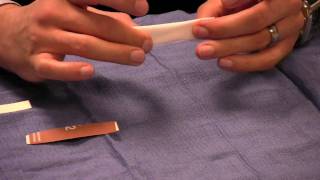
A surgeon (Dr. Shervin Naderi) explains chin augmentation in the context of rhinoplasty, compares pre-made silicone and Medpor implants with a custom-made Mersilene (surgical) mesh implant, and demonstrates how he constructs, shapes, sterilizes, and places a Mersilene mesh chin implant. He argues Mersilene mesh is softer, more natural-feeling, less likely to shift, and allows tissue ingrowth, while noting removal is more difficult if infection occurs.
Chapters
Hi. We're going to talk a little bit about chin implants. Today, chin implants are an important part of rhinoplasty. About 4 out of 10 patients that undergo rhinoplasty require chin implants as well. Now, when I say require, obviously this is elective surgery. It's nothing that's absolutely necessary. But if a patient comes in and complains that the nose is projected too much, that is too long, and their chin is actually too weak, you have to be able to demonstrate that issue to the patient. And computer imaging becomes a very important part of this. So if a nose looks too long, but it's not necessarily that long, however, the chin is much, much weaker. Then to make the nose fit the face and be balanced more, you have to bring the chin up a little bit. Now, there's different variations of this. Again, computer imaging on the video screen will show patients exactly what we're discussing. It's up to them whether they want to get a chin implantation or not. But you can't make the nose that small to fit a very weak chin. So chin augmentation becomes an important part of balancing the face. In about 4 out of 10 patients undergoing rhinoplasty. We've talked about the past and I've blogged this a lot on the Internet about the different forms of chin implants. There's various forms. There's medpore chin implants, elastic chin implants. There's actually ways of cutting the bone, the chin bone, and moving the chin forward and other various techniques. My technique is a little bit different. It uses merceline mesh and it's hard for patients to visualize what this merceline mesh is. We're going to talk about a little bit of the advantages and disadvantages of each. The different forms of chin implants come in different forms and shapes and sizes. And I'm going to show you essentially the silastic ones and the advantages and disadvantages of those. And then we're actually going to make a certain chin implant with merceline mesh today. And you'll be able to visualize what I have here are three different forms of silicone chin implants. And you can see that they come in pre made shapes and sizes and they're soft. You can even trim them to a certain amount. And the different dimensions that are important are the thickness, basically how much augmentation needed in the anterior posterior dimension, the width in this dimension, or the height of the chin implant, as well as the width in this dimension, or basically from side to side. And you can see that again, there's different forms and shapes and sizes. Now, the advantage of these are that they're pre made and it's very simple to obtain these and pop them into place. The disadvantage is that they can shift, they can move, and you can actually feel the edges of them. And especially in women, they make the chin a little bit too square and a little bit too masculine. And I just don't personally prefer these. I think I've never seen one that looked really natural, especially in women. I've never seen one that looked very feminine. And again, when you feel the edges of them on your chin, later on, pretty much forever and ever, you can feel the edges of them and they can shift and move. Also, some surgeons prefer to screw these in, some basically suture them in. But the advantage of these is that if they become infected and all implants have a risk of infection, they're very easy to remove. Now, these same shapes and sizes also come in a material called medpor. Medfor is a porous substance. It goes in. It has all the same disadvantages of this, with the additional disadvantage that it's extremely hard to remove. What I prefer is to make my own chin implants. And when I make my own chin implants, I use a material called merceline mesh. This is surgical mesh. It's a very soft cloth. And you'll be able to see exactly what I'm going to do with it today. So what we do to start with is take a package. It comes in a 12 by 12 inch package, and I open it up and I've opened this one before, and this is the material. And you can see that essentially it's a mesh. It's like a cheesecloth. However, it's a surgical mesh. General surgeons use this for repair of hernias and other places in the body. But what I'm going to do is I'm going to show you essentially how you make a chin implant. I have little cardboard cutouts, depending on the patient's size and stature. And these are just arbitrary. Essentially, it's got a rectangular shape. And what I do is I take the merceline and I start rolling it up and I start wrapping it around this, little by little by little, giving it width. And it just depends on how much width I need. Now, as I'm doing this, this is not a precise chin implant. This is just giving me a template. The precision comes actually during surgery while the patient is asleep. What I do is I take the same chin implant and I can cut it and shape it into the Exact shape that I need, whether it's a small oval, a larger oval, whatever I need, I can do that on the OR table. But over here, I'm essentially just creating a template here. And this is giving me width. Now, this is what I would consider a small chin implant. But you can roll it into however many layers you need. 10, 15, 20, 25, 30 or more layers. The thicker it is, obviously, the larger the chin implant is. So at this point, what I do is I take this chin implant and the ones who have been to my website and know my preference. I don't really like permanent sutures anywhere in the body at all, other than for otoplasty, and we can talk about that later on. But I use an absorbable suture called monochrome. And I take this suture, and all I'm doing is just fixating this chin implant. And what it does, it's one stitch. It just holds things together. Now, sometimes I'll use a blue stitch just to be able to visualize it better. But these sutures come in different thicknesses, different material. But again, what I prefer are these absorbable stitches. What it also tells me is where the midline is once I cut it. So when I'm in the OR and I'm cutting this and shaping it, the stitch shows me where midline is. So I'm actually in the or. I'll take the same stitch, and I'll take a blue version of it, And I'll place that. Now we'll cut the suture. And what I do is this is basically the chin implant. Again, during the operative, actual surgery, what I do is I will cut this into the shape that I need. So I'll take a large pair of scissors and trim this into a small oval shape, something that basically resembles more of this contour. But the advantage of the merceline mesh is that it's soft, it's pliable, it sits right on the patient's bone on their chin, and it conforms nicely. Once it's in place, it does not shift. It's almost impossible to make this shift. The other advantage is I trimmed the edges as well. So what happens is beveled edges are nearly impossible to feel the edges of them. So afterwards, once it's in, it's pretty much impossible to feel the edges of the chin implant or where the chin implant is. It just basically augments the chin naturally. The pores allow your own scar tissue to grow through it. It stays in place. It's very natural. It's probably the most natural looking and Feeling chin implant, you can get the disadvantages, the same pores make it a little bit harder to remove this chin implant in case of infection, where you have to remove it. But again, it's doable. It's just a little bit more technically challenging. And this implant, once it's shaped and trimmed into its special size, it can go from an incision inside the mouth, underneath the lips, or from outside underneath the chin. That's the patient's preference. Older patients, from the outside is perfectly fine. Younger patients that don't have creases under their chin, we usually go through the mouth. However, when you go through the mouth, there's a little higher risk of getting an infection. So once this is said and done, I take the chin implant and this is what's called a sterilization pouch. And I take this and I place it into this pouch and then we seal the pouch. Once the pouch is sealed, this goes into the autoclave and becomes a sterile chin implant. And during the surgery, once we remove it, it's actually sterile, but I still dip it into a mixture of two antibiotics just to make sure we decrease the chances of infection. On top of that, I always have patients on oral antibiotics for about a week to 10 days to reduce the risk of infection and making sure that you have good oral hygiene, not to get any dental infections, because usually infections that are chained come from a dental source. So that's a merceline mesh chin implant, and it's an alternative to the pre made silicone or med pore implants that you see here. Again, I think the merceline mesh is more soft, more natural, does not shift, and conforms to your chin better. Thank you.