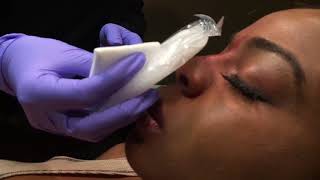
Dr. Shervin Naderi demonstrates a non-surgical nose job using Restylane filler, injecting the bridge and tip to smooth and augment the nose. Results settle in about a week and last roughly a year. The procedure works best for the bridge and dorsum, with limited options at the tip and nostrils.
Chapters
Good morning. We're going to do a demonstration of another non surgical rhinoplasty. We do this every day, all day long. It's a beautiful procedure. I love it. For dorsal augmentation, Asians, African Americans, Hispanic noses, Middle Eastern noses. If you need to augment the dorsum, really non surgical is even better than surgery. Some people say it's not permanent. Well, there's a lot of things that are not permanent. But the beauty of non surgical is it's smooth, it's symmetric, it's adjustable. You want more, we can add more. You want less, do less. Whereas in surgery, once you put it, you're done. And again, even surgically, there could be some edges that show. There could be some asymmetries that can come up later on. So non surgical for the bridge is fantastic. It's limited for other areas, but the bridge I love. Now we have a beautiful woman. If you look at her, probably nine out of ten people would say, why is she even doing this? Why is she here? Well, we're going to do a subtle augmentation. The area here right at the radix and the top part of the nose extending down a little bit lower and a little bit to the tip. Once you augment that, once you lift it up a little bit, it's going to have better definition. It's going to make the eyes and cheeks and lips just pop more. We don't want too much. I've seen plenty of dermatologists and other plastic surgeons that go a little bit overboard and augment it too much. And patients end up looking avatar ish masculine with Grecian or Roman type noses. That's not what we want to do. So we're going to demonstrate this today using restylane, which is usually my favorite substance for this. Thank you. So I start by. If you come up closer, you'll be able to see maybe temperature to it just a little bit. So I start by basically taking the starting point right there. Little book. You feel that much? Okay. Right there. The material has lidocaine in it. We put some topical numbing to begin with, and then as we go, the lidocaine in the actual syringe numbs up further. Trying to hold my hand in a way so you can see really well. She's hardly bleeding at all. But some people do bleed. There could be some bruises. I tell patients, though, you can cover with makeup, go out that night, you should be perfectly fine. This is not an area that bruises significantly. It can, but it's not one of those areas that bruises significantly. Tear troughs usually bruise more. Unless we do the cannula technique, lips can bruise more. The nose is easily comfortable with makeup. The next morning you do have more swelling, even up in the eyelid area. This area between the eyebrows, it can be swollen more. I have had patients in the past tell me the next morning they were sitting, googling, how do I get rid of fillers? Well, you can't look at it the next day. You got to understand that it's going to take a few days. But that night itself, today she can go out. She can go out to dinner, have a drink. Whatever she wants she can do next morning. I would say avoid important things like don't go to somebody's wedding the next day. Give yourself a few days and you can see. Slowly it starts to take shape. It's a very gentle microdropolis technique. I don't like to put too much and then start molding and shaping it and massaging it and beating it up. You just want to be more gentle. And you can see that technique. So very small drops here and there. And essentially rhinoplasty is the same thing. You're shaping the skin by changing what's under the skin. In rhinoplasty, we use cartilage. Some use implants, silicone, med pore, other material. But you know, rhinoplasty surgeons, by and large, prefer cartilage. Cartilage is going under here and shaping and bending things. You cannot shape skin otherwise well. This filler is doing the same thing. And the beauty on the bridge is the skin is loose. So you can lift it, shape it very, very nicely. It's more limited at the tip. I'm going to show you a little bit of injection to the tip. And you certainly can't do anything with the nostrils. But she is beautiful. She doesn't need much. We want to keep a natural look. You don't want to change it drastically. Kind of see where it's going. Is it very uncomfortable? No, it's not good. She's probably a little bit tougher than most. Sometimes you see a little bit of tear shed. Patients often claim that it's just a reflux. They have no control over that. It's not that painful. Something you do about twice a year to maintain. It lasts about a year. But if you just do it once a year, it tends to all go away at the end of the year. So to maintain a certain look all year round, it's best to just kind of refill it halfway through, if you will put some air back in the tires, you have a certain look all year round. Now, the first time you do it tends to go a little bit quicker, but the more you do it, it starts building up and building up and building up. If you drop the camera from this angle, you'll be able to see the profile, and you'll be able to see how it's lifting up here, which makes the transition to the forehead better. It actually improves a shadow that tends to form here, which sometimes makes people look like they're mean or angry. And as you elevate this, it makes it look softer, makes this forehead and the glabella look softer, more feminine. And it's a beautiful transition up in here, but you don't want to go too high. Now we're going to do a little drop to the tip, a little bit of ice to the tip. This is going to give the tip a little bit of projection. We want to stay perfectly midline. You don't want to occlude blood vessels at the tip. That's it. Little bit of tip injection. That one's a little bit of an owie, right? That hurt a little more. Mm. I knew it. But it's fine. Want to be safe. We're gonna check results. It's still cute. It's still feminine. Now. It looks really, really good at this point. But what I do is I tend to overfill it a little bit, just so that in five or six days, when the swelling settles down, I don't want it to all be gone. So we do a little bit more. So for a few days, maybe it's a little bit higher than we want it to be, but what ends up happening is next week, two weeks. Results are lasting longer and maintaining the results. The filler is not a hundred percent material. The filler has filler in it, if you will. Just like when you take an aspirin or a Motrin. It's not. The pill is not 100% filler. It's not 100% material. There's starch in it. There's other carriers in it. Same thing with the filler in the syringe. The 1cc syringe, there's only a certain percentage that's hyaluronic acid. So what you see in the beginning there is swelling. Not from bruising or actual swelling, but the material. And the material goes down in a few days, end up with the result in about a week or so. Again, you can drop the camera and you can see beautiful tan transition. Looks really nice. Smooth here and a little More tip projection. Ready for one more drop. Very gentle down the columellar, right down the middle. What it does gives us a little bit of projection and we want to have a nice super tip break. We don't want this to be masculine, we want it to be a nice feminine nose. Still. She's beautiful. We want to maintain that sometimes some injectors lose sight of the big picture and just focus on the injection side. You got to make sure that the nose fits the person, fits who they are, how they are, their height, their personality, how they dress, everything. It has to fit them. Let's see. Not bleeding much at all. She's doing well. I'm going to check one more time. Looks really, really, really good. I'll do one more draft that I did with an incremental approach. Tilt your chin up just a little. Perfect. Checking. Again. It's right down the middle. You want to avoid the columellar vessels. Some people say they're afraid of injecting the tip. If you don't know the anatomy, please don't inject the tip. But if you do know a denatomy, you can get really nice results. It's looking really, really good. Let's take another look. You can come up here and look at it from this level. This is called a helicopter view. And you can actually show it from this angle right there. So you can show how nice it is. You got more definition right there. Perfectly symmetric, Comes to the tip and has a really nice smooth transition. So that's pretty much it. We're gonna go ahead and just hold a little bit of pressure until it stops oozing. It's essentially a non surgical rhinoplasty. It's a five minute nose job. You can go out, you can go to dinner, to lunch, do whatever you want to do today. And she has a brand new nose. I'm gonna give her the mirror and I'm not gonna tell her what to say, but I know what she's gonna say as soon as she sees it. Take a look. Oh my gosh. Yes. Yes. Right? I thought you were gonna say wow. Alright, you said yes. Okay. Yes is the yes. She loves it. I'll be in here. That's awes. Cool. Thank you.