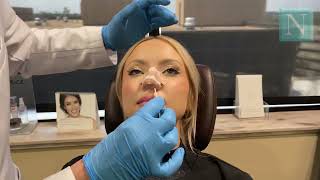
A short instructional video by Dr. Shervin Naderi demonstrating post-rhinoplasty nose cleaning and nostril care. It explains required supplies (diluted hydrogen peroxide, prescription antibiotic ointment such as mupirocin or Bactriban, Q‑tips, gauze), step-by-step cleaning technique (gentle rolling with Q‑tips, application of ointment), timing for saline sprays (begin day 3), and expected timeline for the external cast (about 5–10 days). Emphasis is on frequent but gentle cleaning to prevent crusting and infection and on contacting the surgeon for unusual heavy bleeding.
Chapters
Hi, everybody. We're going to demonstrate cleaning and nostril care after surgery. We have a patient who's had a rhinoplasty. And you can see my typical splint. The splint basically is brown tape, a hard cast, and there's a drip pad on the bottom. Now, I'm going to show you how you clean the nose right after surgery. What you need is hydrogen peroxide, which you prepare and have at home. You'll need the antibiotic ointment. That's a prescription mupirocin or bactriban ointment. And that's something that we send to your pharmacy for you. And you'll need Q tips. Just regular old Q tips or long Q tips. Just something with, you know, cotton ball applicator, cotton head applicator, and some gauze. It's nice to get your own gauze, but when you leave the hospital, they'll send you home with some of it as well. Now, the drip pad. In the beginning, right after surgery, there is a little bit of bloody drainage. You may be changing it every 10 to 15 minutes, but as the night goes on, the following day, the next day, the drainage will slow down to a point where you have to change it maybe every two hours. And. And at some point, once the drainage really slows down, you don't have to wear it at all. But in the beginning part, you are changing a little bit quicker. It is getting a little bit bloody. It should not look like somebody opened a faucet and blood is just pouring out. If that's happening, go to your nurse, emergency room, call me. That's extremely rare. That happens once every several years. But a little bit of bloody drainage is very normal. Now let's demonstrate the cleaning. So how's the best way to use a peroxide? The way I like to use a peroxide is you take the cap and you basically take a little bit of water and you take a little bit of peroxide. That's called dilute peroxide. And I'm mixing it half and half, one to one, roughly. That's the best way to do it because it's not going to burn. Now, you could use full strength peroxide, but full strength peroxide can burn a little bit more. So that half and half is nice to do. Don't put the entire water into the bottle because you're going to deactivate the entire thing. Just use a little capful at a time. Don't double dip. Always use clean Q tips. So you dip the Q tip in there and you get it right now, here's how you do this. So normally we have a sling on, but if the sling is not available, you can definitely tape this to your cheeks. But there is a sling that goes behind the ears and holds the cotton drip pad in place. Take your drip pad off. Each time you take the drip pad off, there should have been some ointment from the last time. So you want to clean that right after surgery. The first day or two, this is going to be a little bit bloody. So you're going to take your Q tip. Look, it goes right inside the nostril and you roll it around. I'm rolling it around. I'm not digging around, I'm just rolling around. I go on the other side. Roll around, pick up any extra blood. She's done a great job of cleaning, so there's barely anything there. But you're just going to clean stuff up. You're just cleaning. You don't want the nostrils to be caked up. You don't want the nostrils to be gunked up. You don't want the nostrils to be full of dry blood and mucus and just kind of brown yucky stuff, because that acts like a little bath for bacteria to hang in there and you can get an infection easier. So I want to clean nostrils, but also don't go scrubbing inside. Don't go banging around. And you should be doing the cleaning Even if you're 14 years old, 16, 18, whatever your age is, even if you're a teenager. I don't want mom and dad doing this for you. Do your own cleaning. Because if you happen to hit something, you'll stop and you'll pull back. If somebody else, the caregiver, does it for you, they may kind of damage something or pop a stitch. So look again, what I'm doing, I go inside the nostril. You can still see the quetipet. The cutip head has not disappeared. It's just basically the head of the Q tip that goes in, goes inside the nostril and rolls around. Does the same thing. Rolls around. Now, there is usually tape covering the columella, the skin here. If this tape falls off, it's not a big deal. Usually you do the same rolling around that area. Roll around the upper lip a little bit. Sometimes you get a little bit blood here. Clean it up. It's very gentle. Now, you could use 5, 6, 7, 8, 10 Q tips at a time. But be frequent, be consistent, but don't be aggressive. That's what you don't want to do. Now Once you've done the cleaning, and this starts right after surgery, as soon as you get home, you want to start cleaning, because that bloody drainage that starts happening, it's going to crust up and get hard if you don't do it. So you want to make sure you're doing that. You take the antibiotic ointment and you take a good amount of it. Look, I'm not shy with the antibiotic ointment. I'm taking a good amount of ointment. You can see how much I took. And what I do is I take this antibiotic ointment and I start in here and smear it on. I'm basically icing a cake. I'm smearing it on there. Then I'm putting it in the same Q tip that went in there and rolled around doing the same thing, rolling it around a little bit, rolling it around a little bit, and then taking the excess off. So the nostrils are open. They're not packed in. I have had periods of my career where I've said, you know what? Just pack it full of Vaseline. Don't worry about it. Leave it alone. And that's because sometimes a few patients got a little too aggressive with the cleaning. 2 o' clock in the morning, had nosebleeds. We had to go back to surgery. But then patients leaving the nostrils packed full of Vaseline, we're coming in with a little bit more frequency of infections because they were not cleaning the nostrils. So we're going back to good cleaning. But be gentle, be careful, be diligent, but be super gentle. So the ointment went inside, rolled around a little bit, and then that's it. Now again, you can clean around the nose, too. The same Q tips. You can clean the upper lip a little bit. You can clean around the nose. Sometimes blood. Sometimes blood can even get trapped underneath the tub. Tape here. And sometimes patients call and say, oh, my God, the tape is black. I'm like, that's just because there's blood there. It's not a big deal. Blood can track up there, but you're just doing a little bit of cleaning. Again, look, a little bit of cleaning. Sometimes you get a little blood tinge on it. Not a big deal. Just a little bit of cleaning. Just be gentle with it. And then once you're done with that, you roll up another. In the beginning, we're talking the first day or two, you roll up another. Look, I'm making a cigar. You just take one gauze, roll it up like that, and then you take a little Bit of ointment right in the middle of it. Don't go too much. Just right in the middle, right there. And then you put this. This is the first couple days as the drainage slows down. And then you put your sling on or you put your tape on, whatever you want to do to hold this in place. So you're doing this for a couple days. But after that initial drainage and bleeding slows down, you don't need to wear this anymore. You can kind of keep this off. The times where I tell patients leave it the whole time is when I. When their drainage is more excessive. Sometimes patients catch a cold afterwards, and I don't want them dabbing their nose. I don't want them to have a Q tip or a cotton ball or a Kleenex or something in their hand and constantly go, boop, boop, boop, boop. You know, don't do that. You don't be dabbing. And if you do have some drainage, let it come to your upper lip and wipe your upper lip. You do not want to be manipulating the nose. Dabbing the nose, wiping the nose. Any kind of drainage comes to the upper lip, and you're dabbing the upper lip. So again, the cleaning is starting as soon as you get home. You get back to your hotel, you get back to your house. Wherever you're gonna go, you're gonna start the cleaning. Every time you swap out that gauze, do a little bit of cleaning so it doesn't get gunked up and caked up. That starts right after you get home. But there's a saline spray that I ask you to use, and that's gonna wait till day three. On day three, that's when you can gently start using the saline. No blowing up the nose, but you can do a gentle sniff if you need to. Just a very gentle sniff as you're spraying the saline. Most of the saline is actually going to drip right back down from your lips and mouth. So do it on top of a sink so it doesn't get all over your shirt. But you take the bottle. Don't put the bottles too far up your nose. Don't bang it up in there. Just a little bit of water. That saline is just basically salt water that goes in there and softens up some of the blood on the inside and some of the crust and scabs on the inside so it doesn't get all crusted up. The goal is to have a nice, clean nose so that you can breathe sooner and not have a soupy bacterial mess up inside. I want the nostrils to be nice and clean. I want the inside to be nice and clean. Stick with that. Be gentle, be frequent, but don't be aggressive. So that's basically the wound care. Now, this is. This cast will be there for somewhere between five to 10 days, usually around six or seven. But anywhere from five to 10 days, you come in, we'll get the cast off, and you still continue the cleaning for a few more weeks after that. But again, you're not packing the nose full of Vaseline, you're cleaning it, doing a good job. The half strength hydrogen peroxide and putting a nice thin layer of that antibiotic ointment inside. Any issues, we're always around, we're always here. 24, 7. You can always reach us. But this is a good quick cleaning video. I have extra videos talking about the other ways of preparing for surgery. We have so much instructions to make sure you have the best possible outcome. We want to make sure you have the best possible nose, and following the instructions really helps.