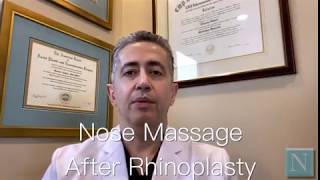
Dr. Naderi demonstrates post-rhinoplasty nasal massage to guide bone and tissue healing. Use firm thumb pressure high on the nasal bridge for 30 seconds, twice daily for weeks or months, to keep bones narrow and maintain straightness. Your surgeon will show you the technique in person.
Questions this video answers
30 seconds.
About twice a day for several weeks to several months.
High on the nasal bone where the nasal bone meets the facial bone (not the middle or tip).
Chapters
Good morning, everybody. I want to make a quick video showing nasal massages. I do ask some patients to massage your nose after a rhinoplasty. And there's a few reasons for that. If you ever broke, God forbid, your leg or arm or a major bone, it's a strong bone, it may be plated, you may have screws and plates there. But even if you just have a cast, it may be there for six weeks or more holding it together, and there's still no guarantee it's going to heal perfectly straight. Now imagine a nose, Thin, flimsy pieces of bone and cartilage, a hollow structure. It's a three dimensional structure. You're only wearing a cast for a week. There's no pins or rods or screws. And sometimes you may need to guide it as it heals. Now, there's two types of massages. One is medializing, or basically keeping the nasal bones more narrow. As I break the nasal bones and do the osteotomies, sometimes they want to spread out a little bit. Again, never goes back to where it was before, but it's nice to keep it where it is. And there's three ways you can do that. Keeping your fingers together, using your thumb, placing it up high in the nasal bone, and then squeeze, really, really squeezing there. It's not in the middle section, Definitely not in the middle. Not at the tip. It's up high at the bone. Where the nasal bone kind of meets the facial bone. That's where it is. Or you can use your fingers, your index finger, or you can use your thumb this way. So either lock together, separate, or fingers like this. Don't poke holes in it. Use the longest part of your finger that you can and just hold. You really got to feel that pressure. I mean, it's gonna almost hurt when you do it. If you're just barely holding it isn't doing anything. So that's one. The second is to guide straightness and symmetry. And again, it's a flimsy structure and, and scar tissue can sometimes kind of push and pull things to the side. If you feel the nose is going a little bit this direction, I want you to take your finger and really push it way across the other side and keep it there for 30 seconds. Don't move it. Just stay there for 30 seconds. If you feel it's going the other way, I may ask you to go in this direction. Sometimes I may ask you to do double, basically push one side, push the other side, and again, try to keep it, keep it, keep it, keep it for 30 seconds. And I may ask you to do this twice a day for several weeks to several months. Allow it to heal. There's plenty of evidence that shows that this is helpful. Many plastic surgeons use this technique. And again, it can help with symmetry. Nothing is ever perfectly 100% symmetric, but this can help in some patients. And I want you to have this for reference. If I want you to do this, I'll tell you and I'll show you in the office, but I want you to be able to refer to this video later on. Have a good one.