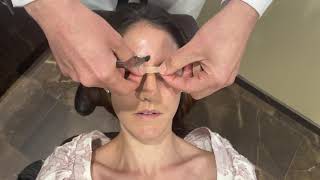
A practical how-to video by Dr. Shervin Naderi demonstrating nose taping after rhinoplasty to reduce swelling and scar tissue. He shows materials (3M Micropore tape, Detachol), gives step-by-step placement (≈1-inch and ≈3-inch strips, crimping technique, support under the tip), and provides usage guidance (taping frequency, duration—some patients up to six months—and removal cautions).
Questions this video answers
3M Micropore tape.
Detachol.
About one week after surgery.
About a 1-inch strip ("maybe a little bit smaller at the very top").
About a 3-inch strip.
Chapters
Okay, so we're doing another video for taping of the nose to reduce swelling. We're starting with the 3M micropore tape. It's a very special tape. We start with about a 1 inch strip, maybe a little bit smaller at the very top. And you press it down. Now, as you press it down, the point is you're pressing the skin back down on the cartilage and bone. This is a patient, beautiful patient, who just had surgery. Cast came off. It's only been about a week, so it's going to be a little tender. And when you press it down, she's going to feel a little tenderness. But just watch how it swells up beneath the tape inferior to the tape. So the tape is actually looking nice and contoured. But look at the swelling right there. So it's milking the swelling down, essentially. And you can start to see the real shape of the nose better when the tape goes on. So the area that's taped is already looking more contoured, more slimmer, but this area is definitely more swollen. The whole concept of taping is to push the skin down on top of the cartilage in the bone so that there's no room for swelling and scar tissue to collect. When you start taping, it's best to tape as much as possible. If you can tape it seven days a week, fantastic. Six days, great. Five, three, two, whatever. Any tape that you do is better than no taping. If you need the taping, not everybody needs taping, but if you have more swelling, if the skin is a little bit oilier or a little bit thicker, topping taping helps. Now watch this. As I approach the tip, I keep this finger underneath the tip so it's protecting its position. And I'm pushing the tape down. Now, when you get down to that area, you stop, you make about a 3 inch strip. You go underneath. I'm not covering the nostrils. It's not too low. It's right there. And it's going to be a little bit of a V shape. It's coming out or maybe a U, but it's definitely not pinching. Don't bring it in together this way. You want to go out in this direction and you want this area touching the bottom of the nose. So the best way to do it is to crimp it like that. Make sure it's touching the bottom. And now if you look at it, there's only a tiny little half dime sliver of the tip open. The mistake a lot of people make is they put too much of the tip exposed, you want most of the tip covered. Now that's one layer all the way down. The second layer is coming up. We're going the other direction. Same thing, crimping it. And make sure this is touching the bottom. So this entire tape is touching the skin. This is the most important part. Really, the most important part is that area. And then same thing up here, coming back up. Putting my finger underneath the tip to support the tip and I'm pushing the skin down. You want to make sure it's covered. Now look how good it looks. The size of the nose. Already got 20% smaller with a tape on. Then you come up this direction. The tape doesn't go all the way on the cheek. Don't make it big and ugly. Just keep it right on the nose. This tape is very manageable. You can wear it around the clock. So I was saying, if you can wear it six, seven days a week, great. If not, do it at nighttime. If you can't go out the house with tape and you have to meet people and get on with your life, just when you get home at night, tape it. It's super important to put the tape on gently, but even more gentle. When you take it off, don't rip it off. If you peel it off too aggressively, it actually attaches the skin with it, pulls it up and creates more swelling. So when you take the tape off, you want to make sure that the tape is coming off in such a way that, that it's not swelling up further. So take the tape off really slowly. We use a product called Detachol. This is. There's a link on this on our website. The Detachel helps. The tape is 3M micropore. And again, the more you tape, the first several weeks, several months, Some patients tape up to six months. Some people only need to tape for another couple of weeks. After surgery, if you're active, if you want to play a little bit more sports, a month or two after surgery, if you want to go on a flight, if you're doing things that create more swelling, the taping really helps. Not everybody needs to tape. Most people don't need to tape. If you have really super thin skin, you don't need to tape. But if you do benefit from taping, this really helps. This really reduces the need for steroid injections. I rarely do steroid injections anymore because of the taping. So watch the video a couple of times before you do it yourself. And the first time you tape yourself, send some pictures to your doctor. If it's me. Send it to me to make sure you're doing it the right way. Have a good one.