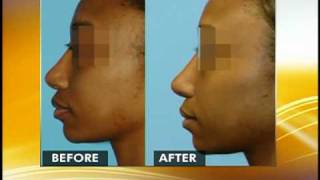
A short interview/transcript of a YouTube segment in which Angela interviews Dr. Shervin Naderi about rhinoplasty and revision rhinoplasty. Dr. Naderi explains that the nose is a three-dimensional, changing structure; lists four main reasons patients seek corrections (poor patient–doctor communication, bad technique, unpredictable healing, and patients who remain dissatisfied); cautions against implants and favors cartilage grafting; and gives rough prevalence estimates for revisions and candidacy. The piece emphasizes selecting a dedicated rhinoplasty specialist.
Questions this video answers
January 5, 2010.
About 5% of the time.
He estimates about 7–8 out of 10 plastic surgeons.
About 20–25% of patients.
Chapters
Rhinoplasty is one of the most popular cosmetic surgeries around. With millions of people having their noses done, it's important to get a surgeon who knows what they're talking about. Dr. Shervin Nadiri is world renowned surgeon with patients coming in from all over the world. Thanks so much for coming in. Thanks, Angela. You know, a lot of people do get plastic surgery and it doesn't always come out the way they envisioned. Unfortunately, you find yourself, I guess, doing a lot of corrections. Can you talk about what that is? Is it only a botched surgery?
It's a complex kind of group that you have to break it down and find out why you're creating the correction. In rhinoplasty, we find that the nose is a three dimensional structure. It's different than everything else on the body. There's no operation really in cosmetic surgery where fractions of millimeters makes a big difference. There's no operation where your results change at a week, at a month, at a year. 10, 15, 20 years continues to change. So, so you have to be realistic with the nose and once you change it, you have to make sure that the nose can withstand those changes. Now, the reasons for correction, there's basically four reasons. One is improper patient doctor communication. If you don't do computer imaging and you really don't know what the doctor has in mind for you, when the cast comes off, it's a complete surprise. Often it could be a good surprise or it could be a bad surprise.
If it's bad, that can't be.
I mean, it could even be a beautiful nose, but it's not what you wanted. So that's one reason. The second reason is just bad technique. Honestly, about 7 or 8 out of 10 plastic surgeons that operate on the nose don't really understand the nose as well. They can do beautiful tummy tucks, breast augmentation, liposuction, but the nose, as I mentioned, is a whole different animal and it just takes a lot of dedication to the surgery.
You said seven or eight out of 10.
This is something that I'm saying, but a lot of people agree with that number. So again, doctors, I've got about 8 to 10 different board certified plastic surgeons, some of the top doctors in D.C. that won't touch noses. They'll just refer them to me because they'd just rather not deal with that and send it to a specialist now. So that's the second part. If the surgeon isn't doing the proper surgery, the third part of it is well, healing. You can't predict how the nose heals, you do the best job you can, and then over time, scar tissue healing nature takes its course. And if there's little slight changes that may need to be corrected. Now, if you look at a nose that was done beautifully and five years later, something slight happens, it may be a five to ten minute revision, kind of a quick little thing. The first surgery may have been an hour and a half to two hours, but the revision's a very quick little revision that happens about 5% of the time. You can't escape that. But unfortunately, I hate to use his as an example since, you know, he's resting in peace, but Michael Jackson's nose was not because of healing. I mean, that was poor surgical decision making, poor, poor technique, nothing to do with healing.
And it seems like quite a few of those.
Right, right. And you see them right here in D.C. as well. And really the fourth one is patients that will just never be happy. They may have had 4, 6, 8, 10 rhinoplasties, and they're just seeking that perfect nose that just doesn't exist. And those patients have to be identified. And unfortunately, it's too easy for surgeons to say, sure, we'll do something, take the money, do another surgery, and then punt them off to the next surgeon. So at some point, you just have to stop, educate them and, and hope that they listen to you. And I do spend an hour sometimes trying to talk patients out of plastic surgery.
Oh, you do?
Yeah. I mean, it's important. You know, about 20, 25% of patients I won't operate on, not because their nose is complex, but because it's just mentally, they're not ready for what realistically can be offered.
Okay. So it kind of depends on what their reasons are for wanting to get this. You hear about. In fact, I was watching one of these celebrity shows the other day, and a woman had implants actually in the nose. Is that something that you do?
Yes. You know, implants are a quick, easy fix. And years ago, I used to actually use Gore Tex implants, which is one of the safer implants. But more and more and more over the last several years, I've just kind of stepped away from implants because I've seen so many problems with them. You know, it's a quick fix. In 20 minutes you can pop an implant and you're done. Beautiful bridge, beautiful tip. But the problem is it's a foreign material. The nose is dirty, There's a lot of bacteria in the nose. So what can happen is the nose may look good at three months, but then three years later, the implant can shift, it can move, it can become infected. And the reality is it doesn't always move and shift and become infected the way that you want it to. Sometimes it just starts coming out through the nose. Oh, that's. And then you get a bad scar on the outside. So it's just, you know, you want to get a nice, safe nose. So cartilage is the way to go.
Your own cartilage, it sounds like at least consulting with you is the way to go if you're even considering something.
Like this or any specialist that deals with the nose all the time. I mean, you just want to make sure that whoever you see really just dedicates his practice or her practice to rhinoplasty.
Thank you so much.
Thank you.
Good information. We'll have more let's Talk Live coming up right after this.