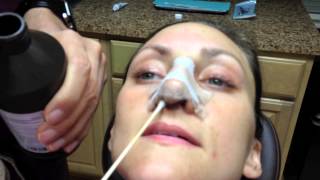
Dr. Shervin Naderi shows how to clean your nose safely during the first week after rhinoplasty surgery. The video covers post-operative care techniques and what to do in those critical early days of recovery.
Chapters
Hi. We're going to demonstrate how to take care of a nose right after rhinoplasty with a patient who's had a revision. Rhinoplasty. She's only a day off from surgery, but she's here for me to check up on her nose and to show her how to do the cleaning. This will be online so patients can refer to it and fine tune their cleaning technique. As you can tell, the day after rhinoplasty, this is about 24 hours afterwards, there's a small splint. I don't put the kind of splint that covers the forehead or the cheeks. It's a small splint made up of Aquaplast, which is a bendable plastic and some tape. Now, if you tilt your head back, you'll see that there is a piece of tape that covers a part of the nostrils. And I'll show how you work around that part that is open and do some cleaning. As you can tell, she doesn't really have much bruising right now. There's a range of patients. Some have zero bruises, some have mild bruises, and some look like they got hit by a bus. I tell people at least wait a month before taking pictures or before going to somebody's wedding or an important event. But other things within about a week or so, once the splint comes off, you can put some makeup and go back to work. Now we're going to demonstrate a cleaning technique. So what I'm going to be doing is taking some Q tips and dipping them in hydrogen peroxide. These are long medical Q tips, but regular Q tips are perfectly fine. So you dip them in, you get them soaking wet, and you use this like a paintbrush. You're basically painting the peroxide in there very gently, working in the area that's open and twirling it gently. You don't want to put too much pressure. Gently getting in there and slowly starting to open this up. Now she's already dried out a little bit. The clean. I always have patients start the same night so that they don't get dried out. There's not too much crusting, but you're gonna slowly get this in there. And as you get it in there, you can see the. It fizzes and bubbles. See, I'm not really pressing on anything. Peroxide starts fizzing and bubbling and you start seeing some of the debris coming off on this. Again, I'm very gentle on this. I'm not rubbing into anything. The head of the Q tip goes in, not deeper. I'm just Gently twirling and it cleans stuff up. We're going to keep going with this. And I tell people, use multiple Q tips. You can use 6, 8, 10 Q tips at a time. Just get it soaked. And you can see as they get softer, it's easier to get in. And you're twirling it around, not grabbing any stitches, not scrubbing or rubbing, letting the peroxide just do the job, and it cleans it up. The peroxide is being painted in there. And you're going to do this at least six times a day. I don't mind if you do ten times a day, but at least six times a day, same thing here. Very gentle. You want to be even more gentle. If there's been an Alar base reduction, which is basically nostril reduction, I do my nostril reductions on the inside of the nostril. So there's going to be some sutures over here. But she didn't get that. There's no stitches there. See, the Q tip goes in gently. And this is something that the patient needs to do themselves. This is not something that the parents or the loved ones can do for them, because the patient can stand in front of the mirror and do this themselves. And if they hit something and they feel some pain, see how it fizzes and bubbles? It's exactly what peroxide does. If they feel some pain, they can pull back. Now, I've used about five or six Q tips. She can use even more. She's actually fairly clean right now. The crustier you are, the more Q tips you have to use. Once I'm done with that, I'm going to take ointment. In the beginning, it's Bactri Ban ointment, depending on if you're allergic to the ingredients or not. Vaseline ointment, even Vasitracin ointment is fine. And don't be shy with the ointment. See how much I'm putting. You're gonna really get this gooped up. Because once it's gooped up, it's easier to clean it the next time she goes in. So in a couple of hours, when she goes back to clean a little bit, it's gonna be nice and moist and lubricated. Gently pushing this in her body temperature, her body heat will melt this and it'll just go right down and actually will lubricate the inside the nose as well. So it's about the size of a very large pea. What I see the patients often don't put enough ointment when they show up with crust and scabs. I don't pack the nose routinely. There's no packing in here. So there will be a little bit of bloody drainage. And we don't want that bloody drainage to dry out. Now don't cut any of the tape, don't trim any of the sutures. Leave it alone. If it's yucky, leave it alone. But do this cleaning, and that's what you're going to be doing. Now, the other thing that you'll be doing is icing of the eyes and cheeks. You can use washcloths that have been soaked in ice water, wring them out till they're dry, but they're cold. You can even put them in a freezer so they're nice and cold. And you're just going to lay them across the eyes like this. You can use gel packs, or you can take a small little Ziploc bag and put some frozen peas in it. And again, the icing is over here. It's not on the nose. It's on the eyes, cheeks and forehead. And you can criss cross them or put two small frozen pea ziplock bags here. But you want to stay off the nose. Keep this dry for the first five or six days. The day of splint removal, you're going to get in the shower, get it soaking wet. The night before, you're also getting in the shower, get it soaking wet so it can come off easily. But for the first five days or so, you want to leave it alone. You can take showers neck down, but don't get the face wet because we don't want the cast getting wet. And that's essentially how you take care of the nose after surgery. I'm pretty specific about how I like things done, but it's very simple, very easy. It's just as demonstrated. And the instructions are on the website. Plenty more details. You can refer to it virginiaronoplasty. Com. Thanks.