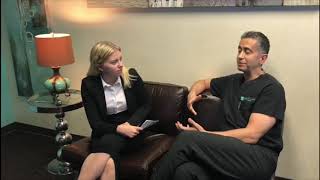
Dr. Shervin Naderi talks about his path to rhinoplasty, what it takes to run a surgical practice, and how fillers work. He covers his training, the business side of cosmetic surgery, and technical details of procedures.
Chapters
Okay, so I wanted to ask you, first of all, like, what subjects do you do?
So high school is just the normal stuff. And then you go through college. In college, you can take any major you want. You don't have to certainly do biology. There's people in philosophy, history. I did psychology and chemistry. But there's certain prerequisite courses that you have to take for medicine, and it's like just a handful of course in organic chemistry, biology, there's a few things. Other than that, you can do whatever else you want to do as long as you meet those courses.
Okay, and how many years has it taken you?
A long time. You know, obviously high school, then four years of college, couple years of masters, four years of med school, five years of residency, a year of fellowship. Add it all up, it's about 16 or 17 total.
And how did you choose to specialize?
So I always wanted to. I remember when I was a kid, four or five years old, I always loved pretty things. I liked. I was really enamored by this dentist that we knew. I was just a kid, but his office was just beautiful, gorgeous cabinetry, really clean. It was very different than ever else's office. And I was really into aesthetics. And through college, I was into fashion. Fashion shows used to throw fashion shows, organize them. And so I kind of went through that route. And I knew I was going to be a surgeon, something with my hands. And I kind of tried out a variety of stuff. Cardiac surgery, orthopedic surgery, urologic surgery, a variety of stuff. But the thing that I kept going back to is I wanted to be super, super specialized in something that's one of the most complex things in all of surgery, which was the. No, I mean, there's brain surgeons that will tell you rhinoplasty is more complicated because of the way the nature of the nose is. So that's kind of what my plan they want. That's really also why I'm in Washington, D.C. you know, I wanted to kind of be in a city where a major city, major metropolitan area, multiple airports. But there was really not a single nose surgeon. I mean, yeah, every plastic surgeon does it, but there was nobody that focused purely on it. And that's why we ended up here almost about 15 years ago.
And what do you like the most of being surgeon?
Immediate results. I mean, to see somebody and give them medications, and maybe they take it, maybe they don't take it. Seeing back for months later, Were they compliant? Were they not compliant? It wasn't my thing. I wanted to kind of be Able to do it, craft it, and see the results right there on the table. I did my wife's nose job two months for our wedding. So I kind of shaped her as I'm watching it transform. And, you know, that's the kind of stuff that excites me.
Yeah.
Okay.
What do you like about being a surgeon on a business owner?
Like, it's tough. I mean, I like having the pressure in being the business owner because I can, you know, if I want to change the color, I'll do it. If I want to, you know, again, it's about having control. I can do that stuff. Not have to go through an organization and submit requests. And maybe they approve it, maybe they don't. If you want to buy software, we just buy it. But it's very hard. I mean, it's a whole different aspect of medicine, and it's something that's quite different. And you have to kind of balance the two with each other. I never let the business aspect guide what I do surgically. And my patient quarters will tell you I'm talking 20, 30 of people out of surgery. I would literally spend an hour talking to somebody out of spending $900 on a filler than to spend five minutes just injecting them and getting the money and moving on. So, you know, you have to separate the business from the best.
Yeah. What do you think you're going to be like in front of me? Is.
Same thing, just maybe. We obviously not bring our new office in Reston, but I don't see much of a change in about 10 years. We're growing. We've had three surgeons with us. Maybe add a fourth one. That's kind of where we'll.
Nice. Okay. So I watched the video of you doing the rhinoplasty.
The actual surgical or non surgical?
The surgical one.
Surgical.
Yeah. You know, you've like taped our eyes. Why do you do that?
So you want to protect things that are around the nose. When you're working there, you want to make sure that you're not damaging other stuff. You know, you're not damaging your teeth, their lips, their eyes. You don't want to scratch somebody's eyeballs while you're doing a rhinoplasty, but you want to have a certain tape where you can actually see the nose. Sometimes, you know, different types of surgeons. If they're working on the belly, anesthesiologist will put a big, huge goggle on the eyes. Well, you can't do that because I gotta be able to see the nose. But certainly we want to move. And it's not just the eyes. I mean, I want to make sure that the patient's arms are tucked properly, Their fingers, their heels, their foot, everything is such that two hours later they don't wake up with back pain or heel pain or arm pain as part of that.
What do you think is the most risky thing with doing a rhinoplasty?
Everything. I mean, driving to the surgery center is more risky than the anesthesia. The statistics say that anesthesia done safely is a thousand times safer than driving on the highways in America. So, you know, it's risk versus reward. But if done properly in the right setting, right hospital, you don't take shortcuts. Do like in your own office and have some, you know, non board certified anesthesiologist and that's less expensive, come and provide anesthesia. There's a lot of people that do that. They try to save money, but we do it at the hospital or the hospital surgery center, even in our own suite. In the future we're going to have board certified anesthesiologists. So those things create more safety. You know, it's surgery. And surgery has risk. There's no doubt about it. Yeah.
What would you say makes a rhinoplasty get bad?
Have you ever seen someone have a bad rhinoplasty condom? So it's very different than anything else in the body. Nothing else compares to the same principles for liposuction. Breast augmentation, even face left or eyelid surgery doesn't apply for rhinoplasty. So, you know, it's a completely different craft. It's a flimsy structure, hollow structure. Little different changes make a big change. And most plastic surgery, the data that came from the American Society of Plastic Surgeons showed that the average plastic surgeon in the United States does 12 a year. That's one a month. I mean, if you dabble in it, and that's the average. So half of them do less than that. So 50% are doing actually less than 12 a year. So if you dabble in it and do it occasionally, you just don't see enough of your own work to be your own judge. I mean, we're the biggest critic of my own surgery. Every time I see a patient back, I'm looking at my notes, looking at my diagrams. What did I do, how did I do it, how can I replicate it, how can I modify it? And that's the thing about rhinoplasty. So you see a lot of really, really bad notes.
So when people are getting fillers, you tell them to not squeeze their hands.
Why is that so? Good question. A lot of times people used to come and say, do you have a squeezy ball? I want to squeeze something when you're injecting me with Botox and fillers. And what that does is that motion raises your blood pressure. It's called a Valsalva almost. And your blood pressure goes up blood vessels. And course, think about when you're at the gym, all the blood vessels are popping and you're lifting something. You don't want that much pressure in the blood vessels because as you poke it, blood's going to squirt everywhere. So you want to be calm, relaxed. Yoga breathing, you know, Lamaze breathing, that kind of situation to lower your blood pressure. And squeezing things actually does the opposite. That's why I tell them, relax your hands, don't squeeze anything. Don't clench, don't give yourself pain somewhere else to distract from that. But with the good gentle technique, it's really bearable. Most of the stuff. Cool, awesome.
So when you do the physio, you're talking about collagen.
So you know, collagen was one of the first fillers that came out years ago. It was either cow or pig derived collagen. You had to skin test somebody, bring them back a month later and do it. But then human collagen came out, didn't need any skin testing. But it went away too quickly. Hyaluronic acids came around. Restylane was the first one in the U.S. then Julian came around. And hyaluronic acids are the safer fillers. They're reversible. You can melt them, they can go away. There's a variety of them. Now, US has less fillers than Europe and the rest of the world because of the fda, but it's safer. And I love restylane for the nose. 99% of the time I'm using restylane for the nose. And it lasts about a year, but roughly about twice a year, people re inject. So it kind of maintains a certain look and doesn't. Yo, yo. Up and down with college. It would have been gone in like two months.