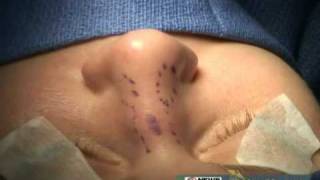
Dr. Shervin Naderi, a board-certified facial plastic surgeon, demonstrates rhinoplasty techniques for cosmetic and functional nasal problems. He walks through a live case addressing a nasal fracture, dorsal bump, and deviated septum that caused breathing issues, explaining closed versus open surgical approaches and how imaging helps plan millimeter-scale changes.
Chapters
Welcome to another edition of a new me your weekly consultation with the Washington, D.C. area's best doctors and professionals. Our guest experts help you learn about the latest medical advances and procedures by providing you with the real information necessary to help you eliminate the dangers of making the wrong medical and cosmetic enhancement decisions. Get ready for your consultation. Coming up, we will be on location at the Naderi center for Cosmetic Surgery and Skin Care in Herndon, Virginia, discussing the latest advances in rhinoplasty and how they can help you get the beautiful nose you've always desired with one of this area's top facial plastic surgeons, Dr. Shervin Naderi. Dr. Naderi is double board certified and received his medical degree from Drexel University School of Medicine. He he is an active member and officer of the American Academy of Facial Plastic and Reconstructive Surgery, a fellow of the American College of Surgeons, and a clinical associate professor at Indiana University School of Medicine where he instructs residents in modern techniques of facial plastic surgery. Dr. Naderi is a board examiner for the American Board of Facial Plastic and Reconstructive Surgery as well. Welcome, Dr. Naderi.
Thank you. It's good to be here.
Oh, it's our pleasure. We have a lot to talk about regarding one of the most popular cosmetic procedures available, the nose job, which is rhinoplasty.
Definitely. It's always been in the top three of the most popular procedures. And on the face, it's the most popular procedure amongst men and women.
That's right. And I understand we're going to have some patients in a few minutes, Dr. Naderi joining us, not to mention seeing you perform an actual rhinoplasty procedure and some patient before and after pics so we can truly get a great understanding of what rhinoplasty entails and learn a lot about it here. So let me begin, if I may, by asking you, if you can please tell us, what exactly is a rhinoplasty for those of us who may not know?
Sure. Rhinoplasty is a plastic surgery of the nose. It can basically involve cosmetic changes for functional changes as far as breathing or a combination of both. It's one of the oldest operations in plastic surgery. And actually it dates back to thousands of years ago where reconstruction of the nose after traumatic accidents or after punishment of the nose was initiated by Indian surgeons thousands of years ago. But it's revolved into becoming one of the most popular procedures in the world, including the United States and Asia and Europe.
Now, you had mentioned that it affects some problems and breathing certainly being one of those can you elaborate a little bit more on some additional problems that the rhinoplasty procedure would address and fix?
Rhinoplasty, when done properly, can actually increase self confidence. It can bring up and highlight the eyes and the lips and take away the nose from the prominent feature in the middle of the face and put it into the background where it belongs. It can also address breathing, but if done poorly, it can actually make breathing worse. Those are pretty much the goals of rhinoplasty. Occasionally you'll see patients that come in and say, I have pain in my nose, or there's other issues that really are not addressed by rhinoplasty, where you have to make sure that the focus and the goal of the procedure is set before going through any procedure.
Well, it's certainly become very, very popular, as we both already touched on here a few moments ago. A lot of folks, they have a nose, they're not comfortable with it, or they see I'm using this as an example of Nicole Kidman and her nose in Hollywood, and they're like, how can I have that nose? So what happens? They would contact you. They come to a plastic surgeon, one who in particular focuses on the rhinoplasty procedure like you do. And what basically does that entail?
Basically, plastic surgeons and facial plastic surgeons are the two specialists that perform rhinoplasties or nose operations. You want to focus on somebody that pretty much does no surgeries within those two specialties. It's such a separate operation than anything else. From breast augmentation, tummy tucks, facelifts, and eyelids, the rhinoplasty is a complete entity of its own. So you really want to dedicate and focus not just your training, but also your practice and your life to this procedure. The thing to understand for patients, when they come from places saying, I want to look like Nicole Kidman's nose, I want to have Britney Spears or Ashlee Simpson is a very popular one, is to understand that each person has a separate nose. They have a separate skin structure, cartilage structure, bone structure, and even two sisters or two relatives may not end up with the same exact nose. And that's why making sure that you're examined by somebody that can diagnose the problem adequately and then come up with an individualized treatment plan is the way to go.
And, you know, it's a great point, because this is a problem that is unfortunately happens too commonly, and that is that somebody wants a nose of somebody that's very well known. And guess what? That nose may not actually fit or look appropriate on that particular individual as opposed to someone else like you just touched on. You know, you really have to look at each individual and together between the patient and the doctor, pick out a nose that would be exactly a good fitting nose.
Right.
The most important part of the consultation process to me is getting to know the patient, getting to know their motivations, what are they doing this procedure for, getting is everything going great in their life? They're just trying to basically improve one aspect of their life? Or do they think that by getting a prettier nose they're going to get a better husband, a better job? All of a sudden everything's going to drastically change and those are unhealthy expectations. But if somebody comes in and they just want to improve their look, improve their self confidence, that's completely appropriate. The most important part of the conversation is the imaging where you have to sit down with the patient. After I examine them, after I can feel and look at the nose and see what I'm dealing with, I take their picture, put it on the computer screen using very advanced software, do some morphing of their nose and show them what I think would fit their face. And then I'll show them different versions as well. Because rhinoplasty is an operation of millimeters, half a millimeter this way or the other way can significantly change the outcome and the look of the face. So I will show them how a little bit taken off this way or a little bit added to this side can make a drastic change. And together we'll come up with something that fits their face. And it's actually surgically plausible because to come up with something on the computer that's not surgically doable is pointless.
And latest in high tech advancements. We're now going to see Dr. Dadari perform a rhinoplasty procedure.
We're doing a rhinoplasty today on a patient who had broken her nose about a month and a half ago. She was interested in improving the nose before that, but then with the fracture creating the deformity that we've shown pre op creating the curvature of the nose, she wants to get the whole thing fixed. She's got a small little bump on top as well. There's two little areas of depression at the middle vault that are collapsed. We're going to fill those in. Her tip is actually good right now. It's swollen with the local, but the tip essentially is fine. We're just going to move the tip down a little bit. I do most of my rhinoplasties through what's Called a closed technique. It's actually technically an endonasal technique, but most people call it a closed technique. In a closed technique, you do everything, you see everything, but you do it through the nostrils without making that incision. I do about 2/3 of my surgeries through the closed technique and about a third through the open technique. The indications for an open rhinoplasty for me are major tip work, tip grafts where I need to suture them in. Otherwise a closed rhinoplasty is a more elegant rhinoplasty procedure. Much less swelling, quicker recovery, less trauma to the tip. She also has a septal deviation and her septum is crooked and it's actually pulling the nose with it. Using scissors, I start the dissection plane. These are very fine tips. Iris scissors. The nose is extremely vascular and you're going through the mucosa. Even though I have numbed the nose with lidocaine and epinephrine, I've also used cocaine. Damp flagence, it's 4% medical grade cocaine that's used to numb and also vasoconstrict the nose. Cartilage is the framework of the nose. Even though the nasal bones are a prop, most of the structure of the nose is built with cartilage and it's an important part of a rhinoplasty as well. Today's rhinoplasty technique used cartilage's framework. We take from certain areas, we add in other areas to create a more balanced, natural looking nose. It's rare to have a completely straight septum. Most people have a little bit of deviation or curvature. When that curvature becomes extreme, it can actually block the openings of the sinuses, creating sinus problems. If the septum is touching the outer wall of the inside of the nose, called the turbinus, it can actually cause what's called contact point headaches. Patients who've had headaches for years and years and years, seeing neurologists and their family doctors, been treated one way or another all along. They had a contact point headache that was a surgical issue. And once you correct that issue, their headaches are resolved and then obviously breathing issues. If the septum is significantly curved or deviated, it can create breathing problems.