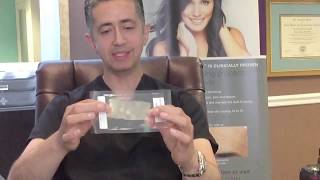
A short YouTube video by Dr. Shervin Naderi (uploaded Aug 21, 2017) explaining Alloderm (acellular dermis) and its use in rhinoplasty for patients with very thin nasal skin. He compares Alloderm to harvesting temporalis muscle, describes the sterile packaged product, the reconstitution/soaking process, typical size for rhinoplasty, and emphasizes safety, tissue integration, and that it is a soft, non-structural 'carpet-padding' graft rather than a cartilage replacement.
Questions this video answers
Dr. Shervin Naderi
August 21, 2017
Chapters
Hi, I want to talk a little bit about Aloderm. You may have heard this. If you come into consultation with me, you may have heard me talk about Aloderm. You may have read about it online or seen other doctors that talk about it. In patients that have very thin skin, we need to augment the skin thickness slightly. Now, that can be done using temporalis muscle. There is a muscle right here on the scalp and it's got a nice thick layer. And we can make an incision on the scalp, open up the hair, get into the muscle, take the lining of the muscle, which is a nice thick glistening layer, and use it for rhinoplasty on the bridge. I used to do that quite a bit over a decade ago. The problem is it's a second operative site. You may lose some hair in this area. Certainly can get an infection or get a bleed in that area. So the other alternative is Alloderm. Alloderm is acellular dermis. It's basically skin cadaver, donated skin that doesn't have any cells in it. So there's really no risk of rejection. Anything can get infected. A primary rhinoplasty can get infected. Any incision anywhere on the body can get infected. But there's no additional risk of infection or rejection or it's as safe as it can possibly be. There is no need for immunotherapy. For example, when you get a heart transplant, lung transplant, this is not like that at all. It's just a little bit of a scaffolding. Think of it as carpet padding underneath the carpet. If you have extremely skin on the bridge of the nose or the tip of the nose, as things heal, you may start noticing edges of cartilage and bone. So to give it a little nice softness, you need some carpet padding underneath that very, very thin carpet. So what is alliger? Well, here it is. If you zoom in, you can actually see this is the material. It's basically skin. And you can see how thin it is. Some people will kind of have this expectation that something very thick. Well, here's how the package comes. It's a pretreated package. It's gone through strict, strict criteria to make sure there's nothing in there. No viruses, no bacteria, nothing in there that can transmit any infections. What happens? And the reason I'm opening this, this has been expired. We have not used it. It has an expiration date. So I'm going to just open it and waste it, essentially. But this is what Aloderm is. Comes in a sterile package. And what the Nurses in the OR do is they open this up and as they open it, they put it and reconstitute it. It comes as a solid, essentially. It's been treated. So this is what the Aloderm is. It's very thin, it has a little backing, and the backing essentially comes off as it gets reconstituted. And the reconstitution, you can see the backing comes up and the reconstitution is essentially putting this in a solution. And what I use is gentamicin and bacitrates and it's an antibiotic solution to make sure it soaks in there. So it's a small piece. It comes in different sizes. In breast reconstruction, much larger features can be used. They can be stacked. It can be a variety of things. But for rhinoplasty, I use a thin segment. I don't need much. It's just essentially, like I said, a carpet padding. It's not a structural graft. There have been studies out there that talk about alderm as replacement for cartilage graft. It's not going to work for that. It's essentially simply a way of photoshopping thin skin to give it a nice softness by adding a little bit more resilience to it. So this goes into the solution over about 10, 15 minutes, reconstitutes and becomes a nice thin, flexible piece of skin. This is a larger segment of it. This would be used for something larger. Again, this is just a sample. The actual product comes wrapped like this. So if you see or hear about Alloderm, this is what it is. It's a perfectly fine substance. There's a lot of different substitutes out there. A lot of different companies try to make it. This is the only one so far that is really safe to use into the node. It doesn't form a capsule around itself, it integrates. So if you go back into the nose six months, a year later, you can't even tell what's the aloderm, what's the part. It just fused into the tissue. The patient's own cells grow through it and it becomes a part of you. Now, you can always see that there is a little color difference because it's a graft, but essentially it's a part of you. It's not a plastic, it's not something foreign. And it's a fantastic option for rhinoplasty revision primary, any type of rhinoplasty. It works well for that purpose. So I wanted you to know what Aloderm is in case we talk about it. This is what Aloderm is. Thank you.