Hair Loss During Menopause…How to Fix it.
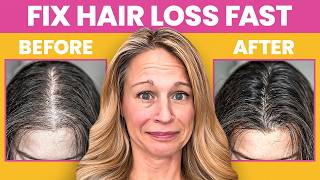
Dr. Tabatha Barber explains why women lose hair during menopause: falling estrogen, altered testosterone metabolism, inflammation, and thyroid problems. Most causes are reversible with targeted testing, anti-inflammatory foods, nutrient fixes, and specific supplements.
Questions this video answers
TSH; total T4; free T4; total T3; free T3; reverse T3; thyroperoxidase (TPO) antibodies; thyroglobulin antibodies.
Chapters
Welcome back to the Fast of Faith podcast. If you're noticing more hair in your brush, thinning at your temples, or a widening part, you're not alone. Millions of women experience hair loss during menopause. But the good news, you don't have to accept it. Today we're diving into what's really causing it and how to fix it. What exactly happens to women's hormones during menopause that leads to hair thinning? There's a couple things going on. First and foremost, when we have a drop in estrogen, it affects our entire body and it affects our hair. So you start to see hair thinning. Estrogen is responsible for growth throughout our body. It's a growth hormone, so it helps our hair grow, it helps our skin grow. There are so many things that estrogen is responsible for. And when we see that estrogen decline, women's hair starts to thin. But here's another piece. Testosterone. You might not know it, but as a woman, you make testosterone. Testosterone is our get stuff done hormone. It gives us drive and motivation. Not just sex drive, but drive for life. And when we start to see thinning around our temples, especially like male pattern baldness, a receding hairline, that could indicate that you have a testosterone issue. And here's the kicker. It might not even be that your testosterone is too low. It might be how your metabolic metabolizing your testosterone. So the majority of the time hair loss can be reversed. It doesn't have to be permanent. It depends on the reason for the hair loss. And I will tell you, it is more than hormones. Sometimes it's inflammation in our body. Sometimes our body is so inflamed that the hair follicle releases the hair and that causes it to fall out. So you want to figure out the reason for your hair loss. But so often it is reversible. Like I mentioned, if it's from testosterone, you might just need a supplement like Hair and Beauty Lift from fast to faith. But if it's some deeper issue, you want to figure that piece out. And so that is what we do at my virtual medical practice, Dr. Tabitha. We look at the thyroid in detail. We look at what's going on in the gut. We look at your hormones and your metabolism pathways of those hormones. We want to see are you making too much DHD T dihydrotestosterone so that we can actually give you an individualized plan for treating that hair loss and reversing it. And here's what most people don't realize. Your hair health is directly connected to what's happening inside your body. What role does stress and cortisol play in thinning hair? Oh, my goodness, this is a big one. And if you've ever had a stressful event, you're going to relate to what I'm about to tell you. When we go through a stressful event, we don't typically lose hair during the event. It's usually a couple months later. We see this when women have babies, they lose hair two to three months after they deliver their baby. So what is happening? The hair has a life cycle, and it consists of three phases. There's the anagen phase, which is active growth of the hair. There's the catagen phase, which is transition, and the telogen phase, which is the resting phase. And so you go through a growth phase, but when you're sick, you get stuck in this arrested phase, and then eventually it goes into the transition fallout phase. So that is why we see this delayed response when it comes to stress about two or three months after that stressful event. But the key is that you want to support your body's ability to heal and regrow that hair. And it's totally possible. We have to get control of the inflammation that's happening throughout our body. So is that inflammation coming from your gut? Is it coming from an illness? Is it coming from a traumatic event that you're no longer dealing with? And if it's an ongoing stressful situation, how can we manage that stress so that it stops causing all of this hair loss? So whatever the reason, we can get control of it and we can regrow your hair. I'm living proof this is all my real hair. I grew my hair back, and it's healthier than ever. But I had to do a few things. One of the biggest things that I did to get my hair healthy again was I focused on my gut health. I did a stool test, and I healed my gut. I had some microbiome issues, meaning I had the wrong bacteria living in my gut, and my immune system was overactive. It was attacking everything because it was trying to protect me. But it was confused, and I had to get it to calm down and respond in a more protective way. So that was part of it as well. And then I had some major nutrient deficiencies from being sick, from having chronic gut issues. And so I had to replenish those nutrients and really support. Support my overall health. Those were game changers. So now that we understand why hair loss happens, let's get into the solutions. What can you do to start seeing real hair regrowth if you're ready to take control of your hair health and get results, I've put together a step by step guide along with our Fast to faith supplement just for you. Click the link in the description to get started. Today, let's talk about one of the most common reasons for hair loss in women, especially over 40. It's your third thyroid. And this is not because your thyroid is failing you or it doesn't know how to do its job. Just the opposite. Our body has amazing divine intelligence. God created our bodies to function and the thyroid is just taking all the input from all the other systems, from the environment that you're living in, all the food that you're putting in your body, and it's responding appropriately. So. So if your thyroid thinks your body is struggling and in survival mode, it will downregulate and look like a hypothyroid picture that will cause hair loss because here's what your body is thinking. We don't have a lot of resources. She's stressed to the max. She's not feeding us. We're starving. We're not getting what we need. We better conserve our resources. We don't want to use energy to grow hair and nail and, and all the beautiful cosmetics. We need to conserve those resources for fighting off the gut infections that we have going on and managing our cortisol, our stress hormone, and doing those internal things to keep you alive and help you survive. So your thyroid knows what it's doing, it's protecting you, but you want it to work on all the other stuff. So first and foremost, work with a provider who looks at your thyroid function in detail. There's a big difference between getting your thyroid tested and getting your thyroid evaluated. A conventional doctor will do a TSH test. Thyroid stimulating hormone. This isn't even a thyroid hormone, it's a brain hormone. TSH talks to your thyroid and tells your thyroid to make more or less hormone. But in standard conventional medicine, we are trained to test a TSH or with a reflex to free T4 if needed. What that means is if the TSH is in the quote unquote normal range, and that range is huge and not a good optimal range. It's a keep you alive kind of range. If it's in that range, your lab won't even check a free T4 level. That's the actual thyroid hormone level. So there's a lot of people walking around being told by their doctor that their thyroid is fine when it's not fine because it hasn't been evaluated properly. So so what I'm talking about is finding a functional provider like myself who will look at the seven different thyroid labs to get a complete picture of how much thyroid hormone you are making, if you are converting it to the active form of thyroid hormone, if you're causing more reserves and conserving of resources, if you have an autoimmune attack on your thyroid and how your brain is responding, responding to this thyroid hormone. So a complete evaluation looks like seven different labs, a TSH, a total and free T4, a total and free T3, a reverse T3, thyroprotoxidase antibodies and thyroglobulin antibodies. Those are the necessary labs to actually see. Are you hypothyroid? And is the thyroid a reason for your hair loss? And the cool thing is that this is reversible, this can be fixed. So you need to work with a functional provider who understands this. But I promise you is probably one of the biggest reasons that I see for hair loss in my virtual medical practice all the time. Let's talk about the best foods and supplements for hair regrowth. First off, the best foods are faith foods. That's what I call the food that God gave us. It's been here since the beginning of time. Animals, vegetables and fruits, right? Those grow from the ground. They either had a mama, they came from the land or the sea. And God gave them to us to eat. Those are full of the proteins, the collagen, the fats, the nutrients, the minerals, the vitamins that we need to actually grow healthy hair. I want to mention the worst foods, which for hair regrowth are all the foods in the boxes and the bags. I call them Franken foods. We made them as man. They are not healthy. They drive inflammation. And inflammation is the leading cause of hair loss. So when you are consuming too many inflammatory fats, all the seed oils, vegetable oil, canola oil, sunflower oil, those types of oils are very inflammatory and they will cause hair loss. So what I recommend is anti inflammatory foods, natural foods that God made. It doesn't need a label in the grocery store. It's in the periphery, it's in the deli, it's in the produce aisle. It has a lifespan. It's not going to last very long. It can't stand on the shelf for two years. Those are the best foods that are going to actually help your hair grow and be healthy. Those foods are full of healthy omega 3 fatty acids. Those are the healthy fats that you need. They're full of different amino acids in the form of complete proteins they are full of vitamin A, D, E and K. Those are your fat soluble vitamins that you need to grow your hair. They are full of minerals like zinc and magnesium and iodine and selenium and all of the micronutrients that your hair need to grow. Those are your best food options when it comes to supplements. Partly you want to know why you're having hair loss in the first place. Most of the time it is from a vitamin and mineral deficiency. Because reading the standard American diet and even when we're eating healthy, our soil is so deficient in minerals and vitamins that we're not getting the same amount of nutrition from our vegetables that we used to get. There was one study that showed that we have 80% less magnesium in the peppers that we grow because our soil is so depleted. Wow, that's a big deal. So it's really important that we supplement these basic vitamins and minerals. That is why I absolutely love my supplement. Hormone Tame Essential Multivitamin. It not only gives you all of the complete vitamin panel that you need, it also gives you antioxidants that really support your ability to to repair your cells and break down and get rid of those broken DNAs and proteins that need to be removed from your body. So that along with omega 3 fatty acid supplementation like Omega Lift, that can really be helpful when it comes to hair growth. And the third one, Hair and Beauty Lift, if you have hair thinning, especially around the temples, then that could be a testosterone issue. And Hair and Beauty Lift is so good fabulous at decreasing your dihydrotestosterone production. The testosterone that is more like androgenic male type testosterone. You don't want to make too much of that, so it helps you metabolize your testosterone better. That one can have profound effects on your hair. Now that you know it's possible to regrow your hair, let's talk about another major issue in menopause. Stubborn weight gain and how to reset your metabolism. Click here to watch my next video and take the next step in restoring your health.








