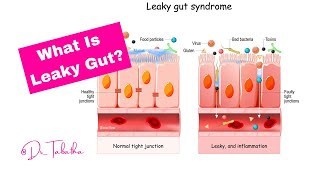
Dr. Tabatha Barber explains how NSAIDs, antibiotics, birth control, and chronic stress damage the intestinal lining, allowing toxins into the bloodstream. Testing can measure zonulin and food sensitivities. Treatment involves removing triggers and healing the gut through dietary elimination for 4 to 6 months.
Questions this video answers
Every 24 to 48 hours.
Zonulin.
June 29, 2021.
Chapters
Okay. What is leaky gut? Leaky gut is a real thing. I'm here to tell you as a medical doctor. It's called increased intestinal permeability. So essentially, in our colon, there is one layer of cells between the food we've digested and we're trying to absorb and get all the good yummy stuff out of, and our bloodstream underneath that, that lumen or that hole where that the food is in. There's one cell that is once a layer that is responsible for whether things get absorbed and come into your bloodstream or whether they don't. In between all those cells are little gap junctions. They look like toll booths. They open and they let in the good stuff, the vitamins, the amino acids, all the stuff that you want to absorb. And then they're supposed to put close and keep out bad toxins and bad bacteria and pesticides and all the things you don't want in your bloodstream. Here's the problem. Things break those gap junctions on a regular basis. The biggest things that break those gap junctions, Motrin, ibuprofen, any kind of nsaid, antibiotics, hormones. So synthetic hormones like birth control pills and HRT hormone shifts like pregnancy and menopause can also damage those. So a ton of stuff breaks these gap junctions. Luckily, the gut cells rejuvenate every 24 to 48 hours, so there's great turnover. And your gut lining heals really well. But as we know, oftentimes we keep going with those things that break those gap junctions. We keep taking the Motrin, we keep getting antibiotics, we stay on the birth control pills for a decade or two. That repetitive assault to the lining makes it so that you get leaky gut. Those holes are open long enough that things start to go into your bloodstream that shouldn't be there, leave lipopolysaccharides and other toxins from bacteria, pesticides. Oh my goodness, so many bad things. But here's the deal. Your bloodstream in your gut has an immune system called the iga. The IGA is your immune system that covers any area of your body that's like outside environment to inside. So your skin has lots of IgA. Your, your nose and nasal passages and lungs have IgA. Your intestines, your mouth, your esophagus, they have IgA. So IgA are like the frontline guys. They are there to protect whatever gets into that bloodstream. Here's the problem. When you repetitively have leaky gut and bad bacteria living in your gut, those IGA levels get depleted. They like Wipe out all the guys on the front line. And so then you have to bring in your second line defense. That's your IGG system. Your IGG system is slower to respond. And what they do is they put an antibody tag on something. So they say, oh, that's foreign. We don't like it. Here's the little tag for your immune system to know we don't like it. And then they go about on their way. So here's a scenario. You have leaky gut. You have things getting in your bloodstream that shouldn't be there. You have your IGA system is wiped out or overwhelmed. And so your IGG system starts attacking everything that it sees. And you could be eating normal, healthy foods like chicken, Brussels sprouts, almonds that aren't inflammatory that you shouldn't be reacting to. But because your bloodstream is seeing everything, it's like an innocent bystander getting shot in the line of fire. They all get antibody tags, everything that they see. And so all of a sudden, you're reacting to normal, healthy foods that you shouldn't be. But you don't realize it because the IGG system is very delayed. So say you're reacting to chicken. It might be two or three days before that response shows up as a cyst symptom. You might be getting headaches from it or crazy fatigue or eczema outbreaks. Eczema is huge with dairy or eggs. By the time you have this symptom, you don't even remember what you ate two or three days ago. So it's almost impossible to correlate that food sensitivity with how you're feeling. The cool thing is, even though the igg branch has a memory, so it sees it or remembers it and it detects and it starts that whole inflammatory cascade all over again. It doesn't have the best memory. If you know what food triggers or food sensitivities you've developed, and you heal your leaky gut, if you remove those foods consistently for like, four to six months, you can almost always reintroduce those foods. And those antibodies have dissolved and gone away. They're no longer being produced, and your immune system won't attack anymore. You will no longer have this inflammatory cascade and this whole response, but you have to consistently remove it so it doesn't see that food and that IGG tag and you have to heal that leaky gut. You got to quit breaking those gap junctions. So there's all kinds of cool functional testing that will help you see, do you have active leaky gut what's your IGA levels? Are you. Do you have inflammation in the gut? You know, what is your microbiome look like? Do you have too much bad opportunistic bacteria? Do you have yeast overgrowth? You have parasites contributing to the problem? There's testing that you can do to look at your food sensitivity responses. You can measure those IgG levels. There's all kinds of awesome ways to figure this out. But if you don't remove the things that are causing the leaky gut in the first place, it's going to be a temporary fix. It always comes back to what is driving the dysfunction. As much as I love birth control pills for the freedom of being able to control your fertility, that's how I was able to go to medical school and do all the things I did is I took a birth control pill. But you need to know that it does affect your health. Leaky gut is one of those big issues that you can get from birth control pills. There might be better options for you, like a paraguard iud, which has no hormones or other options. So that you can listen to my podcast, the Functional Gynecologist. I go over all kinds of stuff like that. But just know that you got to get off the Motrin, you got to get off the antibiotic, you know, cycle that you're on or whatever is driving the leaky gut. Oh, my gosh. I didn't even talk about stress. So chronic cortisol production is one of the biggest breakers of that gut lining of those gap junctions. So we can measure a protein called zonulin, and if that's elevated, that's telling us those gap junctions are broken. So get your stress under control. It will do your gut a world of good. I hope that helped a little bit. Definitely. If you have more questions or whatever, you can check me out on the Functional Gynecologist podcast. If you want to work with me one on one, you can go to Dr. Tabitha. Com. It's D R T A B A T, H A. But I just wanted to give you that information. I hope it was helpful on your journey back to reclaiming your health. So take care.