Avoid These 3 Costly Mistakes When Raising Capital 💰 (Interview with John Assaraf)
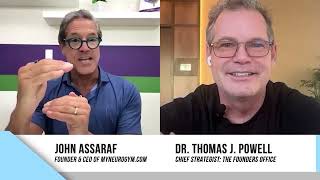
John Assaraf interviews Dr. Thomas J. Powell, a former Silicon Valley banker who's funded over $3.2B in deals. Powell identifies three costly mistakes founders make: accepting misaligned capital under pressure, poor alignment between idea and execution, and weak storytelling that attracts the wrong investors.
Questions this video answers
$28 million.
1992.
A little more than $3.2 billion.
Founders on track for or who have surpassed $10 million in annual revenue.
The Capital Edge Summit.
Chapters
Foreign.
John Asraf here. And you may know, I'm a New York Times best selling author. I'm an entrepreneur, maybe a serial entrepreneur. And I've built five multimillion dollar companies myself. I've raised $28 million for one of my deals. And most recently I was at an event doing a keynote speech. I met this guy at the event who's brilliant and, and he and I started talking and I thought I was a good entrepreneur that knew a little bit about fundraising, you know, growing companies. And when I met this guy who you can see right now, Thomas Powell, what he knew about money, raising money, positioning, language, patterns, I was like, holy shit, this guy is the real deal. And why was that important to me? Well, because I am going to be raising $10 million to grow my company and I'm always looking for distinctions. What do I need to do in the marketplace today? And so I asked Tom if he'd let me, like interview him since I've been working with him for the last, I don't know, five, six weeks. And he's been filling my brain with truth bombs and strategies. They're going to help me raise money and really take my company to the next level. So tomorrow. Thanks for letting me do this, John.
This is my pleasure. And it's such a joy to work with you. And I love how you move people through clarity. It's a skill very few people have.
Thank you. So, Tom, before we get into raising money and maybe some of the mistakes that I was about to make, give us your background a little because I never heard of you prior to the event that we were at together. So what's a bit of your background? Share with me your career path and just overview.
You know, it was always on purpose that people didn't hear of me. So it's been, it's been a fun journey. I also am a serial entrepreneur. I have, you know, a dozen companies or so underneath my own belt that we have personally started. But principally I've been working with founders. I started as a banker in Silicon valley in the 80s. And most of the terms that you hear, such as hedge funds and venture capitalists and private equity, weren't even terms at that time, right? We were bankers or we were outside investors. In 92, we had the first major recession went through as my career and I was able to take a look at people that had money and wanted better returns and people that had good ideas and were bankable but couldn't get the bank loans. And so we started our first fund in 1992. And that since grew into working with more than 500 founders over my career and funding a little more than $3.2 billion in total deals through debt and equity and various other structures. But it's been a fabulous ride. And the great thing is I get to be an entrepreneur with other entreprene. I love it.
And one of the things I loved when I was talking to you is.
Like I said, I've got a little.
Bit of experience, but you're like a PhD of raising money and structure and not making mistakes and having exits. And that's, you know, that's great. How many, how much worth of exits have you had? Just out of curiosity?
We haven't actually calculated that. It's in the several billion dollars.
Several billion dollars I love.
We need to go back and calculate that. And part of it is, is that a lot of times we do an investment and the way we structure it is our investment will be an early stage. But because of the cap tables, it's advantageous for us to get out earlier of the investment and have a trail. So then we usually stay on as the founder's advocate, which is where we actually take a board seat and we'll be on the board through where they get to the next stage, guiding them in that pace.
Love it. And that's one of the reasons you and I connect because I was so fascinated with how you can help me, you know, raise money and then just do it right, and then stay on for guidance and support. And so there are, I mean, listen, I know thousands and thousands, tens of thousands of entrepreneurs that want to raise money. Many of them are not doing well. Who do you help is the first thing right now with your expertise. And I know you have, you know, one on one consulting, that's millions of dollars. But you also have, you know, an event that you do to help a select few entrepreneurs. Who do you like to help? What's the profile?
So the, the, the ideal profile is an entrepreneur that's either on track or has surpassed the $10 million revenue mark. So they've done that in their area. So they understand some of the complexity of building the business and they have some capital to actually do what it is that we teach. And they show that they have a revenue model of people who want to buy. I'm not a great Facebook guy of hey, we've got an idea and I'm gonna be the early stage invest. So I'm the one that, you know, this is the idea we have, this is the buyer we have and we're ready to go. And this is the market size.
Got it. Why are you helping entrepreneurs at this stage of your life? Like, you and I talked like, you don't need the money, that's for certain. Like, why are you doing this?
Well, my wife calls it a sick passion, but it is. I love the game. I love being engaged with the entrepreneurs. It is, absolutely. Somebody asked me, and I ski a lot, you know that somebody asked me if I would rather ski or. Or do business. And I said I'd rather never be in a position where I had to choose between the two because they're both. They're both my loves. And so that really is a passion, you know, along with my family, but guiding people. I really have a fundamental core belief that free enterprise saves the world. And that is just the truth. I believe that it's, you know, no matter where you are, there's always a Chinatown. So it's a, you know, it's a free enterprise, somebody having an answer to somebody else's problem. And I help get them to the point that, you know, Ben Hardy's got this great book out about scalability. Well, scalability still takes capital. So I'm that one small cog in this whole thing. But it's a critical cog.
You know, when you and I have talked, I know that one of the things you wanted to help me do is, John, you seem like a nice guy, and we had just met. You said, you know, I want to help you avoid some pitfalls as a result of me working with 500 founders like you raising, you know, billions of dollars and exiting for billions of dollars. And you had this deep desire to make sure I didn't make the mistakes in today's market to raise money, which is a crowded market, everybody's trying to make, you know, raise money from either retail investors or VCs or private equity. What is that about you that. That wants to help so much?
Well, you know, again, being early stage in the VC world, we saw a fair amount of VCs that came in and it was about the idea, it was about the company. It was really never about the health of the founder. It was never about the growth of the found. The general industry is founders can't become CEOs. So as soon as we can, we get the founder out of there and get a professional CEO, the adults in the room, and you get the kids out who have the idea. And I don't subscribe to that. Now, it does happen, but partly what we do is we look at does the founder have the ability to attract and retain talent. So that is one of our key fundamentals is do they have the people around them? Because that's going to be a pitfall if they don't. If they can't attract talent and keep it around them, they will be exited of their company. But my passion really comes into having that founder be able to grow with their company in a role and be able to have the type of exit they want. But all the time, and I use Seneca as an example, all the time, they have to have truth in their ear. And so many people around the founder are just feeding the founder what they want to hear. They really need an advocate and the truth that the people that they want to hear, the investors are one side, the bankers are on another side, the legal team's on a different side, and the C group is on a different time and their spouse is on a totally different. And they're stuck in this isolation paradox. We've actually named it, it's called the founders isolation paradox, where they're stuck in there. And that is a passion of mine of helping the founders, especially through this capital raising scenario, move through and get stabilized through that isolation paradox. So they raise the right type of capital. John, not all capital is created equal. Absolutely not.
Love it. I've got two more sections in the questions I prepared, you know, for learning and for sharing with our audiences if we go high level. You've done this a long time. Three biggest mistakes. You see these, you know, 10 million, you know, plus a year companies make that want to raise money. What are the three biggest mistakes that they have or make?
Probably the number one. Well, not probably the number one mistake is not finding aligned capital when oxygen is running low. When they need capital to grow a company, founders will take almost any check that will clear. And so in that it could be the bank check and they'll sign away their personal guarantees. It could be the investor that's going to get control of the company. It could be an enticement of doing a venture that's not with the right type of partner. In any case, you've got to look and match the right alignment of capital. And there always is the right alignment of capital out there. But when the founder is not clear on what they're looking for, they will take any check. Yeah.
So part of it is their psychology is the way they're looking at the raise and maybe the challenges they're having is off.
Well, and you know, I've got a very, very simple Venn diagram which is the idea is worth about a third of the deal. The work is worth about a third of the deal, and the money's worth about the third of the deal. And if you talk to any of the other two, they always think the third one is the most important part. Right. So the founder finds themselves piece of like, I need the right team members and I need money, and they give away that idea and. Or they give away the control of the company in that scenario, and they don't have to.
Got it. So. So some of it is how they're looking at it. One of my friends actually went to one of your events to learn how to raise money, and I think I mentioned that to you when I first started talking to you, and I saw what you did at a deeper level. Nate was there, and one of the things that I know you helped him with was how to develop a pitch deck that actually was insanely amazing, but then also how to deliver that pitch deck. Is that something that you love to do in following your structure?
So it was interesting. So that came about almost everybody, and Nate was one of the early people that adopted into that. We were doing it at Draper University, and every. Every person, every founder we're talking to wanted to be introduced. That's all they wanted to do, Be introduced to the right investor. They knew that that was the missing secret sauce. And we said the problem was getting introduced to the right investor will just make you look like a fool if you do not have your story down. Your story has to match what they're looking for. And it's not fabricated. It is literally, you're looking for something that will repel the wrong type of investor and attract the right type of investor. So all we did with Nate and with the others in that room were we got focus on articulating the problem they solve that fast. If they can articulate the problem they solve, then they will attract the people who also recognize that as a problem that needs to be solved. That's. That's the secret. I mean, it's really that simple. It's not the pitch deck, but if the pitch deck is misaligned with that, it doesn't work.
Got it. So there's from. From what, you know, I gathered from you, there's a psychology for you, right? Then there's the storytelling and pitching, right? And then it's aligning with the right investors that really understand what you want to do and want to be with you, you know, for the ride and to make an impact and have an influence is what I felt your heart was all about.
Yeah, because it really is not about finding the right investor. It's then nurturing and curating that relationship. And ideally, as I talk to a lot of our founders, if you're fortunate, you get to do this ride several times, it doesn't matter how big your exit is, you still get to. It becomes a joy to actually build things. And so you want to nurture those investor relationships for a lifetime. And if you manage it like that, which is an entire process in of itself part of what we teach in the six keys, it's an entire process of how do you cultivate, attract and retain as though it's a lifelong relationship? Because it should be.
I love it. I love it. And obviously this is going to, you know, when somebody learns how to do this, it's. It's a skill that they learn, as you mentioned, that they can repeat over and over again. And I know to help people really follow your formula, like I think you and I, when we've talked, it's like Betty Crocker, you know, bake a cake. Right. Like, recipe. Just follow the recipe. You get the cake every time.
Yeah.
You have an event that you do to help founders, you know, that, that want to do it smarter, easier, faster in some cases. What is the event called?
It's called the Capital Edge Summit.
And what will somebody learn at that event? What will they walk away with? So first, what are they going to discover and then what are they going to walk away with?
So again, most everybody that's coming in the room, if they're a founder looking for capital, they're hoping they're going to get introduced to the right capital. And what we actually do is we align their story with what they're doing, with what the capital that is the right capital is looking for. And we go through a framework that does that with them. So they get the foundational parts of not just storytelling, because anybody can tell a story, but this is the story that specifically will attract capital for the problem they're trying to solve. And then we help them with the terms of what that capital should look like and how do you manage through that process. And it's very much like air traffic control. And once you get the airplane up in the ground, you got to get it back down safely into the gate. So we walk through those processes with them. And it is a Buddy Crocker methodology. It's something that we have tried and true. It's nothing fancier. If you want Julia Childs, there's lots of people out there doing it. It's Betty Crocker. It's about a four long program of V follow X and you add Y, you will get to Z and. And that's the combination.
Great. So at the event they're going to learn the formula, they're going to have you take a look at their pitch, how they're pitching stuff. You're going to help them craft a new pitch, you're going to help them with their blueprint that they can then leave and implement and go and raise that 5, 10, 50 or $100 million. Is that accurate?
That is accurate. It's very accurate. And in the room we will have other investors. And this is a very interesting piece of what we attract on our other side of the business. We attract founder exited investors. And by that what I mean is they were successful founders, they had an exit, they want to help other founders and that oftentimes becomes an ideal investor. It's not who you think it is that it's a, you know, McKinsey kid who's working for a VC down in Silicon Valley. A lot of times that early stage funding comes from a former founder. But those founders also need frameworks of when they go invest in other, other founders. So the frame works on both sides.
Love it. And I would imagine, and this we alluded to a little bit earlier, if you find deals that you like, you have a private equity firm, you may, I'm just going to say may be interested in investing in the right founders.
Deal that has always been part of the deal. Probably one of the original sharks in the room type scenario. So yes, we like helping and we like participating when it makes sense, when it's in our wheelhouse of what we're looking to fund.
Got it. And if you have connections and you trust those entrepreneurs, I would imagine you'd open up doors as well for the right people.
That's a lot of the picture of what we actually end up doing and what we generally do is we find that there's already a cross connection and we just pollinate that relationship to help them get and actually take that forward.
I love it. Well, listen, Tom, I wanted to do some high level and some detail stuff. As an entrepreneur myself, I appreciate meeting people who are hyper smart and know way more than I do on any topics. One of my mentors said to me many, many years ago, he says when you bring on people who are smarter than you are in certain areas, what you're showing is how smart you are. And I love to take shortcuts, meaning if you know how to do it I don't want to figure it out. I want to follow your Betty Crocker model. So, Tom, thanks so much for sharing that with me. I look forward to connecting with you more privately, since you're helping me. And I appreciate that. And I hope this serves other entrepreneurs who might need the frameworks, the help, so they don't make mistakes that are costly. They don't waste time. We want to act fast. And they get the help that they need right now with somebody who's proven it and has done it hundreds of times. So, Tom, thank you so much. And by the way, for anybody who's interested in finding out more about Tom's event that he's coming up, we'll put a link somewhere on this page.
Great, John. Thank you.
Thank you, Tom. Bye, everyone.
More from Dr.

The Business You Built May Not Be the Business You Own | Founder’s Office™ Lunch & Learn



Your Business Isn't Worth What You Think It Is | Founder’s Office™ Lunch & Learn


Complexity Is Quietly Destroying Enterprise Value | Founder’s Office™ Lunch & Learn


Simplifying The Complexity of IP | With Tony D'Angelo | Founder’s Office™ Lunch & Learn


