Investor psychology and dynamics | with Leon Eisen | Founder’s Office™ Lunch & Learn
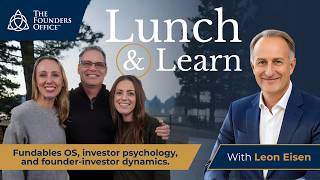
In this Founder’s Office Lunch & Learn session, Dr. Thomas J. Powell and co‑host Candice interview Dr. Leon Eisen, a physicist‑turned‑entrepreneur‑turned‑venture‑investor and creator of Fundables OS. The conversation begins with a brief anecdote about local elections, then pivots to the core premise that successful fundraising is less about finding investors and more about becoming the type of company investors want to back. Leon shares the concrete signals he looks for—post‑revenue (typically $2 M+ for Series A), clear product‑market fit, verifiable commitment letters, clean data‑room structures, and operational metrics such as CAC and EBITDA. He explains his systematic “Fundability Score” and the Fundables OS framework that guides founders on how to present themselves, emphasizing that intuition, resilience, and a founder’s ability to stay under pressure are equally critical. The discussion also covers global investment dynamics (Israel’s “Middle‑East Silicon Valley” and co‑investment with the US), healthcare AI regulatory hurdles, the importance of vision alignment over mere problem statements, and the limited value of polished pitch decks compared to authentic conversation. Leon mentions his upcoming books, patents (including the world’s first FDA‑cleared wrist‑worn pulse‑oximeter), and new ventures such as a Goal Execution Operating System. Throughout, both hosts stress the need for founders to be coachable, to demonstrate real traction, and to match their long‑term vision with that of the investor.
Chapters
Well, hello there, uh, from across the world. Uh, it's Candice and myself today because, uh, Jackie Kiper is off playing around in Florida with one of our other business ventures. So we are super excited. Candice, I got to tell you, uh, for those of you out there, I am so proud of Candice yesterday. She is helping the electoral process, volunteering all day at one of our booths here in Northern Nevada. Uh, you got to tell me, what was it like to be in the voter process yesterday as a volunteer?
I, you know, I, I love it. It's so, it's so fun to be a part of something like that. And, um, this is— I start our first time volunteering. I volunteered with you in 2020, um, and got into it because your wife roped us all in, and Every election the county calls and says, do you want to volunteer again? And I'm like, sure do. Sure. So it's just a great experience. We had a wonderful turnout, which I think is incredible for a midterm primary. A midterm primary, which was primary, is very exciting. And a lot of young people, a lot of first-time voters, which I think is just one of the most exciting parts of the process.
Well, you know, it, believe it or not, it actually leads into our founder conversations today. But the most important, having my doctorate in law and policy and dealing with constitutional law, the place that, especially in the United States, that elections are the most important and the least visited are those local primary elections when you're dealing with who's gonna be your mayor. Cuz we deal with what's the pothole like, or where's the park, or what's the funding like in our city? And those aren't the elections people show up for. They show up for who's gonna be the president of the United States, which we actually have very little impact on. Yeah. Right. So it was great. Well, I, I actually—
I equate it to when you're a parent, like I'm in the thick of being a parent. It matters a lot who your kid's teacher is. And yes, you care about who the superintendent is, but you have very little interaction with them. Yes, they make decisions that kind of end up trickling down to what your kids experience, but your day-to-day kids' experience is so dependent on who their teacher is. And so you care a lot about that person and then go up from there and like, the principal really matters because the school culture is important. And so that's what the local elections really are. Yeah. Community.
Well, once again, Founder's Office stuff. You're going out there and that was awesome to see and awesome to participate in. So super proud of you. And it was fun. So thanks for sharing that. And of course, we are talking about something that's near and dear to both mine and Candice's hearts. Most founders believe fundraising is about finding investors. But what if fundraising is really about becoming the kind of company the right investors want to find? Our guest today understands that distinction better than most. When a physicist becomes an inventor, an inventor becomes an entrepreneur, an entrepreneur becomes an investor, and an investor spends years helping founders raise capital, you get a perspective that very few people in the world possess. Dr. Leon Eisen is a physicist, 4-time founder, venture capitalist, and creator of Fundables OS, a system designed to help founders become investor-ready and build the momentum that attracts capital. What makes Leon particularly interesting is not what he has studied, it's what he's lived. He's built companies from the ground up, navigated the uncertainty, setbacks, pivots, and pressure that every founder eventually faces. He sat across the table from investors, he sat on the investor side of the table, And through those experiences, he developed a deep understanding of why some founders attract capital, why others struggle to gain traction. Leon understands something every founder eventually learns. The entrepreneurial journey is not a straight line. There are challenges, setbacks, doubts, moments when the future seems anything but certain. Yet those moments often become the source of the greatest lessons. Today, we're going to explore the realities of fundraising, the signals investors actually look for, the psychology of trust and confidence, and what it means to build a company that investors are eager to support. And I would encourage every founder in the audience to lean in and participate. This is one of those rare opportunities where the value you receive will be directly related to the quality of the questions you ask. If you've ever struggled with fundraising, investor relationships, growth strategy, or building momentum, this is your chance to learn from someone who has seen the process from every side of the table. So think about the challenge you're facing right now. Think about the questions you've never really had the opportunity to ask, and then Ask. Please help me and welcome Dr. Leon Eisen.
Yeah, thank you very much for— yeah, thank you very much. I am really happy to be here and thanks for inviting me.
Absolutely. Well, you're coming to us from the other side of the world almost. Not quite.
Yeah, I'm in Tel Aviv now. Yeah, I'm in the Middle East Silicon Valley.
The Middle East Silicon Valley.
I love the way you describe it. I move between— so I'm working in Silicon Valley in Menlo Park. We have the office. But I am moving all the time between two Silicon Valleys, Middle East Silicon Valley and San Francisco.
Yeah, people, most people don't really understand until they get a more global perspective how big Israel is in the, especially in the technology side of investment opportunities, right? We've got a number of, of, of co-investment funds that do both sides. Explain that a little bit. How's it work with Silicon Valley and, and the rest of the world?
First of all, it really mimics Silicon Valley. They try to mimic. They have some very cultural difference, definitely, but they try to mimic Silicon Valley. And everything what you have today, you have microphone, you have computer, you have your phone, Qualcomm, everything you can find is really developing there. Almost all the companies have R&D centers. So if you Just drive between Tel Aviv and Herzliya. It's like you drive between, I don't know, Menlo Park and to the south. It's exactly the same, same names, similar buildings, everything same. Microsoft, Apple, this, that, Oracle. So big names, exactly the same. You just, you don't have to close eyes, but you just think where I am now.
Where am I now?
So sometimes when I have the jet lag, I ask myself where I am now. Which tell me wherever I have a jet lag.
I love that. Well, and you also have investments, you have investments in the United States, you have investments in Israel, you have investments in Dubai. Is that right?
We just, in Dubai, we didn't have, didn't happen. We are looking for now, we are investigating some companies. In, uh, we just recently decided to build our branch in Middle East, and we succeeded to invest in the first company here, and it's amazing company, uh, 3 Nobel laureates in the board.
3 Nobel laureates?
Yes, exactly. And this is one of the reason as well we invested. We like such a hype. So yeah, and the second company just, uh, No, we're investing.
So, so you have— you've, you've experienced both sides like ourselves. So this is where you and I initially connected because it's like we have been on the founder side and we're very founder-centric on how we coach founders and help them. You know, our, our kind of moniker is all founders exit. It's just whether it's a planned exit or it's an accidental exit and how do we help them get the maximum evaluation. And on your side, you've been very, very focused, and I love how you kind of sometimes bring that, that parent wisdom to these founders that think it's going to be so easy. And before we started, you talked, you talked about a point that I think is near and dear to Candice's heart. You get pitched a lot, and half the time these people shouldn't even be pitching you because they didn't do any research on if you're even the right person to be talking to about what they're looking to raise.
You raised, you raised, raised the, I don't know, very pain point. And I can tell you that I check recently, I got about 200 DMs from startups every day, almost every day on LinkedIn. And I checked who really visited my page. Profile page. Free, free, free. So they just, you know, spray and pray.
Yes, the amount of pitches we've— we get that were— had they done just even a tiny bit of research, they would have recognized that we're not their— not their investor. And I've stopped some midway. I'm just like, I thank you, I don't want— I don't want you to waste your time, and I don't want to waste my time. I'm not your investor, I'm not going to participate in this. Um, so I'm curious, how do you filter that down? It sounds like obviously you've got your kind of first steps, but we've got people on the phone, on the, on the video today who are going through this. What key points would you recommend they even go through to get a date with somebody like you?
First of all, I am very flexible. I don't care about cold or warm introduction. I care about what is inside. If founder can explain his business very well and get me on hook. For example, also I wrote the memo for founders how to make, how to talk to me. And I send it to them. So first of all, should write, we have revenue, start from this, we have revenue. Last year, 2 million, and we are growing 10% per month. They don't have to tell anything else. I just ask for the meeting. Definitely in 90% of time, I recognize that all this bullshit inside, but I react immediately on this. I don't react on another 99% of, uh, mails where they say we developed XYZ. I don't care what they developed. I don't want to read what was developed because, you know, everybody, million people develop something. I want to understand the problem. Where are they now? And they can read from my profile that we invest in seed A round. What does it mean? They have to have revenue. They have to have product market fit. And if they don't have, they write, we developed XYZ just to to, to, um, to opaque their underdevelopment stage. Yeah, you know, it's, it's quite difficult for me. In the beginning, I was, I don't know, I was very frustrated about all this stuff. And even I, people ask me, uh, why you, you are not founder anymore? Why you— I, I, I, I was a 4 times founder. Why you became investor? Answer: I moved to the dark side of the business.
I love— well, you guys have 100— is it 100 Y Combinator investments?
No, not Y Combinator. We have dozen Y Combinator investments. Uh, we have special agreement and we have more than 100 companies we invested in.
Oh, got it. Okay. Well, that's a sizable portfolio to be managing those various investments in there. And that does give you our dark side of investment, right? So we had a little more than $3 billion in investments that we've placed out there over the years. And that That is, you know, the complexity of managing that in and of itself is an unbelievable complex business itself.
We are lazy. We don't manage them. We just invest because we don't want to be lead. We don't have— we have some analytics, analysts. We do some research. But actually, we don't want to be lead because To be lead is huge responsibility. Why do we?
It's a huge amount of work. It's a huge amount of responsibility.
Yeah, it's money, it's time. We don't want to do it. But we like, first of all, we are very Ukraine-oriented. We invested 4 on 5 Ukraine military startups, very nice startups growing very fast, like Bavono, for example. And we created a special fund called Oppenheimer to invest in Ukrainian military. One of our recent investments was Zilli. Zilli won deal competition in Paris recently.
Love that.
Yeah. And Zilli is growing like crazy. I don't know, $10 million per year they're growing. So yeah, these are our investment, uh, priorities, I would say.
So I want to go back to which matches again within our line. There are investors that want it at the idea stage, and so they're not looking for necessarily the credibility of the actual execution. And then there's investors, and you see them a lot in these angel groups. The problem is what we've seen in many of the angel groups is they don't actually understand that the idea stage doesn't have the founder proof in there. But once they've actually started to get the revenue, like you said, we like post-revenue, even if they haven't closed the revenue, but they've got true commitment letters, not LOIs like we were talking about earlier, but they're actually commitment that says, if you do X, we write the check scenario, that becomes a credibility piece for us. And that is a big part of the substance of did they tell us the opening stories the same? And then when we checked it out, did it actually come through? And you talk about credibility so much on your LinkedIn.
Yeah, right, exactly. Even I tell you, the first thing I do, I, when I meet with founder, I check LinkedIn account because I don't want, I don't want they build a connection from my money, using my money. I want them come to me with a brand, and I want to invest in something that is growing, not just, you know, making foundation. So founder should build the foundation, fundament.
Yeah.
And then come to us for the money to build the building. And this is big problem because, for example, What I learned, I didn't know it before. For me, it didn't happen, but actually I was surprised it happens all the time. The critical, critical, uh, point, uh, is about $2 million. When founder has about $150,000 every month, it's not enough for growth, so they lose momentum. And this is a big problem. So you don't want to invest if there is no momentum. So somehow they don't, they succeeded to raise, I know, $5, $7 million in the beginning to get to this point. And finally I asked, what happened to this $7 million? Oh, we have $2 million in revenue. It kills everything. And companies just die at this point. Much easier to raise capital on idea. You remember from Billions, very interesting episode. Don't say you have the, the revenue. Don't say these. You just, yeah.
No, it's, it is, it is very true. Well, so we have on, cause you have your, uh, OS operating system that you have generously put out there for founders to actually go through before they ever even get on the phone with you. So like you give them the roadmap of how to best talk to you.
Right?
If they just follow you on LinkedIn, they're going to have a far more successful call with you than if they just blindly looked at it and go, no. I mean, it's crazy, right? You give them the methodology. Now they have to have the substance behind them because they have to have gotten to the revenue standpoint. But when they've got that—
I can see the founder like teenager. I have two teenager girls. And I can tell it's very similar. They don't want to listen to you. They do everything what they want, and they come to you when they fail. It's too late.
Help. I, I find that very funny, um, because one of our, one of our requirements is actually coachability. Um, if, if, if on the first call, and we'll, we'll kind of put some objections or, or questions And if they don't seem coachable, it's actually like a full stop, no-go for us. Yeah. Um, but it sounds like we have a similar philosophy. I get pitched a lot of times ideas and solutions to problems I'm not aware exist because they haven't even told me what the problem is, um, that they're trying to solve. So we, we both kind of have a similar formula there. But you seem to have this very, not surprisingly, scientific approach to how you do these deals. I mean, even, even looking at, you know, your, your, your book, which we talked a little bit about, and I know we'll talk a little bit more about, but Trust a Physicist, to have this like very scientific, you know, you, you have really dissected almost best practices. Um, how long did this take you kind of to develop, and do you feel like this is an evolving formula, or is this something that, you know, you— 4-time founder, did you figure this out pretty early, or did it take the 4 times for you to figure it out on the founder side?
No, I didn't figure out before, I can tell you. If I would figure out before, I would raise billion dollar with my knowledge today. I didn't know what I didn't know. If you are sitting on one side of the table, you don't see what happening another side. So you just have some signals, you just see some something very, very, uh, so directly you don't know what happens there. What is in the mind of investor? Why investor suddenly start to teach you about something. And then you check this investor has MBA, never, never build any company. So what investor is teaching you actually? He is teaching you how to become the company they specifically invest, not to become the successful company because they have their interest to deploy their money specifically based on their thesis. So I didn't know all these subtle layers. I was very straightforward. I went, I raised $10 million for my first company, and I didn't learn all this stuff. So what I saw, just result. Okay, we invest $3 million, we invest $10 million. I saw result. I didn't know why. I thought, I'm so genius. Wow, I did something. They invested to me. But now I understand why, why I got no, why I got yes. And even, even more, what I wanted to say, to share with you, uh, I start to, to raise capital. In the beginning, I raised capital in 2008, 2009, my first million dollar in the middle of the crisis. And I thought, wow, no, wow, nobody did it. All my friends didn't succeed, and me, with some Russian accent, in totally not my environment, my culture, I succeeded to raise $1 million from local people living— they born here, born here. I am genius. And then I couldn't trade for another 3 years.
I think that's a lot of times the founder mentality is, and I think that's where your scientific background comes into play, is the kind of— we, we go, wow, I'm, I'm, I nailed this, I'm amazing, and failing to look like really dig deep and go like, what was it about the formula that worked and what is not? What am— what do I need to shift and change? Because the environment has shifted, or the audience has shifted, or the solution shifted. So I think that's a really interesting perspective. And a lot of times we're running into the same founders who maybe they haven't quite gotten that, that far in their, in their own research yet. We do have a question from, from our audience. So and feel free to put more questions into the Q&A. I'll read this first one here. What is the best thing a founder approaching a Series A funder can do to prepare for their pitch?
Oh, it's a question for a couple of days of webinar.
Clear your schedule.
But yeah, but shortly, make a story short, uh, for Round A, they have to have at least $2 million in revenue. Starting from $2 million, not before, because $2 million just shows some product market fit. So they should show not only lagging indicator, they should show lead indicators, okay?
Yeah.
Customer acquisition cost, EBITDA, all this stuff. So they have to show something. That says, okay, we are very good operators. We brought company to, uh, to this point and we are growing, I don't know, 10 times, 10% per month. Why we are growing 10% per month? Because we build this operation. Then I started due diligence and then I see, for example, they have revenue $150,000 and they lose $200,000. $100,000 because of salary or something like this. I started asking why you are losing this money, and they started explaining. So we need these guys, we need that guys, what these guys do. And then most of the time it's totally not optimal, so we start optimization. So in round A, it's very important, uh, to catch up attention. And then to have very clean, clean metrics behind. If once I, I, I, I, I, I saw loan $1 million from the bank, so they sell for $2 million, they are in the minus, they, they just, they cannot, and suddenly I see the loan in the bank. Mm-hmm. Okay. So what is it? Why loan in the bank? Yeah. They have to, to, to, to give up $10,000 to pay every month for this. I don't want to invest in this stuff, but it looks amazing from— it's deck is amazing. Very attractive. This guy just get the first places in all competitions and then you start to dig. And you see all the problems inside. It happens all the time. Yes, all the time.
Oh, we look, we look critically now because decks used to be kind of a visual into the company, but now they can use Claude and they go out to Y Combinator and they're like, ooh, and they, they show up with a good deck, but there's no substance behind the deck. So our really due diligence is show us your data room. We'll sign an NDA, but show us your data room. We don't even need to see what's in your data room. We just want to see your data room structure and their data room, one, either doesn't exist or it's a total mess or it doesn't match anything that they've said. And we're like, yep, we're out. Because if you don't— if you haven't started to understand that, that structure of the company to where you can actually use the credibility of what you said, no matter what it is, if you say it as a fact, you better be able to substantiate that it's actually a fact. Right, right. As opposed to the future.
And sometimes I continue with the companies. I take about 5 companies to, to, um, I'm not to coach, I would say. Yeah. Yeah. Because you know, there is a, what I understood recently, I don't know, nobody is talking about. There are two things. There is a fundable company and there is a fundable, uh, fundable round. Yeah. It's two different things at all. So how to convert company who had fundable rounds into the fundable company to continue continuously raise capital?
Yeah, so there's lots of those. We see those right on the marketplace right now.
Fundable. Yeah. So I look, I look at the market, I look at their team operations. So I see a lot of stuff like, for example, this loan. But I try to understand how can I clean this company to help them to become fundable. If I see some, I don't know, uh, I don't care about vision, by the way. And people, founders think that investor is looking for a vision. I don't care about vision. I care about 10 times return. So don't start from vision. But sometimes if I feel that this company, if I will clean this company, they will make 10 times return. Yeah, I help them.
Yeah, I love that. Well, you know, it is interesting of— so our model, very simply, we say what's the persuasiveness of the problem? And we've got really 3 inputs on that. So the persuasiveness of the problem is, have we already recognized that that problem needs to be solved? So it could be anything along the lines of So, somebody comes to us, they start talking about it. It's like, yep, we're already doing some research in there. If you have to convince us of the problem that exists, then we're not your right investor. There's probably other people out there that are right investors. It's like, we're not the right investor. The second one, is it a big problem? So, if it's solved, we're going to make a lot of money together because if it's just a small— and I use this as an example, even though we have invested in a coffee shop in the past, but if it's a small coffee shop idea, that's not really exciting. It's not scalable, right? So, it's got to be something that's big. And then is there a protective moat? That's the persuasiveness of the problem for us. On the other side, the confidence in the solution starts with that founder. But it's not that the founder's got a great vision. It's that the founder is going to have the resilience to— and has a track record of resilience to stick to it when everything goes wrong, because everything's going to go wrong. And then the second thing is, can the founder attract and retain talent that can actually execute on their ideas. And so where you and I are matching up on there is if they've made some revenue, they've been able to have team in there because the founder's probably not making that $2 million in revenue. They're, they're getting there, right?
Yeah. Right. This is very important for pre-seed to show that, uh, your co-founders and your team is very talented.
Very talented. And you've been able to retain them. So you got to have the founder to keep that, that, that enthusiasm there when everything goes wrong and the creativity to figure out the next stage and the opportunity within there. Because also for us, for many of our late-stage fundings, what we funded in early stage and what they actually exited at are not the same thing. They had to grow and mature and they found another idea and there was another opportunity within there and their team even changed because the team that they had at $2 million is not the same team that they have at $50 million or $500 million. It's totally different. They grow through that.
Yeah, yeah. I can tell you what I learned recently. I don't learn only from other people. I have 1,000 books in my Amazon Kindle. I learned also from myself. And, uh, now I change my approach to how to filter out the companies totally. I— you said people I just convince you about this problem. I don't want people convince me about, to convince me about this problem. I want people coming to me with the problem I, I know already. And this is how I filter out. How did I make it? Uh, couple of months ago I started analytic report about weekly fundraising and 5 shift in the market. Which each week creates in the Substack. And I publish every month, monthly, very deep analytic report with my specific scorecard I developed called Eisen Fundability Score. I also published how to manage and calculate it. It's, by the way, in my book. And I start to think. I know all shifts. I know today, I understand through my writing. I start to understand the future. I start to acquire some vision I didn't have before because I analyze the company, analyze all these shifts. Like, for example, uh, you could— today you cannot raise capital if you write AI native. You have to write AI workflow infrastructure or something like this. It's very important how you frame your business. Yeah. And I have my vision where we are going in 5 years, in 10 years. And now when I get some pitch or get deck or something like this, I compare. I just put this matrix and I compare with my vision. And if it doesn't coincide with my vision, I don't So I don't care about the problem. I care about if this problem coincides with my vision of the future.
Interesting. I think, I think in certain ways we actually say the same, a little bit the same way. We just articulate it a little differently. I care that we've identified something that needs to be solved, which is what does the future look like? I was talking to Kelly in our office earlier today and I'm just loving, you know, you and I grew up in the day of of the early Star Trek. And so they'd have that computer and then with, you know, the, the Jarvis computers and things of AI. And I'm like, man, I am living in the age that I've been thinking of since I was a little kid when Captain Kirk would use his transporter, you know, and do different things. I love that. And that's the vision of the future. But what problem we were solving is how do we get instantaneous access to data, right? That's that, that scenario. And okay, this is the problem. And when somebody can articulate it really well, and it matches what we're seeing, then that's where we start being interested in the conversation. Let's talk about your books. You've got one book that I love the title, Quantum Business Thinking, that's coming out at the end of the year, right? Are you doing—
Yes, this scientific book, we wrote it together. It's a chapter in a social science book, big for, for many for students and for science.
I love that. So, so people are going to be able to sign up that they should follow you without a doubt.
Yeah, they can go to my website and sign up for this book. They will get it. It will be with Professor— I wrote it with Professor from Incognition, Quantum Cognition from Indian University.
Very good. Okay. Well, you and I said, you know, so if you want to be raising capital, that's a, that's a great place to be doing that with the right type of people. You've got a Venture Growth podcast, so you have guests that come on that and you've got your newsletter that's coming out once a week now. I think you've got that coming out on your LinkedIn that people can sign up for as well.
I can add more stuff. I'm also very interested in consciousness and I'm on the board of European Consciousness University. University.
So, okay, expand on that.
What is that? We teach neuroplasticity. It's European Consciousness University, and we teach neuroplasticity there. Also, I'm an author of about 30 patents. And most important, you— everybody knows wearables, right? Yeah, commodity. But they are not— if they're cleared, you cannot use it in, in the hospital. Who created the world's first FDA-cleared wearable monitor, medical monitor? Any guess?
You were the first one, weren't you?
Exactly. First one. And all these, like, Massima, big companies, they use it like a predicate to create their devices. So we created world's first FDA-cleared pulse oximeter and monitor at wrist.
That was your, that was your deal.
Yeah. I sold to about 100 medical systems and hospitals in the United States.
That is crazy. Hey, Candice, we got a handful more questions here. I don't think we're going to get through them all before we get done.
I think while we're on that topic, we've got— somebody just submitted a question. We're developing an SAMD, or SAMD, software as a medical device product for trauma. And we found that even to launch as wellness, we couldn't use the commercial gen models with prompts. They were completely unsuitable. So we also had to develop our own AI that functions very differently than the others. How do we explain that without diluting the value of the software?
Uh, first of all, I never recommend develop something by yourself in startup. You should use everything off the shelf. Because it's not only costly, it takes time, and it doesn't work sometimes. And most of the time it doesn't work because small team cannot develop something reliable. Actually, it's not, it's not funded by Microsoft or something like this. So I don't recommend. But if you have it already, uh, for healthcare it's very difficult because you have to get FDA, you have to get all their SOC 2 and all this stuff around. Around. So it takes a lot of time, it takes a lot of money, but there are many ways how to cut the corner. I like cut the corner. It's not— I'm not talking about technical depth, it's not the issue. How to cut the corner, how to frame. It's very important frame. Politicians know the best how to, how to frame, you know, the same thing. True. Founder should learn in the beginning how to frame things. And when I did, I did several FDA. It was very difficult. But what I learned there, you can say this way or say another way, you get FDA, you don't get FDA for the same stuff. Yeah. For example, you have some point, some dot outlayer, and you remove it. Now you have to explain to them why did you remove it. So, so you learn a lot from this. They have, first of all, I would love to talk to them so they can connect to me via LinkedIn and remind that.
Yeah, yeah, yeah, no, no, so we'll make, we'll make the connection.
We can talk. I would love to learn more because I see a lot of problem with all LLMs and all AI in healthcare. How to make it.
Yeah, everybody's, everybody's running it through their Claude, CoWork, and saying, I've come up with the right answer to it. And we know that that's not exactly, because anybody else can run it in through there as well.
I can tell one of the company, uh, I have my own venture studio, you know, a lot of stuff I'm doing. I have a PhD, so I do a lot of stuff at the same time.
This is why we're, this is why we get along, right?
Because it's the same. Yeah, right, exactly, exactly. And I have today 3, 4, 5 companies. And 3 really working very well. And we launch maybe next month amazing company, it's called Goal Execution Operating System. You put your goal, I want to raise $10 million, I want to sell my car, I want to do this, I want to marry, I don't know, doesn't matter. And it creates your operating system exactly. But most important, based on the book and methodology of the expert. You can create your expert, virtual expert board. You can put Brain Tracy, I don't know, Hormozi, everybody there, free people. They talk to each other and based on this, you can create your operating system based on their expertise. You don't have to take anything from LLM, from the internet. You, you have 100%, uh, fidelity to the expertise you hire. You build the operating system with all blocks around CRM if you are doing these sales or something like this. So all inside, all database. So it's like your operate, a real operating system with dashboard, KPIs, everything for any goal you want. For 5 minutes you have it.
So here's going to be the important thing. So as a physicist, it's not about the research, it's about the question you asked, and then go down that process. So in understanding, you can have Hermosi's book, everybody can have that, it's all out there, but if you do not ask the appropriate questions and prompts, you're just going to get generic garbage that comes out to there, and anybody, you know, gets that answer. It's going to be the people who actually ask the best questions, and that's how you're going to get the best answers. Knowledge is there.
You can take this book, put into the Claude, write, I don't know, 3-5 sentences prompt, get 80% fidelity and 20% hallucination, and build some bullshit.
Yeah, exactly.
And it takes a lot of time because you have to tune your prompt, you have to First of all, you have to put book there, whole book, find it, uh, till you make a lot of clicks, create some, I don't know, uh, design. And then to take this design, go to some other company to, to create some operating system out of this. It takes a lot of time. You know, only 1% of people know how to use Claude. 1% of people in our world. So this is built for people who don't want all this stuff. Who doesn't want, for example, uh, company Zilli. They create advertisement, uh, video. You can do it on a notebook alone by yourself, but it takes time. It's, it's wrong. It's not so good. So you buy Zilli. Here the same. You can go to cloud, spend some time, but you don't know how to code. You don't know how to all this stuff. Put you, okay, I wanna I wanna, uh, how, how, uh, build me up. I wanna teach my kid mathematics. Build me operating system. So build operating system immediately, and you have all, all blueprint. You can download documentation on about this operating system, but most importantly, you can change it. So you build some, I would say, foundation. Then you start using this. You want another stuff, another stuff, you add this by vibe coding.
Vibe coding. That's it. You know, we had— we've had a couple of AI leaders on our show the last month and a half, 2 months. We had Joe Stolte, we had Nate Herkelman. Both are thought out there as thought leaders in the actual execution side of this. And I loved what Nate was talking about was that, you know, he, he has his area of expertise. But that's why he can't build in AI and become an expert just because he's using AI in something that is totally different in that. And, and that is the wonderful piece about how we're going to be able to retain our own areas of expertise and have AI be able to help that. And then maybe ask— you started this off and I know Candice was probably smiling about it— OPE. Is a great way that we love to learn. So we've got, you know, leaders are readers. We've got thousands of books on our bookshelves. And, you know, yes, we can get it through AI, but it's actually the reading and then synthesizing it as ourselves through our own experiences and asking better questions. And that's how we get there. Leon, give me the two books. You've got one coming out in April. You said that's available on your— on your— The Secrets of the Term Sheet. Is that it? What's the one coming out?
It's not available yet.
Okay.
There is some delay. It's called Invisible Game: The Secrets of the Term Sheet Magnet.
Okay. Invisible Game: The Secrets of the Term Sheet Magnet. Is that— can you, can you preorder that on your website now, or is that something to watch for?
No, no, no, you can't. You can't. You can't. We'll have it later.
Okay. And then the other one is your, your one that is—
Quantum Business Thinking. Quantum Business Thinking.
Yeah. Which of course, just by having that title, I'll feel a lot smarter. So I don't even have to read it. I just have to— think it.
Sometimes to be smart is not good. It's better to how to monetize it. I understood I will not able to monetize quantum business thinking well because people don't understand. I have to explain them. It's a new category, so it's not good. Like, you know, I said off the shelf, you, you should go the shelf, you should use some, uh, familiar category to get in.
I love it, I love it.
So that's why I delayed this for half a year, and first I try to get into scientific category and then to popularize it.
I love it. I love it. Well, we've definitely had the book— The Goal is a great way of doing that, where system thinking was able to take it from a physicist and get it out into a process in the '70s. And I think that that's what you're going to be able to do here, which is fabulous. Ernest, I'm going to get back to your question in a future because I think that that's a longer conversation about data room.
I think that that's a whole episode on—
I think we can do a whole episode on building data rooms. And I think that's a great question. But here's the last one for the day, and then we'll— then we're going to pop up your information again. What's the best way to identify if you as the funder understand or align with the problem you're solving? I think you already gave the hint into it. You're not necessarily looking for the problem, you're looking for them to vision. But answer that. So if somebody is looking to you, how do they know that they should actually spend some time sending you their information? And you've given them the rulebook.
Uh, I think it doesn't come from explanation, headline, or something like this. When you— okay, I hope you are not on Tinder. Yeah, but just think about you open the— you're going to find your wife and Yeah. And you are open Tinder or something like this.
Yeah.
Not OnlyFans. Tinder. I don't recommend to find wife on OnlyFans. Next step to Netflix and chill. Yeah. And immediately you see the picture, even maybe it's not so nice picture, but you see this woman based on eyes, on something. Oh, this is, this is what I want. Then you read the headline. Same I recommend to founders. Feel their gut feeling. So go their intuition. Intuition in business is 50% of the success. Any logic— what I did by logic, I failed all 100% and failed on something I, I've done by logic.
Okay, that's, that's interesting. So 50%—
intuition. I see this guy, I like him. Now I want to learn if this guy invest in in my company or not. Or maybe I can learn from this guy and go to Hubble and buy some meeting with this guy, right? But follow your intuition, follow your feeling.
Yeah, and we agree.
Yeah, Candace, Candace and I have a strong philosophy of the wrong investor can kill your future. So as the founder, you want to not just be in the room with the, with investors, you want to be in the room with the right investors. And so that's the process. And I think that that intuition is also in there, because if it's just logic, the logic can change. The, the ideas— once you actually— the, the idea that you have before you get the money, and then the idea of how it actually comes to fruition, because you didn't have it proven, you're building it as you're going, can be totally different. And that logic may not align. So even with all of our frameworks, it's still a part of how our intuition and our ideas and our experience work in that.
We have a gut check rule internally, and I'm guessing, you know, a lot of other funders do. But we have a full gut rule that if somebody's gut is saying no, and of course, like all great funders, we override the gut all the time, and we've been We are constantly proven why we listen to our gut on things. And, um, so yeah, we have, we have a gut rule.
Yeah, it's very important point here because you know why I suggest conversation? Because conversation, maybe your knowledge is foundation of conversation, but conversation is going based on intuition. Mhm. You intuitively just pick up from your brain some interesting stories, I don't know, knowledge, something like this, using, uh, conversation. We call it creativity. So it's a creative process, and any creative process based on intuition. So if you're going to raise capital, that's why I ask to close the pitch deck, because Pitch decks kill intuition. It's like, you know, you, you make TEDx reading from the, uh, yeah, page.
It doesn't work.
Yeah, we never— we don't even look. They don't— I don't look at resumes and I don't look at pitch decks before meeting the people. So by the time somebody's getting up to me to interview them, I do not look at their resume. I don't care. I want to know how they're going to present at that point. Then, then it is we run the deep dive, and it's the same way with— again, back to Ernest's question— I don't look at the data room. Somebody says, I'm going to send you my data room, it's like, I'm not going to look at it, so don't bother. And by the way, I'm not signing an NDA because we're going to talk first. I don't need to have your secret sauce. We'll jump into that if I'm even interested. So don't ask me to sign an NDA to tell me what you're doing because I'm not going to get that deep into it that we're going to get into your IP, uh, to begin with. But if after we decide, then, then yeah, we'll get there. Type scenario.
Well, it's very important to check founder, uh, how founder just sustain under pressure. I all the time, I, in the beginning, I praise the founder, and 90% of founders just get broken. Yeah, they start to defend themselves instead of continue conversation, and this is a very bad— it's a red flag.
Oh, I have, I have a founder today. We're supposed to go travel in another country and there's all these things that the travel and like leave on Friday, right? So it's an international trip, 16-hour flight and problem with getting a visa right now. And it's like, oh, we gotta pivot. That actually is a great scenario because whether they pivot and we're successful or they pivot because they can't get the visa and it's not something they can do and what's the next step do, or do they get crushed? That's actually a great thing to have as an experience because I wanna know how they transition because that's not going to be the biggest problem they ever deal with. Right. So it's actually great to see. And Candice, you got to tell— I mean, what's your one? And this is going to be it because we're running out of time. But what's your big question when you're interviewing people, whether it's we're going to look at a funding or an employee? What— how do you— how do you process that?
Yeah, I feel like we're— we say this on a lot of episodes, but I do ask if you ever get in front of me, I will ask you, like, when have you been bloodied? And I don't want you to come out as the hero. I don't, I don't bet on unicorns. I don't bet on people who only fail up. I want to know when it got really gnarly, even if you made a bad call, and I don't care that it had a good outcome. What I actually care about is that you got up the next day and you went back on the field and tried again. Um, and if it— and So, that's all I care about. I don't care if it was like a flaming dumpster fire that you left behind, like that you had to deal with or whatever it was. I think people think it's one of those like, tell me your flaws and they have to spin it into like a positive. I'm like, no, I don't care about that. I look for resilience and that's because we've worked with partners in the past, we've invested in deals in the past, these people knocked it out of the park every single time and the first time something went wrong, they had no resilience muscle built. They, they floundered. They just couldn't get themselves up to do— take even the next step. And so that's a really important quality we look for, is failure.
Yeah, this is, this is maybe the most important quality because in depression you cannot do anything. And I saw many startups where founder just get depressed and left the company and left investors.
Totally a mess.
You have to check it.
Yeah. Hey, Ahmad, we're going to— I love your question and it's a really detailed question that goes along with Ernest. So we are going to answer that in a future show. Not to say we're not going to get to it, but Leon, you don't see it here, but they're asking about data rooms. And I think that that's from our standpoint, there's a— there's some really good answers out there. But I think we'll make a whole show around that one. Kenneth, I think that's a great, great question.
It's all about data. No, it's all about data.
It is. Leon, Dr. Leon Eisen, let's see one more time how they get in touch with you. We've got your LinkedIn. LinkedIn. And I got to tell you, he's one of my favorite people to follow on LinkedIn. He's got a huge following out there and he just is constantly providing the content that is actually valuable. So you see it in the morning and it's something that you can actually think about and utilize that day, or it's, it's an answer that's there. So follow him on LinkedIn. He's got his website. His podcast and just a great guy to get to know. Obviously, he's in the, in the deal market of looking for the right kind of ventures to back. And so looking at that kind of stuff there, Candice and I can be reached at here. I think you've got Angela. I don't know if you got that one up there. We are also— you can follow me on LinkedIn. Same with actually Candice. You're not on LinkedIn. You are anti-social media. You can't follow except, except Candice and Jackie have the WTF Women Talk Finance, which is a totally different thing. So, you know, half the time I'm bringing middle-aged white dudes on our show because that's who I hang out with a lot of times. So we've got the alternative in that we do have an entire venture that is dealing with women talk finance, and it is so exciting to see as the generations are coming along. And their show's a lot of fun to watch as well. Um, and obviously I'm one of the big fans of the show.
Yeah, he turns into Dance Mom at the end of these, so thank you.
I am the Dance Mom at the end of these.
So by the way, all my life I did the best, best business I did, and, uh, with women.
Absolutely, absolutely. I, I fully believe that. I am, I am so blessed to have the team that surrounds me. And, uh, I joke about the middle-aged white man, but, uh, that is because I are one, but But, you know, my success comes from a lot of the other people that are around me. So it's great. Well, Leon, thanks again for being on the show. We appreciate you so much and keep doing the work you're out there and look forward to doing other deals with you. And those are the questions we didn't get to. We'll get to next, next show. We'll actually create a whole new show about it. So thank you. Have a great day or an evening. It's 9:00, 10:00 now. So thank you for taking your time.
That's amazing. Thank you very much.
Bye.
More from Dr.

The Business You Built May Not Be the Business You Own | Founder’s Office™ Lunch & Learn



Your Business Isn't Worth What You Think It Is | Founder’s Office™ Lunch & Learn


Complexity Is Quietly Destroying Enterprise Value | Founder’s Office™ Lunch & Learn


Simplifying The Complexity of IP | With Tony D'Angelo | Founder’s Office™ Lunch & Learn


