SAFE Notes, Convertible Debt & Founder Valuation Strategy | Founder’s Office™ Lunch & Learn
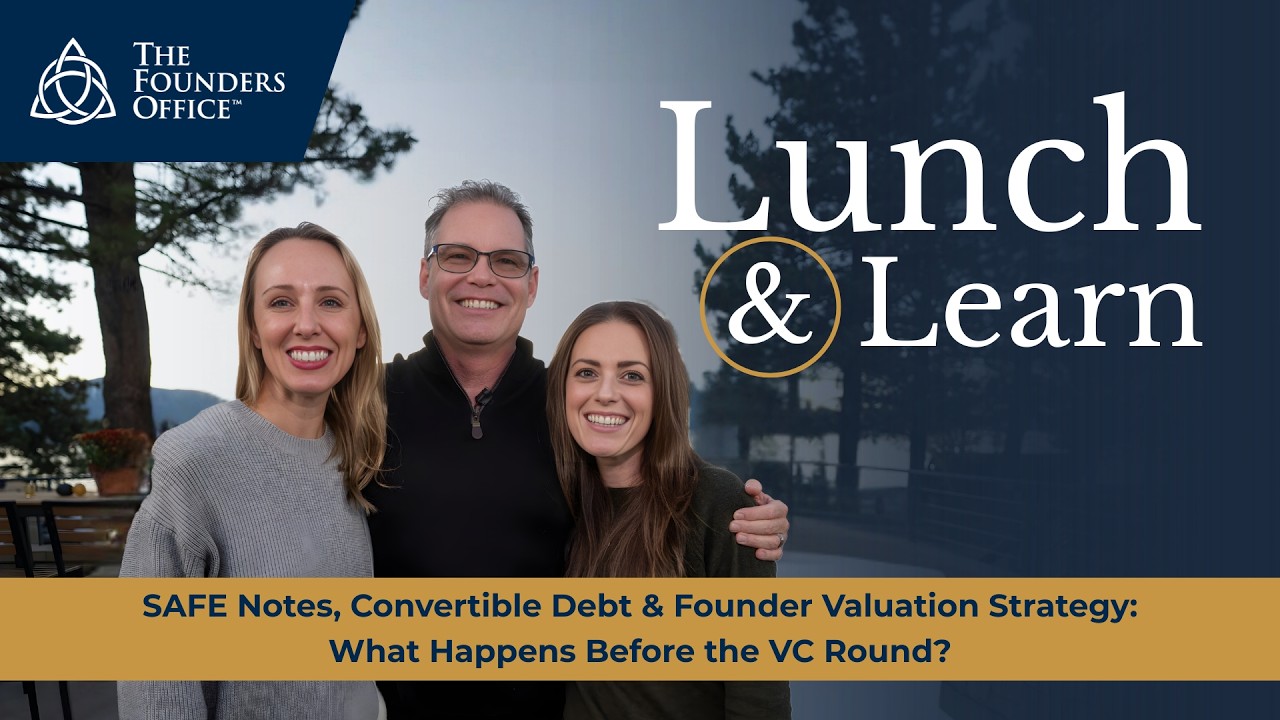
Dr. Thomas J. Powell and Jackie Kuiper break down SAFE notes, convertible debt, and valuation for early-stage founders. Powell recently overturned a 52-year-old SEC rule, and they argue SAFEs are lazy and risky. About 75% of early-stage capital comes from private sources, not venture capital.
Chapters
Well, it is Lunch and Learn Wednesday. Hi, Jackie Kuiper.
Hi, Thomas J. Powell.
It is the two of us today because we have some wayward other fellow members of our family office here. They're out having fun. Candice is, I think, up in Banff. I was getting some photos and Katie is out on Lake Tahoe. Her birthday's this week, so I think she's allowed to, you know, head out and do that. And it is fun because what we're talking about is I'm about ready to head off for a couple weeks. I will be here next week, but I'm going to go ski in Chile. If you haven't noticed, they've gotten 10 feet in the recent 2 days of snow. So I'm going to go ski.
Amazing.
And you just got back from Portugal. And Spain.
And Spain. Yeah. Yep. It was a nice, a nice trip. We started in Barcelona. We had a rental car, drove from Barcelona to Madrid, from Madrid to Lisbon, got up to Porto, had a really lovely time.
Nice. This is the best. This is the benefit of founders' offices in general, is that even though we do, like many other founders, we tend to work too much and have too many different things going on at different times, we definitely do have the freedom to go do and explore in the world, which is a part of that quality of life, uh, which is an interesting thing because we're not talking about it today, but with the team on our technology, we're working on a model, uh, that is kind of— Jesse, who was the founder of Marquee Jets, came up with this thing called the Big Ass Calendar. And I know it's not our topic today, but at some point we should probably cover through there about the most— the thing that we have the least as any human is it's not renewable is time. And so getting into those and thinking through some different concepts and Dan Sullivan uses that in his Entrepreneurial Time System. But with that, what are we going to talk about today?
Because can you, can you open us up with some good news or some exciting news? Any chance you can do that?
Some good news, exciting news? Well, we did have a little bit of news and it literally was in the newspaper last week. Standing in New York City, speaking of that, I was with Katie in New York City and we got to see two cool plays. If you haven't seen them, one's called something, maybe Happy Ending.
Oh yeah, you said that was really good.
With our, with our AI world, it's two robots that fall in love. Super cute. And then the other one was Proof with Don Cheadle, which was also incredible. And that's about a father-daughter relationship. So for me and Katie. But the big news was on then on Thursday, I was in the Wall Street Journal. So that's— Jan, I don't know if you have it there. It's available for people to check out. And it gives a little bit about what went on with the SEC and how we, along with some others, were able to change a 52-year-old constitutional-breaking rule that the SEC has been doing. And they are no longer doing, which is I'm very proud of. That work that we did and, you know, backed by the Mark Cubans and Elon Musks of the world, those two specifically, and myself and NCLA and ICANN and all these others. And it was great to have the recognition from Wall Street Journal to be able to pick that up.
And audience can find the article on our website, right? FoundersOffice.com.
I think they can. Yeah. Lots of stuff out there. Lots of good stuff on, on where it's going. We do, by the way, I do I am a person that believes we need to have regulators. It's just that regulators, just like government, need to have oversight because any, any time anybody's given ultimate freedom and opportunity to abuse people, unfortunately, even if that's not their intent, they do that. So we've got to have guardrails for the SEC, and that's what we're working on. So that's critically important because free enterprise, in my opinion, saves the world. And without capital, generally, these business ideas can't get off the ground. And I think that's what we're talking about.
Yeah. Well, and let's— before we segue into our real topic for the day, it is interesting. You've got your PhD in law and policy, and policy is something that's really fascinating when you look at it because it becomes a set of rules, right? Frameworks, guidelines, and actual rules, laws. And when you stack a rule on top of a rule on top of a rule on top of a rule, somewhere in there, it's possible that a rule isn't fully constitutional, like it's depriving people of rights. And that was what happened in your case. And I think it's very rare that someone can recognize and go, that this isn't right, that this, like, this rule can't be part of this framework because it's unconstitutional. And you pushed it and pushed it and took it from— what court did you start in? You started in a state court, went to the Ninth Circuit, then it went to the Ninth Circuit.
Then to Supreme Court.
Yeah, all the way through appeals.
Yep.
And then you made cert for Supreme Court. That is, it's very rare that, um, an individual, a societal individual can recognize that and then push for change and achieve it. So, um, really, really worth looking at closely.
It is. And what's interesting about it is it does, it does show, and the pathway that when regulators do behave poorly, the legal system is actually designed around, and there are organizations like ICANN and NCLA that help move those through. And so if it was not for the nonprofit legal systems that are out there of some of the brightest and best and well-funded, just because they're nonprofit, well-funded attorney systems that are out there to bring these up through the system. And it's how much of this stuff, Jarkasi, Chevron, and a number of other things that have happened. And just to give a little brief on the, on the case, Right or wrong, at times, anybody, Schwab, Berkshire Hathaway, Wells Fargo, of course, but anybody can find themselves in a settlement with the SEC. It principally is just cheaper to settle than to battle with them. Because especially up until recently, you weren't guaranteed a jury trial as an individual. Jarkasy was the one that changed that. To where you knew you'd have a jury trial. Before that, what you had was an internal judge who reported to the commissioner. And so you would go through these processes, never getting a jury trial, and you would be not found guilty because it's not a guilt or innocence with the SEC. It's simply a civil matter, like somebody bumps a car and they take, they take them to court and it's going to be for a civil matter. That's the SEC. You're in a civil court. Well, the SEC for 52 years said, if you settle with us, you can't talk about it, period. And Jackie, you ran into this. So we— they weren't supposed to do a press release on us. They did a press release. Our PR firm with legal reviewing it sent out a statement from us, and the SEC came back and said, you cannot say anything. And over the 5 years of that statement being out there, the SEC's truthfulness of their statement continued to slip to where they were no longer even being remotely factual in their statements. And we couldn't say anything about it.
And, and actually, I think, Tom, I'm going to add one slight layer on that. I believe there was also a not local newspaper out of a different state that we—
Texas.
Texas. Yep. They ran a story based on the SEC's press release and reached out for comment. And I made a comment and like that our counsel was like, you better retract that. You're not allowed. You're not allowed to make a comment.
Yeah, that was crazy. Well, not, not just, not, it wasn't just our counsel that, that contacted you. Our counsel contacted you and said the SEC has already contacted them.
That's right.
And so, and so what is absolutely crazy is because with the, uh, Supreme Court saying it was, uh, you know, that they didn't need to rule on it because SEC rescinded the ruling, the SEC said, well, 'Well, and we've never really enforced this.' And we're like, 'That's BS, you have.' So they very much knew that they were breaking the Constitution. They very much knew that it was unconstitutional, and they kept winning in court cases until they were going to get it up to the Supreme Court, and they chose that that's not it. But let's talk about capital raising and how that even plays into capital raising. And, you know, I— we have a good friend that's down in Arizona, you know, she's probably going to be a guest on our show here at some point, she's like, the biggest fear of mine is the SEC. And we don't really need to be afraid of them. But just also know that just even when you do everything right, doesn't mean you're not going to run afoul of them. Because they don't have— you don't have to necessarily be doing things wrong. They just have to think you are. And that can cost you tens of millions of dollars just to prove that you are in the right. And you up until now, you wouldn't be able to. So yeah.
Well, let's start with what happens before you even get to a VC round, right? Well, and first, VC means venture capital round. So who are those investors? Who are the VC investors? Are you considered institutional at that point? Let me ask that.
Now, lots of people. So let's go through the capital stack of definitely what it can be. And the— and there's as many different ways to raise capital as possible. In most cases, You start off with one person has an idea. Maybe it germinates because 3 people are sitting around and having cocktails and they're, oh, this is a good idea. Let's start a business together. But one person is the one who vocalized that, and generally that becomes the initial founder. Maybe not. Then they put some money and time in. It could simply be, hey, I'm going to go reserve a domain, and they put it on their credit card. That's the friends and family And that's also the founder's early-stage money going in. So maybe they need to raise $500 to start a website, test an idea, wherever it goes, it moves along that space. As the idea starts germinating, then maybe they're in college and they, they do some pitch contest or they go to an angel round within their local family. Those still aren't the VC round, but that's still the very early stages of raising capital. And YC, you know, Y Combinator is a good example of where these start going incubation. Innovators have become very popular throughout the, the country. In the '80s and early '90s, when I started in this down in Silicon Valley, even the word venture capital was still a relatively new term. And what venture capital was coming about was it was wealthy individuals, for the most part, that had made some money, usually exiting a big company, and they were willing to write the check, and they didn't have A lot of times they were tied to an office, a law office, not a family office. And they said, oh yeah, we'll put some money into you to get you ready to be able to get to the banking stage of this or to the larger capital. And the other part of this is it used to be much easier to take a company public. So you went venture capital and you didn't do A, B, and C rounds that we hear about, or now even D and E and F rounds, but You went to the market because Wall Street was relatively liquid and wanted to help companies get off the ground. SEC's charge was to help small companies become big companies and be able to get the public access to money. Over the times, especially after the late '90s, after Dot-com 1.0 fail, and you got into 9/11, then you got into the 2008, became harder and harder and harder to take companies public. So venture capital continued to grow during that period because as companies like Google came out, or Facebook, and they showed they didn't need to go public initially, they could raise all the money and then they were profitable. So they were able to internally finance. Those VCs made a lot of money. So your kind of question was, what's it like before you get to the VC round? And I think one of the questions in there that we talked about is SAFEs. So you and I've talked about SAFEs. Why, from your standpoint, why do we not like SAFEs? You always hear—
I'd rather have you speak on that. You've, you've stated at length that you are not, not a proponent of SAFEs. I think, I think investors like them because they've become part of the narrative. So there's an inherent trust. There's a lot of groups that use SAFEs. I think Y Combinator, or was it Y Combinator that it was the one that came up with them?
I think they came up with it, or at least they take claim to, to put it out.
But something, but something where it's worked its way into the narrative. So there's inherent trust, so there's familiarity, right? And so investors like it for that reason. Like, oh, I've heard of SAFEs and it, it sounds sophisticated enough. And because investors like it and will write a check on a SAFE, Founders like it, but I love your— I've, I know you've got thoughts on why— what, what's you're saying? A SAFE is a ticket to nowhere?
Yeah, it just, it's lazy in most cases, right? So, and I hate to say that because Y Combinator is great, and if you get on the Y Combinator train, you have a high probability of getting successful, and they're going to do a SAFE, and they've decided that SAFEs are great for them. But for most of the investors that are in our space and family offices in our space, they just don't like the SAFEs. And so let me, let me go through it. In the simplest way, it would be, Jackie, can I borrow $5?
Yes.
Great. Why are you going to lend it to me? Because, you know, I'll probably pay it back.
Yeah.
Right. And if I didn't pay it back, it's not the end of the world for you. It's not going to break your bank.
And I know where to find you.
You do know where to find me. You actually know how to get that $5 back. Call Kelly, right?
I will come and repossess a dog.
Exactly, exactly.
Not repossess, I'll come and possess a dog.
That's essentially the safe in certain ways. They're mostly undefined. It didn't take a lot of thought process on mine to say do it. And on your side, it's probably not enough money that it's putting you at risk. And it says, so if you help me start this lemonade stand, I promise that when we go set it up, you're going to get ownership in this. We're going to convert it to that, or I'm just going to pay you back. Okay, type scenario. And we'll figure out a rate and a term and all that stuff down the road. But I've got this really good idea and I don't have any time to work on the how to put together all the documents and everything. So let's just do a little quick note. And let's get it done.
Do you call it— would you call it low risk but low reward on a SAFE?
I— it depends upon who it is. For the, for the founder, it's very low risk.
Yep.
For the investor, it's ultimate risk because you're not guaranteed anything back, right? And so what happens a lot of times with, um, let's say a founder-led business is very rarely is the initial idea the actual idea that grows into the— be the real business. And so if you have an investor, a founder who doesn't have a lot of integrity, they're like, nope, that one didn't work. And they go build the next idea because it led them to the next idea and they go find their next round of money for that. So the Reg D offerings and some crowdfunding give that investor a little bit, but we also don't have indentured servitudes. And so you don't want to have— the worst thing you could do is have a founder that stays in it. Because of only responsibility to the investors because they got to eat too. And so it just doesn't end up being a, you know, a successful venture. We don't like SAFEs because every time I do an investment, who do I create work for?
Yourself.
Not much for me.
If you're doing a SAFE.
If I, if I just do any type of investment, what ends up happening to you guys?
We diligence it, we look at it, we work on the documents. We, we have a little more work.
Yeah. Or a lot more work. And it's a lot of people, right? Because we're— this is our business of what we do. Whereas most, you know, founder-led investor type groups, it's the founder that exited a company or is making a lot of money and they write a check. Right. Here's the problem with that. And we talk about this a lot was— and we probably don't have many of these, but we might have them listening in on this. We take both sides of this equation. So we help founders raise that capital, not by specifically raising the capital. We may or may not make the investment in that capital, but we have tools that we've used over the years that we know work for raising capital. And you can go check out our website and see those. The 6 Cs of Capital is one of the starting points to that. But on the other side, we help founders that have made a large amount of money, keep that money because— and but we're not investment advisors, we're not managing that money, but it's how do you actually set up a framework for how to invest in early-stage companies? And that's our— also our 6 Cs, but it's our investment probability framework, which gives these 27 points of what did we look for in investment. Doesn't mean it's going to be successful, but it does give a higher probability of actual success. So why the safe doesn't work is it has no thought process in there. So why would I not do— why would I do a safe? If you came to me and said, hey, Tom, I need $25,000 or $50,000 to start a company, I'd be like, okay, here's a check, and we'd figure out the details. But everybody else is further from that other than my kids type scenario. You know, I want details, but it's because it's my space.
Yeah. So then if not a SAFE, what are some other options for funding before the VC round?
Ask it again. Sorry. I was looking at—
So if not a SAFE, so let's move SAFEs aside. We're gonna say we're not doing SAFE. What are some other options then for funding before the VC round?
Well, you can always, so let's, let's, let me take this back. So, and I'm gonna get to Ernest's question here. So let's say you don't have documents yet, and I know this makes you and Angela just cringe at times, but when we've had other co-investors on stuff and they've been out there and they have— actually, I was just at coffee with somebody and he wrote a $2.5 million check. Bless you. Right there. Right. Not me. Coffee. Not this. But we were talking about a time that this other guy wrote a $2.5 million check and said, get me the documents. That's not an unusual occurrence, right? So now the reality is, while you take that $2.5 million check and you deposit it into your bank account, very technically it's a SAFE. It's a loan. You got to repay it back and there's no documents. That's how the whole thing came about, because in the VC world down on Sand Hill, you have— we do that. We'd be— somebody show up and be like, yeah, I need $100,000 or $250,000. Or, you know, Tony Teal, they didn't have the investment documents.
The presumption is if you're given money, it's because you're buying into the company.
You're buying into the company, but until the documents are done, it's a loan secured by an interest in the company. No, it's a loan. It's an unsecured loan. So I write you a check to your company. I name it, you know, Jackie, you name it, whatever. You have a bank account and I write the check and we don't have documents yet. How is the law going to look at that? As in most cases, it's going to be a loan until we get documents in there. Now, we could argue that we've had all these different terms and we didn't, but we didn't put it down in an oral agreement. It's still an agreement. Really weak when you get into court of law, right?
Yeah, really weak. I'd go in and just say it was a gift. Yeah.
And I'd say no, it was a loan.
No, I said there was no meeting of the minds. It was a gift.
Well, and in most cases then they'd say, no, you got it, Jackie, you got to pay that back. It's not a gift. It was not a gift. $2.5 million. Pay it back. You're building a company. You told him on that. Otherwise you persuade him to. So the reason that I say that is, is because as soon as you get the check, get the check into the bank account, right? And figure out what those documents are being, and ideally meet, have the meeting of the mind. So in Ernest's case, you're hiring a venture capital group to raise capital, and I'm not sure if that's really the right thing. It sounds more like you're hiring an investment bank to raise the capital. Possibly it is a venture capital, but the investment bank isn't using all of their own money. Maybe they're using some of their money, but they've got other people and they're going to syndicate that deal. Now, that can also happen with a venture capital firm, but it— so getting a little bit more details on, on the scenario there. Um, so Ernest is asking what's the best. The best for the, uh, founder is it depends. So if it's debt and it has no recourse and no negative really charges within there, and they're not securing anything with UCC filings on your intellectual property, then that's absolutely the best. You didn't have any liquidation preferences. If you have a, uh What— so we did this with an— with a— if you remember back, we did this with a broker-dealer. They were growing their company. We gave them a million-dollar loan and we got a coupon and we got warrants, right? If you remember that, that scenario. So when then, uh, Motley Fool eventually came along and did a capital, uh, equity for them, took out our position, we got our yield that we demanded and we kept our warrants. And we still to this day continue to have payments on that, right?
Yeah.
So that was a scenario that, that worked great for us. So, Ernest, in answer to your question, is, you know, they're going to be able to raise it over the next 6 to 8 weeks. It sounds like they're syndicating it. They've probably already got the investors and they like your business. And usually if it's a bigger investment, investor, they're going to determine the terms. But remember, you always are also in the driver's seat just because it's the money. You don't need to take the terms that they say. It's always open to negotiation, and there's always more money out there in, in almost all cases. I don't know if that, that helped. Theoretically, no.
Yes, I think that's good. Let's see if Ernest says something back. Um, so let's go into, um, keeping it real simple. Ernest said, hell yeah, awesome. Um, let's go into the capital alignment method and talking about thinking about structuring your offering, the differences between doing debt and equity, like pros, you know, pros, cons, cost-benefit analysis on that. And then specifically with the capital alignment method, why it's so important to find the right investors, not the quickest investors. And sometimes first money in is super important, and you do, you need the money. Quick investment is important, but What happens, for instance, when that capital is not patient, for example, or, you know, they— you told them you need the money for a year and it turns out it's going to be 2 years and all of a sudden you've got kicking and screaming investors and you don't have the cash. Like, let's, let's go down that pathway a little bit. Why the capital alignment?
I'm going to, I'm going to use some real-world stories and even would disclose names, uh, potentially, or could be coerced to disclose names, but I'll tell you some bad scenarios of why the capital alignment method.
Yeah, we love, we love the horror stories.
Okay, so successful founder building a big business, really had a great story, and unbeknownst to us, as we were coming in and putting a lot of energy and time and some money into the deal, he was using very short-term, very expensive money to fund growth. Not operations, which that capital was supposed to be used for. So it should have been used for, you know, it was a revolving line of credit basically on receivables. And instead he was using it for capital expenditures of a new building that was being built out. And it came to roost. You know, the creditors came and said, hey, you owe us all this money back. And so in that scenario, kind of like the old Shakespeare, Merchant of Venice. It's like the money is due. And so the only thing this founder had to do was file bankruptcy, not personal bankruptcy, business bankruptcy. But it's because the capital was not aligned with what it was being used for. So he was using short-term borrowings for long-term investments. That is part of the Capital Alignment Method. And when we take it from that standpoint, we go into a bunch of other pieces, such as that founder also had personal guarantees. Now, oftentimes in the early days of starting a business, a founder just can't get away from doing personal guarantees. They're going to use their credit card. Even if it's a business credit card, it still has a personal guarantee on it, right? So they can't get away from that. But as you grow, getting away from those personal guarantees, because the lender should be lending on the business not on the founder. And unfortunately, founders get so tied up into the business that they're like, well, I'll bet everything on it and I'm getting all the rewards. And it's like, no, actually you're not getting all the rewards because you're taking all the risk and the rewards have to be commensurate to how much risk you're taking. So that again is back to the capital alignment method. Unfortunately, what usually has to happen with a lot of banking relationships is the small bank that helped you get started won't be the same bank that will remove the personal guarantees. You have to move to a new bank as you've grown bigger. And many founders look at it and go, but I'm so loyal to my banker. Well, I promise you, the banker is not loyal to you. The banker's loyal to their customers and the Feds and the people who regulate them. And if they have to turn off the spigot to you, they will. Um, so you will do whatever to pay back the bank, uh, and yet they don't have that same relationship with you. So that's also the capital limit method. Then you start looking at what's the right equity. So a scenario we had, Jackie, with a recent investment we were looking at doing, backed very heavily, we were going to put a lot of time and a lot of energy and first capital in, first outside capital in. We came back, their valuation was, in my opinion, very low. And so we came back, we gave them a higher valuation post our first stage money. For the second stage money, and we were looking to have a holding within that company for both guidance and the money that we first put in. They came back and said, thank you very much, this new valuation helps us a lot. By the way, our management team thinks it's too rich on your equity side, so no, we're going to pass. Totally fine, totally good, understandable. That's great. We would have been, in our opinion, a very good partner for them. And the other people who may come in at different ownership percentages may not be the right partners, or they may be the best partners and able to help them expand. So we're not the only money out there, but it was, you know, that was the look at that scenario. So the capital alignment method was our capital wasn't going to align with what their management team deemed they needed to have in the investment pool for them to grow the company. Right now, to my opinion, again, on that scenario, the founder went the wrong way because it wasn't in the founder's best interest. We were— we are a founder's advocate. We have that moving through Trademark, the founder's advocate. That's, you know, that's our moniker of what we say. And it's not advocacy of just being the legal side. It's everything about what that founder as a human is. So this, this gets out to their family, this gets out to their business, it gets out to their finances, it gets to what happens when they exit. All founders exit. What happens within the investment? And also, where does the founder show up so that they don't hurt their reputation? Because if they do that— and I don't mean by having a failure in a business, because many, many famous people have had many failures in businesses— it's they didn't do— they, they mistreated investors in a certain way. Back to that safe, right? I don't know. That's a lot of chatting.
No, I love it. And that, I think you mentioned in this case study, you're talking about the valuation, how they had a valuation. We came in and gave them a different valuation. Let's talk about valuations for a minute and kind of how that all happens, especially before the VC round. Like when it's really early days, how do you give a valuation? How would someone else give a valuation? I mean, you do, you're a spreadsheet wizard. And there's, it seems like there's a kind of like a lot of magic behind the curtain. What are some ways to do early valuations? And then what are some tips for valuation strategy for early founders?
So you could do an EBITDA valuation. You could do an actual hard asset type valuation. You could do a future revenue. Valuation. So we've got this, we just got the patent, this is what we're going to be able to forecast that we're going to be able to bring in. We, you know, and we show through our, you know, nice smoke and mirrors, you know, type scenario that in 5 years the company is going to be worth $100 million. And so that $5 million that you're going to bring in today, our pre-money value, because of just simply the idea we think is worth $5 million. So we're going to be at 50% because we can't make this idea anything until we get your $5 million. But it's the only time we're going to need to raise money. And now your $5 million over 5 years is going to be able to be worth $50 million. And we, you know, that's a, that's a very simplified process.
How do you know that when you know that the money in 5 years will make it worth $50 million? At some point, I presume you are looking at revenue.
So let's use a current model. Uh, let's use real estate because real estate's really a very tangible thing. If Candace was on here, so you can take a current piece of land and you're going to improve that land and it's going to cost, let's say the land costs $100,000 and you're going to put a million-dollar building of cost on there and the market is doing a 5% current cap rate. Now, what the 5% cap rate means, just like in the investment world for founders, because real estate is also just real estate entrepreneurs, right? So what it says is that in the world of institutional, once that, once that building is stabilized, the institution investors want a 5% annualized return. On that building. Companies are kind of the same way. At some point, that stabilized revenue becomes a multiplier. And so instead of using a cap rate, a lot of times they'll use a multiplier. So they'll use 10x over EBITDA, or they'll use a hard fixed asset multiplier, or they'll use a retained earnings multiplier. Any of those things are pretty well known. You went through the SEPA, right? Exit scenario. Those are— you look into the industry and you say, okay, what is it? And certain industries, service industries such as, let's say, an accounting firm is like 3x. That means in 3 years you're going to get your money back.
Yeah, we've got 2 more questions in the chat, but before we go there, this is just a personal question. Like a massive, massive, massive company like SpaceX, Yeah, right. How are they valuing that pre-IPO? How do you put a value on a company like that?
Uh-uh. Pretty much, pretty much, believe it or not. I mean, it is— it, it— what it is is what's— so what is deemed a market?
I don't know.
Hey, well, you do know this. I know why you're— I'm gonna say it and then you're gonna go like A demand, a willing and able buyer.
Yeah, okay.
And a willing and able seller.
Okay.
And a matching price. So what is, what is the value of that company? Whatever a willing and able buyer is willing to pay for that thing, right? So somebody said, hey, I think SpaceX is going to go to Mars, and I think its future revenues are going to be X, and I think that Elon is brilliant, and we're going to put it at a trillion-dollar valuation. There's no real— I mean, yes, then the wizards can get in there and build back a financial model to say it's worth a trillion dollars, but it's all forecasts. And you and I know this truly from any time you put a forecast in there, it's a future forecast. So it has nothing— yeah, it's a forward-looking statement. Exactly. And so you put that forward-looking statement out there and that forward-looking statement gets then all these disclosures that says none of this is actually going to happen, right? This is all made-up shit. We don't really know, huh?
Yeah. Don't count on it. Don't count on it.
And here's all the risks that happen within there, right? Type scenario. But what you do is you have a faith that the value that you're buying in at The faith is the company's actually gonna become more valuable. So when you buy in at a SpaceX, it's already valued at a trillion dollars today. What are you forecasting?
That the comp— you're assuming the company is gonna do something. It's gonna have— there's an assumption there that si— you know, significant revenue or significant assets or something to justify that value.
Yeah. Well, so let's say. I put in my $100,000 to SpaceX and not counting the market movements of other speculators buying in or anything, it hasn't gotten anywhere near its real trillion-dollar valuation of market value because it's producing a tangible vehicle that's of that at this revenue, whatever. So the only way my, my $100,000 becomes more valuable is because other investors think it's worth more. Right now. Right.
Okay.
Over the next 10 years, maybe they do hit to Mars and maybe they do end up having these revenue things and they've got 5 governments that giving them contracts. And so all of a sudden they really are truly a valuable company because of— and they are a valuable company, but I'm talking about from a revenue sustaining standpoint, no other competition, all the moats, everything's there. And it is truly throwing off dividends or whatever else that makes it that trillion, not just because it's a willing buyer, willing seller. It's, it's now there. I still only have $100,000 in there.
Mm-hmm.
It's not worth any more than $100,000 unless the market said now it's worth $2 trillion. Yeah, that's the market essentially.
Okay.
Okay. So you're for future forecasting and but you go back to then a real estate model and I'm not— it's just because it works really in understanding business too. It's just a little easier to understand. I've got tenants, I've got a current tenant, and it is a top-notch company. It's Coca-Cola, a company that's likely never to go out of business at this point. But it could, right? They're my tenant. That coupon is going to be worth less than if I had a whole bunch of fractional tenants in there because I'm going to have to pay more for that. Does that make sense? So that's where you get a 5, 6, 7 cap rate. It works the same in the, in the business side. Okay, so other questions.
We have some investors looking at us and we have revenue for 8 years but now commercializing drugs. How can we value this business? Start with the revenue for 8 years, right?
Yeah, absolutely.
Look at the revenue for 8 years, then what kind of multiple can you get on that?
Well, but, but let's take this as a totally different side.
Are we talking legal drugs or But let's take value.
Let's take it down a whole different side, because if this person came to us and we're going through that initial valuation with them, what's one of the first questions, Jackie, we go down relative to valuation of the company? We were just doing this. We were just doing this with one of our clients yesterday. What are we trying to separate out in the company?
The IP.
Exactly. So your revenue is a tangible asset. That's a value of the company. It sounds like you've got a new product or something else that's coming in. And depending upon where that is on the intellectual property, trademarking, commercialization of that, that's a future value. So you want to value the two separately. And I was just— we were just on a ski— we were just on a fundraising call with a ski company, right? And I'm like, no, those are 3 separate companies that you've got. You've got to value them separately. And you definitely want to have your IP set, and that's one of the most important pieces. And then in the drugs, it depends. Again, is it going to have to go through an FDA approval and you already have FDA approval? Way more current value than future value of I've got to get through my phase one with FDA and get the approval on that. So I don't have enough information to exactly help you out. But Jackie's point of if you want current market value and you've got 8 years of revenue, you might be a borrowing customer and don't have to give up any equity. If you're giving up equity, it's because of the future value that you're going to be able to do. And that's going to be what do you see it being in? And this is an oversimplification, but what do you see it being in 5 years?. And then you back it into what's the present value of the company and how much, how much equity do I need to get there? So present value, if you just kept the company right now as it is and you own 100% of the company and the company based off of a multiple of, let's say, 3 times earnings, just kind of math. And so the company's worth $3 million and they're going to bring in $3 million. To help you get to the next stage, you'd say, okay, the pre-money value is $3 million, but the IP is worth another $5 million, so it's $8 million. So they're going to get $3 million on an $11 million valuation. We should probably use a whiteboard at some point and do—
um, Zev, if you— oh, and he said, I hear pharma is a 10x multiple. Um, if you email Angela Or go to the website, you can book a discovery call with us and we can, we can dive into your specific situation a bit more.
Yeah, you get, you get that with, with you and Katie and Candace and whoever else on there, right?
Yep.
Those discovery calls, that's cool.
And then Ernest has another fantastic question. He says, if we have someone coming in with $1 million on top of the $5 million, will they have different valuations? I believe the $1 million will come in before the $5. Does that skew valuations in a negative way? Should $5 million come in before the $1 million?
Ernest, it's a great question. So it depends. And I know that I always sound either like a lawyer or an economist in these type of questions. The million could be extremely valuable depending upon who the million is, meaning the million could cause the other $5 million to fall like that. At better terms. So it could be that the million is extremely valuable or it could be the million is going to be a strategic partner for you. And so they're going to be able to launch you into new markets that you wouldn't be able to go into. So they're going to put cash in. And that for me is generally the most ideal that we start looking at initially is not just friends and family and who's going to be the right investor from— they, they will say yes, it's who's going to make the biggest impact on this. So again, I just had coffee with— and this is for a nonprofit that we're raising money for. I didn't ask them for a check. I asked them for their support, because if I get this person's support, the raising of the $40 million that I want to raise for this nonprofit goes through the roof without him ever writing a check, right? And then if he does write a check, then that's even better type scenario. And it works the same way for the for-profit world. Um, so that again, you can shoot us on there on Discovery.
Um, Can I read this next one?
Sure.
Noman says, this is rather a good education. Thank you, Noman. I'm gonna make a point on that in a second. Uh, we'll have Tom answer your question first. I'm a pre-seed founder currently building a B2B SaaS solution. Curious on pre-seed, do all founders need to raise capital via VC or can it be just private investors?
It's almost always private investors. The VC market is a very small sliver of the bigger checks that you're going to see written out there, but it's still a small sliver necessarily. Family offices in many cases are becoming more and more the bigger checks than the VC checks. Uh, and so you're seeing that where, you know, somebody's had a big exit type scenario. But I don't know, I can't remember what the statistic is, so I'm going to be overstating it or understating it, but it's roughly 75% of all capital for all early stage companies come from friends and family, and it's not even done properly with Reg D disclosures or anything else along those lines. And it never gets into a problem because it's, you know, it, it just never gets into a lawsuit. It never hits a security, but it probably violated some securities laws in there. So you want to do it properly if you're going to do friends and family. But in most cases, it's private investors. And Jackie and I and our team, Candace, We believe in the private investor world, and we believe that it should be easier for private investors to invest, and it should be easier for startup companies to get those private investments.
And if you know what you're doing, it is easy to do it compliantly. I'm going to make a point. Noman, thank you for stating this is a rather good education. We appreciate that. Typically, we are a consulting type firm where we do— we take on a select number of clients. And because every client is so bespoke, we kind of navigate them through whatever they're going through at the moment. It can be a little bit of crisis management, troubleshooting, legal strategy, you name it, we help with it depending upon where the person is at. But Tom, as you can tell, is a fantastic speaker and is a hired gun as a speaker. So if any of you are interested in having him come and speak to your company, if you buy him, you get me for free. I'll come along. And my, my, my great job is setting a framework and asking the right questions and helping prompt to set up. But you've had fantastic questions today. This entire audience has. And if this is something that would be of value to you as a founder, to your company, instead of doing like a workshop, coming in and taking half a day and having, you know, questions ready, having your specific things that you're navigating right now, whether it's considering a capital raise, if so, how to go about it. We are happy to come in together and kind of workshop that with you.
So, absolutely. And we have, we do have tools on our websites to get you guys going on your own kind of self-help, do-it-yourself type scenario or answer some questions. You can get to the Investment Probability Framework. I think, Angela, can they get there directly through our website or do they have to go to that directly, indirectly? I don't know. That's a question for you. But you can get to the 6 Cs off of our, you can actually, I will give you this. So we had a call right before this call, right, Jackie?
Yep.
For a ski company. And for anybody that follows me knows that I am big in the ski industry. But we don't have a lot of investments in that side, uh, other than an awful lot of money that's gone down a rat hole, uh, at different times. But they were smart. They went to our website and they did exactly what we said to do, which was research the investor before you meet with them. And they put their deck in exactly our model that we teach people to do, right? And so it was, it was a cool— now I still had feedback for them because they just blanket put it in and they, you know, there was other pieces that they need to do, but it was great. And we did end up saying that we're I'm going to make a small investment into their company, right, type scenario. So we'll see where it comes out. Um, so Angela says foundersoffice.com. You can see through the various, uh, pages on there, you can get to the 6 C's, which is our model for how to storytell, uh, your capital raise. And then the Investment Probability Framework, you can also put it in there, and it tells you how likely you are to get the fastest pathway to raising capital within there. I think that's so— that's— and by the way, the Dr. Ronnie is— go use it for your nonprofit nonprofits. The difference on the nonprofit is your number one most important thing is what problem are you solving? And your number two thing is What's the impact when you solve that? And impact instead of making a profit, what's the major impact? So case in point, I am the incoming chair for a nonprofit ski mountain. It's not just about skiing. It's about getting youth and adults outside mountain biking and skiing and using the outdoor activities instead of having to spend large amounts of money to go elsewhere or just not doing it altogether. Our impact right now is when this was originally running, it had 16 days worth of skiers and that was the entire thing. Our goal is to be able to get people utilizing the outdoors in the tens of thousands of people at very little or no cost for 365 days a year. So our impact on the massive amount includes even how that impacts the Tahoe area for heads and beds of visitors that would come and visit so we can get an economic impact. So that's the same way for nonprofits as you start figuring out what's the impact going to be. I don't know if that helps you, but it does still apply straight back there.
I think we've got one question to kind of wrap us up today that brings us full circle, which is where we started. Brian asked, I'm a co-founder of MillConnect.ai. And milkconnect.com. We're pre-revenue and waiting to drop our app. We're thinking about selling SAFEs or notes. Would that be a good idea for help with our startup, or should we look into fundraising private investors or capitals?
Well, your notes are still going to be most likely securities, so you're going to run into— even on the notes, oftentimes it's going to be a security unless it's less than a 12, especially if it gets fractionalized or multiple people doing the notes into there, which in very many cases— so you almost bump up against the same problem, whether it's, it's an actual equity or it's a note. So now you need to get a good securities attorney. And by the way, not all attorneys are equal. And by that, I don't mean just that they're not all of the same intelligence or capabilities. They're not all of the same expertise. So your personal injury attorney is not the same attorney that should be doing your securities laws. And your securities attorney should not be necessarily doing your IP laws, right? We use— we have a law firm, the Founders Law Group, and yet, Jackie, 95% of the time we're bringing in other lawyers, right?
Yeah.
Because it's like we know enough, but that's not our expertise. So I don't know if that answers that question or not. Scenario— I do want to answer the foreign ownership, control, or influence question. I just missed— I missed where it went to. Where was it?
Under Answered, did I say Answer Live?
I think so.
Foreign owner influence.
Yeah.
For dual-use companies, how have you seen it?
It can be very, very, very tricky. We're actually dealing with this for one of our clients right now that they're getting pushed into that because one of their senior executives is living overseas. And so all of a sudden it becomes, is it a, is it a foreign-owned company or is it a foreign-operated company or how is that working? So it's beyond our scope to answer here on this, on the thing. Generally what you'll see is you will set up a domestic company operating in one place and a domestic company operating in another. We've personally had companies that were out of Guernsey and then operated in multiple locations, right? Jackie, you're like, yes, Bermuda as well, other things. So it also, I will tell you, wreaks havoc on your tax returns so that you don't want to just have legal questions answered. You want to have tax questions answered. I don't know. Did we get— we got more questions. That's crazy.
Let's— can we put a pin in this? We're a little bit over time and I loved all the questions. Thank you guys so much for such great engagement. You can pop your questions in the chat yet and we'll save them and we can do a whole nother Lunch and Learn on this topic. Sharing.
And just gonna pop up how to get in touch with us, uh, Jackie, the, um, and so this is me, and you can follow me on Substack or LinkedIn, uh, and Instagram. Jackie, and of course Candice. And I'd be remiss if I didn't mention WTF, Women Talk Finance. So I really, you know, uh, our company started with an also another female founder who unfortunately passed away But so in that scenario, and I have, you know, 7 sisters and 3 daughters and surrounded by just amazing women in the world. And so we love backing women-backed companies. And there's such a different perspective in many cases of talking about all the world of being a founder and all the things that go on and all the complexities. And that's the space that we bring Women Talk Finance. I understand at some point you're going to let someone be a special guest on your Women Talk Finance. I heard you guys actually say this. I think I got it.
I did say that, that someone is you at some point.
I'm gonna actually get to come on there.
But you guys, so I'm gonna come into your neck of the woods later this summer, early fall, and we'll do some in-person recording. Awesome. Um, that's what we're looking forward to. And so that will probably be the best time to have, to have you live and in person. Yeah.
Good. Well, uh, I— guys, check out Women Talk Finance. It's fun. It's fast-moving and it's always very interesting topics. Uh, Brian, appreciate your comments. Or actually everybody's comments. I loved them. Uh, send us things that you'd like us to talk about because again, we are a founder-centric, founder-focused, founders advocate. And by that, what I mean is this isn't just academia. Yes, we have a lot of degrees in our organization, but we have real-world, real experience. More than $3 billion raised and deployed over our years. I've been doing this— well, my first company started almost 50 years ago now. This is crazy. I can't believe that, which I don't even know how that happens, but it does. And so, you know, it's an awful lot of experience. And plus we hang out with a lot of really cool people too. So they get to come on as guests. So the site is foundersoffice.com, foundersoffice.com, and you can get most everything there. And we will see you next week. And Angela, did you have ways that they can get out to that Wall Street Journal article or no? Were we able to ever get that up? Maybe, maybe not. I can't ever hardly get her to talk. I ask her questions and I want the voice in the sky to come on and say, yes, no, stop doing that.
There you go. I'm busy.
This is Angela, guys. Okay, well, that's the story. Did you, did you get a QR code or any way to get there? Or no, right there. Google it. There's a QR code right there. Don't see it. Oh, it's right there. My Google's in the way of it. There's a QR code. You can get there, uh, and actually get there. And by the way, you can also leave comments on that as well. It's an interesting story, at least to me, because I lived it, uh, and we've helped tens of thousands of people, uh, with this scenario. Thank you all. Everybody have a great week, and, uh, I will be here one more week, and then I'm off to ski for 20 days down in Chile.
Amazing.
I know. I'm looking forward to it. Life of a founder. Thank you, Jackie. Thanks for being on today. Yeah.
Thanks everyone. Appreciate all the engagement and the great questions.
Yeah. Loved it. It was great.
More like these.
Take care.
Bye.
Bye.
More from Dr.

The Business You Built May Not Be the Business You Own | Founder’s Office™ Lunch & Learn



Your Business Isn't Worth What You Think It Is | Founder’s Office™ Lunch & Learn


Complexity Is Quietly Destroying Enterprise Value | Founder’s Office™ Lunch & Learn


Simplifying The Complexity of IP | With Tony D'Angelo | Founder’s Office™ Lunch & Learn


