The path to sustainable differentiation | with Richard Weylman | Founder’s Office™ Lunch & Learn
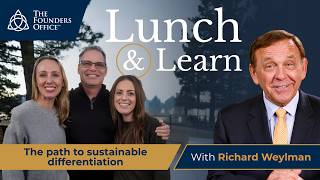
In this Founder’s Office Lunch & Learn, host Dr. Thomas J. Powell moderates a conversation with relationship‑expert Richard Weylman, joined by panelists Katie Powell Hinnitz, Candice Powell, and Jackie Kuiper. The discussion centers on how artificial‑intelligence tools are rapidly democratizing efficiency, making many businesses look alike, and why that threatens traditional sources of competitive advantage. Weylman argues that sustainable differentiation will come from two pillars: (1) mastering relationship skills that create emotional, advocacy‑driven connections, and (2) delivering an elevated experience at every customer touchpoint. He illustrates these ideas with concrete case studies—Freddy’s Steakburger & Custard’s “Freddy’s Way,” Chewy’s automated yet personal pet‑owner outreach, stadium concession redesigns, a South‑Florida restaurant’s charging‑station redesign, and a donut shop’s anniversary‑text program. The panel also explores how to embed this culture through hiring for attitude and effort, codifying rituals and training programs, documenting and trademarking cultural IP, and scaling authenticity with automation. They discuss reaching younger generations, modeling behavior, and ensuring the culture survives post‑exit. Throughout, the conversation blends personal anecdotes (Weylman’s orphan background, Powell’s family ski‑to‑sea trip) with actionable advice for founders seeking long‑term, AI‑resilient growth.
Chapters
Well, happy Wednesday to everyone. I'm so glad to be here with each of you, and we have an amazing team lineup today. Candice told me that this is like The View now, where we have more moderators than we actually have guests joining us today. But of course, you know Candice Powell joining us from the Founder's Office. And Jackie Kuiper, general counsel, member of the Founder's Office, and someone who's new to the team but not new to our Lunch and Learn, has been on the Lunch and Learn a few times. But Katie Powell Hinnitz, or as I also like to say when it rings on my phone, Dr. Katie Powell Hinnitz, is new to the Founder's Office and is getting us systemized and structured because again, where that comes from is helping to lead some of these unicorns, companies that hit billion-dollar valuations. And how does she help the C-suite? Well, we're fortunate to have her join us not just here, here, but also on Lunch and Learn as a moderator today, right?
I know, I feel very blessed to be here. And especially because we have just an exceptional guest.
Well, let's start there because I was down in San Diego, as I think some people may know or saw some of the footage. I was down there with a group on artificial intelligence, and this is some of the leaders in the world. And today, artificial intelligence is making business faster. It's making them more efficient. It's making it easier than ever to automate communication, marketing, customer interactions. And at the same time, it's making businesses look remarkably similar. So what happens when everyone has access to the same tools? That question sits at the heart of today's conversation. Our guest, Richard Weilman, has spent a lifetime studying what causes people to trust, stay loyal, and become advocates for business. Not because he began as an academic or a consultant, but because relationships became essential to his own survival. Richard was orphaned at 6 years old, lived in 19 foster homes, and attended 11 different schools. From an early age, he learned how to connect with people, build trust quickly, and create meaningful relationships under difficult circumstances. Why does that matter? Because the lessons he learned as a child became the foundation for an extraordinary career helping organizations understand the difference between transaction and relationships. Richard saw firsthand the most successful companies were rarely competing on product, They're creating an experience, trust, and loyalty. Something we've come to say here around AI is it's got to be authentic. To the businesses that endure are the ones that create relationships competitors cannot easily copy. Richard has dedicated his career to understanding exactly how that happens. He's a Hall of Fame keynote speaker, bestselling author, and one of the leading voices on customer loyalty. His latest book, 100 Proven Ways to Acquire and Keep Clients for Life, was recognized by Forbes as one of the top business books of 2024. Richard, welcome to the Founder's Office and Lunch and Learn.
Tom, thank you so much. And thanks to all of you from the Founder's Office for this wonderful invitation to spend some time together with you and all your constituents. Thank you.
Well, I'm going to, I'm going to do something that I— it's just going to be hard because I want to jump in all the time on this conversation. You and I just riff off of each other all the way through it. But with that, Katie is the one who invited you on as our guest today. So I'm going to start there. And by the way, she was holding up her book, which my other daughter didn't get. And so now I'm in big trouble. So, we're gonna have to rectify this right away.
Well, I will say too, Richard, I believe that you are giving a very generous offer of the first chapter of this book to our listeners today. So we'll be sure to share that link. I will say, as somebody who has studied customer psychology and is a lifelong learner of this stuff, this book was immensely profound. And I think the reason why is because it's so tactical. I felt like I could read this and better our ability to serve the people we choose to serve in an exponential way. And so thank you, because this has been not just a good read, but a great resource for us. Um, so Richard, I— there's 100 ways that you have identified here. And for the founders, um, who join us on these weekly Lunch and Learns, it's probably a little bit of a tough question for you, but what would be kind of the, the biggest thing you'd want them to know, um, that will help them in kind of a noisy AI market to help them embody the principles that you teach so well?
Wonderful opening question. Foundationally, in every business, doesn't matter if you're running an HVAC, if you're running a law firm, if you're running a software development company, a financial practice, a restaurant. Thomas was right in the very beginning when he said that AI is obviously having an impact, transformational impact on the way business is done, efficiency, effectiveness, et cetera. And I've been very, very, very involved with AI since 2019 with a client in Mumbai, India, when we called it machine learning. So, back in terms of the understanding of process. But what's— what everybody's excited about AI, and at the same time, many people are terrified of AI, and rightly so, because there's a lack of understanding. But there is no question it's going to build effectiveness and efficiency, and it should help with margins in the business. But As Thomas pointed out, very rightly so, that the challenge is that because everyone is going to have access, it has become democratized. And as a relay, as a result of that, it's going to be ubiquitous. And what that really means is all of, or many of the things that, shall we say, traditionally, we'll use that word today, sets companies and individuals apart in the marketplace are going to be flattened. And that's going to go away, that traditional Sometimes it's intellectual capacity, sometimes it's the way we service or do things. Many, much of this is going to, shall we say, become very commoditized because AI itself will become a commodity. It's going to be available in the marketplace for everyone. So then the question becomes, what do we do to have sustainable differentiation? In other words, if all the things that currently set us apart, if any of those things are going to, shall we say, no longer set us apart, then I believe as business owners, founders, as executives, as leaders, we have to make a decision about what's next. And if we're not thinking about what's next, and I'm not talking about next quarter, I think as a leader, we have to step back and say, and I have the privilege of working with many different companies, and I have people that want to talk to about their next, let's talk about the, how we're going to finish the next quarter. Okay, well, I'd like to talk about how we're going to finish 2040. Can we really be focused on like 2030 or '40? That's where I want to be focused on 2040. Let's get, let's get over there for a few minutes and to help us strategically think ahead. And so if we look forward to 2030 and '40, as an example, there's two things that are really going to help us with sustainable differentiation. And that is two fundamental set of business. First is our ability to master relationship skills, the ability to connect with people at a high level, not just in terms of transaction, but emotionally engage people at a level where they really feel like they're part of something larger than themselves and they relate to people. If you look at the word relationship, what is the root word? Relate. If you took Latin, you get a sense of, you know, when you talk about curate, well, what does curate mean? What it means is care of. So you want to take care of your relationships you have in the business because that's where lifetime value, I call it LTV, really matters, particularly if you're going to sell a business someday. LTV is what matters. It's, it's not EBITDA, it's LTV. That's what people really want to buy today. As an investor myself. So relationship skills are important and I can give you many, many, many examples and I've had the privilege of seeing firsthand and you have as well. And then the second thing is, is the second thing that's going to set you apart is a sustainable business. And as a founder, as an executive with your team, is the ability to elevate the experience at every single touchpoint. That you have with customers, prospects, individuals in the marketplace. If you think about social media today and everybody, you know, well, we need to be on Instagram, we need to be on X, let's put the brakes on for a minute. What are people sharing on social media? They're only sharing one thing, their experience. Yes. They share their, let me tell you about my experience in that restaurant. Let me tell you about my experience with, and that's what people share every day, all day. An influencer out there is one of them taking pictures of everything. That they do to share the experience that they have. Well, if we step back as marketers, not merchandisers, merchandisers focus on product, but marketers focus on people. And my whole life has been focused on let's look at these people and what are the people in a stucco house thinking? That's what I want to know. If I can figure out what the people in a stucco house are thinking, and that's going to help us be more effective strategically. And what they're thinking is, I want to go somewhere where I'm going to have a great experience. I'm going to go to a restaurant, the food's good, but if it's so noisy we can't have a conversation, Mr. Powell, then you know what? The next time Katie says, let's go back to that restaurant, I'm going to say, you know, we could, but God, we can't even hear ourselves. And you know what? You're right. Let's go somewhere else. So the realities are that there are two things that are going to be sustainable in terms of differentiation, our ability to build relationships and master them. Give you many, many examples. And our ability to really deliver an elevated touchpoint experience every single touchpoint with the individuals. That's what's going to set us apart. We're already seeing it in the marketplace. There are many examples now of— we see it politically, we see it in terms of almost every industry now, that that ability to build relationships and elevate the experience at every touchpoint is crucial. Long answer, Katie, but I hope that was helpful.
It was so helpful. Thank you.
You know, I'm going to jump in there. Just, I said I was going to let them talk, but of course they can all interrupt me. But I just want to say, because we, this last weekend with my family, had this most amazing experience. And it reminds me of the book Good to Great, which of course, you know, we all read back in the, what, late '80s, early '90s when it came out. And one of the things that I'd always tried to perpetuate in our companies and in our family was you get the right people on the bus and then you get them in the right seats on the bus. Right. And that is critical. And then another part of that is get out of their way, but In that, it also works in our family. So, we go on this trip. It is a grueling drive up to the Canada border, but we make it fun. Now, by we, I actually mean my family all make it fun and I get to go along, which is super cool experience for me. Then, because of my marvelous crazy wife, she skis up a hill, then I climb up the next hill and ski down it, then the brother runs down the hill, and we're talking for 96 miles. Another brother goes and he does the bike ride, right? Then these two girls go canoeing down for 3 hours, and then the next son does the ride through the town, and the last son-in-law rides or rows across the thing. It's called Ski to Sea. It's been around for 52 years. Why has it been around for 52 years? Because of the experience, the shared experience. It is such an authentic experience. And for me, it was just amazing because it just proved one more time we had so much fun. Everybody's blistered and hurting and whatever, hungry and, you know, tired. But it doesn't matter that everybody had a great time. And that's what I think business is. What you're getting at is being able to share that at whatever level it is. Even things don't have to go right. Things just have to be that whole authentic experience.
You are absolutely right on the screws. And that's a real-life story of what happens when people have a time of enjoyment together. You know, people today, I think that we miss sometimes as leaders and founders and as executives, that happiness is not just derived from the product or the service, it's from the experience.
Oh yeah.
Or the emotional connection. So people talk to me all the time, well, Richard, you know, we'd like to, we have a, well, I'll just keep, I won't mention the company of course, but I had a company last year that they do satisfaction scoring with their clients and they're excited about it. You know, we send out these surveys and I talked to the CEO, he said, God, we got the highest satisfaction scores in history. And I said, well, just remember, satisfied clients are loyalty neutral. He's like, what? I said, well, satisfied clients are loyalty neutral. Your goal should not be satisfied clients. Your goal should be delighted advocates, be basically champions for your brand. Yep. Well, he said, you know, I read the book and you're right. I mean, there's some things we could do, but we're really good. I mean, we have record satisfaction scores. And then he called me in March and he said, listen, he said, I know I told you we were good, he said, but we lost 17,000 households last year. He could barely speak. He said, I don't even know what to do. I said, well, the first thing we have to do is realize that our goal is not to have satisfied clients. It's rather to have what? Delighted advocates.
Advocates.
And we spent many months now working on delighted advocacy. I don't want to do satisfaction. I want to have brand champions. If you— in fact, I speak on this, as you know, Thomas. So that's something I speak about. But I think that's where sustainable differentiation— I'll give you— may I give you an example, like a case study? Would that be helpful?
Please. Can I ask a question in there just to see if I'm even tracking on the thing? Because one of the things that we have talked about is someone satisfied because they come back. Someone is an advocate because they refer others to use your service. Well, Well said. That's what you need to measure is really that advocacy of the referral partners. And again, one of the strengths Candice has had in past businesses we've built to billion-dollar levels was she was able to find the advocates and then just make sure that they were so well taken care of and everybody that ever came in, but to their individual needs. And that has been the secret of building multiple businesses that we've had in the past is that advocacy of that side. But that's the understanding of advocacy instead of understanding just the client in front of us who's using the service.
That's exactly right, brother. And what that does, it engages people at a deep emotional level. And let's back up and go back 40 years. Well, you know, we got to build a business by word of mouth. Well, that's exactly what we're talking about here, except today it's all over the internet that you hear about people going on Shark Tank and other, and you know, I have clients and friends there and on Shark Tank. And, you know, they always laugh about it. People come on here and whether we invest in them or whether we don't, it goes virtual. Success. Yeah. End up doing millions of dollars with the business perhaps primarily because of what the positive word of mouth that that imprint has upon people. And it's exactly the same thing. So it's like Freddy's Steakburger and Custard started by an older gentleman in Wichita, fast food chain, not a big one. Long story short, they reached out to me. I met with the board and I did an audit of some of their stores. And I said, here's some things I would change to elevate the experience here. We're going to start a fan club and we're going to get involved there. And you have a thing called a Freddy's Way. We're going to expand that so that every employee every day has— we're going to do a virtual discussion. And it's so when people come into work to work their shift, there's going to— today we're going to smile and be friendly. Everybody got it? What are we going to be? We're going to smile and be friendly. Great. Today everybody's going to get a free, what, little bit of custard. Everybody got it? Free custard. Don't forget. So we built this sense of, shall we say, things that we wanted to emphasize every day called the Freddy's Way. All right. Well, when I audited the stores, all the chairs were bolted down. It was booth. And I told the board, I said, we got to tear out half these booths. And put in movable chairs. And they're like, do what now? I said, we're going to tear out, because I sat there on Wednesday night and watched when I audited these stores. And the Girl Scouts come in and the Bible study comes in and the people from church come in and the Boy Scouts and the baseball team, they're sitting on booths yelling across the booth to each other. If you took and gave the chairs so the chairs would move, they could slide over to the corners and have their own little groups and they could have a sense of community inside the store. Well, they did it. They went in, we removed them, about half of them, left them in.
A little different.
They just sold the company for $2.7 billion, Freddy's Steakburger and Custard, because we just won the National Restaurant Award for the best fast casual in the United States. We crushed everybody, Smashburger, Culver's, everybody. Why? Number one reason went back, the sense of community.
Crazy. So different of value. You know, I was reading something from Marc Andreessen. Not too long ago with NY Combinator, and they said, you know, we will invest in anybody that can show us how they uniquely keep and retain clients and the people that do just become advocates. And what he left out of there was the authenticity, because it seemed like it was becoming, how do you make this a contrite, contrived mechanism? And it's like, no, that's not what you were talking about, was they were allowing that organic piece. Now, we have a lot of founders that are joining us on here, and many of them watch after the fact, but I'd love to engage some questions from them because they're starting up companies, different things that they're doing. So if they have questions also, we'll be watching for that as they come through. But to a founder, you're hearing that everything— and boy, you and I remember this, nobody else on our panel right now really remembers this, but let's go back to 1995. Okay. And we were still doing the dial-up where you were not quite putting your phone down on the modem, but you were plugging it at least into the computer, right, directly. And it would take forever to get through there, right? But remember that shopping and movies and everything were gonna be on the internet. And it's the furthest thing from the truth. Well, we're in that same revolution right now where everything's gonna be AI. And the reality is that's just not true. So if you're in an AI business or centered business and somebody can duplicate your technology, 'cause once it gets out there, you can write code to duplicate it. How do you differentiate yourself? Whatever it is, pick one. Let's talk through it.
What would be one? It makes no difference what kind of business you're in. The truth of the matter is, yes, agreed, it's going to, shall we say, commoditize a great, a large part of business, the efficiency, effectiveness, the service side, etc., the ordering. I mean, we can make a long list here. And some people are resistant, but I can remember the first cell phone I had when it was a radio phone in your car. It was about this big. Big and it was too— one hit, you had to take your hands off the wheel because it was so heavy. And, you know, you had to be careful what you said because it would sometimes would skip over to somebody's TV set if you're going through that town, it was on the same radio frequency. So I had several of those calls and learned that lesson hard. But the point is, then cell phones come out and people are like, no, no, no. But look, today everybody walks around with a computer in their hands. So it's the same with AI. It's going to commoditize a great deal of the business world. But what's going to set us apart is that ability to elevate the experience and to really, let me summarize it this way, and build relationships. Today, if you're going to build a highly successful business and retain, first acquire and second retain clients, you've got to personalize and humanize every single interaction. That's where the magic is today. Look at Chewy, perfect example. I was speaking in in Nashville at the Opryland Hotel, a few thousand people, and I was speaking for about 45 minutes on creating clients into champions. And I mentioned, I said, I happened to see online this morning that this woman posted about her cat, and her cat had died, and she had sent, she had a standing order with Chewy for cat food and the cat food just came. And so she called Chewy and said, I want to return this cat food because my cat has died. And Chewy said, absolutely not. You cannot return that cat food. You must donate it to the shelter. And the audience goes, woo-hoo. And I said, yeah, but that's not the best part. I said, 3 days later, she got a bouquet of flowers and a card, a condolence card from Chewy. And at that instant, Thomas, this woman stood up in the middle of the audience, held up her phone and said, That was my cat. What are the chances of that happening? I mean, I mean, you know, 20— I know it was 20,000 people. It was like— and I was like that. She said, yes, that was my cat. And look, she said, already I got 700 likes.
Well, isn't that— that's, that's the whole story of authenticity there beyond your own story, right?
I mean, I just stopped and said, ladies and gentlemen, what does this tell us? The whole room starts chanting, we're switching to Chewy, we're switching. And then people got in line to tell me their Chewy story. That's crazy. When this, my latest book came out, I had a book launch party and this individual who owned a restaurant in South Florida came up to me and he said, Richard, I'm right in the middle of the financial district. There's like 9 restaurants in our office pooling area. And he said, I do, I'm the furthest from the big towers where all these financial people work. And he said, you know, I'm only about half full, bringing lunch. And these other places are pretty full. And I said, well, what do people do when they come in for lunch? He said, well, what do you mean? I said, well, what do they do when they come in for lunch? He said, well, they eat lunch. I said, no, no, what are they doing when they come in for lunch? He said, what do you mean? They're having lunch. I said, okay, let's start over. When they come in, what is the thing that you observe them doing? He said, well, they come in, the first thing they do is order and then they're on their phones. I said, I said, that's your answer. He looked at me, what? Should I give them phones? I said, no. I said, tell me about how your restaurant's laid out. So he drew it out and I said, let's put a power cord all the way around to every booth and run stanchions. So when people come in, your assistants, your waitresses and waiters come up with a basket with a red cord on it with a charging device, say, would you like to charge your phone? He was like, oh my God. Anyway, I got an email from him 3 or 4 weeks later. He said, oh my God, we have a line.
That's amazing.
It's so simple, paying attention things.
Mm-hmm.
No kidding, they're having lunch. That's not the question.
I mean, the question— that's what they came in for. That's not their experience. I had an observation. It's so funny you mentioned this because I bet a lot of us have these stories. And so I'm going to ask this kind of long-winded question, but some of that personal touch— Chewy's a great example of one that has maintained the personal touch even as they've expanded. But we have a local grocery store, family— it was family-owned for forever, um, and it was not that— it's never been the cheapest grocery store, but it's always been the experience. Well, they sold in the last handful of years and the experience has changed drastically. And my friend actually went this morning and she messaged— we were chatting and she's like, God, it was awful. Like, the experience was awful there. She actually called the manager to just be like, you— I want to love the story. Like, you have a training opportunity here. Like, multiple employees actively ignored me. And she was like, the response from the manager was exactly what you would expect based on the employees, like didn't care. And now they're part of a really large chain, right? And so, what I'm saying is, is we see how much emphasis founders especially put into that customer care because when you're the founder, every single customer is so important to you and you cherish them no matter how big you get as the founder, you really care. And it seems like it can get lost. Lost in that next— the thing that was so important to the value of your organization can get lost, and some of the identity of the organization can shift. How can our founders listening today better embed, or what questions can they be asking of themselves, of their team, of their customers, to better embed and ingrain that into their organization as like practice, because what Chewy did is a process. That wasn't like an employee felt bad and they took it upon themselves. That is a process. So it was beyond just doing what is right, and they implemented that into the actual business. How can our founders do that? Because that is value-add to their organization.
Brilliant question. And it's an answer people don't think— the sad truth, the sad truth is, Candice, that many people that build businesses don't think about this until after the business has been sold and the very tragedy that you just articulated occurs. And having the privilege of having built and sold several businesses,. And I have a dentist who just sold his practice for a great deal of money. And I worked with him and we really, this is really an issue of culture. We developed a culture at Freddy's. We developed a culture called the Freddy's Way. When Freddy's got sold, the owners had to agree that the Freddy's Way was going to be continued to be institutionalized.
Love that.
My dentist sold a massive practice. It was in writing in the document, you must adhere to the culture that we have created. And we gave the tenets of that culture. I refer another friend that I worked with that had a printing company. It was crazy story. 18 years old, gets out of high school, works for a printer, guy's in his 60s, and he decides he's going to buy the guy out because the guy's going to sell the business. And so he talks the guy into selling him and out of, and then you know how that all works. And so he sells the company to this kid who quadruples the size of it. I mean, it's exploded. Well, then he got into another part of business making signs. So he decided he was gonna sell the printing business. But same thing, he came to me. I said, Mike, you built a great culture. And we have various things that every day gets recited by the staff in terms of customer interaction. That has to be codified in a contract. That's exactly what he did.. And now the guy that bought it, actually it was a company that bought it, has now grown it again by 2x by adhering to that. So here's the, here's the bottom line to your point though. The bottom line is that today an awful lot of people, there's plenty of people that we get to hire. And the mistake that I've made as a founder of several companies and had the privilege of building and selling, but I learned the hard way. Is who you hire. A lot of the— for the first couple of companies I built, I always hired for skill set. Yeah, we're going to get the skill. And well, he's not exactly fits how we do things, but it's okay, we'll make it work. Make it work. What I finally figured out was you hire for two things, actually three, but there are two things: attitude and effort.
Totally.
I want to hire attitude and effort. If I got somebody with a good positive attitude that's willing to put in the effort demonstrated by all the other things they've done in life, maybe it's how they did in school, whatever it might be, I'm going to hire that person. But then there's one more thing. And I mentioned this at Freddy's because they wanted to expand the franchise. We're going to get franchisees. And I'm like, no, we're not. We got all these managers that are running your stores that you own. Let's buy them a store, build them a store, let them own it, and we can duplicate the culture.
Oh, absolutely.
Absolutely. Well, of course we did, and it exploded. But here's the key thing. And they said, how do we select? I said, don't ever forget, hire attitude and effort. And one thing you can never ever forget, if you want to build a culture around the customer that's relationship-oriented, experience-oriented, you can't train nice.
Absolutely. Absolutely. And I— you hit it on the head. The manager is So important because then they're hiring. And I, I think we start off LinkedIn profiles and job app, job, you know, ads are probably the worst offenders because we're starting off with, to me, some of the least interesting information. It's like your credentials, basically. How many letters do you have after your name? And to me, that's That's actually some of the worst people I have ever hired.
Actually, Candice, tell Richard how you and Jackie specifically go through and what is the one thing that you start with when people— what's the one question they have to answer when they're getting interviewed?
Oh, I mean, I ask for their bloody story. Like, when did you have something horrible happen? You made a terrible call, and I don't want this to turn into a 'Uh, it's a negative, but really it's a positive.' I'm like, 'No, no, no, like, it needs to be bloody, and you were questioning all your life choices.' Not because I'm sitting here like looking for some juicy, gory story, but I want to know that you got yourself back. Like, eventually it didn't have to turn out well, it could have been horrible, but you got up and you still went the next day and tried again at something new because That's resilience. You have to be resilient.
And so, yeah. And Jackie, we look at that because, Richard, I know you're an investor as well. We met through basically somebody who said we'd both connect up, and that person is probably one of the best connectors I know. But Jackie, when we're doing due diligence, we don't want to just know the good. We want to know the bad too, right?
Yeah, all of it. It's really interesting, Richard. I'm taking this a slightly different direction. So much of what you said, without saying it, to me points to youth. Like you said, you can't train an attitude, right? You— in my mind, you can't also really train an adult. And you gave that story about changing an entire business just because you allowed the kids to move their chairs and create community. And I feel like what you learned in your youth shaped who you are and what you have shared with the world today. So if we're, if we're bringing this all back to the need for human connection, as the baseline of all of this, how do we better reach the youth to like reestablish this? We know youth are like, they're on their screens, you know, they're, they're, they're not going to know a world without AI. So how do we get back into that really like human social connection element with the people coming up that are going to be the next founders, the next leaders, the next entrepreneurs, the next business owners?
Well, it's a great question. And I think that from my perspective, the most important thing is, I think, as founders, as leaders, as people who have been down the road and understand the importance of relationships, let's put it that way, regardless of what your role is, is to be involved in a community where you're helping to develop the skill set of younger people. Now, people say, well, how can I do that? Volunteer to go to the school and be willing to speak. I've done it many, many, many times. Where I go to the school and I'll speak on, and I mean, I've spoken at Anderson, I've spoken at Wharton, I've spoken at high schools, and I don't need a fee. I just want to go and share the experience of what it's like to be number one resilient. You know, I mean, I was an orphan and my parents died when I was 5. My dad died when I was 6. I lived in 19 foster homes. I was almost killed in an auto accident. I survived cancer. I mean, you know, I was in the military and went through all of that, but, It's not what happens to you, it's what you do about it and the next step you take. So then I try to relate it. Also, I do a lot of work with high school seniors that are going into sports, particularly that are going to like the basketball combine, etc. I've spoken there many times to explain to them that they may not make it to the NBA or in some cases the NFL, but what you have to do is to develop the skills to connect with people. And occasionally, very occasionally, I'll have, well, I've had a couple of companies that have had me speak to their employees about how to help their children build relationships. And everybody said, well, we need to tell them this and we need to tell them. I was like, no, you don't need to tell them anything. What you need to do is demonstrate, not talk-a-straight. Okay, so in other words, if you're telling them don't spend so much time on your phone or so much time on TV. Do something active with your children so they understand the relationship skills. Sponsor things at your home where children can come and interact with other children and not on their phones. In fact, I had dinner with a couple last night who said, you know, the kids are on the phone all the time. And I said, why do you think that is? Well, they really enjoy it. And I said, well, are you on your phone a lot? And they had each during dinner, hold on a second, hold on. I watched you pick up your phone. He said, well, I've got this deal I'm working. I said, they have a deal working too. It's called TikTok. He sat there for a minute and he said, oh my God, he said, I keep telling them to stay off their phone while I'm on my phone, or they'll come and ask me to help with homework and I'll say, hold on a minute, because I'm on my phone. And then I get mad because they're on. I said, well, there's your answer.
So Richard, on that point, yeah, modeling what we expect to see. And I think to the grocery store experience this morning, right? And me and my friend look at it going, our first customer service jobs, I was basing my— how I served clients based off of how I saw clients served. What can we expect the next generation to think of as a work ethic serving of customers when what is being modeled across the general— like, I think of airplanes are a great example. The way the airline experience was when you guys were flying is wildly different than how it is when we fly now, right? So I don't have a memory of this really luxurious, both from an airline perspective and passengers. Passengers treated it like a really luxury experience. Like, we certainly weren't getting on airplanes in our sweatpants and taking our shoes and socks off like some people. So How can a younger generation even know in this AI world how to deliver great customer service? How can our founders sitting on this phone call right now memorialize today what is expected in great customer service if the next generation has very few opportunities to truly experience what great service is?
Another great question because— but I want to reset it. May I do that? Please. What I would suggest and what I've done with many, many, many, many, well, Minnesota Vikings, good example. Okay. They build a new stadium and they call me and said, we want, you know, so would you come up and audit the stadium and give us some suggestions? So I walked through the stadium and just made list after list after list after list. And Kevin, who is, who's now at the Chicago Bears, who I'll be working with, they're going to build a new stadium, probably not in Chicago, but that's another topic. But in any case, he was the COO at the time of the, when I worked with the Vikings. And he was COO there before he became CEO of the Bears. And 2,500 part-time employees, many of them young, and, you know, serving concessions. And I had, and I told the owners, I said, you're going to have to buy 2,300 more TVs. They were like, do what now? I said, we're going to buy 2,300 more TVs. That's what I've counted as I've walked through the building. 'Why would we do that?' I said, 'Because nobody wants to go to the men's and ladies' room and miss the game.' And I always stand at the checkout line. And I said, 'And we're going to have these people who are running security stop pointing people to the men's and ladies' room, but open their hand.' I said, 'And what we're going to do on the fan book page, we're going to stop signing emails as best because that's the number one most hated by people. We're going to say warm regards or kind regards, which is the two most light.' So we're gonna communicate with our fans with warm regards and kind regards and not sincerely yours, which is institutional. I gave them a whole list and I said, we're gonna widen the parking spaces and double the price and you'll sell them out in a week. And they took them 10 days, but they sold them all. So because they were too narrow and you bang your doors on your Ferrari. So just a little bit. So I mean, you know, but the point is that in the end when we sat down with the vendors about, you know, oh, we're hiring all these high school kids, great. I said, how do you train them? Well, we just bring them and show them how to run the register and how to be able to take an order. I said, well, then we're not gonna drive revenue. So what we did is developed an educational program to teach every single person. We did it with Chick-fil-A. Truett Cathy was a dear friend of mine when he founded and I worked with him. And I think we would all agree that Chick-fil-A is hiring a lot of people outta high school, et cetera, and it's please, thank you, and my pleasure, and you've got a smile every day. And if you like extra extra pickles, then they recognize you, you're getting extra pickles without having to ask. So that's what we brought to them. And we went from 17th in NFL revenue to 7th in one year with a losing team, which is $380 million, which was not my fee. But boy, it was a tremendous home run for them. So they were happy about that. But the point being that the answer to the question is, is the fundamental training. A good example is public grocery store owned by a family here. It's public now, public meaning, you know, the IPO. But their training program is every— you check out, I don't care if you got one little bag, they're going to ask you, 'May we take it out to your car for you?' Uh, they're going to do— if you're— they have a person in the parking lot, so when you wheel up to your car and you're unloading all your groceries, they don't worry about whether you put your cart away. They run right up, 'Let me get that for you, and they put it away for you. All these things are all young people, many of them are still in high school, that they put them through a several-week training program. So the answer, Candace, is the training. I, you know, Ritz-Carlton, I look at them, what we do there. We have the gather room. Every shift, whoever the shift manager and everybody on that ship gets in the gather room, and today we're going to have a conversation about who's in-house and what is the protocols that we're going to be following, what we're going to highlight. And we're, we're gonna greet guests in the hallway and we're gonna say, please, thank you, my pleasure again, and good morning, good afternoon, good evening. We're gonna greet people. So the point is you can train them. The problem is what we train them is on is the transaction, the product, the platform, and the service. But we never teach them the culture we want. If you teach them the fundamentals of the culture, like we do at Ritz, at Four Seasons, we do at Four Seasons. I mean, I don't need to give you a list here, but all the companies I've had the privilege of working with, we first say, what is the culture going to be? Then we build training stepping blocks so that people, what, learn how to deliver the culture. And as a part of that, they become, what, comprehensive, and they become masters of building relationships and delivering an elevated experience.
Show them, let them. Reinforce it.
Go ahead, Jackie.
Pardon? I said show them, then let them, and then like positive reinforcement.
Allow them to do things. You're right. Every shift we have one point in like the Freddy's way or in the Monarch way or in the Viking or whatever it is. One thing that is in our culture, today we're going to reinforce this. Today we're going to smile and be friendly. Okay. What are we going to do? Today we're going to make sure everybody gets greeted with a hi or a howdy. I have one client that they want to teach everybody howdy. What are we going to do today? It's going to be howdy. Well, they're in Texas, so it's a big deal to them. And guess what? What do people do when you come in here? They say howdy. They go howdy. Now the customers are coming in, howdy. So what's happening is you're inculcating that into people. At Chick-fil-A, when you drive up to Chick-fil-A with the double lines and all the things they're doing there, you always have these young high school kids for the most part standing with a clipboard, you give me your order. And when I wrote this latest book, Katie, that you have, Candace, I'll send you one. I don't want to be on the wrong side of the family here. But what was really, I was, I talked to anyway, Dan, long story short, I wanted to interview people in line at Chick-fil-A. And I just said, I want to find out what they say. Well, they're not here for the chicken sandwich. I said, I know, but I want to find out what they say. And so I would interview, so I hear, oh, the food is really good. And I said, why are you really here? Well, they're so friendly, they're so kind, they always say please. I said, and they kept talking about the experience and it's very quick and they're always so polite and their order's always right and then et cetera. But then I got to this one car and I asked the woman at the driver's seat and I said, so why are you here at Chick-fil-A? Oh, the food is really good and they're so friendly, et cetera. And the little girl in the back seat seat, she jumps up and gets her head between the headrest and the car post. And she said, and they always recognize my car and bring me extra pickles. And that is why Chick-fil-A—
Bonus points.
And it sticks with them forever. She will remember that and share that story with lots of other people, which again becomes that advocacy and that authenticity.
Well, and from a valuation standpoint, you were really clear on the document it, document the culture, document the training, name it. I love the Freddy's way. Name it, get this IP'd, and now get this trademarked, get this culture actually trademarked. And for our founders listening, this now has become a value add, not only in the customer retention space, but also in the value for your business when it does become time to sell. And it makes it so that, you know, I— the family here that's going into their old grocery store, that every single one of them, the family, it was the rule, the family had to work checkers at the grocery store here. And I can tell you right now, my first thought was It has to be so hard for them to walk into their old store and see the terrible customer service that their store that they worked so hard as a family to build now has after they sold. And when you document and you memorialize that culture and it is now considered the way of your business, you will recognize your business when it outlives you, when it, when it goes beyond what you've built and sells. So I think that's so valuable.
Well, you're exactly right. And what you end up selling is your way of doing business. Mm-hmm. That's what people end up buying.
Yeah.
And Richard, you know, our children, because they will have good customer service skills, right?
And, and that is value.
That, that customer base just keeps growing and growing and growing. Yeah. And it's all based around the culture and the two fundamentals. You've got to master relationship skills. You can teach those. And you've got to codify and give people permission to deliver an elevated experience. After this happened with Chewy, I did a lot of work with Chewy and I found out that every single customer service rep has full authority, doesn't have to check with anybody. If your pet dies or something catastrophic occurs, or if you've got some pets you're proud of and you send them pictures, they're going to have a painting made and sent to you. It's a department they have in the firm. To do what? To build a relationship with who? With their customer base who have become loyal advocates on their behalf.
You know, when I read that book, that excerpt in your book, Richard, I too have a Chewy story. Chewy will have my business for life because they send my dog a birthday card every year. And it just, I know it's automated, but it is that extra little moment that makes me feel that they care more. Than anybody else providing me this service. And that is really amazing.
What's great about it, it's automated. That's beautiful about it. It's part of their culture.
But just because it's automated doesn't mean it's not important.
Nobody meant—
pardon? Yes, just because something is automated doesn't mean it's not important, because I can tell you the way it probably started for Chewy back in the very early days was not automated. And as they scaled, they had to— what they— you got to honor this. When we automate things, it's, it's something we didn't let go by the wayside. It's something we were like, this is still such an important part of our culture, but we're growing so big. How can we still honor this and scale? And I think that's beautiful. I love when something is automated because it meant they kept a really important part of their culture and made sure that it scaled with them and didn't get forgotten.
And I think— There's two things I'll mention to you. I was privileged when I was younger that one of my, I won't give you the whole backstory, but suffice to say, I was involved with Porsche Audi and we built the third large, very, very successful operation there at a Porsche Audi dealership. And I was recruited by Rolls-Royce to take over a service stop between New York and Chicago.. And there I built the third largest Rolls-Royce dealership network in the United States in a town of 1,800 people in the middle of nowhere. I did it by marketing cars all over the country. But the way I really did it is that I would, we did a lot of different things, but one thing that really set us apart and the only way I could automate it, back in the day, we had punch cards. And Thomas, you might remember those, would you sort them out and you have a punch, punch card reader. It was like old. Oh yeah. Before we really even had—
Candace actually made wreaths out of punch cards because I brought them home from Wells Fargo Bank at the time when the data center came around and she made these beautiful wreaths out of them. Yeah.
Little girl. Okay. Same. Okay. So you're familiar with the punch card. But what I did is I kept track of when every one of my customers started their business and the day they bought their car. So every year on their business anniversary, I would send them a congratulations, another successful year in business. I would send every year congratulations, another successful year as a Rolls-Royce owner. All my widows got a dozen red roses on Valentine's Day. I wrote down the date that their husband or their wife died and they got a card from me. And that's, and I, in Palm Beach, I mean, I would go to Palm Beach, check in a Colony Hotel. I had days where people come in and I'd sit down in the suite and I would sell 4 or 5 Rolls-Royce purchases that day because they would heard about the fact that you really care about us, Richard, and you take care of. And we were upstate New York shipping cars down. And there was a dealer in Palm Beach who was, let's just say, pretty full of himself. So we did very well. In fact, he eventually went out of business. So it was, I felt really good about that, by the way. But in any case, but it was all about the real, and we can do this as a founder today. The day I do business with you, is that in your database right now? So every time you're sending me a happy anniversary. I can tell you right now, August 4th, 2019, I bought a donut from a place here in Sarasota, Florida. I have a home here, as Thomas says, you all know, and another one in Honolulu, halfway to Asia, because I do a lot of work in Asia too. But long story short, there's a place here called Paibo Donuts. Donuts, right next to the police station. Great, great.
That's so funny.
Tagline, when she came to me, I said, your tagline ought to be arrestingly good donuts. So that's what they got it. And, and it's, they open at 5:30 in the morning, and if you don't get there by like 7:30 or 8, they're sold out. Long story short, I bought my first donut there August 4th, 2019. Now I'm not a donut guy, but I can tell you, how do I know I bought it August 4th, 2019? Because every August April 4th, I get a congratulations squad member. Wow. $5 off your next order of donuts. And I've told people this story. I wrote about it. And I can tell you, I have people all over the country that have come to Sarasota for meetings, Ritz-Carlton, other places. They've gone to Five-O Donuts and they're like, Richard, every year I get the same text.
I love that.
Richard, what does that cost?
Nothing. Yes.
So this is a 40-minute show. We're already 10 minutes after, and we could probably take 2 or 3 more hours without a doubt. I— we're keeping your time, but I want to make sure, Angela, and pull up because you have made this generous offer to read the first chapter in 100 Proven Ways to Acquire and Keep Clients for Life. You can actually even get this before Candice gets it. Katie's already got her copy, but— so, Richard, there's a little backstory on that. You know, Voss, who writes about negotiation, right?
Yeah.
So, so we're doing some business together and different things. And I remember that Candace is a super fan of him. And so I bring her home a signed copy. Jackie gets a signed copy. I've got a signed copy, and Katie's about ready to rip my throat out. So, so now it's become this thing. So you are now the, the, the new benefit of that. But for everybody out there, get the first chapter of his book for free, his website. I got to tell you, following you on YouTube and those now Shorts that are out there, it's a great way to start the day and just be put into a, into just a morning positive. I've got you, Jim Rohn, Earl Nightingale on tape. And, you know, these are the, these are the masters that I listen to. So it's awesome.
Yeah. And I've just done an— I have a, I don't know, about 30 or 40 of them now on my website without any ads, YouTube ads or anything. Just go to the website and click on videos and all vignettes are there. We just put up a bunch more.
Oh, that's awesome. Well, you, you are absolutely amazing. I've also got to take this point to, to mention, uh, right after our recording, uh, Jackie and, and Katie and Candace are heading off to do the next recording of WTF Women Talk Finance. It is the most amazing show to watch and be able to empower, uh, our female financiers and in this workplace as it's continuing to grow. And what an opportunity. And, you know, for me, one of the, one of the saving graces for me is I had 7 older sisters and 3 of them super close to, and I was beat into submission early so that when I went into a profession, I had no bias against anybody. I wanted to find the most talented people. And what I have continually found in many cases, it's always the women that are way more talented than anybody else. So it makes it really super simple to when you don't have, have that thought out there. But join them on Women Talk Finance. I don't know who your guest— well, your guest today is Katie. Yeah, is that right?
Yes, it is.
Wow.
Okay, Dr. Katie Powell Hinnitz.
Dr. Katie Powell Hinnitz.
We're not shorting anything.
Dr. Katherine Ann.
Yes.
Oh boy, I feel like I'm in trouble, but very honored. Honored to be on your podcast, ladies. I'm so excited for the conversation. And Richard, thank you so much for joining us today. I have to say, one of the themes for this conversation was modeling the behavior that you want for your customers. And I have to say, Richard, you are an exemplary model. Like, I feel like I am better equipped to go do right by our clients just learning from you. So thank you for all that you've shared with us today.
Thank you. It's a real blessing to be with you. I'm honored to be a part of this and what you all are doing at the Founder's Office and just the approach that you're taking to really help people achieve their true potential and help these founders really be on a foundation. You know, build your business on a rock and, you know, no matter what the storms come and you can be resilient, you'll bounce back. Just stay focused on the customer and try to see things from their point of view and the experience, their point of view. And that's what you're doing at the Founder's Office. So I'm just proud to know you. Most importantly, I'm grateful for this opportunity, and I want to thank you all.
Oh, Richard, it has been so our pleasure. And you know, one of the things we say here often is, is founders always exit. It's 100% assured. It's just whether it's going to be on their choice or on the global choice, the world's choice, God's choice. However it goes, they're going to exit. And what you talked about today was systemizing that authenticity as well as part of it. So when you can make it Freddy's way, and it becomes the process. So it's not just the founder who handles the top clients, it's actually anybody who handles a client is empowered to do that. It doesn't matter what AI does, you will always be critically important to the show.
And I'll just say this to you in the closing on your exact point here about systematization. Uh, many years ago, I was invited to a secret sect based in northern Japan, and, um, The entire military is run by 18, 19, 20, 22-year-olds. It was amazing. The air base commander was 25 and he was quite a young general. And I met— they had their E-6Bs. These are the aircraft that jam all of the electronics. And he said, I want you to meet our lead technician. So I met him and I said, so how long have you been? He said, too long. He said, I'm out of here in 4 days. I'm getting out of the military. So I turned to the commander. I said, well, what are you going to do? He said, oh, no problem. And he turned to the kid's name was Doyle. He said, right, Doyle? Doyle said, yeah, no problem. Just because I'm getting out. He said, we got systems. As long as you got systems, you got no problems. He said, of course, if we didn't have systems, we'd have nothing but problems. There is a great point.
That is so true. Well, thank you everyone for joining us this week on Lunch and Learn. Look forward to seeing you guys next week. And Richard, great travels. I know you're all over the world. And really a thank you to you because you do share just this powerful, powerful message that has been timeless and continues to be timeless and will forever be timeless in how we treat others. So thank you again. And it's such a pleasure to become friends with you and get to know you. Thank you very much.
My pleasure very much. Y'all take care. Take care.
Bye, Richard.
More from Dr.

The Business You Built May Not Be the Business You Own | Founder’s Office™ Lunch & Learn



Your Business Isn't Worth What You Think It Is | Founder’s Office™ Lunch & Learn


Complexity Is Quietly Destroying Enterprise Value | Founder’s Office™ Lunch & Learn


Simplifying The Complexity of IP | With Tony D'Angelo | Founder’s Office™ Lunch & Learn


