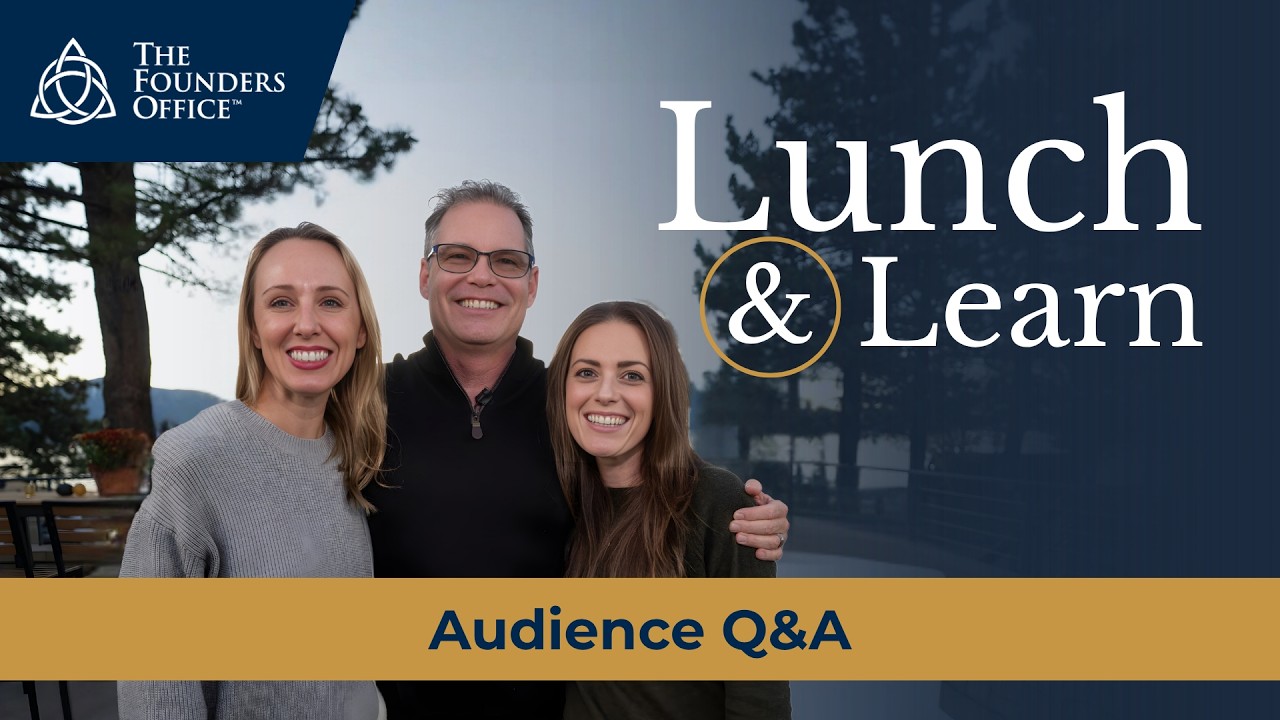
Why Great Businesses Become Impossible to Sell | Founder’s Office™ Lunch & Learn

In this pre‑recorded Lunch & Learn episode, Dr. Thomas J. Powell and Dr. Katherine Ann Powell‑Hinnetts discuss why successful businesses often become difficult to sell and how founders can protect and extract value before a transition. The conversation opens with a celebratory announcement that Sky Tavern, a nonprofit ski‑program organization where Powell grew up, has secured a 99‑year lease from the City of Reno for $1 a year, illustrating the power of long‑term, mission‑driven entrepreneurship. The hosts then pivot to the broader theme of founder transition, sharing personal anecdotes (a retired haberdasher, Powell’s own legal battle with the SEC, and a 60‑year‑old tailor) to highlight common pitfalls: founder entanglement, lack of succession planning, and the emotional weight founders place on their businesses. They introduce the “optionality framework,” a systematic approach the Founder’s Office uses to give founders multiple pathways for exit, protect them from regulatory and capital‑alignment traps, and keep the business viable without the founder’s daily presence. Specific risks that make a company hard to sell are enumerated— founder dependence, customer concentration (e.g., an 8 % concentration example), and personal guarantees that can balloon to hundreds of millions. To mitigate these, they recommend extracting intellectual property, using cash‑flow‑based financing tools that do not require personal guarantees, and diversifying the customer base. The episode also promotes practical resources: the free Founder’s Risk Assessment tool and the upcoming Founder’s Compass beta, both designed to surface hidden risks and suggest next‑best actions. Finally, Powell plugs his long‑running “Powell Perspective” podcast and the “Women Talk Finance” series, positioning them as platforms for sharing founder lessons and celebrating women in finance. The overall message is that founders must build optionality, plan early, and use structured tools to ensure both personal wealth preservation and a smooth, value‑preserving transition.
Chapters
Welcome to Lunch and Learn. We are here today talking with Dr. Katherine Ann Powell-Hinnetts, and I don't know what we're really talking about. I know this is prerecorded on this one, yes?
Yes, this one is. We are making sure this is an episode that we wanted to go deep in. We've done some prep for some, some questions to really glean. But
it's also because we're doing something kind of cool today, right?
It sure is. Today is a big day. Why don't you tell the audience?
So Sky Tavern, a place I grew up on as a small child and now have the benefit of being a chair of, we today are in front of City Council in Reno, Nevada, where we have negotiated with the help of Mayor Shevey And the council and the staff of attorneys and lots of others to move from having a 5-year lease to a 50-year lease to now we are actually securing a 99-year lease from the city for $1 a year. And why this is important is decades ago we had Marcy Herz, who was a competitive skier, had started a program called the Junior Ski Program. She actually started it by taking kids in the back of her station wagon and bringing them up to the hill where a guy named Wayne Paulsen— all of this is entrepreneurial stories actually— but Wayne Paulsen started with the first ski lift back in 1938 on our mountain. And Wayne Paulsen grew our ski industry to the point that we had the 1960 Olympics at Squaw Valley, which is now Palisades. So the benefit of this 99-year lease The other thing is the ski industry in total is challenged by it's getting too expensive for most youth to be able to ski and snowboard. And with this lease, it gives us the longevity to be able to afford that. And that is the benefit of being an entrepreneur, is we bring these entrepreneurial skills to a nonprofit business that benefits generations to come. I was one of those kids. You guys were those kids. And I'm so happy to be paying it forward. So So that's why we're recording today.
Yes, this is very exciting news.
And we're talking about— We're
talking about— We're talking about businesses. We're talking about businesses and why they become hard to sell. But big congratulations to you and the Sky Tavern team and our community for this. That's a big milestone.
You know, it's really on the shoulder of giants. The more I learn about the mountain, and we're 88 years since that 1938, and so I'm now, as the chair, My goal is over the next, you know, 12 years, which I won't be the chair for 12 years, but over this next 12 years, we're setting it up for the next century. And when you think about it, it lives way past— now, of course, mountains live way past us, but an organization that does something like this and has the impact is huge.
I think that's a really interesting segue into a theme that we know our audiences, our clients, those we seek to serve as the Founder's Office really care about, which is kind of that, that further end of the founder spectrum, which is that transition time. So you're talking about, okay, you're not going to be the, the chair of Sky Tavern for, for 12 years. There's a transition component to that. And so this, this transition spans any type of industry, any type of founder. But let's dig into that a little bit. Why do transitions seem to be such a sticking point sticking point or unprepared point for most founders?
Okay, I'm gonna take a step back. So I'm in Taos this last weekend, right, and, uh, with your wicked stepmother, and, uh, we're having a nice time, and I get a phone call from a friend who I have not talked to in years. Now, this friend became a friend— he was my haberdasher, so a guy that made clothes for me down on Rodeo Drive, and I used to have this just unbelievable collection of suits that were unbelievably priced. And yes, I used to wear suits often, and I don't anymore. But I did wear this tux that he made when I was in D.C. Mm-hmm. For an NCAA event a few weeks ago. And it made me think of him. And I believed that he had retired because he had closed his shop on Rodeo Drive. And I get this call and I look down and I'm like, oh my goodness. So I answer the call. I'm talking to him after 60 years of being in business. He is finally, finally retiring. He moved into a small little office place. He's been working for that period of time for all of his clients he's taken care of. He has touched so many people's lives. Yeah. But the part that we talked about was that I have the good fortune of my children. You guys are part of this family office, and our family office is much more about the business. It's not— it's very little actually to do about businesses, although that does incorporate a lot of what we do. but it's all the things such as Sky Tavern and all the other things that we do to touch people's lives and make impact and also make sure that the family members are taken care of, which is really what the reason for having a family office is about, is how do we pass on those ideas. And he had said that, you know, one of his disappointments was that one of his kids didn't want to go into his business. Hmm. So he built 60 years, he had touched So many people's lives. And when you wear the clothing like that, there's so many memories and things that go on to it. The suits that I've worn when I was in, you know, Lloyd's of London, and the pictures that I got at NCLA, and when I was at the Ninth Circuit in Hawaii with my granddaughters and my family that were there. All that stuff is tied around that. Mm-hmm. Yet he wasn't able to Pass that on. And so for many founders, I think that they think that they have to leave the business to a family member. Yet if there's not preparation to do that, leaving it to a family member may be burdening someone something that they don't want to do. So cheers to his children for having the strength to say, no, I don't want to do that. But also the regrets that he didn't along the way be able to identify somebody else who would have loved to take that 60-year business forward.
And I'm sure, I mean, not to speak for this gentleman, but I'm sure for the founders that we know and founders, you know, being founders is part of our like lifeblood in this family, would be that I'm sure he wouldn't have wanted them to take it on just as a business, but a passion, a vocation. And so understanding those signals Early is probably a pretty core principle. So how early should a founder be talking about exit planning, let's say, like their transition time, their ideal transition outlook?
There was a book written probably 2 and a half decades ago now called Built to Last, which is a great book, and a number of different things in it, and his analysts, you know, and at the Same time or shortly after that, another book came out, and I don't— I'm pretty confident it wasn't by the same author. We can check that, but it was called Built to Flip. Hmm. And so a lot of stuff that's going on, especially these huge valuations when no companies do not have any revenue models or anything else going on, it's based off of ideas. It was very similar to 1999 where we're watching these people become billionaires, you know, that are— that have really because they have an idea and the market's chasing it, but it's not, it's not necessarily sustainable. I think the built-to-last model is not about building something that means you're going to be doing it for all of your life. Kudos to Greg for building a business that he was passionate about for 60 years, and he built a lifestyle business that took care of him and his family as well as a passion and all those various things, but he didn't build something that was transferable. And that's okay, 'cause most businesses are actually like that. Most entrepreneurs, most founders don't end up actually exiting the business to another person buying it, but all founders do exit at some point. And most can't exit on their terms. So Greg can exit on his terms, at least that's great, right? But it is, do you wanna build the business to be in perpetuity And if you don't, that's also okay. There's plenty of reasons to build a lifestyle business. It all depends upon what you want.
What your goals are.
Yeah, what your goals are.
So part of what we do at the Founder's Office is that founder's advocacy component. We call ourselves the founder's advocate. You are chief advocate. And one of the institutional frameworks that we've really leveraged to support that advocacy work is the optionality framework. If you could tell our audience just a little bit more about why building optionality for founders is not only beneficial for the founder and their eventual transition, but also the business and the value of that transition.
So in all of our work, very rarely has it been a founder who— they'll all tell you, or not they'll all tell you, but many will tell you, oh no, I saw it big and it was great and I saw it, you know, boom, and all of a sudden I'm super successful because they lose sight. And I think it's kind of like even childbirth, although I've not personally ever experienced that, I've been adjacent to childbirth a number of times, is that they forget after a while the pain of that and they remember the success of holding the baby and everything. And being a founder for a business oftentimes seems like that. They forget all of the things and believe believe me, their family members don't forget all the things, but they forget all the things that went into it, including running up their credit cards, maxing out their credit, not being able to buy Christmas presents or all the various things that have happened in there. Maybe it wasn't this last business, maybe it was their first business and they went through it, but a lot of times that's driven through there. And the optionality comes in— most become fortunate because the options never got cut off to such a point that they weren't able to build that business. Mm-hmm. And if you go back to the history, you know, constitutional scholar here, and I look at and I study our founders of the country, and it's, you know, it's nice that we get to be able to use that term as the founders of business. Our founders of our country were about giving second and third and fourth and fifth chances to entrepreneurs because they knew that that was the lifeblood blood. And unfortunately, the systems in the United States now are mostly built around closing out those options for those founders. I mean, stick them in there, really stick it to them if they make a mistake. I mean, you even have regulators that do that, like one strike, you're out forever, right? Nothing that, that would be so against what our founders originally said. Bankers are like, one strike, you're out. And so the optionality needs to be that they have a founder's advocate That lets them know that the system is trying to put them in there. And I use the, you know, the adage of in a ham and egg breakfast, the founder is the pig and everybody else at best is the hen laying the eggs, right? The founder is committed and the founders need to be committed. I mean, when we invest in a founder, we want to know that they're committed, but what we don't want to do is kill them. Mm-hmm. So that they lose their entrepreneurial spark, that, that thing that is so unique to such a small group of people.
And, and let's unpack this a little bit because we know, and, and I want to ask you a little bit later too about what, what you look for in that transition component if you were to buy something from a, from a founder themselves. But talk to me about what might happen if the company is so dependent on that founder's
You see it often, you see it often in restaurants. And in restaurants, what ends up happening is a person buys a restaurant. Your older sister had a coffee shop, right? And she found that she could never take time off because people that were coming to the coffee shop expected her to be there. Mm-hmm. Even though she's not serving them a coffee or whatever, they came to say hi, they did different things. That happens a lot of times in those restaurants, and that happens in the small, in the small businesses. Insurance companies or the small single shingle lawyers—that's not a business; that's a proprietorship, right? And then maybe there's other employees that work within there, but that's that proprietor. So the business itself is generally not worth very much if you extract that person out because what you have to do is you have to pay that person to stay there. So it's the—I mean, right now we're watching the Dodgers and Ohtani. Surely seems to be the high-paid priced talent on that team, even though they've got a $340 million payroll. Sorry, maybe you guys might win tonight, but you know I'm not that sad because we are Red Sox fans. But you know nonetheless, you know that's a boy, and that's not the Ohtani team; that's the Dodgers, right? It's got a hundred-plus year history, needs to not have that dependence. Right,
exactly. So oftentimes, and I think from like an organizational design perspective, oftentimes that dependency can be not just the founder. You can have those key people for whom without, things break.
Who's the key person at like Google?
I don't know. There's probably so many.
We've known so many people that are executives. They're all critical. They're all important. But like, if you pull one out, Right? Who's the key person at Tesla?
Yeah.
Elon.
Yeah.
Right? And so all of a sudden you look at that and like the board of directors is willing to pay the guy, or at SpaceX, you know, pay a person to become a trillionaire. And you're like, hmm, do you really want to have everything betting? Because clearly Elon's not the brains behind every single invention that's come out of there. Yeah. Right? So it's not to pick on that as a scenario. And it's great if you're Elon and you become the trillionaire. Right? But as the shareholders, boy, you certainly got some risk on that scenario. Absolutely. What happened, you know, we saw it with Apple. So I was there in Silicon Valley at the time, and I was a huge Apple fan, still am to this day, although probably less enthused today because mostly they're a phone company, not every other products that they've got. So, you know, they fire Jobs, and he goes out and he kind of starts some new other different ideas, Pixar, and, you know, I mean, other things that have come out and because of his creativity and his founder. But that enthusiasm came back in. What was different about that company, because again, trillion-dollar valuation, was for the most part they were able to, like General Electric, to take, you know, that founder spark and build systems around it and attract other people in there. Now, it hasn't lasted forever, but it did attract other talent. I think Google has done a marvelous— again, we've known a number of people that have, you know, brilliant people that came in and they allowed them to grow that.
Exactly.
And by the way, the Dodgers, same way. They stole people from the Red Sox. They brought them over to there.
And they were super bitter about it. Yes.
I mean, come on.
But they had a winning strategy. So one thing, I'll get into this a little bit because I think the nuance is so important. So when you think about some of the most effective founder organizations that have grown into institutions, they started with that transformational leadership. But one of the biggest risks of transformational leadership is that when that leader leaves, so does that goodwill, so does that energy, so does that commitment. And so as the founder's advocate, we're working with a client Now who's early in his, what will be a lifelong career as a founder. And every time we talk with him, I'm always so impressed. He has something new and expansive.
Every time.
Every time. And it's not just something little he's doing. It's compounding and it's so wonderful. And what I'm most impressed with him about right now is his foresight in saying, I can no longer be the brand. How do— how am I creating a system that helps people in the ways that I would like to help people in the world without it being me? And to have that insight early before he reaches the point which founders, you know, many founders will have burnout or deciding, you know what, my priorities have changed and I want my life to look different, or I've done this venture, I want to go start something else. He's not doing it from a need perspective. He's doing it proactively. What would you say to founders are a couple of key steps they could start? You know, we, we talk about delegating isn't, isn't always helpful. Like what do, what does a founder do to ensure that a business is very transitionable whenever they're choosing?
Well, first let's, let's speak to what most founders get yelled at and legitimately yelled at, right? And it's not unfounded, is you just need to delegate. You just need to trust your people, right? Well, there's a couple challenges with that. One, there's a reason probably the founder was the founder. They were willing to take more risk. They were willing— they thought a little bit quicker, were more intimate with the problem. They understood, to the founder's isolation paradox, they understood the unintended consequences that everybody else doesn't necessarily see. I've had this happen Untold amount of times in my own business that someone in accounting sees this and sees a simpler way to get through it. And what they didn't realize is that the complexity was actually there because of legal, and legal didn't understand this was over here for accounting, and the two weren't specifically talking about what they were doing in that space, right? Mm-hmm. So delegating wasn't the problem, the communication— and you couldn't even communicate because there's a reason Accounting didn't know—
Exactly.
Some of the pieces of why legal was doing that because they weren't, you know, in those, and they shouldn't have been. They wouldn't have even had necessarily the capacity to understand what was going on without bringing them all the way up to speed. It's not that they're not intelligent people, it's just that's not their job, right? So all of these things systemically sits up there and you see these as companies get bigger, why the bureaucracy becomes so big and sometimes slow moving. And that's why entrepreneurs kick the crap out of them in a lot of cases, right? So let's go to another side of that though. So the delegating is one thing, and entrepreneurs do this. The other part of that is you delegate and then they do something and you give feedback, and so they're like, well, I can never get it right, so I'm just gonna always let the founder take care of it. And that, I mean, that's still a problem that I have at times, right? Because I give— I am a better way. I always find something better that I can give as feedback, and that's just a Very tough thing to manage through. Let's go through the other part of this though. Probably the place that it becomes very challenging is where founders don't realize they've put themselves into a prison. Mm. And that is sometimes on the regulatory side, that their names, their licenses, all the various things get in there and they're held to it and they're kicked out of their business for life, right? Happens with the SEC. It happens with with other regulatory scenarios. And of course, everyone on the outside believes for themselves they want to get second chances, but for others they're like, oh, you must have done something wrong, you deserved it. And that's our human nature. Mm-hmm. It just kind of falls in that scenario. But the part that it also shows up, and it's incredibly crushing a lot of times, is the capital alignment method. And we talk about that a lot. So the founder puts on that credit card, then they borrow on the loan, then they get their small bank and their bank is willing to do it. do it and they have them personally guarantee something. And those personal guarantees continue to grow until all of a sudden you've got personal guarantees that are $100 million. Yeah. They're not even worth $100 million. Yeah. Or in our case, we had one that was worth $1 billion in personal guarantees. And like, we're not worth $1 billion at that time, right? So that was a crazy, crazy scenario to say, like, you know, what do you do? So those limit options.
And I think options, you and I have talked about this a lot. I wanted to say though, the definition is fundamental attribution error. And I think when you start to name that, it's really helpful because it's saying—
It's a big doctor word, isn't it?
It's saying that when I do something, it was an exception. When you do something, it's the rule. It's your character. And so the more you can look at people through that lens of saying, That's— that may be their exception, right? That I may have caught them in their moment of exception. It allows us to give grace. I think a second part of what you're saying though is when we talk about optionality, when we talk about alignment, from my perspective and my discipline in approaching these things, when you are the person who has that stress, that weight, This has to work out. What we know to be true is that can start to cloud your ability to make sound judgments over time.
All the time, not just some of the time. There are these movies that it's always like, I'm the clinch, you know, I'm going to take the shot, I'm the clinch hitter, I am the person that when it's stressful I can get it through. But what they don't realize is all the collateral damage that has happened along the way to get it to that point. And what comes out of that, including wear and tear on your own body.
Exactly. All of those sacrifices when you get tunneled and tunneled and tunneled. And so I think the biggest component, part 2, those optionality is, is, is protecting yourself from getting into that space where you can actually be that free founder, that expansive thinker that moves things forward. from a place of that, that founder spirit, that entrepreneurial spirit, instead of pushing things forward because you are the person on the line. And it's a very understandable place to be. But there, there are, as you say, better ways to do that.
You know, it sounds crazy, but so for all of my life, for whatever reason, my childhood or whatever, I've hated bullies, and I've always been willing to stand up to bullies, not always understanding what that meant. And there's an old movie, uh, it was, um, Back to the Future. Mm-hmm. And in it, he had to learn that he had to not always be willing to take a dare and stand up, you know, to the bullies and different things in that. And he finally learns it and changes time. So I didn't get that chance of being able to change time because of it. And I still struggle with it. Obviously, Powell v. SEC, big bully, United States government, and, you know, willing to take them on even though it didn't personally do anything for me. I mean, I didn't get a bunch of money out of it. I didn't, you know, didn't change my story specifically other than it changed tens of thousands of other people to be able to tell their story. And hopefully the government won't act poorly like that again. Why that's important Is we don't see the cost sometimes when we're in it. And so I remember when you guys were little and I'd see something bad going on, I would be willing to put myself into danger to stop that. And what I didn't realize that I was also putting then my own kids at danger because of something that happened, right? And so I had to think about that one time and it actually hit me. It's like, you can't do that because I actually owe a lot to my family. Mm-hmm. I owe more to my family than I do to strangers. Mm-hmm. Right? And so that sense of giving. So what founders oftentimes are doing is they're willing to put so much out there and they think they're the only one risking. They're doing it for their family, they're doing it for their employees, they're doing it for community. And what they don't realize in a lot of cases is, and I say this from first person, that, you know, the damage that I'm actually doing to the people that I care most about. And that's where those optionalities actually start coming back around, is extracting the founder. We do 2 things. We extract the founder from the company because as we know, as we've seen in studies, you know, 3/4 of a founder's wealth is in that company in most cases. That is so different than somebody who's been an employee. Yeah. An employee has the wealth in their house in most cases and in their retirement Mm-hmm. Right? So they've got it there. Founders a lot of times have leveraged the crap out of their houses to build the business, or if they did, they've got a nice house, but, you know, who knows what's going on with that. And then they have no retirement accounts, right? Everything is the cash flow back to the company, even though they may have millions of dollars. It's still like right on the verge of being there for a lot of them. So the first thing we do is extract that Founder out, as you talked about, so we can sell the company, even if you never sell it, right? But then the second part is extracting that wealth out of the company. And that does not include bringing in PE. Maybe it does, private equity, but it doesn't mean you have to. It doesn't mean bringing in bank financing. There's lots of other tools that are available in today's world of how can we extract that out and get that there so the family's taken care of regardless if that business ever sells.
It's that capital alignment. It's seeing what is the most aligned solution to your goals. And so we're going to wrap up here with, I think, like a— I want to give you a tangible scenario. We have— A test? I know, a test. Let's
see how I pass this.
So let's say somebody has— they have actually pretty great revenue, right? They have great revenue. But they may be facing a really hard transition, like this company is going to be hard to sell. We've talked about a couple of things. So we've talked about maybe the founder is too entangled with it. So somebody buying it is saying, this is not gonna work if you are not here. What would be another reason in your mind that we could solve for that? Would it be, you know, customer concentration? Would it be— You know, disparate cash flow. What would you say there for somebody in this position?
Yeah, and customer concentration. I was just talking to a friend who sold his business, somebody we helped guide a while ago, and in his business, his largest customer was 8%. And the other guy who was a Fortune 50, I think, accounting, you know, controller at one time, CFO even, I said, like, oh my God, 8% concentration, that'd be horrible. For a public company, having an 8% concentration would be really tough. But for an SME, a small to medium-sized enterprise, that's not unusual. That's actually pretty small. 12% to 15% is where we'd start getting concerned. 25% of banks is going to be very, very, very concerning. Yeah, we've got a problem. So 8% actually wasn't too bad. But the problem with that was, is if that customer called, He picked up the phone, right? Even at 8%, because that 8% was probably their profit margin. So how do you get— how do you extract that out of there? How do you diversify? How do you build it so that you have more of those clients out there so that you can get to some smaller percentages? There's also a lot of other things such as just not— so at the Founders Law Group, part of our, part of our organization, we help a lot of founders with extracting out the IP. Mm-hmm. And so the intellectual property and naming the processes and building what that revenue is, is where part of that valuation. And IP is actually financeable, and it's financeable without the personal guarantee from the founder, which is awesome, you know, a cool way as well.
Absolutely.
And there's another, there's another great way. We've talked about it a number of times. There's some amazing products that allow the use of cash flow that does not drain at all, generally, the profitability of the company, nor even the cash position of the company, and allows tremendous wealth to be built for the founder separate than what they're doing. And it still stays in the business, but it's extracted from the business. And by the way, generally protected over time from regulators, generally protected from creditors. So it's another great foundation out there.
Because you talk about that all the time, is, is Founders don't get the same protections as an employee.
Not at all.
And so what I'm hearing in this scenario, I kind of thought that that's where we would go here. But what I'm hearing from this scenario is, one, it's very personal. It's very, it's very specific to what that specific founder is going through, what they've built, what their immediate problems may be, may be outlined, and what are their, what are their near-term goals, right? Everything is solvable, such as So long as we see what are, what are the goals and where's the gap between where you are and the gap.
Well, yeah, but you also got to solve for the risks. And the risks are the seen and unseen. And a lot of those risks are market risks. And money makes a lot of people feel like or believe that they're smart. And money and wealth a lot of times is Just simply timing. Bad decisions generally do follow bad outcomes, or bad outcomes follow bad decisions. Good outcomes usually follow good decisions, but it's not universally true. And especially in building wealth, it's a lot of times luck, timing. Mm-hmm. And so that's where that comes in. So what if the timing doesn't work? Is there another plan? Mm-hmm. Mm-hmm. Right?
And so we have a great tool for that, which I'm excited we share every week. It's on our website, which is the Founder's Risk Assessment. It helps us untangle that piece. It's a, it's a free tool. You can go in and you'll get your score of where kind of the most urgent and emergent risks you may be facing. Oftentimes we like to say You know, it's the ones that you know about that we can tackle, but it's the ones that you don't know about. Yeah. And this tool does a good job of asking some of those questions to kind of get in those edges. So you'll find that on the QR code here as well. We also have another tool maybe for both the founders and the advisors themselves, Founder's Compass. And this is— we are super proud about it because it's not something that is released yet. We are actually accepting beta users, folks who would like to try this out. What we've done is taken this IP, our IP. So when you talk about extractable IP—
I did nothing, by the way.
You had all the brainpower. Our team is sitting there like, wait, explain that to me again. And we've put it into a really dynamic tool in which it goes through all of the tools we use with our private clients and allows people to get their next best action and actually kind of use our thinking around what can be done to get the best outcome, which is the founder less dependent on the company and the company less dependent on the founder.
Yeah.
So we're accepting beta, beta clients right now for folks who want to be part of this initial testing. We just want to see if it's valuable to other people. We use these tools daily with our clients, so we want to make sure that they're valuable to others before we do a formal launch. Let's talk about your podcast, Powell Perspective. It is launching here soon. This is a false question because there's only one right answer, but how are you enjoying filming your podcast as the person behind the camera?
My daughter's very bossy, but when she was little, she said, I'm not bossy, I'm confident. And 20, well, 30 years later, but 28 years later when she used to tell me that stuff, it's the same. I just have
better
ideas. Yeah, I know. It is great. It has been fun. It's kind of funny to hear it being launched or relaunched when your brother also did videos of me back in the '90s, I think, and up there. So Powell Perspective has been around for a long time, especially during the downturn. That's where the Standing in the Rain, which we talked about earlier today, came about, which was the perspectives during the economic downturn of 2008, right? So for many of the people now in business, they weren't really adults at that time, right? You were a little, little person. So that what you— that can help you frame what your ideas are and look at that kind of stuff. Exactly. So hopefully that's what the perspective is about. It's not really about me per se, but it is, you You know, we tend to, as we age, hopefully we tend to take a little bit different look at things. So we bring that in and guests and thoughts. And it's also got a little bit of my story on there, which I think has been interesting to go through.
Well, you talk about you've learned through history, right? And I think something that's been transformative for me being the person behind the camera doing my best to press the right button, but is that you've learned so much from the people who went before you. And so it's not just sharing your story, it's those lessons from one founder to another to say like, No, this is how you architect a life of that freedom, of those options, of the ways in which you can, you can have a life that you do have the things you value, and it's fortified for you while you're still growing something that helps others. And so it's really wonderful.
It's fun watching you and your husband and, and your older sister and her husband and the others, and they're doing things either totally different than what I did, which is great, and but also Sometimes finding ways back into saying, oh, this is kind of why Dad maybe does these crazy little things over here, type scenarios of it's really added to, you know, a value in life. And I have tried to build a life that is one analyzed a lot, probably overanalyzed a lot, and then implement.
Yeah.
So implement new plans Right. So I was watching a video the other day of a guy, and I think I've told you guys this before, he's 92 years old and he's skateboarding. Mm-hmm. Right. And so what I loved about it was he had sticky notes all over his house when the professional skateboarder came over to interview him. And so we would have looked at that and said, oh, Alzheimer's.
Yeah.
Right. It had nothing to do with Alzheimer's. What it was, was it was as he walked past the sticky note, he grabbed it and he'd go do lunges. Or he'd go do standing on one foot, or he would do— and, you know, I do all these different things that make my daily process to be healthy a big part of that, right? So even that's the Powell perspective type scenario of like, what little things have I done that I've learned from other people, and then be able to implement those different things in my life.
I'm a tried and true example of going, oh, I kind of like that strategy. Maybe I'm going to Why, Dad?
What are you doing?
I kind of like his yoga and listening to Jim Rohn in the mornings.
The best one was your little brother. I watch him now and he lays out his stuff the night before by the door. Yeah, right. So he's remembering everything that goes there. And that's obviously, you know, I lay out my clothes every night before just because I don't want to have the mental load of figuring out what I'm going to wear the next day.
Exactly. I love it. So much more to come on the Powell Perspective. 2 last things, something that I've never done the promo for it before, and I'm very excited to. WTF, Women Talk Finance. My just amazing sister and our amazing colleague have really just a phenomenal show, so.
You talk about paying it forward and also showing the talent of our, you know, our family office and the other companies that we own and various different things. And you take all of this expertise and you've been a guest on it a number of times. I've got 2 guests. I'm going for 5 because I want to do exactly the same thing. I think I have 3. You have 3, I know. I'm going to get made fun of when I get finally onto the 5. But it is sharing and it's impactful and it's so varied from the other things that we do, but it still ties back to that founder's journey and women in finance and all the things that are going through, which is a It's a gift to me, believe it or not, because it's my, my business partner who passed away a number of years ago was one of the leaders as a woman in finance. Right. I'm lucky to be in it. I'm reminded of that most days. And so it's really pretty cool.
It is really cool. We're super proud of it. Please check it out. Share it with your friends because it's just, it's so enriching every time we listen to it. I know that's a very biased perspective, but I think it's also true.
Well, you've got a JD with an MBA and an MBA that's been in finance and owned multiple, multiple companies as well as seen a very large portfolio. And then you've got incredible Yeah. That come on that.
Lots of learning, lots of sharing, and lots of fun. So it's very exciting. Well, thank you so much for hanging with us today. Here is where you can find us. It's on foundersoffice.com, as well as where you can find us individually. Anything you'd like to say to close us out?
No, just really enjoy these Lunch and Learns. And please know that we're not here today, although you may be watching this— well, you'll be watching it recorded no matter what. But that go check out Sky Tavern right here on my logo. And see what we're doing on this mountain. It is amazing what a nonprofit can do of just teaching kids to slide around on snow and adults as well in an adaptive program. And our family has been involved in this since— well, I've been involved since the '70s. I taught you guys there back in the '90s and now to be carrying it forward. And so thank you to the team. Thank you to our mayor and thank you to our listeners and watchers. Thank you.
Wonderful. See you next week.
Thank you.
More from Dr.

The Business You Built May Not Be the Business You Own | Founder’s Office™ Lunch & Learn


Your Business Isn't Worth What You Think It Is | Founder’s Office™ Lunch & Learn

Complexity Is Quietly Destroying Enterprise Value | Founder’s Office™ Lunch & Learn
Simplifying The Complexity of IP | With Tony D'Angelo | Founder’s Office™ Lunch & Learn