Your Reputation Is Being Underwritten | with Charles Zakarin | Founder’s Office™ Lunch & Learn
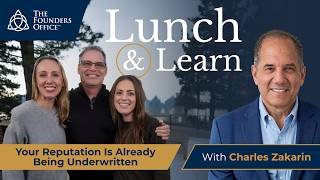
Charles Zakarin, founder of RMG Digital Solutions, explains how AI algorithms now control what appears when people search your name. He shares tactics like scholarship-based SEO campaigns, maintaining updated digital profiles, and auditing yourself through ChatGPT to catch damaging content before it spreads.
Chapters
Well, hello everyone. I am obviously coming to you poolside from San Diego, so I should be beachside down there, but there's no power and I was afraid that it wouldn't work as well. So Tom Powell here at Lunch and Learn, and we have just an amazing show today. Like always, joining me to bring the fun to everyone, our general counsel. You actually bring fun, fun to law there, Jackie. Jackie Kiper.
Thank you for saying so.
It's been a goofy day because, you know, as you know, Candace and myself and the rest of the family, or most of the rest of the family, we were doing what, Candace, this last week?
I was questioning my life choices. I was floating down a river, trying to—
You were floating? You didn't look like you were floating.
Trying to stay upright and not capsize.
So we just finished the Ski to Sea, which is, I think it's in its 52nd year up in Northern Washington, right on the Canada border. And I got to hike up a hill to ski down it. And our whole family did this relay race that was 96 miles of a variety of combination That is truly the founder's life, and we had just an absolute blast, uh, fun time. So glad, uh, for that. Today though, we're going to be talking about something near and dear to my heart. Imagine spending a lifetime building your reputation and then waking up one day to discover the internet has already decided who you are before anyone ever speaks to you directly. Not a judge, not a jury— an algorithm. All Our guest today understands something most founders do not realize until it's too late. In the AI era, your digital footprint is becoming your first impression, your credibility filter, and in many cases, your public identity. Most people think reputation management is about image. Charles Zakarin understands it's really about accuracy, context, and trust. Charles is the founder and CEO of RMG Digital Solutions, a firm specializing in high-stakes reputation restoration for executives and organizations navigating complex public exposure. He works at the intersection of AI platforms, search engines, and digital narratives, helping clients ensure that what the world sees is accurate, current, and properly contextualized. When the stakes are high, people rely on Charles because he delivers clarity without hype and results people can count on. This is an important conversation because every founder already has an AI-generated reputation forming around them in real time. Please help me welcome my good friend and someone who has personally helped me with reputation management, Charles Akron.
Thank you, Tom. Thank you for having me and very nice to see everybody.
So Charles, I'm gonna start at the beginning. How did you find me?
I believe it's called cold email and we at the, like, I get 3, 4 years ago, we were experts at landing in an inbox. And luckily, on the day that you received your email, it landed in the inbox, I presume. And as you told me later on, you were spending a lot more money with someone else who was not being effective. And you said, let me check this guy out. And we got together, we sat down, and you gave me a chance. And In a couple months, we started seeing some improvements, uh, and, uh, everything's gone swimmingly since then.
That is— that's beyond true. So, uh, Jackie and Candace and myself are all intimately familiar with the situation that happened, but for anybody that doesn't know it, you can simply look up Powell v. SEC, and you can fast forward almost to the end of the story because this week Guess what happened? Anybody? Anybody? Bueller? Bueller?
I know. No one's gonna say no.
What happened? What happened? What happened? What happened? Tell us the end of the story.
It's like rescinded its gag rule.
5 years in battling them— 8, actually, more than 8 years with, uh, the people from NCLA. And, uh, the SEC has been violating people's First Amendment rights, the Constitution, our government violating the Constitution for 52 years. And we took it upon ourselves to, with the battle, with NCLA's help and a number of other friends, we took it upon ourselves to battle the SEC. But where Charles comes in is because during that time, they absolutely have the power of the pen. They had the ability to write any press release, whether it was true or untrue, and press as many things as they wish to out on the internet. And what Charles did was he was able to make sure that the real story could get out there, even though he couldn't speak against the SEC. So, Charles, how did you get started in doing that? Because this is an amazing business.
2009, some— someone walked up to me and said, and I don't remember exactly what it said, Chuck, my— the name that most people call me. I was just on Google and I saw X. And I said, what are you talking about? So I went to Google, I Googled myself, and I was not happy. So first thing I did was I called my attorney and I said, someone has said X about me and Can you please help me and get this off of the internet in about 15 minutes? And, uh, uh, he kind of giggled and, and left, and he called me back in 15 minutes, told me where the, the website that, uh, uh, this first post was on, and, uh, that, um, I should start making plans to get used to that being there because it's never coming down. And that was the beginning of an odyssey because after the first one, you know, the second one came and the third one came and all of a sudden my personal and business reputation was in tatters. And my business, which was 20-some-odd years old, was quite affected by it. So I went and I hired over the next 3 years about, let's— it was 3 firms and none of them made a difference. Ultimately, this is so 2009 to 2012, 2013. I took it upon myself to fix my reputation and was successful and really enjoyed the process and was 51 years old and ready for career number 2. And that was the start of it. And 5, 6 years later, I started RMJ.
That's fascinating. And there's so many nuggets in that story. First of all, the fact that if you are in business, at some time, some point, somebody's going to do something that can destroy your reputation. And a thing that I was reminded of a number of times through building companies is the character is something you build. The reputation is what other people build for you. And so, in that, it can be torn down very quickly. But what you have been able to do is turn that experience into a money-making venture, a livelihood for you that actually not only just helps people with their own reputation, but an important part of that is you also do good work while doing that, meaning not just are you changing that. So, talk about that. What was your— a little bit of how— what do you do that makes an impact that creates beyond reputation side.
I had someone told— someone tell me that an SEO strategy that was quite effective was the establishment of a scholarship in the name of whomever the client is. And at the time, it was primarily law firms. So XYZ Law Firm Scholarship. And it could be for $1,000. It could be for whatever you wanted it to be. Whatever it was, the light bulb, a light bulb went on for me and I said, this is what I want my company to be about. So I contracted with a company to manage a scholarship for me while we ran a reputation management campaign. And there was a website built for the, for the scholarship. And I remember a month in, I called the owner of the SEO agency and I asked him, How do we get the money to the winner of the scholarship? And he said, oh, we leave that to the client. And, uh, which to me was— it made it— I don't know what the percentage would have been, but to me it was like, I know that, uh, a lot of people are not getting scholarships that are supposed to be getting scholarships. Um, so within, I don't know, a month or two we took on our first scholarship, and the first thing I did was I put in place a setup where we made certain that the student— if we put out a scholarship, we made certain that the money ended up in a student's account and that it got routed the way it's supposed to. So essentially, and this has gone on since the very beginning, we put out a scholarship. Let's say it's for 6 months. Uh, uh, during that time, let's say we got 100 to 150 submissions from students. Um, we will actually get in there and help the client and pick the top— the what we feel are the 10 best essays. We'll then give it to the client who will make the choice, comes to us. We then get together with the person who they— my client chooses. Let them know they won and make sure that they wanted to accept the award. And usually they did. So then we would put together the, the process by which that would happen, which meant having them write a paper check, send it to the financial aid office of that university, and they redirect the funds into the student's financial account, and their tuition balance would go down by the amount of the award.
How many dollars have you caused to be given to students?
Uh, I never counted it. Can we, can, can we round it out and say half a million dollars?
Half a million dollars. So doing good work while doing good work to help people in there. Uh, that is awesome.
Can I tell you, in, in, in, in a million years, or however long we want to call it, I never thought that I would be able to have a company, uh, uh, that, uh, was in a position to tell a client to give money to someone for a good cause, and that it not only would they— that, that it would help them. So this is just a win-win-win-win-win and win.
That is so cool. Well, so Candace, I don't know, Jackie, if you've ever had anybody impugn your reputation, but Candace, I remember distinctly, uh, when Yelp was was coming out and you had the coffee shop. And I seem to remember a time that it was just like, it blew my mind that you could not get someone's bad rap about your coffee shop off your thing. Yeah, tell that story.
But also there were some times that somebody wrote such a good one that they wouldn't post it because they thought it was fake. And like, I had to go through, jump through hoops. But along those lines, I wanted to say a lot of our viewers today Maybe they're not going through necessarily what Tom went through, what we went through with our reputation, spending decades building it, building, um, a really solid, um, track record, and then seemingly overnight having it not just damaged, but from an agency that has priority on the internet, because a.gov, a.edu, those all take priority on the internet. So those always are going to pop up high. Um, what some of our— what a lot of people on this channel today probably have experienced with is what I've had experience with as well in my other businesses, because those are— it's just so quick. I remember reading things on Yelp that, you know, it's one side of the equation and there's this tactic where you have to respond and it's super weird. Um, somebody I didn't fire, or somebody I fired then came on and posted a terrible scathing Yelp review. Couldn't get that down. Um, Glassdoor reviews, all of those things that then you— they just are little knives, you know, into, into your hard work. So that's probably a more relatable reputation piece that a lot of our listeners probably have experience with. What can they do to manage some of that? And then is there anything they can do to prep for potentially the day that decades of hard work can get instantly lit up like a flame? So two really easy, light, lowball questions like we discussed.
Thank you. Thank you. I like that. So, uh, uh, the first thing is I do want to say that to me as a person who manages, runs a business, my second business, I have never personally given less than 5 stars. I've given nothing or 5 stars. I do not have the heart to give someone less than 5 stars because running a business is a difficult pain in the neck. Right?
I do the same. I feel like everybody should have to receive a 1 star before they can give a 1 star because You also don't know what's going on in that business owner's day right now. You don't know if somebody in their office had a horrific accident, somebody's out. There's, I mean, there's so many things that could be going on. Yes, there's just bad business, but to try to damage somebody is not okay.
Yes, yes.
Uh, so I'm sorry, and the second question was, I was saying, what can people do in prep, like, this is so reactionary. And our experience was we kind of organically built a really solid reputation. So when it was getting really beaten down, it was this reactionary reputation management plan. Is there a proactive reputation management plan?
Uh, well, so, uh, starting with the question of What should a person do if they get less than, let's say, 5 stars or 4 stars or 3 stars, 2 stars, 1 star? No matter, you get a review, you take that as a learning experience and you take that as positive feedback. And if it's ridiculous, you take that as, as positive feedback and you figure out a way to own up to it. And a person who spends any time looking at a set of reviews will come to understand that the owner that does that cares about their business. Kind of simple as that. Yeah. As far as proactive reputation management, that's kind of a separate— that kind of moves us away from review management. And if only I could convince people to do proactive reputation management, if only.
What does that look like? What does proactive reputation management look like in 2026 when we've got tons of AI, everyone's online? Arguably, this whole conversation has been changed by an online community because people react different and treat others differently when they can, you know, say whatever they're going to say from the, from behind the safety of their screen. I think the psychology behind it has changed, right? And we've got to be, as consumers, we've got to be a lot more discerning. This time we talk a lot about the 6 C's and one of them being credibility. This is about your own credibility, but also deciphering what out there is credible, what's just trolling, what might actually have some substance behind it. So yeah, I guess my question is, how do you proactively navigate all of that right now with just literally the sheer volume of content that sits on all over the spectrum from just garbage to actually valuable content? How do you navigate that right now?
So let's start with Google Search, which 2, 3 years from now is going to be a tool for scientists. As far as I'm concerned, because, you know, the fact is that when you go ask a question or you prompt ChatGPT and you get an answer, that's easier than going and doing a Google search and getting 10 blue links, as we call them, and then from there going to search. So a Google search is a search upon a search upon a search until you find what you're looking for versus the nice little easy ask a question, get an answer. So who is going to win in the end? Right. So, but as far as proactive, you know, what does a person do? The easiest way to figure that out is go to ChatGPT or AI mode or any of the LLMs that are out there and ask them your name, say, who is John Smith, and take a look at the answer and see if you're happy with what it says and where it comes from. And, uh, let's just call a profile that is not too active thin. You will instinctively know if you have a thin profile because it's just gonna— it's not gonna feel luxurious. So if you're thin, You want to feel luxurious. Now, how do you get to, to be luxurious? It's the same process as, as it is for the person who actually has damage. Um, and I'm just going to use this universal term, content. And you just do content, and there's many, many, many different ways to do content. You put down content and you watch as your profile, let's say, on chat thickens up, gets luxurious.
So is that, you know, first of all, I loved your idea about how Google is today relative to how AI is. And remember, and you and I definitely remember the Dewey Decimal System where you used to go into the library and you had to use the library, you know, librarian and help you go do the researches. So So, you know, we remember that and my kids remember hearing about it. Actually, Candace has set up in her library behind herself a Dewey Decimal System of the banned books that are on the library and an actual checkout and has a Selectric typewriter to actually do this stuff.
I do.
So you're right. So it is old school. However, what you're talking about is a volume of data. It doesn't get rid of the bad stuff. It's what people generally will see. And within the AI search, it's also looking at relevance, right?
Right, right.
So part of that is, is that reputation management is not a one-time one and done. It's not about just writing a response out there. And so I'm going to change gears here a little bit. Jackie mentioned that we had a win, and I'm going to call it a win even though it's kind of a bittersweet win, because what the SEC did was being a bad actor themselves. If anybody with the SEC was doing something for 52 years breaking the law, and they broke the law, they broke the Constitution, right, for 52 years in a row, thousands and thousands of times. If somebody did that as an individual and then told the SEC, hey, we've stopped doing it, don't, don't go to court, The SEC would laugh at— you would definitely have impact from that, right? But the SEC came out 3 weeks ago and said, hey, we're going to stop this. And then yesterday they actually announced and said, hey, Supreme Court, because we stopped, you shouldn't look at it. Don't look over here and go look over there. So that actually came out yesterday. Why that matters though is what the SEC said about the people is still out there, and what people haven't been able to do is actually tell their stories. Right. So in the reputation management now, you and I were chatting about this yesterday. You have this idea of where people could potentially, if they have a desire to— I mean, the next morning I woke up and my wife had written me a nice note that said, "How's it feel to have your voice back?" Right. And people don't understand what that's actually like to not have your voice, to have your voice taken away from you. And so there's thousands of people. We've been receiving these letters. I mean, I don't know if you've got one of them handy, but I know I've got some comments that are handy here. How can you help people actually get their voices back when they've been destroyed?
Well, you know, the first thing you said there is awfully scary because now how are we supposed to look at this decision, right? Because it can be turned an executive order or an order that what has been given can be taken away, right?
Absolutely.
This is why you're going to the Supreme Court and this is why you're continuing to, to put the fight, uh, forward. Um, so, uh, it's so, uh, let's just call it as of right now, we have the delivery, the, the, the ability to send a message. And, uh, uh, the instinct always is to say, I'm gonna put out a press release. But the problem with a press release, let's just say we're still in Google days. Where you're doing a search, you, you put out a press release that will stay there for a little while before it starts moving down the page from, and it goes off page 1 to page 2, page 3, etc. So what we have come up with is a kind of a formula for making the equivalent of a permanent press release, which means you're getting out that same message that you would put with the press release. but it's not going to go anywhere. It's just going to stay there. Hopefully, if we can place it in, in the case of the SEC, let's just say the SEC says you're a bad guy and, uh, you with your press release says that's not the whole story, uh, please click here, which it's almost like the positive thing is more interesting than the negative thing. And it's not going anywhere.
Well, yeah, but it, it is interesting because I was on a national news station, international news station, I guess, late last week about this scenario. And the broadcaster comes on and says, oh, these are all the things about you. And of course, it's that volume of information, which I have 40+ years of being in business. There's an awful lot of good stuff about me as well. But of course, that is still, even with reputation management, it's still, you can get to it, right? And of course, I have also decided that I would make it to the forefront because I wear it more like a Scarlet A, and I'm out there saying, look, what the SEC says is not accurate. We need to be able to share my side of the story. However, no one can do that until we all can do it. And so that was, that was what the, the story is about. But what you're saying there is that we could actually sit there and put someone's story out there, or you can sit there and put somebody's story out there. And we talked about it a couple different ways because I think some people are still going to be nervous because you also said what the SEC giveth, the SEC can taketh away unless SCOTUS comes in and says no, you can't, right? So at this point, the SEC— so I think some of them are, are nervous about that. But so you could actually help someone tell their story on a website, and it doesn't have to be about the SEC. It could be about any other thing that has happened within their reputation, right? Because this works for many things.
That's right. That's right. And, uh, by the way, uh, the— oh, probably the nicest way to talk about what's been— how you've been wronged is to nicely talk about how you've been wronged. Uh, don't go and poke the bear, right?
Like, not trying to bury it, but try to have open dialogue, maybe? Is that what you're saying?
Uh, well, yes, to have the open dialogue, but As far as the give it and the take it away thing, this is another benefit of this program that we've developed, which is with a press release, not only does it go away, it can't change. With this program we've developed, you can change the messaging once a week and it just sticks there.
So we have a few questions coming in. I do want to invite the audience to submit their questions through the Q&A. Um, we've a little bit of time left. I want to— we've got a question here. What are— because some of our founders are new founders, and so they're so deep in the thick of it that sometimes reputation management might be on the back burner. So, um, or they haven't really experienced this yet, so they haven't— it hasn't been a priority. This is from someone, uh, what are the key things new founders should do to protect their reputation proactively, if anything?
Well, the, the first thing they should do, there are what we call listings, and put out as many— a listing is Crunchbase, for instance. A listing, it could be LinkedIn. The, the obvious things that everybody's heard of, fill them out. Let them, let them kind of spread over your digital footprint. And that's a good start. For a founder, they're probably investing a lot of their own money or other people's money. This is the situation where a person should do a serious, serious proactive reputation management campaign as, as thick as, uh, if there was damage to the person's reputation. You, you can't, you can't protect yourself enough. And if you do protect yourself now and something happens, you're going to look a lot better. If Tom had, uh, 2, 3 years of work in advance before this happened, it may never have hit page one, and it, he might have been less upset. He would've been less upset. I'm not saying that he wouldn't have gone out and done the truly heroic things he has done, but, uh, um, the, the, the, you know, it feels much better if it's sitting there on Page 3 because of all that work you've done.
Yeah, it's not, it's not fun, especially when people don't know about the SEC, because one, the SEC's civil, which means they're not criminal. Which means you're not a crook no matter what the SEC finds out. Well, you might be, but you're not just because the SEC says you are. But it is interesting when you have friends and family come up and say, oh my God, I didn't know you were a crook, right? It's like, yeah, boy, this is a really interesting thing, how far it's fallen. But it does go to something that I, that I really do appreciate what Candace does in our hiring, and she did this way before this SEC stuff ever came out, was that she didn't ask people about their wins. She asked them about when they got beat up and how did they survive that? Because one of the most important things about being a founder is resilience. It's not an easy lifestyle to choose, right? And then for many of us, it's one that's chosen for us because we just can't keep a job. So you become a founder because, you know, you've got lots of great ideas, and you've been self-employed and as a founder for all these years as well. So that being able to have that story so that at least you get to start start the conversations off from the right foot. But it does not mean that you hide it. And that's really critical because we talk about in the 6 C's that the, you know, the credibility is key. And so you need, in many cases, need to lead with it and almost in some ways almost joke about it. Like you talked about, you started this business because your reputation was damaged, right?
That's how you lead with it, Tom. Well, and also I love that you tout yourself as highly unemployable.
It's true. He's on the block.
He's like, he's on the termination block every week with us at this point.
So this all goes directly to another great question that came into the chat. Someone asked, what should someone do if their affiliate partner or investor has a reputation issue? How do I as a founder react? I would encourage right off the bat, maybe not a lot of reaction, but some calm, like, information gathering. And we do, we had a client where we were really, that they, they had an issue. It was like a whistleblowing issue internally. And we were kind of coaching or guiding saying, really get out ahead of this. There is a story here. What's the full story? And so you as a founder, rather than being reactionary, maybe get some information. See what this is all about. Is it a true and valid reputation issue? What's the full story? And then from there, there's a lot of different good advice here, both from Chuck and Tom and Candice on how to navigate that going forward. Do you get out ahead of it? Is it something where it requires a correction? Is it an integral part of the story where it's part of the resilience of that person? Chuck, Tom, Candice, I don't know if you'd add anything to that, but I think see it as an opportunity. to maybe learn a little bit more before you make any big decisions?
Yeah, firstly, a person that gets into reputa— a person that has been damaged online, from my experience, uh, we're smaller niche agency, so I know all of our clients. Um, these are people with fortitude. These are people who want to get their voice back. These are people who've had their voices taken away. So they're willing to take that, that first step, right? And I'm just thinking about the review commentary that we were making at the beginning. It's own up to your mistake, whether it's a mistake or not, to, to have dialogue. Now, the tragedy of it all is that What you're describing is not generally what happens. What, what happens generally is the millisecond that someone spends looking, sees something negative, and on to the next. So it's lovely when, when people care enough to look at a profile and say, you know, there might be value here and I want to dig a little deeper. It's just not usual.
Well, I'm gonna go, I'm gonna take it totally aside on this. So we, one of my best friends and business partners for a very, very long time, he and I became friends and business partners because someone while she was on vacation, she was working for a competitor and they misspelled knowledge on her ad with her face. And I'm reading it and the marketing department brings it to me. And one of our people was kind of chuckling and said, oh my God, this is horrible. And I said, you know what? She probably doesn't know it based off of— because I'm reading her resume and we knew a little bit about her. I said, reach out to her and let her know. And so— and I said, and invite her to lunch. And so we ended up becoming fast friends and business partners. And unfortunately, she passed away 7 years ago now, almost this month. But, you know, it was just— it was that learning of It's a mistake. It's just a mistake. Giggle about it. We make mistakes. We're humans. And anybody that thinks that they live a life that isn't full of mistakes, it doesn't really know even what's going on. Now, it's did you learn from them? So we have lots of mistakes that we learned from the SEC. The biggest one was ever signing basically the settlement at the end and not understanding what the full consequences of those are. But that's not even the biggest mistake. There's a whole bunch of mistakes that were within there. But, you know, that's the scenario of when you can only have one side of the conversation. And Charles, what you do is you bring a second side, or at least the ability to have a seat at the table to have a conversation before you get shouted down by an agency or anything else that's going out there. Uh, Kelsey, looks like we've got it.
Oh, I'm sorry, one more thing to add is we've talked about, um, having discretion and making sure people's voices are heard, and there's always two sides to the story. So yes, yes, yes, all of that. And, um, once you know all of the information Maybe, um, maybe there is someone that you've become involved with that doesn't deserve the benefit of the doubt, or that you want to create some distance from. We've also had investments where that's been the case. And what do you do then? Um, use your discretion. And in that case, you make it clear, you, you make the divide, you make the, um, the distinction between you and your organization and who you are and what you stand for as the founder, what you're building. And then if you had an affiliate partner or have one that down the line you found out maybe there's not the alignment you originally thought there was, then I think it's important to just be honest about the distinction, right? Without throwing anyone under the bus necessarily, just saying, this is who we are, this is what we stand for, That's, you know, however you want to navigate that. If you're under contract and you've got a partner who's got part ownership, use your discretion to say, this is a conversation where it's important that I make the distinction between us.
You know, Jackie, I want to add to that too. And it reminds me of a movie clip because I always use those, right? I think it was Clear and Present Danger where— is it a recent movie clip or something that only a certain generation— A little, little newer. The book might be 1974, but I think it's Clear and Present Danger. And, uh, it's where the president's being given advice because one of his advisors is found to be doing something very naughty, and they want him to distance himself. And one of his advisors says, no, you tell, you tell everybody that you are very close and very dear friends and you know nothing about it, and it's a shame that this has come out, you know, for him. And you give, you know, we're there to give him support and things. That is When you go through these type of things, and most everybody at some point will go through something about that, whether it's needing, you know, Charles, and I hate to say it, but most people, you know, Charles, I'd like to say, I'd like most people not to need your services, and then you become creative and help other people, but there will always be people that need your services out there. So, but stand by people because we all do make mistakes at different times or we have things said about us. And I've got another question for you, and there's one here from one of our listeners, but, Can you help companies or organizations as well? And the reason I ask that is I'm involved in an organization right now that is getting thrashed by a minority of people that are just hitting it. And can that kind of stuff also help where you can be out there? And should you be proactive about it or just do you let those bad Yelp scenarios just sit there?
Never let anything sit.
Never let it sit.
And yes, and yes. A reputation management agency must be able to help an organization. It is, it's not exactly the same thing, but, you know, I mentioned the word content earlier. It's kind of, you've got to put down content. Now, there, it's different than it was not too many years ago. You, you know, you used to be able to, I was thinking about, I live in New York. Let's say, what's the— and I'm a Ranger fan. What's that team you were telling me about?
Oh, the Knights. Yeah, let's see. They're going once again. Once again.
Right. So if I'm a Ranger fan and I'm from New York and I'm like, gonna write content about myself about what a big Knights fan I am, Google knows me already and they're gonna discount that content because what's he doing talking about what's their call?
So to be Golden Knights, just because we have those right there, just want to get right. Golden Knights.
This is a really, really refreshing thing about our business, which is it's all about truth. You cannot— you mentioned that things are there that are negative. Well, you know, uh, has everybody done— everybody's done something in their life that, uh, they're— they prefer— they wish hadn't happened to them. Um, they're just lucky enough that it didn't appear online.
Oh yeah, every day I think about that. I— and I tell my kids that. I'm like, man, we are like— we all do really great things and really awful things every single day, even if it's just a thought at somebody, right? Like, there's moments of our day that we're super proud of and not proud of. And I'm just grateful that I don't have cameras following me around highlighting.
Yeah. Yeah. If I can make a, make a statement, a blanket statement for all my clients, uh, um, the process of going through this where I'd mentioned them getting their voices back I say that these are better people. They're the same people, but, you know, the humility they've learned to end up on the other side, the— I think that the second part of their lives, so to speak, will probably be more fulfilling than the first. I know mine is.
It's crazy. It really— I mean, it really is amazing. I'm trying to find this letter, if I can find it here before we head off. Because, Charles, you were responsible for me getting this letter. We actually did a— Charles, you got to say what you did. I came to you and said, I want to reach out to all the people of the last at least decade and reach out to them that have been gagged. And it's tens of thousands of people that have been gagged, have their voices shut down by the SEC. And so because of that, now, again, many of them are willingly— many of them did things that maybe they did need to get in trouble for, whatever else. Scenario, but none of them get to share their story. And so, Charles, if you can just share it with you— I'm going to see if I can find the letter because I think it was really powerful. I have it here. Kelly, Angela, look at that.
Look at the menu on thomasjpowell.com.
Huh? Is it on there?
Yeah, it's, um, one second.
Thomas, pardon the, the intermission while we Okay. Do text.
So voices on ThomasJPowell.com, voices.
Okay.
That menu. There we go.
Look at this. Oh, this is a blacked out one. Yes. Okay. So if you don't mind me just reading this really quick, just because, let's see here. Oh my gosh, there are so Many. Okay. My case was a life-changing experience for me. I'll spare you the details, but in short, my firm and clients were the victims of a massive fraud, perhaps the largest in history, film history. After being investigated myself by the SEC for years and after successfully defending myself against allegations that I was operating a Ponzi scheme— clearly I wasn't, and my administrators, accountants, and bankers easily defended us— and after successfully defending myself against allegations that I misperceived priced my fund investments, which I didn't. I didn't even price my fund. Um, uh, I was the victim. Let's see, where was it? Yeah, sorry, this is not great. Uh, the main line was, I will never recover from this. Yeah, that was the bottom line. I mean, he gets into it. I'm sorry I didn't have that prepped up. I should have, but it was— so Ernest asked a really good question. We'll leave it on this one, but is it similar to public relations, or is this strictly crisis public relations? And Charles, we, a number of months ago, we put out a Substack and I said, you know, the best time to work on your reputation is now, kind of like planting the tree, not waiting. So people don't have to wait to start working with you. They can work with you well in advance. Is that correct?
That is correct. And that is recommended.
Highly recommended. How does someone get in touch with you? That's an Angela question.
Go to Charles Zakarin, and if you spell that right on the first time without looking, it's C-H-A-R-L-E-S Z-A-K-A-R-I-N. Or you could just go to RMGdigitalSolutions.com.
And there's a message from the founder. What a handsome, great— just—
there is a message.
Yes. Find Charles on LinkedIn, RMG Digital Solutions. A message from the founder. And, uh, I can't tell you how much I appreciate you just for coming on the show, but also so how much you just gave me a peace of mind knowing that it wasn't just going to be always front and center a negative story out there. And boy, the SEC sure has tried a number of different times, right? And so you've been— this has been, again, when you go to battle against them, they want to actually wage a war as well. And it's been interesting to do that. Candice, Jackie, anything else to close us out today?
Thanks for all of the insights, Chuck. It's an interesting conversation. This, this, your comment about the digital footprint, this is so, it's huge right now. We're all, we're all online. That's where everything is, where everything's happening. So, yeah, I feel like it's changing so fast and all the time that even though it's no longer new, it's still something that we're all kind of constantly navigating.
This is true. It's very difficult for reputation management firms right now and SEO firms. We're all trying to figure out what's next. And anybody says— who says they've got it figured out, they should think— not be quite so confident. So Right. So but just know that we're, that we're, we're all trying to do the best that we can, I hope, for our clients.
Well, and you may be wondering how this, what this has to do with raising capital and being a founder, but I would tell you it has everything to do with it because capital is followed when it follows credibility and credibility is our reputation. And as we said, we build our character and others build our reputation. But there are a lot of things you can do out there to make sure that the reputation aligns with your your character. And that's what I can promise you Charles does. And one of the key pieces that I loved is it wasn't a bunch of fluff. It is all very real stuff that's put out there to make sure that you can work through this. So it's not about doing a PR spin or a campaign along those lines. It is absolutely about making sure and getting the truth out there. So, uh, my friend Charles, AKA Chuck— and I call them both ways— but, uh, thank you so much for being on here. And thanks for being a truth teller. And, uh, for anybody that is is wondering, please contact him. And like planting the tree, do it now instead of waiting until, you know, 20 years from now when it's a little bit late for that. So Chuck, thank you. Candace, Jackie, thank you. And WTF, we've got, we've got a new episode coming out, huh?
Every week.
Every week. It's awesome. Women Talk, Women Talk Finance. I am so proud to be part of this as a sponsor and just what these ladies are doing out there. And I tell you what, I find guests easier, I think, for them than I do for myself, because there are so many fabulous women that are doing amazing things. And this Women Talk Finance, you need to check it out wherever you listen to your podcasts and love it. So go have fun with that one. And Chuck, again, thanks for joining us.
Thank you.
Everybody, we'll see you next week. Have a great week. Take care.
Take care, everybody.
More from Dr.

The Business You Built May Not Be the Business You Own | Founder’s Office™ Lunch & Learn



Your Business Isn't Worth What You Think It Is | Founder’s Office™ Lunch & Learn


Complexity Is Quietly Destroying Enterprise Value | Founder’s Office™ Lunch & Learn


Simplifying The Complexity of IP | With Tony D'Angelo | Founder’s Office™ Lunch & Learn


