Building a Creator Business Beyond Your Home Market
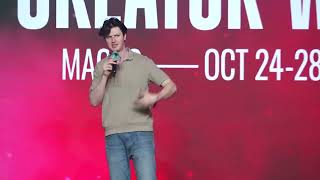
FanFix's co-CEO explains why creators should expand globally in 2025. Global internet users hit 5.5 billion, digital payments in developing markets topped 50%, and platforms now offer AI dubbing and multi-language tools that make international reach cheap. He walks through a three-step framework: use the tools, hire regional teams, and create content for each market, with examples from Brave Wilderness and Andrew Callaghan.
Chapters
Hello everybody. I'm so excited to be doing this. Again, as Jim just said, it was so lovely speaking some 18 months ago in Singapore. So yeah, I'm just so excited to be doing it now. I'm doing this session on building a creator business beyond your home market, which is funny, by the way, because this is like majorly preaching to the choir. If you are here, I assume you're already very aware of the larger opportunity of going beyond borders. So, you know, pat yourself on the back. You are already way ahead of most people, most creators. But yeah, I'm excited to go a lot deeper into this today. So a little bit about myself. I am the co-CEO of FanFix. We recently just crossed $200 million paid out to creators. Which is a really exciting milestone. Maybe a round of applause for $200 million. I mean, thank you for the creators, not for me. It has nothing to do with me. And then in addition, I lead the creator strategy for our parent company, Super Ordinary. And we do a lot. We've sort of been one of the first to really step into China in a major way with brands, with creators. Accelerating and really capitalizing off of that live streaming boom, this was largely something that Superordinary was leading. So very relevant to the whole story, but it's funny, really what drew me to this topic when I was first discussing with Jasper was in our very early days of FanFix, as we were thinking about our platform, we were thinking about, okay, what are we going to be doing? You know, you can imagine we had a sales team that was based out of North America. So naturally, it was, okay, now focus on finding creators who are based out of North America, right? And then what kept happening with our salespeople here in an LA office is, well, why is it that we keep getting these creators on our algorithms that might be from totally different demographics, right? Maybe it's like Vietnam, maybe it's the Philippines, maybe it's Brazil, especially when, again, we had tailored our algorithms for creators who are in the US. And it's funny, it was one of those huge light bulb moments because it made us realize, oh, what's happening is this creator represents the 1% of creators who is really understanding the larger value of expanding beyond their home market, hence why it is now, you know, sat in front of our algorithm. And that was like a huge eye-opening moment for us And then from there, we started working with a lot more creators on their approach to really cross borders. And just, you know, I think it's the core creator tenet, right, is thinking about what you do more like a business, and then properly operationalizing. And a huge element of that is, of course, the international. And really, the way I want to highlight this is, of course, it's not 2015 anymore, which sounds like a very corny phrase, but What does that really mean when I say like, it's not 2015 anymore? Well, I think in 2015, if you're a creator, that's around when I was starting on the business side of this whole industry, you know, it was very easy to justify doing nothing but staying in your home country and really making that your sole focus, right? But now, things have changed, and I'm gonna bore people with some statistics and numbers, but that's because that's my style. I love data, unfortunately. We've gone from 3 billion to 5.5 billion people online. We've gone from the digital world, call it the creator economy, going from 15% of global GDP to now 10 years later, 30% of global GDP. However, those two statistics really mean nothing if not for this next one, which I didn't put here, but in developing countries, the digital payment penetration, aka adults who are engaging with digital payments, has gone up from about 37% to over like 50%, right? Which is absolutely massive. Like that should really show suddenly in all of these new markets, there's a real opportunity, right? For a creator to monetize, for a brand to step in, for a platform to do a lot more. Um, and I want to go through some of these numbers because this really speaks to why now 2025 is really the time to start thinking about it. Like, We could have said at any period of time, like, you know what, it would be really smart to start thinking globally, but right now is this very unique opportunity. So YouTube launched multi-language audio, okay, and that basically just came out. They did like a soft launch, but now it's something that's really started to become rolled out. 25% increase in non-primary watch time on average from creators who are engaging in that. Instagram, this, I mean, it's so funny. This is the timing of us doing this conference because this came out like 2 weeks ago. Reels on Instagram, they just enabled AI dubbing for English to Spanish. Like, this just happened, which is absolutely insane. Again, how relevant this conversation is. Channels on WhatsApp, they get, you know, a little advantage because they were earlier, 2023. But channels now in basically every country. Snapchat absolutely dominating UAE. And, uh, TikTok, 25% of global ad audience in Southeast Asia. And we'll go into a little bit of what that means and the significance. And then of course, the US Latino GDP is $4.1 trillion, which is larger than France, which is absolutely crazy. So really, the 1% of creators who think beyond borders will be the ones who outlast algorithms, outsmart AI, and build true longevity. It was a conversation, I think yesterday somebody brought this up on a panel. They said, you know, I think AI is going to do away with maybe like the bottom class of creators, which I totally agree. But by the same token, it's really AI that is going to allow so many creators who leverage it, who understand, okay, I'm going to use AI to better build my business, to really come out on top and then operationalize their creator business for something that's more skewed towards longevity. And really, there's 3 methods of creator global expansion. And, you know, consider this. What I should have done is put, you know, how after you do a PowerPoint, you have all these regrets of, man, things you should have done. Imagine there's an arrow in between tools, teams, and new IP, because really this is like a progression because it's very easy to say, hey, suddenly go global if you're a creator, right? Or if you're a business helping creators, you should absolutely help them go. A lot easier said than done. But this is the method to almost baby step into something that's a lot bigger. So first, with tools, as we just discussed, YouTube has basically just launched multi-language audio, which is absolutely game-changing. You can upload the audio file, whether it's Arabic, Portuguese, you know, I'm blanking on other random languages to use as examples, but Hindi and Spanish, there you go, it does it for me. And at the same time, Reels just launched their tool as well, as well. Teams, so this is when after you've tested out with the tools what's working, you then can start to build out a team to help you really scale and operationalize in that region and actually build a true entity. So this is an example, Brave Wilderness. They're a massive US YouTube channel. Every one of their videos does like 10 million views on average, right? Well, they realized after testing with tools, Okay, wow, there's a massive opportunity here for us to actually build out channels that are in Portuguese, right? So suddenly, why is that an advantage over just doing it on their main channel? Well, suddenly it makes way more sense for a brand to approach them that maybe wants to get towards a Brazil audience to go, okay, great, we want to launch on this channel. Whereas if it was just on their main channel, the economics wouldn't make sense, right? The creators would go, well, we're way too expensive for this. Also, it's only a tiny sliver that is Brazil. But suddenly, after they know that there is interest, they're able to correctly operationalize and make that for something that is a brand new entity, brand new channel in the region. And then lastly, and by the way, I really want to underscore this, if I were to make any creator economy prediction of, of what's really going to happen, call it a year or 2 years from now, where I'm the most bullish, it is far and away this. So new IP for new regions, I think, is the most exciting opportunity. And this is my favorite example. Channel 5, Andrew Callahan, he's a creator out of the US. He basically takes a very irreverent style on news. He interviews Hunter Biden, and then Pete Buttigieg, and man-on-the-street interviews, has developed a real audience as like this modern-day journalist, right? Well, of course, he realized like, well, that's a very kind of esoteric localized thing. It doesn't work if I just dub that and then put it in Spanish, and then suddenly, You know, the Spanish-speaking audience would love it, doesn't really make sense, right? It's another country's politics. So instead, what he did is he said, what if I take my exact style, and I realize what resonates in these other countries, and I start to build that out with my brand, his, Channel 5, being the holding company, being the parent company of it, right? So that's what he did, and it's so brilliant. So now, this guy is, he must be a contractor or an employee, You know, maybe he has some equity in this new entity. He is almost like a hired person, is the best way I know how to really phrase it, for this new region, right? But that is IP that Channel 5, Andrew Callaghan, is building specifically for this totally different territory that he's not usually stepping into. So I wanna go over the most valuable creator markets because out of, of course, every country, there's, you know, pros and cons. I think the ones to best focus on, the ones to best really put attention to, if you are a creator or a business that is looking to help creators expand, it's really going to go to these. So first, MENA, far and away Saudi, UAE, Egypt. So I'll tell you guys, when we were building FanFix, this was our earliest days. Once upon a time, we were actually doing more revenue overseas than we were doing domestically. And, you know, a huge driver, not the sole one, was MENA. There's such a rabid creator economy, such a thirst for creator content and exclusive content that we were really blown away. Fastest growing digital economy per capita. Also, I believe it's something like 70% of the population in this region is like under the age of 35, which is absolutely insane. Snapchat, in terms of platform habits, Snapchat absolutely dominates. I really would describe it as the equivalent of maybe like WhatsApp in Mexico or WeChat in China, right? Snapchat is really the communication, it's how you talk with all of your friends, it's how you get entertainment. Snapchat is really everything. Next, of course, is Spanish language market, right? 600 million plus Spanish speakers. Actually, an interesting study recently came out It is US Latino teens, I believe it's something like 70%+ use TikTok daily, whereas other teens are using it maybe like 50%. So TikTok, absolutely massive. YouTube remains the most popular platform. China, again, this is like, this feels ridiculous saying this to this audience that China is a massive opportunity. I feel like folks probably know this, but again, largest e-commerce economy globally. That of course is both the influencer marketing, the livestream shopping, Everything that everyone here is probably extremely privy to. Best suited for US creators with product tie-ins, but really fits for all creators. Of course, I'm gonna go over the main ones, would be XiaoHongShu, call it that's your Instagram. Bilibili, that being your YouTube. You know, WeChat may be best thought of as like a Snapchat meets iMessage, something of that nature. And then lastly, Southeast Asia. So this was a stat I forecasted, 'cause it really blows me away. 25% of TikTok's ad audience is Southeast Asia. So you might say, what is an ad audience? That doesn't really mean anything to me. Well, if you are an advertiser and you want to utilize TikTok to reach an audience, you basically have a pool of like 1.5 billion users. 25% of those are in Southeast Asia because the community in Southeast Asia around TikTok right now is so rabid, so intense. It just really is lending itself to an insane opportunity. Um, and also, yes, YouTube Shorts are absolutely massive. Honorable mentions, how could I not? India and Brazil, love them. The only reasons they're not in the main, call it 4 or 5, you know, sometimes issues with CPMs. And so this is a little bit of a cheat sheet of how one would start to step in on the platform side, right? Mena, build Snap native and then dub for YouTube Arabic. Spanish world, turn on Spanish multi-language audio on YouTube, do the Reels AI dub, and then run a WhatsApp channel to start to really congregate your community. Southeast Asia, short form, hire a trend scout, which I'm going to get into very shortly. And then lastly, China, of course, I would say start on Red, which is Xiaohongshu, and then you can expand in any other method. And really the 1, 2, 3 that I want to go over of this is how you tackle this is again, first identify and use platform tools. So many of the creators that we've talked with who have started to expand globally, it all starts with a little, you know, nugget. And by the way, for us as a platform, when we started to really expand globally, the same thing happened. We noticed a little bit of data and then we said, wow, if we extrapolate this data, I bet something absolutely incredible will be the same. So first things first is checking analytics, right? Seeing, wow, almost inadvertently there's some other country, there's some other language where my content is resonating. It was not a part of the plan. It was not something I intended for. But looking at analytics, you'll start to see, okay, something is really hitting in whatever. Maybe it's Brazil, maybe it's a Spanish-speaking market. Who knows, right? Then know your content fit, right? Again, going back to politics, if your content is politics, it probably is not going to fit many regions, whereas Maybe if you're a couple duo and you do short-form content and it's very funny and silly, yeah, that's probably going to resonate with many different, like, many different languages. And then lastly, do a localization test. Actually, it was the Stokes twins who talked about this yesterday, which was fantastic. One of the best things you can do is utilize short-form as a way to properly test the waters for a new market, right? So immediately you could run an Instagram Reel, a YouTube Short, a TikTok to see if something is resonating in that language. And then if it is, you suddenly know, okay, wow. So this is a real opportunity for me to start to expand. 2, hire teams and build systems. So often when we talk with creators, they'll say to us, they'll be like, okay, well, what do I do in terms of— so, okay, I know the audience I want to go to, right? Maybe it's a US creator and they go, I know that what I really want to do here is step heavily maybe into China, is maybe step heavily into a Spanish-speaking market, but I just don't know literally what the next step is. To which every time without fail, and it's actually, hence the term without fail, it has never failed, solicit your audience. Like literally put up an Instagram story, say, hey, I'm looking to expand into this area. Does anybody, one, live there, or two, have experience in that field? And then finding people who could be interns or contractors, it's very, very easy. Two, using job boards, similar thing, Handshake for college interns, or Upwork if you wanna find people. Like, I know creators who've actually hired whole task force out of maybe like Colombia through Upwork, and it's worked very successfully. And then lastly, building channel presences in that region, right? That's really the biggest thing is then knowing, okay, I've used the tools, I now know that this resonates for this audience. So therefore, I'm going to build out, you know, maybe a TikTok page, an Instagram page, or a YouTube channel specifically for this region. So then I can start to get brand opportunities. And then 3, of course, is build the empire. That's where you've successfully operationalized, right? You go, okay, now I am dubbing and modifying my existing content for a new language that is now being placed into their own channels respective to the region. And now I'm starting to notice there's a little nugget, there's a little opportunity that I didn't previously see, which is, okay, maybe something is resonating here that wouldn't really fit with my main audience, but I can now expand elsewhere. Well, that's where you then get into a situation similar to what I showed you with Channel 5, the political channel, where you start to build content specific to the region. And that's where you're really expanding IP and honestly better thinking of your channel or main influence almost as a holding company that then starts to spin off many different media assets across many different regions. And then, of course, finding local opportunities. I wanted to shout out a few partners, many of whom are here. These are, of course, great partners who can help with the, you know, finding of brands and everything else. And then also building in public. If you're a creator, this is a guy that I know who started building out his livestream shopping business, then started posting about it on LinkedIn, and then suddenly he gets deluged with opportunities, new partners, everything else. I want to end on my last 2 minutes here with 2 examples, both of these China, of creators who've done this really, really well. So Pamela Reif, she is German-American, and massive on social media, right? She wanted to then extend into China. So of course, she started working with a team to start putting her content on XiaoHongShu, really start building out the audience, and also making some of it a lot more relatable, right? So in the last slide, I'm not even gonna try to pronounce it because it would be so embarrassing if I did, but she talks about how her studies are like, You know, a notorious— notoriously rigorous studies that happen very often in China. And then at the same time, she does an ad specific to this platform for the, you know, largest mobile carrier in China. Another company name I'm not going to try to pronounce because I know I would get it incorrect. Jimmy Ouyang as well, massive comedian, absolutely hilarious, did something similar, right? He was posting his content in the US, he quickly realized, okay, wow, a lot of this is resonating in China. So suddenly that was his nugget to then start building out on these new channels and then start building out the audience. And now, as you can see, he has a massive community on Xiaohongshu, which again is just benefiting his whole business. So I'm going to end on this note. The global creator economy is projected to exceed $500 billion by 2027. Up from roughly $250 billion today. And this conference, there's been a lot of conversations about AI and concern for creators, which I think is super valid. As I've talked about, I really do believe there's a bottom class of creators who are going to be greatly impacted by a lot of this innovation. But again, by that same token, I think creators who find— I have to say the dreaded 7, 6, 5, 4. I'm going to go 20 seconds over. But the creators who do find the opportunities to go, okay, you know what, I'm going to look at my own data, I'm going to see where there's an opportunity. Again, I really— those countries that I highlighted are the best opportunities for any creator who wants to expand into a new region. Then going, okay, let me start to repurpose my content specifically for this territory, build out these properties. And then lastly, which again, I'm going to say, prepare yourself, you're going to start seeing way more of this in the creator economy going, okay, now for this other region, I'm seeing a massive opportunity for now starting to build something out specific to this territory that that will really be the future. And by the way, creators who do that will be the ones who not only, you know, completely persevere through any AI sort of fear, but also build really successful, long-lasting careers. Anyways, thank you guys so much. This has been a pleasure. And yeah, thank you.