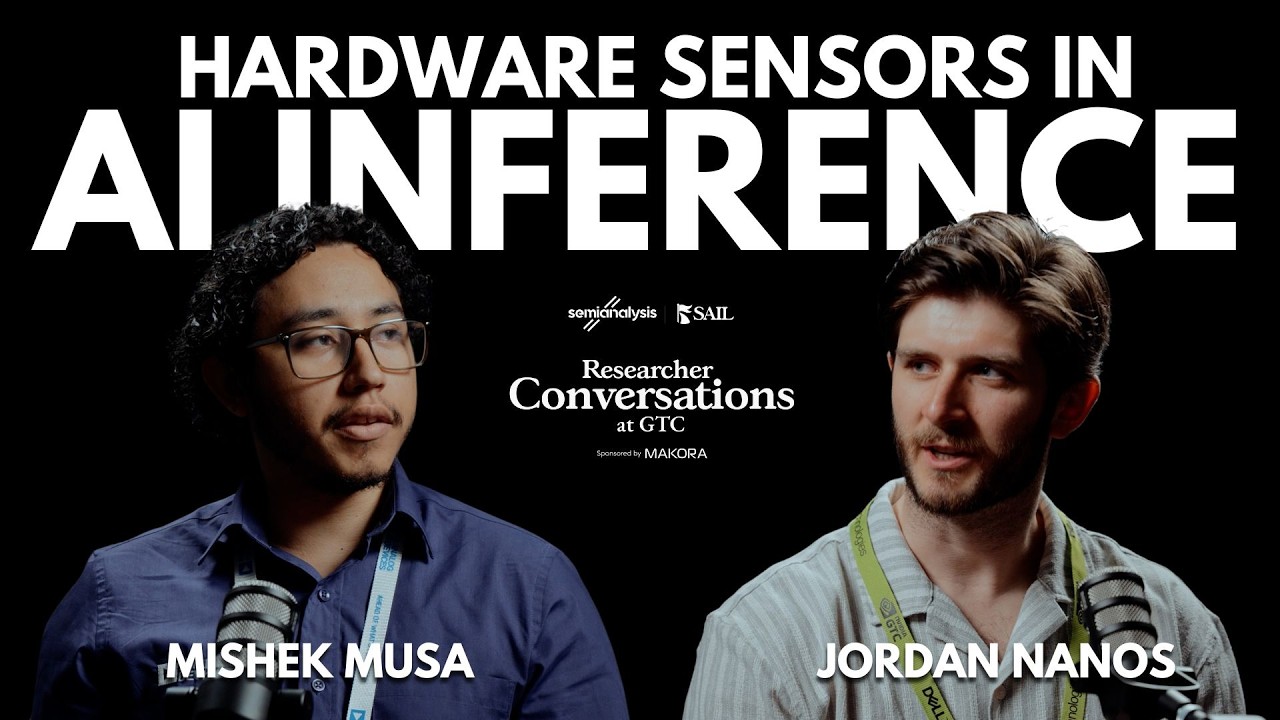
Jordan Nanos interviews Rishik Musa from Analog Devices about hardware for AI inference on robots. Analog built a multimodal tactile sensor for robot grippers and is working on edge compute solutions to run inference directly on robots, plus plans to release physical benchmarks to close the gap between simulation and real-world performance.
Chapters
Hi everyone, welcome back. This is Jordan Nanos here for SemiAnalysis and Sail Media at GTC 2026. I'm here with Rishik Musa. We're gonna have a little chat about, yeah, what's new. Welcome.
Yeah, thank you.
So you guys had an interesting demo on the show floor this week, and I know you're part of a A new division within ADI. Can you gimme a, just like a high-level summary of what you guys are working on?
Yeah, so I'm with the Emerging Tech Hub in Analog Devices. We're a relatively new group focused on robotics and edge computing within the company. We're a 60-year-old company providing semiconductor and chip-level solutions. However, our group works a little bit higher level at the system level, trying to see how we can integrate our existing technologies into robotic solutions. And kind of push the edge of technology there.
Yeah, cool. So take me through what are some of the concepts or ways you see robotics would be useful in these applications?
Yeah, so I'm specifically talking about one of the demos we're showcasing here at GTC. We're using our in-house built tactile sensing solution. Essentially, it's a sensor that fits into like the fingertips of robot grippers or hands or whatever types of dexterous manipulation we're trying to accomplish. And it gives us a sense of the forces we're applying as we're grasping on objects. It allows us to be delicate if we need to handle, for example, the fiber connectors in a data center type application. And so what's nice about the sensor as well is that it's a multimodal sensor. And so not only are you getting force feedback and the pressure sensitivity, but it also has accelerometers. and some vibration sensors that can give you a better picture of what's happening at that interaction.
Okay. So literally plugging in cables?
Yeah, that's one of the applications. We work very closely with a lot of different partners in our team. It's kind of a co-innovation space within ADI. And one of the key applications that we're noticing is trying to automate some of the maintenance that's done inside of data centers. So going in and disconnecting cables, polishing fibers, And all of that requires a high level of precision as well as sensitivity to these types of connectors. And so we think some of the solutions we're providing there—
You guys have a robot using one of the clickers right now to clean?
At the moment, no. But that's kind of the step where we're trying to push. We're also trying to engage a lot more in the robotics community. So we're developing a set of benchmarks that'll be physical boards that are analogous to types of problems we see in data centers. Automotive cable harness assembly, gearbox assembly. It'll all get released to the public, open source so that researchers and people in the industry can work on these problems and be able to share knowledge around how we go about solving these problems.
But wait, yeah, so the benchmark or the leaderboard is gonna be a robot in a room set up that—
Not necessarily a robot. You're welcome to choose whichever robot you want to use to solve the problem.
Oh, okay.
It's just a board that sits on the table and the robot can go in. program it however you choose to, whether it be classical control or using newer AI-driven policies in order to solve these problems and hopefully be able to allow others to learn from what you're doing as well.
Yeah, a little bit different than grade school math benchmarks though, I think it's still—
Yeah, a little bit. But what's nice too about what we're doing is that not only are we providing somewhat of the physical device itself, but also we're working with key partners to develop high-fidelity simulation assets that allow people to train their policies in simulation. We'll be able to provide simulations for our sensors as well. So like our tactile sensing or time-of-flight solution that's able to create a depth scene or a depth estimation of the scene we're looking at. And all of that can be used together to create really nice robotic solutions.
Yeah. So what does this look like as a product that you guys would sell? Would it be A software product people can run on generic robots? You would sell a robot itself?
So we're not a robotics company by any means. We provide the solutions that enable roboticists to do what they do best. We control a very precise signal chain all the way down through our analog-to-digital converters, CMOS sensors, now tactile sensing, time-of-flight sensing. And we're really pushing basically at the edge of what these devices can do to enable roboticists to go in and solve these problems using our sensor and our other types of technologies.
Got it. Makes sense. Where do you think you guys go from here? More benchmarks, more examples?
Yeah, I think robotics is a longstanding challenge in terms of being able to collect data with robots. And so being able to provide this type of solution where if we have very accurate simulation models, it minimizes what we call the sim-to-real gap. And then from there, people can, you know, choose, you're free to choose how you wanna solve those problems. But we just wanna be the company that's enabling people to be able to do that. And if you choose to use our sensors, we think that's probably what's gonna be best. But again, it's all about enabling people to do what they do best with their robots.
Makes sense. Yeah. What are some of the applications, I guess, that you're most excited about? I guess the, yeah, the cleaning of fiber is one that Comes up all the time in data centers.
Definitely, yeah. We're pretty excited about the data center, particularly within our group. We have some key partners that we're working with to see how our system level group can kind of integrate some of the solutions and be able to test it out. A big thing for us is being able to understand the problems that people are having in the industry and what they need to solve or how we can provide the technology that will enable them to solve those problems.
How do they do that? Do they provide data? Do they provide just like a spec that you have to design towards?
Well, yeah, so that's kind of the unique feature about our team. It's kind of designed around this idea of being a co-innovation hub. So they're more than welcome to bring their engineers into our lab. We work together to try to solve the problem, whether it be they're bringing in new tech from their company and seeing how we can support that, or we're showing off some of the new tech we have and how we can enable them to solve their problems as well.
Do you have any examples of like collaborations that you can talk about?
At the moment, no, but it's ongoing and we're pretty excited about what we're doing.
Makes sense. How about GTC in general, right? There's lots of work with NVIDIA and GPUs and AI and training models and stuff like that. Are you guys doing anything unique with the, on the model training side, you know, in terms of like maybe how you run the system infrastructure or data center for yourself?
Yeah, so I wouldn't necessarily say we're doing anything necessarily unique on the training side per se, but when it comes to actually deploying the model and doing inference, we have a team dedicated to edge computing that's trying to push the technology to the point where we can take these large models, distill it down into a form factor that allows people to run it on their robots, in your autonomous vehicle.
Yeah. Yeah, so what does that look like? The chips are getting a little more powerful every year.
Exactly.
Maybe a little more energy efficient. Meanwhile, the models, the distillation's getting a little bit better. So they're kind of converging together.
That's the idea is that we're taking these large models, putting it into a compact form factor that can sit on the edge in a more power-efficient way. And then that enables you to not have to be having a super big GPU box sticking off the side of your robot or whatever. All of it can be You know, put into a really small form factor.
Yeah. Are these NVIDIA GPUs or are these custom chips? Kind of varies?
I think it depends. I'm not too much involved on that side of the story when it comes to edge computing, but—
It can be pretty complicated just to get a model to run on some of these custom chips that people are building. So I'm curious if there's A way in which the chip itself might be co-designed with the model that it's actually going to be running.
Yeah, I think that that's a big part too. And again, when it comes to the co-innovation that I talked about is that we're not only in the robotics space, we're also in the edge computing. So we talk to the big players in the space and see how we can integrate their technologies or sorry, their models into the fabric of whatever we're trying to design.
Yeah.
When it comes to custom SoCs or ASICs and whatnot.
Right. Yeah. I guess there's a lot of cases where people might be training really big models and just have no idea how they— I guess it solves a task, but let's just, what, wait 3 years for the chips to catch up?
Exactly. And so we're thinking a little forward and like, where do we see these models getting deployed in the robotic space, autonomous cars, home robots?
Yeah. Awesome. Well, yeah, you got me thinking about something to do my laundry now instead of just the fiber ends, but yeah. Okay. I think that's a good way to wrap. And, um, yeah, I just want to thank everybody for watching and appreciate you coming in and taking the time.