Transpersonal Effects of Self-Initiated Expatriation on Retirees
In this symposium presentation, Elizabeth Carrio introduces her qualitative research on how self‑initiated expatriation influences retirees both personally and collectively. She frames expatriation as a growing social phenomenon among baby‑boomers that can generate transpersonal effects—experiences that transcend individual identity, such as heightened purpose, empathy, cultural understanding, gratitude, and a sense of global citizenship. Carrio defines transpersonal effects at both the individual and societal levels, noting that not all expatriates experience them and some may face challenges. She explains her motivation for the study, emphasizing an embodied epistemology rooted in transpersonal psychology: research should arise from lived, body‑mind experience rather than being purely intellectual. The presentation sets the stage for exploring how retirees, as a demographic cohort, may act as agents of cultural pollination and paradigm shift, while also acknowledging the variability of outcomes.
Chapters
them in the chat box or you can raise your hand after Elizabeth's presentation. So up next we have Elizabeth Carrio, who I know personally. We've both just graduated from the ULF Trust after our 3-year master's and we were in our personal tutor group together, so it's an honour and a privilege to introduce you, Elizabeth. I know a little bit about your working journey and Yeah, you're beautiful. You have a beautiful way of speaking. And, uh, after working in governance and change management, change management in a political diplomatic world, um, which was more focused on power than the well-being of populations, Elizabeth decided to come back to psychology and study psychology. And now she's supporting people and organizations in their quest for meaning, which I think is bringing more meaning to your life. And, um, like I said, she's a graduate of the LF Trust, and I think you're also doing a PhD alongside that, amongst many other things. And her talk is going to be on trans— the transpersonal effects of expatriation on retirees. So thank you and welcome, Elizabeth.
Thank you, Rainbow, for this My short presentation. I'm very pleased to be here. I'm going to share my screen, and I think this is it. And where am I? So I need to go— where is it? Let me see if I can— I have something on my screen. Elizabeth, if you go right to the very bottom of your screen, bottom right-hand corner, can you see a little square? You've got a little movable— that's it. The next one. That's it. Absolutely. Yes, thank you very much. All the technique is sometimes difficult. So thank you. Thank you for this opportunity to present my research and to all the symposium for presenting my research. So as you can see, it's about transpersonal effects of self-initiated expatriation on retirees. So in this research, I try to show that self-initiated expatriation can have transpersonal effects, not— but not only on individuals, but also on societies. Because of their growing number, you know, we have a generation where we call the baby boomers. So it's this number of of expatriated is increasing more and more. And I observed that we are witnessing in fact a social phenomenon which has also transpersonal effects, not only economic effects but transpersonal effects. In other words, these retirees participate in the emergence of a new paradigm. So what means transpersonal effects? Before to start the presentation, I would like to define the terms. On an individual level, they refer to experiences that transcend personal identity. These effects may take different forms, such as an increased sense of purpose, greater empathy or cultural understanding, or increased sense of gratitude. On a collective level, transpersonal effects refers to a global— to a sense of global citizenship, a greater tolerance and openness, And because of this growing number of retirees, they, they participate to the pollination of the world. Of course, not all the retirees who choose to live abroad experience these transpersonal effects, and some may encounter challenges that outweigh the potential benefits of expatriation. However, for those who are open to the experience, self-initiated expatriation can be a powerful opportunity for growth, connection, and personal fulfillment. So why did I choose this subject? In fact, I've chosen this subject because of my own experience. I think that in order for research to be credible, the research has to be embodied on an epistemological level. I think also that embodied experience is a critical aspect of transpersonal psychology. It emphasizes the importance of a body-mind connection in understanding our experience of the world and to make sense of it. For me, research is not a purely intellectual exercise.
It's—
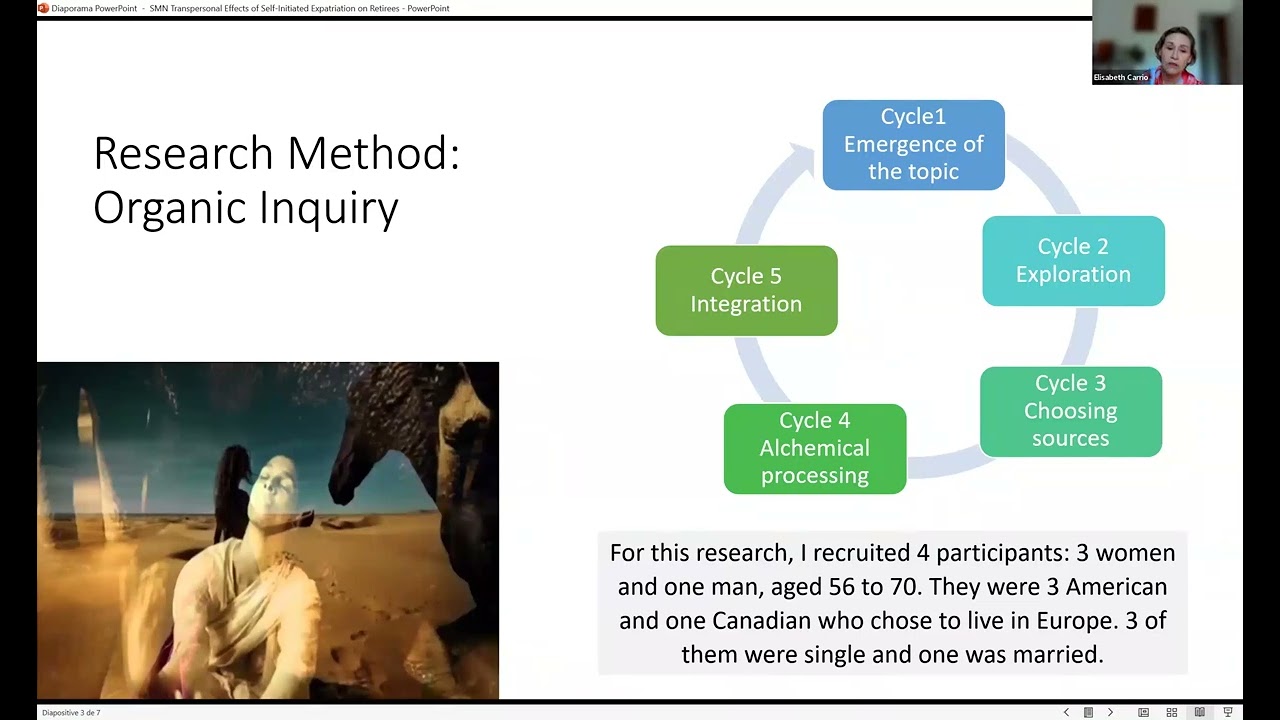
it has to be useful to the community. It must be grounded in personal and lived experience, again, which we try to make sense. So I chose this subject because I am partially retired for 2 years, and since then I really felt— I feel— I really felt an increasing need for living, to live abroad and to extend my experience. Before studying transpersonal psychology, I thought that it was because I traveled a lot since I was young because, because of a war, because of exile during my childhood, and then I traveled also for professional reasons. But I really— I realized thereafter during my study that other reasons may explain the need for expatriation, such as curiosity, the need for novelty, searching for roots also, what are my roots, or reconnecting with my ancestors. And what I did, by the way, during the psilocybin session, and when I saw my ancestors as warriors and also exiled people. So I chose this subject and for my research project to go deeper, and because I discovered that a lot of people was— were in the same situation than me. So I submitted the project proposal to Aleph Trust, and it was accepted. For this research, I used a methodology called organic inquiry developed by Anderson and Broad. Organic inquiry is very interesting, as you can see on the screen, because it's an inward examination of my own experience on the topic, an outward movement on analyzing other participants' experience, and thereafter again Any inward movement returns to my reflections on my own shift in understanding in the light of new data. So it is an ongoing process, it is an alchemical process, it's a long-time process also, made up of multiple cycles. This is not the good sense, this is the good sense. So organic inquiry also allows access to subconscious knowledge, and it is an effective way of explaining the universal through the personal experiences. By subconscious knowledge, I mean information that is not currently in our conscious awareness, but we have learned and stored in our minds through past experiences. But I am also referring to this field of information described by Rupert Sheldrake under the concept of morphic resonance, to which we can access through intuition. So I went through the 5 cycles, right? You can see cycle 1 was the cycle during which the subject of a research project emerged, as I already described. In cycle 2, I explored my own values, my assumptions, my understanding about the topic, while we reviewing the literature. And in fact, we don't have a lot of literature on the subject. As soon as the subject has been approved by the RF Trust, I started to deepen my research and my relationship with the subject. I wrote my thoughts in a journal daily, every day. I also meditated regularly. I made some shamanic journeys. I also paid more attention to external signals such as unexpected meetings or conversations. On this topic, and I also analyze the contents of my dreams. So as you see, I try to connect to the Akashic field through a lot of different means. And during this period, of course, more scientifically, I started to look for articles and books on my topic. Cycle 3. Cycle 3 consists of choosing sources because I receive a lot of information, so I have to, to go to, to choose my sources and to go in a deeper on a deeper level. As being myself a participant in this project, I went on writing down my own story from my experience. I selected articles and books, and also I started to recruit and interviewed my participants. So 4 persons accepted to be interviewed, 3 women, 1 man, 4 free American people, free American, 1 Canadian, age 56 to 70 years old. 3 participants were single, 1 was married. I didn't investigate further in this— at this level, but I think it's important to say it. They are all coming from what we call new countries. So interviews, I conducted the interviews on Zoom. It was recorded. I used a semi-structured questionnaire based on 6 questions, but in fact, it was really an open discussion. Cycle 4 focuses on how I change and what I have learned from data collection. And indeed, my analysis of the subject evolved, and I realized the implications of this research were more profound than I initially thought. In the beginning, I believed that only personal reasons explained the decision to live abroad. And I underestimated completely the impact of expatriation, not only on retirees, on individuals, but also on societies. Because I receive a lot of information, as I told you during my previous stages, I have to identify the data which were directly relevant to my research. But— and I also follow my intuition, and I also use some software such as Klaxoon, if somebody— some of you know it. And/or it's mine. Cycle 5, cycle 5, I integrated all the data and I drew some conclusions which are temporary conclusions, in fact, because I think this research has to be conducted further. So, this is the results of my research. And I hope you can see it because it's— I tried to compact it on one slide. And in fact, we have 3 parts. From 3 main topics emerge. The one— and each may be considered as a step in a journey towards a new life balance and a spiritual maturity. So the first, here on the left of the screen, it's about the reasons explaining the decision for living abroad. And indeed, there were very, very different reasons explaining it. Each Each participant has his own reasons. Among them, we can find, from the literature only, maintaining a privilege, economic privilege, or searching for a better quality of life. But from the participants, I have another overview. They talk about time awareness, fulfillment of a dream, loyalty to ancestors, a quest for a meaningful life. And especially, and perhaps above all, they seem to have some common personality traits. And this also has to be more investigated more deeply. The second theme, what you see on the center of the screen, is what happens during this journey, the transformative process of this journey, and what are the coping strategies that the retirees put in place. Living in an unknown country is a challenging experience. Some of them may not talk the language, and retirees may face difficulties of acculturation. In front of these difficulties, participants adopted a surprisingly similar attitude towards the culture of the home and the host countries. They distanced themselves from both cultures, and they created a circle of friends made up of expatriates as themselves, they construct— they constructed what I call a liminal space, at the same time being outside the local culture and mixed with it. And within this liminal space, a transformation takes place. The participants have a feeling to be special, to become special, as well as a feeling of having found a new family, And these facts improve tremendously their well-being. The third topic that I found is on the right of the screen, is that it's a journey with no return because of this transformation. Not only do these expatriated retirees recreate a transnational and multicultural community, But they improve their self-knowledge and their level of spiritual maturity, as demonstrated through the interviews. In fact, I was— I based my work on a new work on theory that Tom Stan in 2011 developed, which is called gérotranscendance. And gérotranscendance relates to a redefinition of the self. A relation in the redefinition of a relationship with the others, a new understanding on fundamental existential questions such as death, life, age. So retirees are less self-occupied and at the same time more selective in the choice of social and other activities. Gerotranscendence also encompasses an increased feeling of affinity with past generations. And a decreased interest in superficial, superfluous social interaction. This is the main direct finding from interviews, but I came then to the 3 main findings from the interviews and the literature. First, the emergence of a new archetype. I think we can witness the emergence— we are witnessing the emergence of a new archetype. archetype because we are living in good health more and more, longer and longer. This archetype is made up of a trio of 2 other archetypes, the Old Sage and the Traveler. It refers to a figure or character who has reached an advanced age and embarks on a journey leading to spiritual and personal growth. The Old Sage Traveler archetype may be often depicting depicted as having gained wisdom and experience over a long life and being able to share their knowledge and insights with others. This archetype may also symbolize a passage of time, inevitability of aging, and the search for meaning and purpose in life. Because the number of— the number of these retirees is continuously increasing, The self-expatriated retirees challenge the preconceived ideas of retirement, aging, and death, but also the artificial dimension of frontiers, of physical borders, compared to the need of freedom of human beings. Second finding is about eternal exile. The attainment of this higher level of consciousness added to the aging process makes that return to the previous state or to their home country quite impossible. Whatever the reasons for leaving their countries, the expatriated retirees do not intend to return. When abroad, these retirees recreated a community of like-minded people with its codes, its value, Showing distancing again from the local cultures. Living in a foreign country prompts them to improve their self-knowledge and their limits, their level of spiritual maturity, characterized by a deep understanding of one's spiritual belief, a sense of inner peace and purpose, and the development of qualities such as compassion and empathy. And the third finding is that is pollinating, is they are pollinating other countries. Eritreans' decision to live abroad doesn't— does not only transform the individual but also societies, because again, this number, their number is increasing. The expatriated Eritreans modify also society's beliefs, promoting multiculturalism, transnationalism above the borders, and pollinating local culture. They also teach younger generations the importance of freedom to be authentic, to be yourself. In addition to being a bridge between cultures, they challenge the beliefs of Western societies on retirement, age, death. They question the notion of direct family and community in which affiliation becomes fluid. They work towards a more inclusive world based on mutual understanding through the promotion of essential values such as openness, curiosity, otherness. They took the role of transmitter of an experience of elsewhere and the other. Conclusion. So, conclusion. In the discussion I think that these retirees especially encourage us to ask ourselves questions about the definition of life. What is life? Their experiences show us that life is a dynamic and continuous flow. To be alive is to be constantly self-constructing. Life doesn't stop under the effect of an external event such as retirement. It continues to unfold following the instructions inscribed in the DNA of each one. To be alive means to evolve and transmit genetic information inherited from our ancestors, while of course transforming it and adapting it to the context. Ritai expatriates demonstrate the vital force that characterizes the living and which is animated by an interior impulse or a drive which pushes to set us free from the limits, internal or external limits, and to overcome fears. This vital force response to 2 needs, to my opinion: the need of responding to the immanent principles of evolution and the need for purpose. Movement and purpose, or evolution and purpose, combine here towards a dynamic of self-discovery of others and oneself. Retirement is considered in Western society as a social marker of old age. However, the conclusions of this research project show that this is not the case. Retirement may also mark the beginning of a more fulfilling life in line with a dream or a personality. The living is also capable of regenerating itself. It is separated from others and at the same time needs them, needs others to exist, thus forming what we can call an ecosystem with shifting forms, as shown by the communities created by these retirees. And though it was not their intention, these retirees shake up and open the way to a new form and more inclusive societies. So I thank you for your attention, and I've got further. So, and really, I am at your disposal. I think it's this research project may be deepened. So I really appreciate all your comments, and which can— because I would like to do a PhD on this subject and to go further. So I will appreciate all your questions, comments, or observations for deepening my research. Thank you very much.
More from Elizabeth



3.1 Archétypes & sous-personnalités : vous n'êtes pas un seul moi — Comprendre




Transformez Votre Vie : Atteignez Vos Objectifs Grâce à la Psychologie Transpersonnelle


