12 Lies About Marketing That Are Killing Your Sales
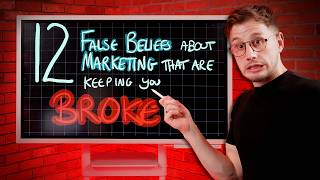
Elliott Botterill, CMO of Entrepreneur's Circle, debunks thirteen marketing myths keeping entrepreneurs stuck. He spent $80K on ads to generate $1.1M revenue and 6,000 leads in 30 days, proving that marketing is math plus creativity, not intuition. Common mistakes: obsessing over landing page beauty, emailing too rarely, and blaming ads instead of testing variables systematically.
Chapters
Ladies and gentlemen, 12 false beliefs about marketing that are holding you back and keeping you broke and not allowing you to get the results that you want in your business. You see, as a business owner, as an entrepreneur, as someone looking to spend time, effort, and their valuable resources on marketing and making people aware of their stuff so that they will buy it, what goes on between our ears greatly affects the results we're able to get. And in this video, I'm going to unpack 12 of the most common false beliefs that I have seen hold back very smart people, very capable people from achieving the levels of profitability and customer acquisition that they want. You see, we must understand the fundamental truth about our being, and we must understand that what goes on in our head, in our brain, the thoughts that we have ultimately lead to how we feel, and then based on how we feel, we act. So all of the thoughts, the things that go on in our head, are responsible for all of our actions in this world, and all of our actions are responsible for all of the results that we will ever achieve and experience. So it is critically important that we focus in on the things that could be holding us back. You see, the dangerous thing about false beliefs are normally that we don't even know we have them. So my job in this video is to make you aware of what they are. Welcome back to the YouTube channel. My name is Elliott. For those who don't know me, welcome back to my loyal viewers. Started my career in marketing over a decade ago, working at a very large independent advertising agency. Then I started my own business in my mom and dad's front room, as you can see there. Grew that into a 7-figure agency, had a great time, and then exited and joined Entrepreneur's Circle, where I'm now the Chief Marketing Officer. And during that time, I had the pleasure of working alongside many of your favorite gurus in the space. And so currently, we are an 8-figure business. We have a software company, a high-ticket coaching program, and a low-ticket community. And as you can see, last 30 days as of recording this video, we spent around $80K on ads. So actually, we're spending a bit less at the moment, but our profitability is beautiful. We did $1.1 million in that 30-day period, generated 6,000 leads, a bunch of calls and sales, and so on and so forth. I say this so you have an accurate lens as to where this information is coming from, because you should never trust random strangers on the internet. Now, this channel is all about driving traffic, converting traffic, and closing sales. And today I have got 12 false beliefs across each of those 3 categories. And we're gonna start off with driving traffic. The first false belief that a lot of people have is that nowadays, particularly on Meta, which is the primary place where we run our ads, is that you need to give your campaigns lots of time to learn. We must allow it to exit the learning phase. We must give it a few weeks to adapt so this algorithm can do a good job. Now, the root cause of this belief is in the algorithmic nature of advertising platforms. Meaning that now more than ever, the algorithm does all the work. What do I mean by that? It looks at who are engaging with our ads and converting and then goes and finds more of them. Back in the day, we did have to allow days and weeks in order for the algorithm to learn effectively, but nowadays we have to wait way less, and people use this as an excuse to not take action and to not make changes and to not make new ads and test them out. Because frankly, the advancements in machine learning and AI that have rolled out in the last couple of years that are now embedded within the Meta Ads platform, particularly, that sucker learns so fast. And plus, it's normally never a factor based around time, it's based around your spend as well. So especially as you become a more competent advertiser and you're spending decent amounts, the thing is going to learn very quickly. But all of my many, many years of advertising now, spending many, many millions of dollars, I know that when we launch a campaign, within the first 48 hours at least, most of the time sooner than that, we can tell if it's working. You can just flip and tell if it's working. It's very rare that something doesn't work very well, trundles along, and then picks up. So that is limiting belief number 1. Test quickly and kill quickly. If we don't see traction within 24, 48 hours, something is off. We make changes and we move. We don't go waiting for this thing. Limiting belief number 2 is that we want to test lots of creative and that volume wins. So this is a dangerous belief because it's actually kind of true. To a degree. You see, we absolutely do want to test lots of creative, and to an extent, volume wins. Meta tell us that the top 0.1% of advertisers, they simply test 11 times more the volume of creative. And so we have good reason to believe this, and I partially believe this. The bit that makes this untrue is that people forget about the quality. And yes, we want to produce volumes of creative, but now more than ever, the quality of them is important. You see, we live in an age of AI where people are generating AI copy left, right, and center. Our Meta ads account is filled with AI features that will produce AI headlines, AI copy, even AI images and creatives for us. Now what this means is the landscape is filled with AI slop and they— there is more volume out there than ever before. We can win and we can stand out by actually making sure our stuff is of a higher quality. So we are seeing better results when instead of trying to produce 50 ad creatives, we're producing 20 really good ones and we're putting way more time and effort into each of those 20. So instead of what we used to do a lot of, which would be we make our hooks, we might make, you know, 10 hooks, then we would film some bodies and then we would film some CTAs and that in total would stitch them together. So you'd have 10 times 2 times 2, you'd have 40 ad variants there, but they'd all be kind of similar. Now instead of doing that, we'd much rather just film 20 unique ads that are going to be of a higher individual quality. So we still have sufficient volume, but we are prioritizing the quality as well. And the top advertisers, you bet they're not only pumping out volume, but they are doing it to a very high quality. So that is the important counterbalance. I've seen many accounts get wrecked because people just do volumes of rubbish stuff. Third, the next false belief is that you should never test individual variables, that you're much better off to take all your ad copy, take all these headlines, enable all the Meta's AI features, throw them all into a dynamic creative ad set, and boom, let it test everything all at once. For me, that is a recipe for a treacherous future. You see, when you don't test individual variables, you can never establish causation. We never know truly what was the thing that actually led to the good or bad performance. If we can isolate the individual variables and conduct our advertising and our marketing in a scientific way, then we can pocket the learnings and we can make sure we do more of it if it was good, or do less of it in future if it was bad. And if we consistently do that over time, then we are able to have a very happy life where our results just get better and better. If we don't do it, and what a lot of people do, they never capture the learnings, and as a result, they stay flat and they have ups and downs and ups and downs because they never understand what is actually causing the change in performance. And worse, when they do things that don't work, they don't capture that, so they repeat the same mistakes over and over again. And it's a vicious cycle. So it's quicker and easier to not do this, but by taking the time and use the 4-phase testing system that we use, and I teach my clients to use inside my secret vault, we're able to isolate these variables, capture the learnings, and then make sure we utilise them moving forward. This brings us to number 4. I've lost count of how many times I've had a client say this. But my audience, they're not on Facebook. They're not on Facebook. Shut the hell up. Yes, they are. Yes, they are. Even you, business to business, business owner who doubts that your high-level decision makers are on Facebook. Let me tell you, they are, or at least a vast majority of them are. Let us not forget that Meta is not just Facebook, but it is Instagram. and it is WhatsApp as well. And cumulatively, it's something insane. It's like 3 billion people across these platforms. And so I've never ever seen a case where somebody's market is not on Meta. And in fact, some of my greatest success stories within my agency were businesses in niches that historically none of them used Meta ads because they had this belief that their audience is not there. So as an example, a locksmithing franchise, which historically, if you need a fucking locksmith, it's normally because you're locked out your house, and so you Google it. And so that whole market, the Google ads are very expensive, that's the primary place where people go, but they're still on Facebook and we can still reach them to a degree. And so we had some really nice success running some Facebook ads there. But yes, your business is not that special Meta's reach is insane, so they probably are on there and that belief is probably holding you back. Number 5, when it comes to driving traffic, is using Meta's AI tools for creative. So this is the headlines it's going to generate. This is the body or the ad copy it's going to generate. This is the images and indeed the adjustments, the AI adjustments. Now, nothing wrong with testing these. But if you go in and follow all of the instructions that Meta tells you, you're in for a bad time. And let me tell you exactly for why. Advertising is effective because it interrupts the pattern. If you think about the best adverts, whether it's on TV, in a newspaper or on a Facebook or Instagram ad. The ones that are effective are the ones that are able to stop your attention. They are the ones that interrupt the pattern of which you are scrolling and capture your attention. Therefore, we need to produce assets— headline, ad copy, image, video creative— that is unique, that is distinctive, so that it fulfills its role of interrupting the pattern and capturing the attention. Now, if everybody is using the same AI tool, then everybody's creative is going to be generated using the same patterns. You can already tell this. It's so easy to tell now if someone has used ChatGPT to create an ad or do a LinkedIn post. Okay, we can tell. We know that the AI creates using patterns. It's recognizable. And so we are here because we want to get extraordinary results. If you're watching this video, that is because you want to get extraordinary results. Therefore, we have to do the things that the majority of people are not. And for us, that means saying no to some of these silly tools and actually doing the hard work ourself. So right now, it's a death sentence to just hand over all control, because if you do that, you are going to be capped and you are going to get average results. This moves us on to converting traffic. So we've got the traffic from our ads, it's now on a landing page, we want to convert it into the next step, whether that's a lead, a booked call appointment, or even a sale. So false belief number 6 is that my landing page needs to be beautiful. Nonsense, I tell you, nonsense. Landing pages are not there to look nice. That is not their function. Their function is to take the person on the page and turn them into a converted next step. Get them to fill out the form, get them to book the appointment. It is a functional conversion mechanism designed to turn attention into action. Now, I've got nothing against landing pages that do look beautiful as long as they prioritize the functionality first, as long as they're designed for conversions. That is the methodology that we follow. DFC, designed for conversions. Now, most web designers out there do not understand conversion rate optimization. They do not understand the principles of converting someone's hard-won attention into that critical conversion next step. And as a result, they design things that look nice. They follow these templates and they produce something that aesthetically looks pleasing but is not specifically designed to convert the user. Landing pages are functional things, therefore we design them functionally. They should be simple, and if you want a whole other video on landing pages, there's one on my channel. But this is the kiss of death when you let poor web designers who know nothing about conversion optimization design your page, and frankly, some of our best converting pages are some of the ugliest, okay? Which is kind of crazy, but we're always designing for conversions. Next limiting belief about landing pages is that my page needs to be as short as humanly possible. Now let me tell you, short versus long, what is better? Should the page be tiny or should it be massive? The answer, it doesn't flippin' matter. We have got amazing high-converting pages that are teeny tiny. We have amazing pages that are super, super long. The length is not the causing factor. What is the deciding factor is the quality. Okay, the quality of the thing. And so we want to focus on building quality landing pages and make sure that every single part of that page functionally deserves its place, helps move the user one step closer to taking the action. Whether we can do that in one bit or whether we can do that in a humongous bit, We don't mind, but what we certainly don't stress about is the length. The short attention span is a myth that frankly costs businesses millions. The right people will read an awful lot of stuff. Finally, we have fewer form fields on my lead form when someone's opting in equals more leads. This is another dangerous one. Because yes, in theory that is true. We always talk about how we have the lead quality paradox where in order to get more volume of leads, the actions that we take to do that typically reduce the quality. And when we want to improve the quality of our leads, well, those actions typically lower the volume. So it's a paradoxical relationship that we have to manage. Now, in the vast majority of businesses, prioritising the quality is something I greatly encourage because reducing form fields so we literally just have, you know, email address and nothing else, it's kind of not that helpful. We want to add in qualifying fields that tell us useful stuff about the prospect and enable us to determine Are they good quality or not? Because where most people fuck up here is they don't even have a clue around what quality lead is. They have no definition. Okay, it's based on did that person buy immediately or not? And that is rubbish. We need to know, we need to quantify what is the very definition of a quality lead and what questions can we ask in order to figure this out. Because in nearly every case, adding in 1 or 2 qualifying questions that are multiple choice that enable them to signal if they're qualified or not is going to, yes, give us slightly fewer leads, but is going to give us tremendously higher quality leads that ultimately are going to lead to more sales and ultimately lower our CAC, our customer acquisition cost. And that is the thing we truly care about. Every other metric comes secondary to customer acquisition cost. That is the holy North Star that we want to make all of our decisions based on. And typically, in most cases, slightly fewer leads that are of higher quality will net you a lower customer acquisition cost for all sorts of reasons. None more so than most people's follow-up absolutely sucks, and they don't have the capacity to respond to leads very quickly and actually call them all up. And so therefore, actually reducing the throughput coming in helps them do a better job. So that's a key belief and something to think about there. This moves us nicely into the closing sales section. So limiting beliefs around actually converting leads and booked calls into sales. Number 9 is, I don't want to email too much. Oh no, I send an email once a week. If I send it anymore, people are going to start getting annoyed. Absolute nonsense. This is going to hold you back a lot. You You see, firstly, why do people get annoyed at receiving too many emails? I tell you why. You get annoyed by receiving too many emails if they're fucking boring and not valuable. That is the reason why. If someone was sending you incredibly valuable stuff every single day, you would lap it up. I have one or two people that email me daily. and I love their emails because they're entertaining and they're educational, and I learn something in a humorous way every single day, and I fucking love that. But then I have other people's emails that I might receive once every few weeks that I hate, not because of the frequency, because of the content inside. So if you send boring and rubbish stuff, then yes, people will be annoyed. But if we send things that are valuable then we can send a lot more of them. And so again, value can come in many forms. For most of us in a business case, it's going to be sending stuff that's educational and informative, so real insight, but also wrapping up in a layer that is entertaining. That is the perfect balance. Now, why this holds people back so much is because when you don't email frequently, the whole power of email is broken. Email is a relationship building tool, and when we get leads in our system before they become a sale, in most cases there is a journey and they need to consume a lot of our stuff before they are ready to become a customer. And so our job is to help them consume, is to supply them with valuable bits of information, with emails to nudge them along this journey. And so if we send one a week, that's okay, but it's going to take a long time. If we send one a day, hey presto, we're going to move through that journey 7 times faster. So it's never a case of email volume, it's around what you are sending in it. And the more you do it, if you do it properly, the quicker you will get results. Limiting belief number 10: email and email alone is my follow-up system. A lot of people are stuck in the past and they believe that email is just the sole channel that you can follow up with your leads. Let me tell you, you are in for a sad ride if that is the case. We still love email, don't get me wrong, but email performance generally is on a decline because of all sorts of changes. Now, you need to— if you want to get effective follow-up in place and have a proper system, You are gonna need emails. You're gonna need SMSs. If you're in the UK, you're gonna need WhatsApp and good old-fashioned phone calls. Okay? There seems to be some myth that people don't pick up the phone. And let me tell you, that is such a myth. Phone calls move the needle so hard in our business. It is a joke. But in particular, out of all of these, if I had to just recommend one, it's SMS. SMS cuts through the noise. You get like a 99% open rate. It's super duper powerful. So highly recommend you get some SMS in because if you're just relying on email, I've seen lots of people have their marketing completely die because they built these funnels that rely purely on email and now email is just less effective. Okay, it's getting less deliverability and all sorts of other stuff. So we don't want to rely solely on it. Number 11, letting AI optimize your funnel. Now, intelligently using AI to make specific parts of your funnel better, I agree with, but just feeding it a landing page, feeding it your ads and getting it to rewrite it for your target demographic, it's going to get you stuck. And the reason it gets you stuck is because of context. Okay? Artificial intelligence is very powerful. However, it does not understand you and your business anywhere near the level that you do. We forget that our human power is that we know what is going on. We've interacted with the customers, we've been on the journey throughout the business, we know what all of our different divisions are working towards, what our quarterly goals are, and we know all the nuances. Okay, we know the nuances because we've absorbed all this information over a very long time. Time. Now, AI only knows what we specifically tell it about our business. And so without you doing a complete Neuralink brain dump of everything to the AI, it's always going to be missing some context. And so this is a major limiting belief. And I've seen many funnels recently get killed because they've just decided to recreate or redesign their entire funnel by telling AI to make it better. and then lo and behold, it actually makes it worse. So AI is very powerful, yes, but when used in conjunction with our own context, which is where you as the business leader ultimately are of most value. Finally, number 12 is if results are bad and sales aren't closing, let's fix the ads. Let's blame the ads. Everybody loves to blame the ads, okay? And this is a very rudimentary belief that is going to get you very stuck because we want to be diagnosing, we want to be understanding what is the actual constraint. Is it the ads? Is it the landing page, the offer, the conversion mechanism, the follow-up, the no-show sequence, whatever? There's so many things it could be. Stop blaming your ads. 80% of the time when you think it's an ad problem, it's not an ad problem, it's something else. Okay. And this is why you have to have scorecards in place and you have to be able to identify your constraints so you can solve the real issues. And the people that spin the wheel and just get stuck and hate their life are the ones that focus on the ads and just keep making ads and don't address anything else. The ones that move forward tremendously fast are the ones that are able to systematically identify the constraint, take the specific action to solve the constraint, and then move everything forward. So those are the 12 false beliefs about marketing that have been holding you back. I've got a bonus one. Perhaps the biggest belief of them all. Marketing is creative. It's intuitive. It's all about a work of art. Ladies and gentlemen, marketing is not just about creativity. Marketing is maths plus Creativity. But the mass is the most important part. I can almost always tell how accomplished a marketer is within 30 seconds by asking them a few questions about their marketing. Because if you don't know what your cost per lead is right now versus your target cost per lead, your customer acquisition cost, your landing page conversion rates, all these type of core numbers, then let me tell you, you ain't marketing. You're doing some arts and crafts with a big budget. So we've got to get all over those numbers and then inject our creativity as a way to move those numbers to where we want them to be. And the inability to comprehend this and learn this is what holds so many business owners back, and it's what makes them feel stuck. Because when you understand the maths, you understand what metrics you need to move. When you understand that, you know what actions you can take to move those metrics. Therefore, it's like this world that was just covered in foggy mist is now visible for us for the first time. We know every single week what we should do to make things better and get more customers. But when we're missing that knowledge around the numbers, what they should be and where they should be, then we miss out on that. We are left guessing, flummoxing around, and that's when we feel anxious and panicky because we don't know what to do. So ladies and gentlemen, 13 false beliefs around marketing. I hope some of these ring true for you. Let me know in the comments which one of these you've been suffering with. And here is to cracking those beliefs, moving forward, and getting some epic results in the future. If you like this type of content, drop a like and subscribe. I appreciate your time. Have a great day. Peace and love.








