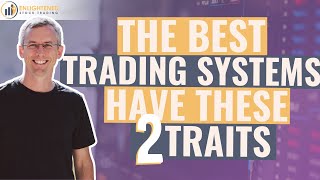
Adrian Reid (Enlightened Stock Trading) explains that the most durable, profitable trading systems share two characteristics: (1) they are psychologically hard for most traders to follow (uncomfortable or countercrowded entries such as buying after sharp dips or holding long trends through drawdowns), and (2) they are counterintuitive (ideas people assume won't work). He advises systematically testing ideas you feel uncomfortable with, journaling untapped concepts, and building confidence via rigorous backtesting; he promotes a downloadable "Trading System Confidence Cheat Sheet" as a resource.
Chapters
Have you ever found yourself struggling to develop a new trading system or find a new trading system that has a consistent, stable edge that holds up over decades of backtesting? My name is Adrian Reed and I'm from Enlightened Stock Trading. And this week I was developing a brand new trading system for the trading system collection. And this system looks amazing. It has a consistent, stable, profitable edge. And the equity curve is really nice and smooth, has a high win rate. So the equity curve is strong and there's very low drawdowns. But what struck me when I was developing this system is that there's two reasons why most traders fail when it comes to developing trading systems. And the first reason is that good trading systems are psychologically hard to follow. You see, I've tested hundreds of systems and I've taken thousands of systematic trades. And without doubt I can say that some of the most profitable trades that I've ever taken have been psychologically the most difficult. The ones that I least wanted to take, the signals that my systems generated that I least wanted to take, are very often the most profitable. Now why is that? Well, my theory is because if you look at a chart and you don't want to take that trade, then most other traders out there won't want to take that trade. Admit psychologically, we're all wired the same. So that trade is not going to be a crowded trade. It's not overloaded. There's not lots of people already in the move. And so you're getting in, assuming you're following a system, you're getting in at a moment where you've got the maximum edge, you've got the minimum competition. The psychological challenges of system trading are always that you've got to follow the system. You've got to take every single signal, regardless of whether it feels good or not. Now, if you take that concept and extrapolate it out to the whole, to the system wide level, sometimes or almost always, the best systems are the ones that are psychologically difficult to trade. So why is that? That's because those systems as well are not crowded. If something was psychologically easy, everyone would do it. And if everyone was doing it in the market, then it wouldn't make money. This is one of the reasons why trend following works year after year. You know, sometimes there's drawdowns and sometimes there's dips. But over decades, the strategy keeps coming back and it keeps working because the vast majority of people don't have the psychological makeup, the intestinal fortitude to follow that system, to hold, to Buy something that's going up and hold it and hold it, regardless of the market dips and gyrations until the trend obviously changes and starts going down. That is psychologically difficult, and that's why it keeps working. Take mean reversion, for instance. If you're buying a stock after a sudden dip, waiting for the spring back, when you look at a chart, the sudden dip, the really aggressive fall in the share price, is not a place where psychologically we would naturally want to enter. And so if it's psychologically difficult to want to enter there, most traders won't be able to do that consistently. And that will give that system a stability. Because you're in a system that is not crowded. There's not hundreds of other people, thousands of other people doing that because it's psychologically hard. Most traders do the easy thing. They take the OB trade. But I'm here to tell you, to share with you, that the obvious trade doesn't work. The obvious systems don't work either, okay? So the first reason why most traders struggle developing a trading system that works and holds up over decades in backtesting is because the good systems are psychologically challenging. So that thing that you don't want to do in trading, that's the thing that you should be investigating.
Sometimes when you develop a system, you don't tend to test the things that you're naturally uncomfortable doing. But sometimes that's where the gold lies. So if you're testing and designing and playing with different system ideas, stop and take a step back and have a think about what you haven't tested, what haven't you analyzed thoroughly, because you don't feel like it's a good idea, because sometimes there's some gold in there, you go back and you journal about that, you find some ideas, chances are you, you'll find some profitable trading systems. The second reason why most traders struggle to develop systems that are good, that have a solid edge, that holds up over decades in back testing, is that the best systems are counterintuitive. And it's very closely related to this issue of the psychological ease of trading that we talked about just before. Because if a system is counterintuitive, you wouldn't think that it would naturally work. And again, we don't tend to test or analyze things that we assume naturally won't work because it's a waste of time and energy, right? But if you have a think about all of the things that you assume don't work in the market.
And write them down and look at them and you're really honest with yourself, chances are you haven't tested those things thoroughly. If you haven't tested them thoroughly, then there could be some little nuggets of gold waiting for you. Because I've found in my backtesting that sometimes the most counterintuitive idea gives the biggest edge because people aren't looking there. Traders move and investors move in a herd. They bundle into the favorite sector, they take the same trades, they have the same emotional reaction to different moves in the stock market. Investment markets move in psychological herds. And if you can bring yourself to step back from that and have a look and find counterintuitive ideas, ideas that you have naturally assumed wouldn't work.
Because of all of your experience in the outside world. They're the things you need to test in the stock market. Because when you test the counterintuitive things, you're going to find some edges that other people have not found. And that's how you make it. That's how you make it big in the stock market. Trading systematically with a system that is psychologically challenging to trade.
And that is counterintuitive, because if you got those two things, that system, chances are that's going to last for decades because most people won't be able to follow it. But if you as a system trader can design that system and do the testing to build the confidence in that system, then you could end up with a trading system that has a sustainable edge that will make you money for decades to come. That's what it takes to be successful as a systematic stock trader. You need a stable, robust system that you've got confidence in that is psychologically difficult for the masses to follow. And that is somewhat counterintuitive because other people aren't looking there to find that idea that way. It's not going to be a crowded trade. It's not going to be a crowded system. If you can do that and build the confidence. The confidence is the key. Because the confidence that you get from testing this system properly is what's going to get you past those two things, the psychological difficulty and the counterintuitiveness of that system. So in order to build confidence in your trading system, how do you do that? Well, click the link on this post and download my Trading System Confidence Cheat Sheet, which gives you the exact steps that I follow every single time I develop a new trading system. And I'm following those steps today while I finalize this trading system that I talked about earlier. Download the Trading System Confidence Cheat sheet and start looking for trading ideas. Where other traders aren't looking. And chances are you'll find some nuggets of gold that'll make you a ton of money in the future. My name is Adrian Reed. This is enlightened stock trading. Click the link and make sure you download your trading system confidence cheat sheet. That's all for this video. I'll see you in the next one. Bye for now.