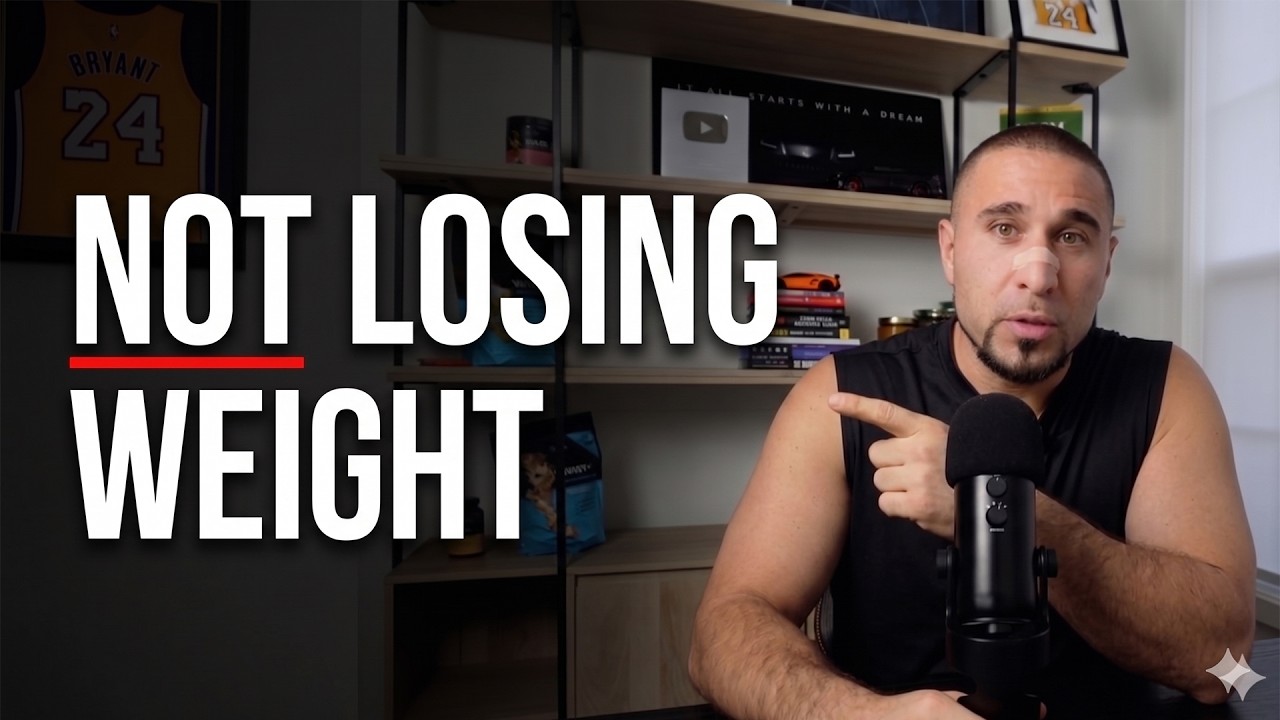
In this 7‑minute YouTube video, fitness coach Eric Roberts explains that many people miss subtle physiological cues that indicate muscle growth, leading them to doubt their training and quit. Drawing on his experience with over 25,000 clients, he outlines seven specific, often‑overlooked signs: (1) night‑time overheating caused by the body’s elevated core temperature during muscle repair; (2) persistent, heightened hunger as the body demands extra calories to fuel new tissue; (3) sudden, intense mid‑day fatigue that mirrors a phone running a background update while the body is allocating resources to recovery; (4) a reduction in post‑workout soreness, which actually signals that the muscles have adapted and are now more efficient; (5) a delayed feeling of tightness or “concrete‑setting” in muscles 48‑72 hours after training, indicating tissue remodeling; (6) a stagnant scale weight despite visual changes, explained by the trade‑off of fat loss for denser muscle; and (7) the appearance of new veins, reflecting increased vascularisation to support new muscle. For each sign, Roberts uses vivid analogies (brick pizza oven, car towing a trailer, software update, concrete setting, neighborhood wiring) and real client anecdotes (Victor, Kylie, etc.) to illustrate the concepts. He reassures viewers that these signs are normal, encourages them to trust the process, and concludes with a call‑to‑action for his 8‑week online coaching program and a link to a companion video on “what I wish I knew before I started lifting.” The overall takeaway is that recognizing these signs helps trainees stay motivated, adjust expectations, and continue progressing toward muscle growth and fat loss.
Chapters
You're probably building more muscle than you realize. After getting in decent shape myself and coaching over 25,000 clients, I've seen your body has 7 strange signs when muscle is being built, but most people don't know them, so they get discouraged thinking their plan isn't working and they quit before they see a change in their body. So here are all 7. The first sign is the one that almost nobody connects to building muscle, and it happens at night in bed. You're trying to fall asleep and you're burning up. You kick the covers off, but then 5 minutes later you're cold, so you put them back on. And then you do the thing where like you put your feet out and you're thinking like, is my thyroid off? Am I getting sick? Why am I so hot and sweating? I want you to think of your body like a brick pizza oven. And now I want pizza. You light the fire, the flames will go out an hour later, but the bricks? Those bricks throw off heat for the next 12 hours. Your workout is the fire and your muscles are the bricks. Long after your workout is over, your body is still hot from the inside out. Doing the work of repairing your muscles that you just tore down in your workout. And this was happening to one of our clients, Victor, who had never lifted weights before he signed up for coaching with us. And as he started to get a few months in, he noticed himself sweating as he was trying to go to bed. And he thought there was something wrong, but then he looked in the mirror and saw that his body was starting to change and build muscle. And that's when I told him, if you're hot at night when you didn't used to be, that is a sign That your body is building muscle because the process of building muscle requires calories burned, which increases your core body temperature, which means you'll be more hot at night than you normally would. So this is a good sign, but this also has a side effect, which brings us to sign number 2. And this is the sign that makes people think they have completely lost control, but they haven't. Your body has just changed jobs. What happens is you sit down for dinner, you eat a full plate of food, and now you want seconds. And so maybe you eat a bit more and you are genuinely full, but an hour or 2 later you're hungry again. And then you go to bed a little bit hungry, you wake up and you're hungry, and you're thinking, what the hell is wrong with my body? You think you have no self-control, you're just gonna keep eating, you're gonna get fat. But this isn't a willpower problem. Think of it like a car towing a trailer up a mountain. That same car on a highway just sips gas, but if you hook a heavy trailer behind it and you make it go uphill, how many miles to the gallon you can get is going to severely decrease because you're using up so much more fuel. Building muscle is the trailer. Repairing your muscle, growing your muscle, pushing hard in your workouts All of these require a massive amount of calories. So it's not that you're eating too much, it's that you're finally eating enough. And this is currently happening to one of our clients, Kylie. Before, she had never really followed a proper strength training program. She had kind of just done Beachbody workouts and random machines in the gym. But now we've got her on a proper workout routine and she is increasing her calories And she's still hungry and not gaining weight on the scale. So if you're suddenly feeling hungrier, almost like a bottomless pit, and your workouts are getting harder and you're pushing yourself more, this is a good thing. You can't build the house you want with no material. Hunger is your body asking for more bricks to build more muscle. But all of this building also has another side effect, which brings us to sign number three, and it shows up around two. It's 2 PM, right in the middle of your workday. You're sitting at your desk or you're driving home, and out of nowhere, a wall of tired hits you. Not like normal tired. Not I didn't sleep that great tired. This is like an aggressive tired. The kind where your eyelids feel super heavy and your brain just kind of clocks out. And it doesn't really make sense because you slept fine, you had some caffeine, you're hitting your calories for the day. But what's happening is this: Think of your phone running a big software update in the background. Your phone can still work. You can text, you can scroll, but it's slow. The battery drains way faster than normal, and the back of your phone is getting hot. That's your body installing muscle. Recovery is the update. And while it's running, everything else slows down because your body is using its processing power somewhere else. And this happens to me every so often. And before I realized what it was, I thought there was something wrong with me. But then when I understood the science, I thought, okay, I'll take 10 to 15 minutes, either try to close my eyes or just chill out a bit, and I know it will pass. And so if you're hitting random walls of feeling tired, don't panic and don't drug yourself with caffeine. The update is running, so just let it run. Eat, hydrate, and And keep going. And now, signs 1, 2, and 3— all of these happen outside of the gym. But sign number 4 happens in the gym, and it's the one most lifters get completely wrong. Do you remember how it felt the first month you started lifting? You could barely sit on the toilet after 2 days of doing legs, or going to wash your hair made your arm and your back muscles super sore. And you loved it because you correlated the pain with, this is working and I'm building muscle. And then a few months in, the soreness kind of just stops. And it's weird because you're doing the same workouts, you're even lifting heavier weights, but you're not getting anywhere near as sore. And so your brain goes, I'm not training hard enough. I need to switch programs. I need to do more exercises, more sets, more reps. But that is the wrong move. Soreness stopping is actually a graduation. Think of what happens when you first pick up running. You'll put on your shoes and you'll go run a mile or two. And when you first start, you're going to come back. You might have blisters on your feet. You might have shin splints. Your calves, your legs are super sore. But as you get a month, 2 months, 3 months into it, you won't be getting blisters on your feet anymore. Your legs won't get as sore after running, does that mean you got weaker at running or worse at running? No, you actually got better. The damage stops because now your body has gotten used to it and knows how to handle it. Your muscles do the exact same thing. Less soreness equals less muscle damage, and less muscle damage means you can train more often with heavier weights, which means you can build more muscle. Not less. So more times than not, soreness is a beginner's reward. Once it stops, your body is just better at its job. So don't chase being sore. Chase lifting heavier, doing more reps, and pushing yourself close to failure, because that's what builds muscle, not how sore you are. But here's the weird thing. Even when soreness stops, there's a different feeling that shows up 2 or 3 days later, and it tricks people. Into thinking they might injure themselves. And sign number 5 is weird because 2 or 3 days later, you go to stretch or you go to reach for something and the muscle almost feels like locked or tight. It's not painful, but it almost feels like it's been pumped full of something and forgot to let it out. And your first thought is, I overdid it. Maybe I'm about to injure myself in my workout. But how I want you to think about this is pouring wet concrete inside of a form. When concrete is first poured, it's kind of sloppy. It's easy to kind of push around. But over the next 48 hours, it gets harder and tighter inside the form. If you touched it during that window, it would feel rock solid and stuck. That's your muscle. While it's rebuilding bigger and stronger, it locks up the inside of the form of the original muscle shape. And so this is a sign that your muscles are to get bigger, fill out more, and look more defined. So if it's a sharp pain, stop. That's not good. But if it feels just more tight and dense, that just means your concrete is setting, and it's a good sign for building muscle. And sign number 6 is actually another way that your body is gonna gaslight you, and it's probably been driving you crazy. You've probably been training for a couple of months And you feel different. Your clothes feel different. People might even start saying something to you. But you step on the scale, and it's the same number as when you started. And you think, what's the point of this? Why am I not seeing progress? You get discouraged, and you're about to quit. But the scale is lying to you. This is what happens when you trade fat for muscle. Fat is bigger. It's more squishy. And it takes up more space. Muscle is harder and more dense, and it takes up less space. When you trade a pound of this for a pound of this, your body will look different, but the number on the scale isn't going to change because both of these are a pound. So if your scale isn't moving, but your clothes fit different, the mirror looks different, people are telling you you look different. Stop freaking out and thinking you're doing something wrong. You're losing fat and building muscle at the same time. And this flows perfectly into sign number 7, which you're not gonna notice by the number on the scale either. One day you're washing your hands and you look down at your forearms and there's a vein running down it that you didn't notice before. Or you look at the back of your hand and you're noticing veins. Or you're putting on a shirt one day and you notice a shoulder and bicep vein. And some people think this means you're losing fat, which that is a part of it. But the bigger reason is what nobody talks about: new muscle needs plumbing. Think about what happens when a new neighborhood gets built in a town. Before the houses go up, there's nothing there. It's just dirt. There's no power lines. There's no water system. But as the houses get built, the power company has to run Run new electrical lines. The water company has to run new pipes underground. The internet runs new cable. Your veins are the power lines and your muscle is the neighborhood. As you build new muscle, your body literally runs new vascular wiring to deliver oxygen and nutrients to the new muscle tissue. So that vein on your forearm isn't just decoration, it's a brand new power line to a brand new neighborhood. So New veins equals new wiring equals new muscle. It's one of the most visible forms of proof that your body is building new muscle. And if you want to make sure you're doing everything right to build muscle and lose fat, that's exactly what we do in our 8-week program with our online coaching clients. There will be a link in the description of this video below if you'd like to learn more. But if you're now sitting here thinking, okay, Eric, my body is building muscle, but what should I actually do differently to build it faster, I made a video with everything I wish I knew before I started lifting weights. It's right here. You can click it and watch it right now.