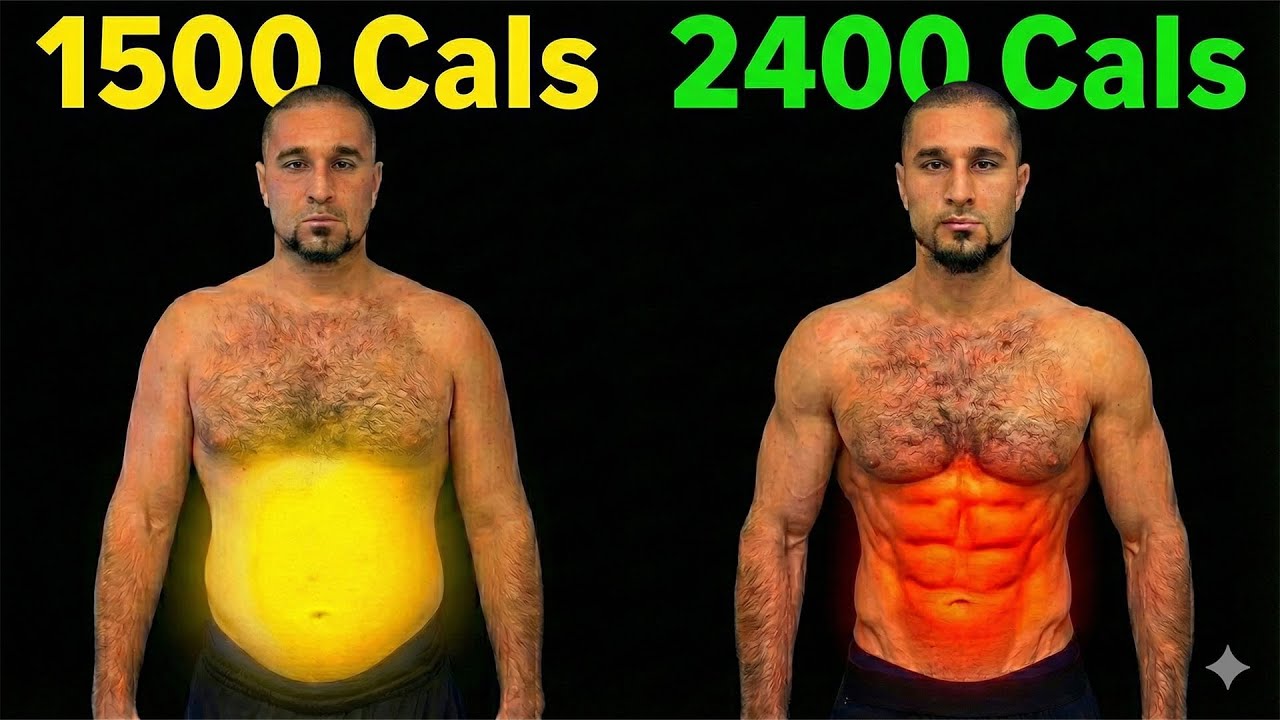
In this solo instructional video, fitness coach Eric Roberts argues that severe calorie restriction is counter‑productive for long‑term fat loss. He shares his personal transformation from 22% to 8% body fat, which occurred only after abandoning a 1,500‑calorie diet in favor of a higher‑calorie, sustainable approach. Roberts structures his argument around four core concepts: (1) the “deflated balloon effect,” where aggressive dieting shrinks muscle (the balloon) faster than the surrounding skin/fat (the pillowcase), leaving a soft, “skinny‑fat” look; (2) the “efficiency trap,” where the body adapts to chronic low intake by shedding muscle and down‑regulating metabolism, turning a high‑output V8 engine into a fuel‑saving hybrid; (3) the “seesaw effect,” describing how extreme calorie cuts raise hunger dramatically, creating an unstable lever that leads to binge‑eating; and (4) the “pressure solution,” which recommends moving to a modest calorie deficit (≈500–700 kcal/day) that “unkinks” the metabolic hose, boosts calorie burn, stabilises hunger, and preserves muscle fullness. He backs the recommendation with a free calorie‑calculator link used for his 25,000+ online coaching clients and teases a follow‑up video on timelines for stubborn belly‑fat loss.
Chapters
Most fitness gurus are lying to you about how low you need to drop your calories to lose body fat. I went from 22% to 8% body fat, but only after I stopped starving myself on 1,500 calories and started fueling myself with 2,400 calories. So here's the brutally honest truth about why eating less isn't going to work long-term and the exact method to burn more fat by eating more food. And the first point is what I call the deflated balloon effect. This mistake usually happens when you aggressively cut your calories too low. You might see a drop in the scale initially, which feels like a win, but when you look in the mirror, you don't look ripped. You actually look softer and smaller. This is where most people panic and then lower their calories even more, thinking they still have too much fat they need to lose. But the fat isn't the problem here. Deflation is. Think of your physique like a party balloon inside a pillowcase. The balloon is your muscle. The pillowcase is your skin and stubborn fat. To get that toned look you're going for, you need the balloon, the muscle, to be fully inflated so it presses tight against the pillowcase. But when you starve yourself on 1,500 calories, you deplete your nutrients inside of your muscle. And in simple terms, you let the air out of the balloon. The pillowcase hasn't changed size, but because the balloon shrank, the pillowcase now looks saggy and soft. You didn't get fatter. You just lost the internal pressure that makes you look lean. So the brutally honest truth is, by eating too few calories, you are shrinking the balloon faster than you are shrinking the pillowcase. Someone who eats more calories keeps their balloon fully inflated, and even if they have the same amount of fat as you, they look leaner because their muscles are pushing tight against the skin. So do not mistake losing weight on the scale for getting a lean physique. If you just deflate your balloon, you will always look soft and skinny fat, no matter what the number on the scale says. So to fix this, we have to prioritize inflation over starvation. But before we talk about exactly how to do that, looking soft is only the immediate problem when you cut your calories too low. The real danger happens when you force your body to stay at that for too long. And point number 2 is what I call the efficiency trap. Most people think if they don't look how they want, or they've hit a plateau with their fat loss, well, I was losing on 1,500, now I'm stuck, so I gotta go down to 1,200. And this is a trap. Your body is biologically designed to survive famine, aka starvation. If you feed it 1,200 calories, it's gonna learn how to survive on 1,200 calories. It does this by stripping away expensive calorie-burning tissue, aka muscle, and downregulating your metabolism to match the low intake. So you're basically training your body to burn less fat. Think of your metabolism like a car engine. A muscular high metabolism is like a V8 gas-guzzling engine. It burns fuel just sitting at a red light, and so that makes It makes it inefficient, but it's powerful and it burns through a tank of gas rapidly. And by the way, this is an exact replica of the car that I currently have. How cool is that? But a low-calorie, muscle-wasted body is like a tiny Prius hybrid. It's designed to save fuel and it can go 500 miles on a single tank of gas. When you chronically undereat too few calories, you are essentially going to the mechanic and swapping out your V8 engine for a hybrid engine instead. This is why you start to see people eat next to nothing in bird-sized portions, and yet they're struggling to lose an ounce of body fat. They've spent years dieting down their engine and have become efficient on such low calories that to continue to lose fat, they have to do these extreme diets or extreme cardio routines. So here's the brutally honest truth: in the fat loss game, efficiency is the enemy. You want the gas-guzzling V8 engine because the person who has the highest metabolism is going to burn the most fat while keeping the muscle so they look lean. Now, before I break down exactly how to fix this and get your calorie amount back up to where it should be, I need to cover the final fatal flaw of aggressive dieting, which brings me to point number 3, the seesaw effect. And the mistake people make is simply ignoring the physics of your own biology. Most people think if they push their calories lower and lower, they'll just be able to out-willpower their hunger and cravings. But that's not how this is going to work. You can't suppress one side of the equation without a violent reaction on the other side. Think of your diet like a playground seesaw. On one seat, you have your calorie intake. On the other seat, you have your hunger and cravings. When you aggressively diet down to a very low calorie number, you are slamming the calorie seat all the way into the dirt. And because it's a lever, what happens to the other side? The hunger seat shoots into the stratosphere. The harder and lower you push your calories down, the higher and more aggressive your hunger and cravings become. You're creating a massive imbalance, and you're sitting there white-knuckling the bar, trying to hold the seat down while your hunger is staring at you 10 feet in the air, just like waiting for you to slip. And this is exactly what happens When you eventually overeat and fall off your diet. You have a bad day, you go out to dinner, you step off the seesaw for one second, and because the counterweight, your hunger, is so high up, it's not gonna just float down gently. It slams down, which then causes your calorie intake to shoot all the way up. This is why you don't just eat one slice of pizza, you end up eating 6 slices. Or you don't just have some Oreos in moderation, you have the entire sleeve. The violence of the overeating and how many calories you eat is directly matched to how low you tried to push the seesaw. And so the brutally honest truth is you're not going to beat your biology. If you slam your calories to the floor, your hunger will always overpower you in the long run. And that's why taking the approach of eating more calories keeps your seesaw balanced. And it keeps your hunger level more in line with your intake, so you never have these big crashes. So how do we stop the overeating, fix your metabolism, and actually get lean? Well, we have to stop trying to starve your fat off and start trying to pressurize it off. Which brings me to point number four: the pressure solution. So now you know that eating too few calories isn't going to achieve the fat loss goal you want. The mistake people will go and make is oh. Eric said to go eat more food, so let me just go eat everything now. No, because if you do this, you will overeat and you will gain fat. We need to find that sweet spot in your calorie deficit to burn fat without the negative side effects that we just learned about. And for this, I want you to think of your metabolism like a garden hose. When you cut your calories too low, you are essentially kinking the hose. That sounded kind of weird, but the flow stops because the water, the calorie burn, just trickles out. You aren't burning much energy. The hose will go soft in some areas because there's no pressure. The hose itself will be squishy and limp. This is why your muscles look flat and undefined. And the pressure builds behind the kink until eventually that hose will burst, aka you will end up overeating. Now let's look at what happens to that same hose when you open the valve and eat more calories in your calorie deficit. You get high velocity. The water just starts blasting out. You're now burning significantly more calories every day just by existing. The hose now becomes more like rock hard since there's water flowing through it, and it looks more thick and defined because it's full of water. This is your muscles on higher calories, and the sustainability of of this open valve. Because the water is flowing freely, there's no pressure that builds up in the hose. Your hunger signals drop because the system is getting what it needs. This is the sweet spot deficit. By moving your intake from a starvation level to more of a performance level, you unkink the hose, and you might theoretically be on a smaller deficit on paper, but because your output, your calorie burn is so much higher and your adherence is better and you're not falling off your diet every week or 2 weeks, you'll actually lose fat faster. For the over 25,000 online coaching clients that myself and my company has worked with, that sweet spot of a calorie deficit is usually about 500 to 700 calorie deficit per day. And this means If your maintenance calories are 2,500, a 500-calorie deficit would be 2,000 calories. And if you need to know exactly what that number would be for you, you can click the link in the description below to use my totally free calorie calculator. It's the same one that we use with our online coaching clients. And so the brutally honest truth is volume creates pressure. If you want your muscles to look full and hard, you want your metabolism to be as high as possible, and you want it to be sustainable, then you need to unkink the hose and let the water start flowing freely. But now that you've unkinked the hose and fixed your metabolism, the next obvious question is, how long until that stubborn belly fat actually disappears? Well, I broke down the brutally honest timeline for how many weeks it's going to take for you to lose that stubborn belly fat. Click this video here to watch, and I'll see you over there.