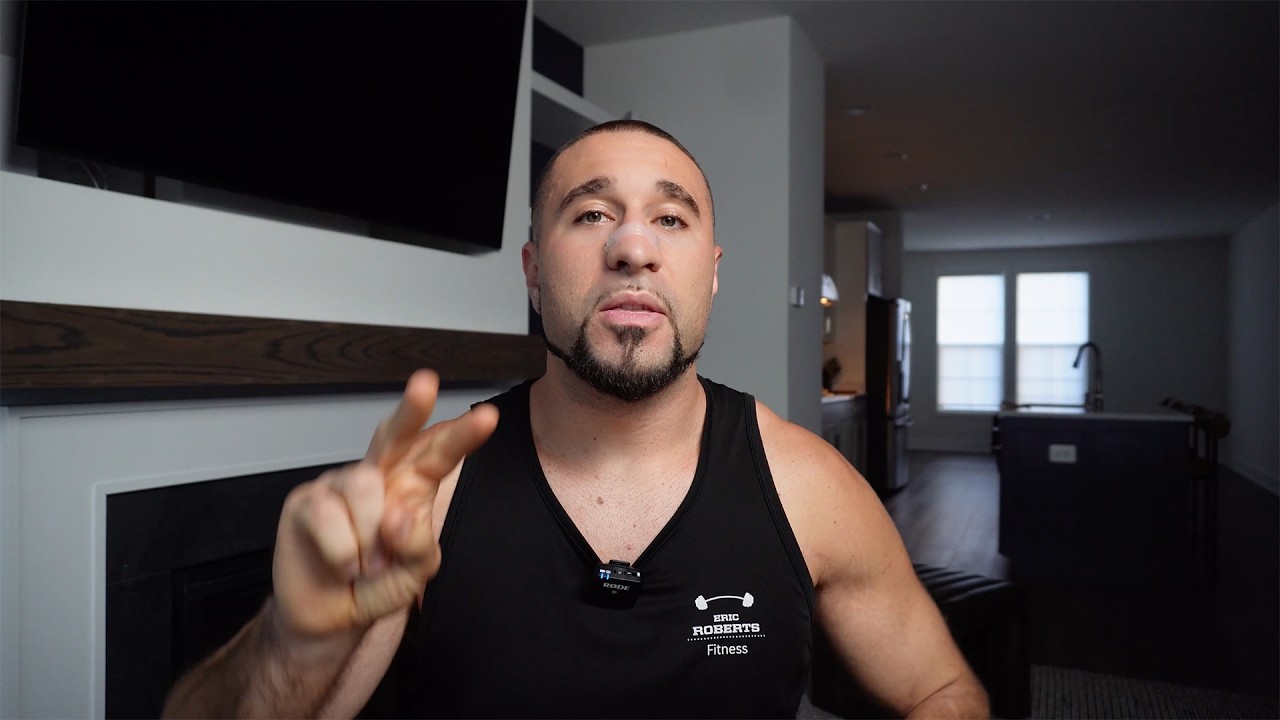
In this 12‑minute instructional video, fitness coach Eric Roberts outlines a step‑by‑step system he’s used with over 25,000 clients to shed 15–20 pounds in roughly eight weeks, targeting the Thanksgiving deadline. He begins by critiquing the generic advice of “eat in a calorie deficit,” introducing the “pregame” method—tracking calories before eating to enable real‑time portion adjustments and increase adherence. He then dismisses high‑intensity cardio, recommending low‑intensity “zone‑2” cardio (60‑70 % of max HR, conversational breathing) for 1 hour per week, framing it as a “cruise‑control” approach that avoids cortisol spikes and hunger spikes. Next, he challenges the myth that high‑rep, light‑weight training “tones” the body, advocating low‑volume, higher‑intensity resistance work (2‑3 sets of 5‑12 reps, near failure) to preserve muscle while in a deficit, using a client case study for proof. He introduces the “house‑cleaning effect” analogy to explain why belly fat is the last to drop, emphasizing patience and consistent deficit over quick fixes. Finally, he presents the “sandwich rule,” a three‑phase (before, during, after) strategy for handling nighttime and weekend eating temptations, stressing that one‑off meals don’t ruin progress if overall consistency is maintained. Throughout, he offers a free calorie‑calculator link, promotes an 8‑week fat‑loss coaching challenge, and cross‑promotes a deeper walkthrough video. The overall message is a concise, actionable cheat‑code playbook for rapid, sustainable fat loss.
Chapters
There's 2 months until Thanksgiving, and if you're looking to drop 15 to 20 pounds before then, I'm going to give you the exact system I've used with over 25,000 clients to get them those exact results. I'll give you immediately actionable cheat codes you can start doing today as soon as you leave this video to start making faster progress. So you might want to write these down. And the first one is, by now you've heard you need to be in a calorie deficit to lose fat. The problem is that's not really helpful advice. Knowing you need to be in a calorie deficit is different than actually being in a calorie deficit. Because the problem is you can know what to do but still end up overeating at night or on the weekends. This causes you to not only slow down progress, But get frustrated with yourself and eventually end up quitting. So what can we do to fix this? It's something I call the pregame. No, this is not what you do with your friends before you go out on the weekends. What do most people do when they try to be in a calorie deficit and track their food? They eat the food first and then they track it after. But this is wrong because it's reactive. You've already consumed the calories. There's not much you can do at this point. But if you pregame and track your calories before you actually eat the food, this does a few things. Number 1, it lets you see how many calories you're about to consume. So if you wanted to change the portion sizes, if you wanted to swap it out for some lower calorie items, you can do that. Number 2, it makes you mindful of the food that you're eating so you can decide if you actually want it. And number 3, it helps you stay in the calorie deficit because if you know your calorie deficit is 1,700 calories per day and you're tracking everything you eat before you actually eat it, your likelihood of sticking to those calories is much higher because you'll know exactly what you're going to eat to hit that. And by the way, if you need to know how many calories you should be eating for your calorie deficit, I have a totally free calorie Calculator if you click the link in the description below. It's the same one I use with our online coaching clients who pay us, so I am not holding anything back. Click the link below, enter your information, and it'll tell you exactly how much you need. And now, pre-gaming is cool, but this next cheat code is really where you'll see the faster progress. When most people think exercise for weight loss, what do they think? High-intensity cardio, out of breath, sweating, your heart rate is through the roof. And sure, this may burn the most calories in the moment, but what you may not know is after, it spikes your cortisol, leading to short-term water weight, as well as your hunger and your appetite, making it harder to stick to your calorie deficit. Which is why instead of doing high-intensity cardio, I opt for something I call the cruise control method for our clients. So high-intensity cardio is like F1. It's fast, it zooms by. But low-intensity cardio is like cruise control on a Tesla. You just sit back and let the car drive at a steady pace. And this is called zone 2 cardio. It's where your heart rate is 60 to 70% of your max heart rate. Or if you don't have something to track that, you should just be able to do the cardio while still breathing through your nose or able to hold a conversation. And this cardio can be done on a bike, on the elliptical, incline treadmill walking, walking with a weighted vest. And if you're serious about dropping 15 to 20 pounds in the next 8 weeks, add in 1 hour per week of zone 2 cardio. This could be all at once on one day, or this can be broken up throughout the week. So say you do 2 30-minute session. And now those 2 cheat codes, they're awesome, but this 3rd one is where most people fuck up, and it goes against a lot of the advice that you have heard to get a toned, lean body. High reps for lightweight tones the muscle. If you lift heavy, you'll get big and bulky and add muscle mass. Have you heard either one of those before? There's this theory that doing more reps More exercises, lighter weight is going to help tone your muscle and speed up weight loss. But the issue is this is not true. And in fact, it can actually backfire on your journey to lose 15 to 20 pounds in 8 weeks. Doing a lot of sets and reps and exercises leads to more fatigue because you're doing more with your body. And when you're already in a calorie deficit, your energy, your calories are limited. So you don't have as much energy to recover from workouts. So if you're piling on 2-hour workouts, doing a ton of reps and a ton of sets, you're creating a lot of fatigue that your body has to recover from. And when it can't recover from that, what happens? You get low energy, more fatigue, higher cravings, because your body is telling you we need more calories to recover from this. You're also at a higher risk of injury. Your cortisol is higher, so your body would actually look worse. It's like if you were to consistently redline your car and just put your foot on the gas the entire time, all the way down. At some point, the engine is going to break. So instead, it makes more sense to go lower volume, higher intensity training. And higher intensity doesn't mean high heart rate, short rest periods. Higher intensity in this case means lifting heavier close to failure. So instead of doing 4 sets of 12 to 15 reps, you should be doing 2 to 3 sets of 5 to 12 reps. Because getting lean is a mix of lowering your body fat and having enough muscle to show. You're losing body fat through your nutrition. Your workouts should be centered around building muscle and getting stronger. And I know because whenever we program this for our clients, they're a bit hesitant at first. Like one of our clients, Michael, he came to us working out for a good majority of his life. He had always done 3, 4, 5 sets of 12, 15, 20 reps. So when we showed him his workout program that was 2 sets of 6 to 8 reps, he was kind of like, is this really going to work? But to his credit, he trusted us and you can see the transformation that he made. And by the way, if you're interested in getting a personalized plan made specifically for you and having a coach dedicated to you to check in, answer your questions, hold you accountable, and make adjustments so that you see progress every week, you can click the link in the description of the video below to learn more about my 8-week fat loss challenge. And now this next cheat code will target your belly fat specifically, so I know you're going to want to listen to this. A lot of people claim to have the secret to losing belly fat. Take this pill, do this workout routine, try this detox or special diet. And here's the truth: they're all lying to you. Seriously. And let me explain why. This is something I call the house cleaning effect. Let's say you wanted to clean your house. What would be the first thing you would have to do? You'd probably have to pick up all the miscellaneous stuff on the floor so that you could vacuum, whether it's toys that your dogs play with, whether it's stuff that you keep on the ground, you'll have to pick that stuff up first. And then after you do that, you can vacuum, but then maybe you would have to pick the rug up to clean under the rug as well. And then you would get into the kitchen and the bathroom where you get on your hands and knees and you scrub the floor. I used to have to do this with my mom when I was a kid, and I hated doing that. And that's what happens with your body And your body fat. At first, it gets rid of the easy fat, the areas where it has the most blood flow. So typically your face, your arms, even your hands and feet. And for ladies, sometimes this is your boobs. And then it moves to a little bit more stubborn areas where there's a little bit less blood flow. This could be your love handles, this could be your thighs, and then it will move to the areas that have the least blood flow and the hardest to get to, AKA your belly fat. And there is no pill, powder, special workout that is going to fix that. The truth is you just have to stay consistent long enough with your calorie deficit and your workouts to get to the point where your body pulls from your belly fat. And I know this isn't sexy to hear. I know this isn't going to be something where I'm going to sell you a bunch of diet pills But I just want to tell you the truth and give you proper expectations, because if you don't stick with it long enough because you get discouraged and you quit, you'll never get to the point where you actually do lose your belly fat. Which brings me to cheat code number 5, and this one is important if you find it difficult to stick to your diet at night or on the weekend, because after coaching over 25,000 clients with their fat loss transformations, I know There's two times where most people fall off their diet, and that's at night when you have cravings, you're watching your favorite show, you've had a long day, or the weekends where you're running errands, you're out of routine, you're going out to eat. And I get it; it is much harder to stay on track with your calorie deficit during time. So a simple rule that you can follow is what I call the sandwich rule. Most people only focus on I overeat at night, or I'm going out to eat on the weekends, and that's where I fall off. But what about Before and after that. For example, what if your problem wasn't actually overeating at night? What if it was because you weren't eating enough food, protein, calories, water during the day to make yourself so not hungry at night? Or what if it was because you didn't get a workout in, you didn't have meal prep before you were going into eating out on the weekends, and then you have no plan on how you'll get back on track the next morning. You need to look at these times as before, during, and after, not just during. This way, beforehand, you can set yourself up for success, and after, you'll know exactly what you need to do to get back on track. Because here's the truth: one dinner out on the weekend doesn't ruin all of your progress, just like one dinner on a Tuesday night doesn't make all of your progress. It's what you do consistently. And if you set yourself up for better success before and you have a plan to get right back on track within 24 hours after, these one-off events that happen, they're not going to ruin your progress because you'll just actually stay consistent. Which, if you're consistent, that's how you lose your belly fat. How I tied that back. And again, these cheat codes are awesome and I hope you steal them, but if you don't actually take action and do these consistently, this new information that you just got was all for entertainment. It won't actually affect your results. So if you want help building all of this into a personalized plan for you and your life, plus have a coach check in all week with you to answer your questions, guide you, hold you accountable, and make adjustments to force your body to make progress week over week, click the link in the description below to learn more about my 8-week fat loss challenge. And if you're interested in an in-depth walkthrough of how to build a plan to lose fat and build muscle at the same time, I did an entire video on that. Just click right here to watch that coming up next.