How Often Should I Weigh Myself For Weight Loss I Is it ok to weigh each day
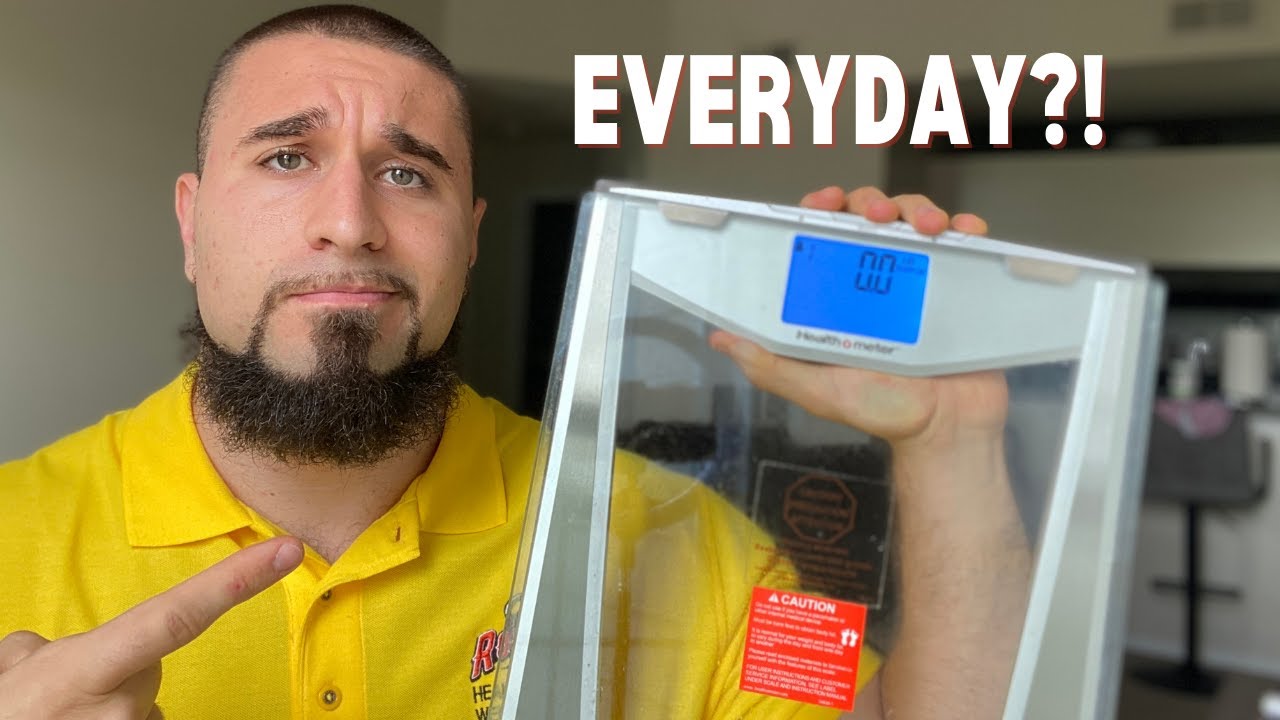
Eric Roberts recommends weighing yourself every morning for weight loss, then averaging the readings weekly to spot real trends instead of reacting to daily fluctuations from sodium, workouts, or your cycle. The scale is just one metric; also track measurements and how clothes fit, especially if you're building muscle.
Chapters
Duh. That's weird. I can't wait to start the video. What is going on? YouTube, what is going on? Welcome to the video. Welcome back to the channel. Hope you're doing absolutely amazing. In this video, we are going to be talking about how often should you be weighing yourself, because some people are going to tell you, um, listen, you should not be weighing yourself at all, sweetie, while other people are going to tell you, no, no, you need to be weighing yourself every single hour, sweetie. There's no seconds missed here. And then some people are gonna say, no, you know, be weighing yourself once a week. So what is right? What should you do? What should you not do? How can you make sure you don't become obsessed with the number on the scale? I'm gonna talk about all that here in this video. I think this is one of the most important videos I'm ever going to make. So please make sure you do not skip anything and watch the whole way through. Number 1, I wanna give you the real deal. I want to give you what I believe is the best strategy for the majority of people. I do this with pretty much every single one of my online coaching clients, and that is I believe you should weigh yourself every single day, every single morning. Now, I'm going to tell you why in this video, but before I go into that, I completely understand that everybody is different and everybody has a different reaction. There's certain things that go on in people's lives that, listen, that makes us individuals. Tell every single person what they should do unless I work with them, right? So I will say that first and foremost. But for the vast majority of people, I believe you should be weighing yourself every single day. I'm going to tell you a few reasons why in this video right now. Number 1, above anything else, I wrote this here: you are never going to weigh the same number on the scale day after day after day after day. So even if you do get to your goal body weight, and even if you do get to a point where you're comfortable with the number, whatever it is, you are never going to weigh that same number. Your weight is going to fluctuate. It's going to fluctuate down, it's going to fluctuate up, it's going to fluctuate staying the same. You're never going to weigh the same number on the scale, and you can fluctuate for any different number of reasons. You can fluctuate for the amount of sodium you ate. You can fluctuate because it's your time of the month if you're a female. You can fluctuate because you have to go to the restroom. You can fluctuate because you had a very tough strength training workout the day before. There's so many reasons why your weight can fluctuate. I could do a whole separate video on this, and actually I have done a whole separate video on this, so if you wanna check that video out, I'll link it here somewhere above. It's an entire video on why your weight is going to fluctuate and why it is never going to stay the same. But first and foremost, if you understand that off the bat and you actually know why the scale is doing what it's going to do, like you know why it went up, you know why it went down, you know why it stayed the same, whatever it is, and you can truly understand that and have the knowledge for that, well then at that point you now understand it. So it's less emotional because you're using logic as opposed to emotion. So if you do step on the scale and it does go up, God forbid, you can now use logic as opposed to purely emotion because most people step on that scale and see a number and it's purely emotion, whether good, bad, or indifferent. If it goes down, great. If it goes up, this sucks, I'm a failure. And so, it's a pure emotional response. And what I want you to do is transition away from the emotional response and move to a logical response. I don't want to say don't have an emotional response because, listen, you're not a robot. You're a human being and we're all going to have emotional responses. But the quicker you can move away from the emotional response and move towards the logical response of what's going on, why is this happening, why did it go up, why did it go down, what's going on, and you can understand it, the less emotion there is and the more you're able to understand and be consistent with what you're doing. So understanding first and foremost, your weight is never going to stay the same. never stay the same. Number 2, I want to throw this at you. I didn't write this down, but I want to throw it at you. Let's talk about if you were a manager. Let's say you're a manager of Apple, an Apple Store in California, wherever it is. If you were going to look at your data of sales over the month, right, to see, hey, did we make money? Did we lose money? Do we have the same amount of revenue? You know, money coming in, money going out. What do we do? You're normally not just going to pick 4 days out of the month, because 4 days out of the month don't really tell you if you're having a month where you make money, a month where you lose money, a month where you maintain your money. Let's say, for example, you pick, you know, a random Tuesday, a random Monday, a random Saturday, and then a random Thursday. Okay, well, Thursday might be slower because it's not the weekend, and Monday might be, might be busier because people got paid. But that Friday, people might not get paid until Monday, so it's slower. And so there's so many variables that you don't really know what's going on because you only took 4 data points out of the entire month. So you can't really tell if you're— where you are trending because you don't have enough data. And that's why I'm going to transition into— we're going to talk about weekly versus daily weigh-ins. So let's say, for example, you start off on the Monday and you're 198.5. 0.6, right? Cool. Let's say you just weigh in once a week. Let's say your next weigh-in is 199.4. You would lose your shit. You'd freak out. You would be like, I'm a failure. You'd be like, this is not working. You'd be like, my diet's not working. I suck. What am I doing wrong? Again, all of the emotional responses, right? Now let's say you weighed in every single day and on Monday you weighed 198.6. And then on Tuesday you weighed 198.2, and then on Wednesday you weighed 198.4, and then on Thursday it was 197.6, and then Friday was 197.4, Saturday 198 flat, Sunday 197.2, right? So let's say that, and that, by the way, that's very possible. That happens all the time. And as you can tell, it's fluctuating. It's going up, it's going down, it's going up, it's going down, but it's trending down, right? 'Cause you started at 198.2 and it's trending down. You saw 196, you saw 197, you saw those numbers. But let's just say on Sunday night you had a meal that was higher in carbs and higher in sodium, which by the way, you know, on a weekend people going out to eat, so on and so forth, very possible for that to happen. And then you weigh in on Monday morning and because you had more carbs and because you had more sodium, you weigh in heavier. And you think, oh my God, this isn't working. My diet's not working. I'm gaining fat. I'm a failure. Because you only took this weigh-in and this weigh-in right here. You didn't see throughout the whole week you were actually trending down. And this is why if that does happen on Monday, which again, it's gonna happen, your weight's gonna spike up. It's normal. It does not mean you're doing anything bad. It means you're a normal human being. If and when that does happen, now once again, you're not going to be as emotional over it. And again, this will take time, but you're not going to be as emotional over it because you can clearly see there was multiple times during the week where you saw 197 and you were trending downwards. And so understanding that, you know, you can get your daily weigh-ins and you don't, you don't, you know, compare yourself to from Wednesday to Saturday, that those 2 weigh-ins don't matter. What you would do is if you weighed yourself on, you know, let's just call it January 1st, you would compare your January 1st weigh-in to February 1st and then March 1st and then April 1st. That's when you would compare weigh-ins. You don't compare weigh-ins week to week or even month to month. I'm sorry. You don't compare your weigh-ins day to day or week to week. You compare them month to month because you can see a trend start to develop over a period of time. And again, if you only took your weekly weigh-ins, you would not have saw that you were trending down that entire week. And what this causes is most people quit. Most people quit because they think they're not seeing progress. You probably would have quit because you would think, well, screw this, it's not working. I got to do something different. I got to change something. I got to lower my calories. I got to go keto, whatever it is. But you didn't realize that it was actually working to a T and you were actually seeing tremendous progress. And if you just would have kept going, you would have saw 197 and then 196, 197, then 196 and 195 and so on and so forth. Right? So daily weigh-ins, in my estimation, by far the best form of getting data that you need in order to make sure you are seeing the progress you want to see. And now again, you need to get the average, right? It doesn't— one week is not long enough to get an average. This is why I say you need to weigh yourself for 3, 4, 5, 6, 7, 8, 9 weeks, because over that period of time you'll be able to get an average. This is where you might hear people talk about, you know, losing— I say a healthy rate of weight loss is losing 0.5 to 1.5 pounds per week on average. I'm gonna put— I'm gonna put a chart here of my— of one of my online coaching clients above who she's steadily trending down with her weight. Her average is trending down over a period of time, and this is because I know this because she weighs in every single day, and I can see over a period of time her weight— you can see the, the picture here— her weight is trending down. The only way I know that is because I get these weigh-ins, we get the data, and And then we go from there. So you can't take your weight on a 1-week or a 2-week or a 3-week basis. At the very least, 4 weeks. Get your data and see, are you trending down? If you started that, you know, started that first week at 198.6 and then by week 4 you're at, you know, around 194 or 195, that would be tremendous progress. That would mean you're trending downwards. But if you don't get that, you don't know that. Okay? And piggybacking off that point, remember, the scale is literally just data. That's it. That's all this is. And again, I know a lot of people have a very emotional response to it, which I'm not gonna tell you not to because everybody's different, but you have to understand that the scale is just one form of data. And honestly, it's by far not the most accurate form of fat loss progress at all whatsoever. 'Cause number one, It can fluctuate for so many reasons. But also, number 2, let's say, for example, you are partaking in a strength training program, which I hope you are. If you are partaking in a strength training program, a few things can happen, but most importantly, let's say you're building muscle from that strength training program, which would be a phenomenal thing. It'd be a phenomenal thing because that means you're changing the way your body looks and so on and so forth. Not only that, but you're getting stronger, feeling like a badass, all those great things. But let's say in a month's time You lost 3 pounds of fat, but you gained 3 pounds of muscle, right? You gained 2 pounds of muscle on your glutes and you gained 1 pound of muscle on your shoulders, whatever it is. The scale is not going to change because you lost 3 pounds of fat and you gained 3 pounds of muscle. A pound of fat weighs the same as a pound of muscle. Muscle is more dense than fat. So what that means is it takes up less space on your body. This is why going into it, if you, you need to be tracking other forms of data, measurements and progress pictures. For my clients, we get measurements every 2 weeks and progress pictures every 4 weeks. So if the scale's not going down, but you see that your measurements are going down and your progress pictures are looking different, that means you're losing fat and building muscle at the same time. That is, by the way, The best thing you could do in your weight loss journey. That's, that's what most people are trying to do. So if that's happening for you, you are fucking amazing. But this is an example where the scale is— it's not going to show that. It's not, it's not going— it's not going to show that you're losing fat and building muscle. Your measurements and your progress pictures and your clothes fitting differently, that's what's going to show that, not the scale. So the scale is not the, the end-all be-all, nor is it anywhere close to the best for the best way to track fat loss and weight loss progress. And so all these forms, whether it's progress pictures, whether it's measurements, whether it's the scale, whether it's your clothes, it's all just data for one big science experiment. So that's really what I tell my clients is like, we're just, it's one big science experiment. Your body and your journey is just one big science experiment. And so the more data you can get for your science experiment, the better outcomes you're going to have and the better results you're going to have, because you can know what's going on. It's like if you were to ask me, hey Eric, can I afford this house I want to buy? I'm like, I don't— I have no— I know nothing about you. What is your salary? How much do you make? Are you getting a bonus? Do you have kids? What are your other expenses? Do you enjoy going out to eat? Do you enjoy buying fancy cars? Like, I need more data. I need more data to make a decision. It's the same thing here. The more data you get, the better. And so that is why I believe you should be weighing yourself every single day. And one last thing I want to kind of throw in here at the end, it's something I learned from my good friend and mentor, Jordan Syatt. This is a form of, it's called exposure therapy, right? So if you are like very, very afraid of the scale, the best way to get over that fear is to face it. In the same way, if your kid comes home and tells you, you know, mom, dad, there's a bully at school, you know, they're bullying me, what should I do? You're probably not gonna say, well, just keep running away from it and just keep running away from him and make sure you hide in the locker room and make sure you hide in your locker at like, No, you're gonna say, hey, go kick the kid's fucking ass. Excuse my language, but go kick his ass. So you want them to face the bully, not run away, because the more you expose yourself to it, the better you can be, the more comfortable you will be, and you will face it as opposed to continuing to run away from it. So as opposed to running away from the scale, educate yourself on it, expose yourself to it, understand there's gonna be fluctuations, understand that even when your weight spikes up, it doesn't mean that you did anything wrong. It doesn't mean it's a bad thing. You just have to keep going. And if you keep going, you will continue to see progress. I can't tell you how many clients I've worked with where we start working together and their weight spikes up. They tell me, Eric, this is where I normally quit. What am I doing wrong? What's going on? I'm like, nothing. Nothing is going wrong. You just need to keep going. So they keep going and they see themselves drop down again. They drop lower than they were and then lower than they were. They're like, oh, holy shit. I'm still losing weight, but what happened? My weight spiked up this day. It's like, okay, so your weight spiked up. You're a human being. As long as you keep going, you're going to see the progress you want to see. So as opposed to, in my opinion, running away from it, face it. Understand it. Educate yourself on it. Go watch that video I talked about where I talked in depth about why the scale is going to fluctuate. What does it mean? Does it mean you're gaining body fat? Is it just water weight? What does it mean? Educate yourself because the more educated you are on a topic, the more you understand it, the more comfortable you feel facing it, right? So listen guys, hope the video helped you. If it did, please feel free to leave a 5-star rating review. I have a podcast you can leave a 5-star rating review on. Feel free to leave a thumbs up, subscribe to the channel. I appreciate you. I really do hope this helped you. If you have somebody who you know could benefit from this video, feel free to send it to them because I think this is a topic that a lot of people struggle with. So hope it helped and we'll talk soon, alright?










