How To Create Your Own Workout Schedule I How to Create A Workout Plan For Beginners Pt 2
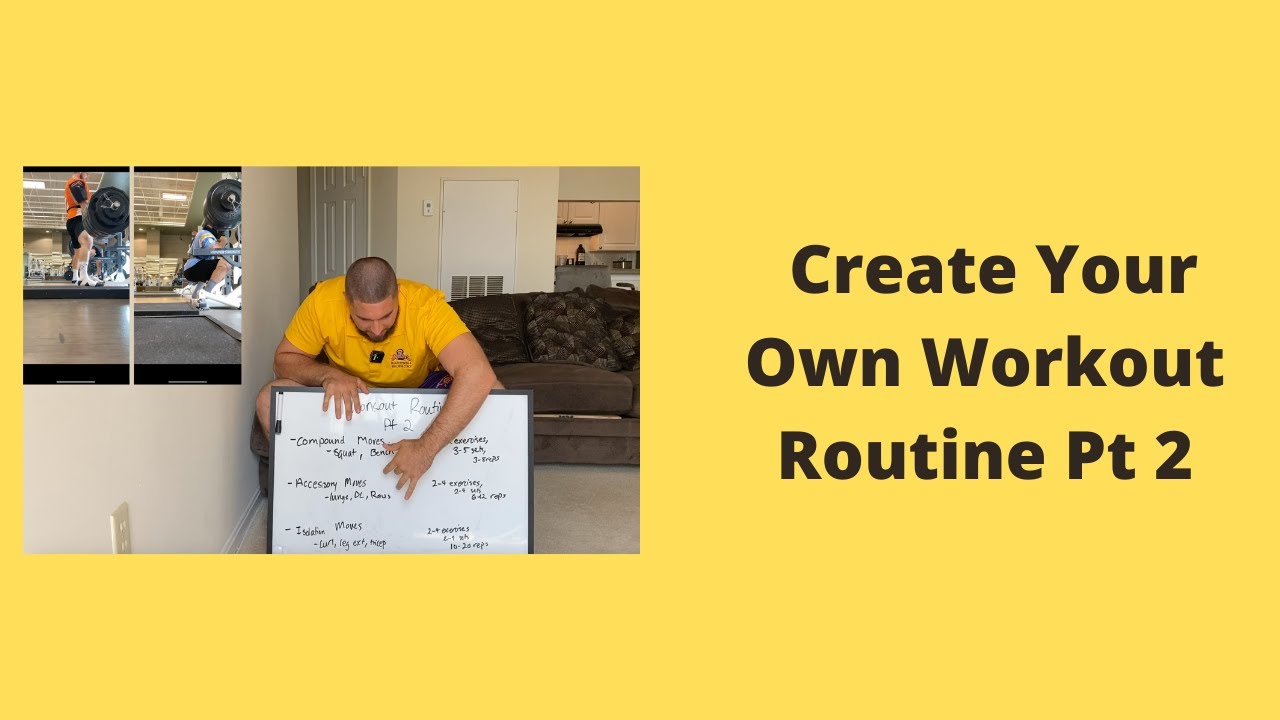
In this instructional video, Eric Roberts expands on his beginner workout planning series by outlining a structured approach to designing a workout day. He begins with a quick recap of part 1’s core principles—prioritizing strength training, applying progressive overload, and training 3‑4 days per week. Roberts then introduces a three‑tier exercise hierarchy: (1) metric‑based compound movements placed at the start of the session, performed for 1‑2 exercises, 3‑5 sets of 3‑8 reps with long rest periods; (2) accessory movements positioned after the compounds, 2‑4 exercises, 2‑4 sets of 6‑12 reps; and (3) isolation movements at the end, 2‑4 exercises, 2‑4 sets of 10‑20 reps for muscle “pump.” He explains why order matters for strength, safety, and recovery, and emphasizes tracking weight or reps to ensure weekly progression. The bulk of the video is a concrete lower‑body example: sumo deadlifts (3 × 5, 120‑180 s rest), box squats (3 × 6‑8, 120‑180 s), supersetted reverse lunges and single‑leg RDLs (3 × 8‑10, 120‑150 s), and a tri‑set of single‑leg hip thrusts, hamstring curls, and butterfly bridges (3 × 12‑15, 10‑12, 20 reps respectively, 90‑120 s rest). Throughout, Roberts stresses progressive overload via weight increments or rep additions, proper rest intervals, and form maintenance, ending with a call for viewers to ask questions.
Chapters
Alrighty guys, what is going on? Welcome back. This is the part 2 of how to create your own workout routine. Literally filming this on the same day, as you can see from my still new haircut. Just changed shirts because why not keep things interesting? Um, all right, cool. So there's a lot on this board. I'm gonna quickly recap what we talked about in part 1. So in part 1, we covered you should be strength training, not just cardio. Your workouts and your exercise should be based around strength training. Number 2, you should be progressively overloading. And again, this just means lifting more weight or lifting, doing more reps or one of those 2 main things. There's other ways to do it. We'll talk about it right here. This is kind of what this part 2 is going to be about. And also, 3, working out 3 to 4 days a week, more than enough. Something like upper body, lower body, full body, or upper body, lower body, upper body, lower body. That way you're hitting your muscle groups 2 times a week. You're making it sustainable. You're allowing your body to recover from the workouts and yeah, all those good things. All right. So let's dive right in first and foremost. So we're going to talk about how you can— so let's say you're doing a lower body day. There's going to be, you know, a whole, a whole list. I'm going to wipe this board clean here in a second and we're going to go over exactly what a day looks like, but I'm going to teach you the principles first. So the very beginning of your workout, these, the first 1 or 2 exercises you do during a workout should be your metric-based compound movements. And what do I mean by this? Compound movements are going to be things that involve your entire body. Things like squats, deadlifts, overhead presses, uh, all those things that, uh, like, like a chin-up for example as well. Like all those things that involve your entire body. Using, doing a squat, you're using your legs, using your core to brace yourself. You're using your upper body to hold the weight. You're, you're, it's a full body movement. Same thing with a deadlift. That's a full body movement. Yes, those exercises are more legs or more back or whatever it is, but that's a full body strength-based movement. So you're looking to get those at the beginning of your workout no matter what. Those should be placed at the beginning of your workout. And again, I said metric-based because those are the ones you're really looking to get better at each week. So if you're doing a sumo deadlift from week 1 to week 2 to week 3 to week 4, you are looking to go— if you're doing 100 pounds, 100 pounds, 110 pounds, 120 pounds, 130 pounds. You're looking to do and increase the weight or increase the reps. And we'll talk about it here, but you're looking to get better at those. Those are the ones you really want to be tracking, making sure you're improving upon. So 1 to 2 exercises for each workout, and then 3 to 5 sets of 3 to 8 reps. So again, you're seeing you're not going very high in reps, and 8 is the, is the max, I would say, for these compound strength-based movements. But you're looking to do again 1 to 2 exercises. So if you're doing a lower body day, your metric-based compound movement might be a sumo deadlift, or on the next day your metric-based compound movement might be a front squat. So you're looking to do 1 to 2 exercises that are going to be— these are the ones I'm going to make sure I progress and get stronger at week to week. Okay, 3 to 5 sets of 3 to 8 reps. Again, it's a, it's a lower rep range. You're not looking to, you know, get a burn in your muscles. You're looking to get stronger. You're looking to, to build a strong, solid base foundation. This doesn't— and we're going to go over rest periods and that kind of stuff too, but making sure you understand that this is where you get stronger. This is where you do these movements to get stronger. And that's what you want to do in the first 1 to 2 exercises of your day. Okay. Moving on to the next one, accessory moves. These are things like lunges. These are things like single leg deadlifts or other deadlift variations. These are things like rows. These are things like Arnold presses. All these different types of accessory movements. These normally complement the compound movement. So, excuse me, you're doing things to complement. If you're doing a bench press, you can do an overhead shoulder press next. That's an accessory, a dumbbell overhead shoulder press. I'm sorry. That's an accessory movement to your metric-based compound movement, right? So looking to do things like accessory moves. Again, these are going to be 2 to 4 exercises. In each workout, 2 to 4 sets of 6 to 12 reps. Okay? So again, if you're doing, let's say you're doing, we'll keep it simple with sumo deadlift for your compound movement. You're going to do 3 sets of 6 reps. That's your, that's, that's your first exercise for your first sets and your first reps. That's what you're doing first. The next movement could be you're doing a reverse lunge. You're going to do 3 sets of 8 reps on that reverse lunge. Okay? So now you have your 2 Uh, 2 exercises with the both sets and the both reps right there laid out for you. Okay, so again, you can do more than one. So these are normally going to be based around anywhere from 2 to 4 exercises. Um, 4 is on the upper end, but you can, you can go up to 4 exercises for these accessory movements. Okay, so again, you're still looking to— these are still going to be challenging, these are still going to be tough, you're still, still looking to get stronger at these, but this is where you can start to up the rep range a bit to kind of build some more lean muscle mass. Whereas this is, you're really focusing on strength here. This is where you can kind of get into, okay, I'm going to start to build some, build some muscle definition. Okay. So getting down to the last one, isolation movements. These are things like leg extensions, leg curls, bicep curls, tricep extensions, all the little muscles. And the problem is most people want to do these first because they think that, oh, well, if I just do a bunch of bicep curls, then, you know, I'm going to get my arms toned as possible. Or if I do a bunch of glute kickbacks, I'm going to get toned glutes or more defined glutes. The thing is, when you do a deadlift, a sumo deadlift, for example, those 3 sets of 6 reps on those sumo deadlifts are going to be way more effective and way more beneficial for you than if you did 5 sets of 20 reps on glute kickbacks, right? Because you are using way more load. You're lifting heavier weight for this. So that means your muscles have to work harder as opposed to just doing 5 sets of 20 reps on glute kickbacks. You're not doing that much for your body. Not to say there's not a time and a place for it, but the time and place for it is towards the end of your workout where you're already done your strength-based movement, you're already done your accessory movements, you're getting more towards the end of your workout, and you can kind of just get some pump work in. That's why isolation exercises are normally going to tend to be— you have 2 to 4 exercises with 2 to 4 sets of 10 to 20 reps. 20 is probably on the upper end. I normally don't, don't go that high sometimes, but, um, I would say within 10 to 20 reps. And again, This is where you're doing more things to feel the, feel the muscle working. So if you're doing a bicep curl, you want to feel your bicep curl, you want to feel your bicep working. If you're doing side shoulder raises, you want to feel your shoulders working. This is where, again, you can increase the reps to kind of feel the muscle burning a bit more. Not that that's an indication of anything that's super crazy as far as changing your body, but that's kind of what the isolation exercises are for. And again, anywhere from 2 to 4 of these exercises are plenty. You don't have to go do you know, 6 exercises of biceps or 6 exercises of glutes or 6 exercises of hamstring curls, you're going to be already getting a ton of the work done with your compound movement and your accessory movement. Those I want you to focus on more than anything right now. And you kind of fill in with the isolation movement as you get towards the, the end of the workout. Okay. So, and just a quick note on that, the order in which you do these does matter. It does matter because if you're trying to do your metric-based compound strength movement at the end of the workout, You're A, going to not be able to put forth as much effort, which means you're going to decrease the results you see. You're not going to maximize your performance. But also B, you're probably going to get injured because you trying to lift heavy weight for not that many reps at the end of your workout, that's not that good, right? So I want you to really kind of focus on this is the first 1 or 2 movements of the day. These are the next 2 to 4 movements of the day. And then you finish with your isolation for the next 2 to 4 movements of the day. All right, guys, I hope that makes sense. I'm going to wipe the board here clean and we're going to go into a sample lower body day as far as what that may look like. All right, so here we go. All right, guys, what is going on? So I changed shirts again because why not? If you've been watching this far, let me know you saw all the shirt changes. I want to see who's watched this far. All right, cool. So let's go over a lower body day. And again, it's going to be the same principles I talked about earlier. So we're going to have our compound movement, we're going to have our accessory movements, And we're going to have our isolation movements. Okay? So let's go over the first one. The first is going to be sumo deadlifts. Okay? So for sumo deadlifts, we're trying to do 3 sets of 5 with a 120 to 180 second rest in between sets. So this means you do sumo deadlift for 1 set of 5 reps, rest 120 seconds, 1 set, 5 reps, rest 120 seconds, 1 set, 5 reps, rest 120 seconds, move to the next exercise. Okay? So There it is. You have your metric-based compound movement, your sumo deadlift. You're trying to go— 5 reps should be 5 hard, heavy reps. You shouldn't get to rep 5 and you're like, hmm, I probably could have done 3 or 4 or 5 more. I have a whole separate video. I have a whole separate article on that. I'm going to link that here in the show notes, but these 5 reps should be hard reps. They're not supposed to tickle, as my good friend Jordan Syatt would say. So these 5 reps should be hard, should be difficult, and you should be focusing on getting stronger week to week. So if you do 100 pounds for 3 sets of 5 reps, the next week do 110 pounds, the next week do 120 pounds. How much you go up is dependent on every individual and dependent on a few things, but look to try to increase your weight each week for this. Okay? So that's one way you can get this compound metric-based movement. That's the first exercise. The next one is going to be a box squat. So whether you do it like with holding a weight right here, You can do it with a bar on your back. However you do it, you can do a box squat. So you squat down to a box and come right back up. So that's your second compound-based strength movement for your lower body day. Okay? So we're doing 3 sets of 6 to 8 reps with rest is 120 to 180 seconds. Again, just like this one. And very quickly, the rest is important because if you're trying to do 30, 40, 50 seconds in between your sets, you are not letting your muscles recover. This is just— it's an absolute fact. Your body cannot recover in that time. So what does that mean? You're not going to lift the heaviest weights you possibly can for the most. You're not going to give forth the most effort for the most reps you possibly can. So you will. If you start with 100 pounds on your first set, if you only rest 30 seconds, you might drop down to 90 pounds because your body is not recovered yet. Your muscles aren't recovered yet. You're not mentally recovered. You're not. You haven't caught your breath yet. You should not be going into the next the next set with a. You should be going into the next set ready mentally and physically. You should be recovered with your breath. You should be ready to go put forth as much effort as you possibly can into that next set. Okay, so the rest, that's why I put that here. It's very important. Please don't cut your rest to 20 or 30 seconds. Please don't do that. That would not make me very happy. So, so yeah, here we put 3 sets of 6 to 8 reps. So for example, if you're doing box squats, what you could do to try to get better week to week for Progressive overload, what we learned in the first video. So week to week you can say, hey, okay, for box squats I'm gonna pick a weight that is very, very hard for 6 reps. So for those 6 reps, let's just say 100 pounds is hard. So on week 1 you do 3 sets of 6 at 100 pounds. Week 2 you do 3 sets of 7 at 100 pounds. Week 3 you do 3 sets of 8 at 100 pounds. And then week 4 you can go 3 sets of 6 at 110 pounds. So you can up the weight and drop the reps again. Okay, so that's another way you can, you can do progressive overload is adding a rep each week. You can increase the reps. It If you increase the reps, you're lifting more weight over a longer period of time. So that still is progressive overload. Okay? So those are your 2 compound-based strength training movements. These should be, again, your bread and butter. These should be your biggest focus of the day. Make sure you get these down, make sure you hit these, make sure you're getting better at these, and you'll see success. Next, let's go into the accessory. And so 3A and 3B, what this means is you do a superset. So what a superset is, you just do each exercise back to back. So you're going to do One set of reverse lunges for 8 to 10 reps, and then you go straight to your single leg RDL, which is just a single leg deadlift. So you're going to do one set of reverse lunge, one set of single leg RDL, and then you take a— and then you take your break. So you take your break after you do those 2 sets back to back. All right. And then again, so you're doing the rest is 120 to 150 seconds. So again, reverse lunge, you're working your quad muscles here and some glute muscles. You're doing 3 sets of 8 to 10. And then the single leg RDL, I didn't even write it down, but you can also do 3 sets of 8 to 10. I'm sorry. So I forgot to write the single leg RDL, but same thing. You're doing 3 sets of 8 to 10 reps for the single leg RDL. Okay. And again, those are your 2 accessory movements. Those are your 2 movements that are going to be still somewhat full body, still somewhat compound and complementing the exercises you have above. Okay. So you have your 4 sets, you have your 4 exercises and your 4 sets and reps down. We're looking good. Now let's finish with the kind of isolation movements. So 4A, 4B, and 4C. And again, this is a tri-set. And again, you just do 4A, 4B, 4C, and then you rest. Okay? So 4A is going to be single leg hip thruster. This is for your glutes. And as you can see, we're increasing the reps here towards the end of the workout. So 12 to 15 reps for each leg because it's single leg. So 12 to 15 reps for each leg for your single leg hip thruster. Number 4B is going to be a hamstring curl. You can do a hamstring curl with a yoga ball. You can do a hamstring curl with your dumbbells, any type of hamstring curl. And again, 3 sets of 10 to 12 reps. And you're going to do a butterfly bridge, which is just a form of a glute bridge. It really, really burns your butt up. So you can definitely look that up. So butterfly bridge for 3 sets of 20 reps. And then again, after you do all 3 of those exercises, you rest from 90 to 120 seconds. So again, as you get— as you can see, you get more towards the end of the workout, you can start to bump the reps up a little bit. So for the single leg hip thruster, it was 12 to 15. For the dumbbell hamstring curl, it was 10 to 12. And for the butterfly bridge, it was 3 sets of 20. That's where you can kind of get more of your volume in, and you're not going to be risking injury or risking not recovering because a butterfly bridge is bodyweight. A single leg hip thruster is bodyweight, right? So like, you're not risking— these are not moves where if you get really, really tired or if you get really, really high in reps, you're going to break your form down and it could cause major injury. Because if you're doing Sumo deadlifts for 3 sets of 12 reps or 3 sets of 20 reps, you can easily break down your form. And that is an exercise where you can honestly really hurt yourself if you do not do it correctly. So if you keep your reps lower, you have to keep that form for a less amount of time. And if you have to do that, you can keep your form better because it's only 5 reps instead of 20 reps, right? So again, this is where you can build your isolation. You can build some of your glutes. Like there's 2 exercises here for your glutes, for the hip thruster and the glute bridge. You can add some extra glute work in to get some, obviously, some more, you know, more glute definition or more glute growth, whatever it is. So, uh, so yeah, guys, that is how you, you would set up a workout right there. And again, like, keeping in mind all the principles we learned in the first video, you're still trying to progressively overload each week. You're trying to get better each week. You're, you're trying to get your form better. You're trying to get everything better week to week. You should be tracking and, and getting better week to week. But, uh, yeah, guys, that is how you do it. That is an example lower body day, and that, that would be how you do it right there. So I would go back and rewatch the videos if you have a question. Comment here below, send me a message, do whatever you do. I would love to help you. But, uh, hope you guys enjoyed, and, uh, yeah, we will talk soon. Thanks so much.










