How To Fix Skinny Fat Once and For All in 16 Min
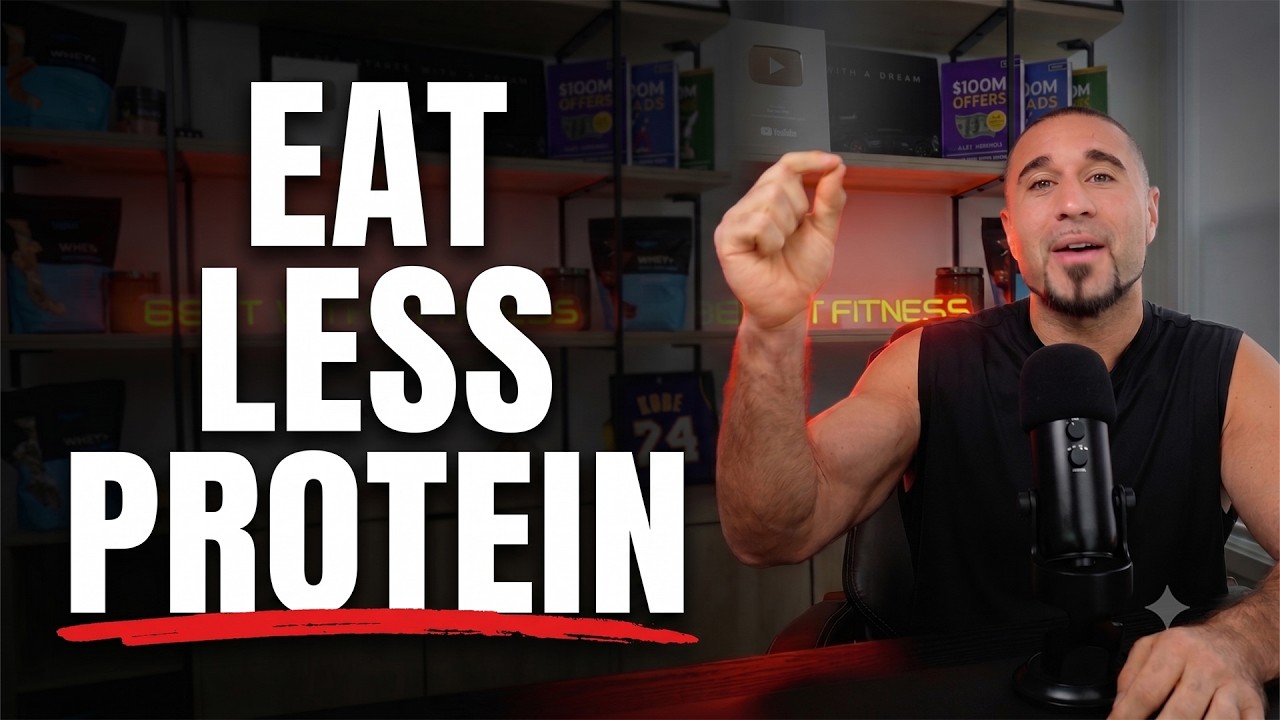
In this 16‑minute instructional video, fitness coach Eric Roberts explains why many people who lose weight still look "soft" – the skinny‑fat condition – and provides a step‑by‑step plan to transform that physique. He first clarifies that skinny fat is a problem of body‑fat percentage, not just scale weight, using a simple red‑shirt/blue‑shirt analogy and client examples (Bremer and Steph). Roberts then outlines a "ladder" calorie approach: start with a modest 300‑500 kcal deficit to shed visible belly fat, then raise calories to a new maintenance level to fuel muscle growth. He recommends a protein minimum of 0.8 g per pound of body weight (≈145 g for a 180‑lb person) spread every 3‑5 hours to maximize muscle protein synthesis. The workout prescription emphasizes low‑volume, heavy‑weight training – 3‑4 sessions per week, 4‑6 (or up to 8 on full‑body days) exercises, 2‑3 hard sets of 5‑10 reps, focusing on mechanical tension rather than high‑rep volume. Roberts warns against common pitfalls such as perpetual calorie deficits, excessive cardio, and high‑volume routines that dilute intensity and recovery. He concludes by offering an 8‑week one‑on‑one coaching challenge with personalized nutrition and workout plans, and points viewers to a free calorie‑deficit calculator and a follow‑up video on signs that belly fat is about to drop.
Chapters
Have you ever lost weight and still somehow looked soft? That's skinny fat. And after coaching over 25,000 clients, I can tell you dieting harder will never fix it. So here's why it happens, where everyone goes wrong trying to fix it, and the exact plan you can follow to get that lean look. So let's start with the moment that messes with everybody's head. You did everything right. You're eating less calories. Doing some cardio, and you can see the scale is dropping. But when you take your shirt off in front of the mirror, you still look soft. There's no definition, there's no shape. It's just kind of like a smaller version of your previous body. So your brain does the only thing it knows how to do and says, I must need to lose more weight, cut calories more, do more cardio, drop more body fat. And that right there is the trap because skinny fat isn't a too much fat problem. It's a too much body fat percentage problem because whether you're a man trying to get to a certain body fat percentage or a woman trying to get to a certain body fat percentage, that is how you'll look more lean and defined, not by weighing a certain number on the scale. And most people don't know this, But your body fat percentage can go down without you losing any fat. And I know that sounds like it doesn't make any sense, but stick with me. Everyone thinks body fat percentage only moves in one way, which is by burning off more fat. And this is why people will cut their calories harder, add in more intense exercise, and keep chasing a lower number on the scale. But your body fat percentage isn't just one amount, it's actually a ratio. Picture a room with 10 people in it. 4 of those people are wearing red shirts. That means 40% of the room is in a red shirt. Now, how do you lower that number? You could kick all the people out who were wearing red shirts. That would be like dieting harder. Or you could bring in 10 more people who are now wearing a blue shirt. Now there's 20 people in the room. And still, there's only 4 people wearing a red shirt. The room just went from 40% red shirts to 20% red shirts. And nobody left the room. The red shirts are your fat, the blue shirts are your muscle. If you build enough muscle, then more of your body mass is muscle and less of your body mass is fat. So percentage-wise, your body fat percentage would go down. And that ratio is what lean, defined physiques actually consist of, not just a smaller number on the scale. And this is exactly what happened to our client Bremer and Steph. And I'm gonna show you exactly what we did for both of them to fix their skinny fat look. And it's first gonna start with how many calories you're actually supposed to eat and when, because the timing of how many calories you eat can make or break your progress. Because at some point, fixing skinny fat actually requires you to eat more food, not less. People usually fall into one of two camps. Camp one says stay in a calorie deficit forever. They're usually scared of gaining weight back, but muscle can't grow without enough fuel, so they just stay soft and Tired and hungry on top of it. Camp 2 hears build muscle and they jump straight into eating a ton more calories and use the excuse of, well, I'm bulking, so I need to eat more. But they end up stacking more fat on top of the skinny fat. So both camps kind of just stay skinny fat forever because the fix is actually taking a ladder approach, not a big leap. Think of it like if you were taking a road trip and your gas tank is getting close to empty. Driving on close to empty is fine as long as you're on the way to a gas station. And that would be like a slight calorie deficit, eating less calories to drop some body fat. But building muscle, that's like taking a cross-country drive, and you're not going to be able to do that if your gas tank is getting down to empty. So at some point you have to stop, fill the tank, and work that gas tank back up to be able to get to your ultimate long-term goal. And this is exactly what we did for one of my clients, Bremer. We first started him in a slight calorie deficit, about 300 calories under his maintenance calories, because as you can see in his before pictures, he had a little bit of belly fat that he had to lose. So our goal was to first get that belly fat off, and then once we saw it was coming off, we then had to rework his calories back up to give his body enough fuel to be able to build the new muscle definition that he wanted on his body. So we raised his calories to his new maintenance calories Which just means the amount of food your body can take in while maintaining its current body fat. Because the extra calories he was now able to use towards building more muscle, and that's when his body actually started to change shape. He noticed more ab definition, more shoulder and arm definition. And so for you, with your calories, start in a 300 to 500 calorie deficit depending on how much belly fat you have to lose. And I'm not talking about if you have like some extra little skin down your belly. I'm talking about if you kind of have that beer belly, for example. So the more of a beer belly you have, you'll probably be more towards the 500-calorie deficit. The less of a beer belly you have, you'll be more towards a 300-calorie deficit. And if you need to know exactly what that number is for you, I have a free calorie deficit calculator. It's the same one I use with our online coaching clients, so I'm holding nothing back. There'll be a link below in the description. You can use that to figure out your number. And then once the fat visibly starts to go away, especially in your midsection, that's when you are going to work your calories back up to your new maintenance calories and give your body the fuel it needs to build the muscle it needs to lower your body fat percentage and increase that lean, defined look. So now that you have that, that's just one part of fixing skinny fat, because if you miss this next part, you'll just end up gaining fat, not muscle. And I'm sure you've probably heard you need to eat 1 gram of protein per pound of body weight to build muscle. So if you weigh 180 pounds, That would mean you need 180 grams of protein per day. So you try to set up your meal plan so you can do that. You're drinking 2, 3 protein shakes a day. You're scarfing down a chicken breast at 9 PM at night. And quite frankly, for most people, it's gonna be pretty difficult to hit that. It's gonna discourage you and probably make you end up quitting. But at the very least, you just don't need to do that. Think of building muscle like watering a plant. If you dump a whole gallon of water at once, most of that water runs straight off the soil. It's wasted. But if you water it steadily throughout the day and you give it the correct amount, it soaks it in. The plant will actually use it. And your muscles work the same way with protein. And I've watched this pattern long enough after 10 years of coaching over 25,000 clients. The ones that set their protein goal astronomically high most of the time end up quitting. But the people who set realistic protein goals and set up their day so they can hit that goal, those are the ones who stay consistent and see the biggest change in their body. So as opposed to trying to eat a gram of protein per pound of body weight, what I want you to do is take your current body weight in pounds— for my friends outside of the US, Multiply that by 0.8 and use that number as a daily minimum for protein. So let's say you wanted to weigh— so let's say you weigh 180 pounds. 180 times 0.8 is 145 grams of protein per day. Now, if you maybe end up eating a little bit more, it's fine, but you don't need to. Set that as your minimum, and as long as you're hitting that, you will be able to fix skinny fat. And a bonus, if you want faster results, try splitting up when you eat that protein every 3 to 5 hours throughout the day. This is going to help something called muscle protein synthesis, which is just the actual process that your body uses to build muscle. So you're spiking muscle protein synthesis multiple times throughout the day, which can help send more signals to your body to build more muscle. And now I need to be very honest with you. You can nail your calories, you can eat the correct amount of protein throughout the day, But if you do not do this last step, it won't matter and you will not fix skinny fat. And that is the way you set up your weightlifting routine, because most people get it wrong. And that's why even despite dialing in their nutrition, they never change their body. Because most people trying to fix skinny fat are doing workouts very high in volume. And what volume means is the amount of sets you're doing, the amount of reps you're doing, the amount of exercises you're doing per workout because you think more is better. If I do more reps, more exercises, more sets, I'm gonna build more muscle. And trust me, I did the exact same thing when I first started lifting weights because I thought more was better. But it wasn't until I learned this the hard way, and now I've been able to teach this to all of my clients to get them to see great results. And that is, think of building muscle like driving a fence post into the ground. Doing high reps with light weight and a ton of exercises is kind of like taking a toy hammer and trying to just lightly tap that fence post. You, you'd be sweating, your arm would be burning, but the fence post would barely move into the ground. Whereas doing heavier weight for lower reps and less exercises is like taking real swings with a sledgehammer. You're more likely to get that post deeper in the ground if you're taking it with a sledgehammer. Muscle grows from those heavy swings. It's something called mechanical tension, which just means how much actual tension are you creating inside of the muscle when you lift weights. And here's why a lot of high-volume workouts fail at building muscle. Number 1, all of that volume kills your intensity, so it lowers how heavy you're able to lift and how close to failure you're able to lift. Now, I know people in the comments are going to say, well, Eric, when I lift 15, 20 reps, my muscles are burning and I can feel it and I feel exhausted. You're correct, but most people go to failure with higher rep, higher volume workouts from a cardiovascular or endurance perspective, not A muscular failure perspective. So yeah, you'd be pushing yourself and it would be burning, but you're training more of your cardiovascular and endurance rather than your muscular. So that was kind of 1 and 2 put together. And then number 3, recovery. Remember, you're eating in a calorie deficit or at calorie maintenance. You're not eating in a calorie surplus. So your body only has so much fuel to go around for recovery and muscle building. If you were in a 500-calorie surplus per day, you'd be able to recover from a lot more volume in your workout. But if you're in a slight deficit or maintenance, there's only a limited amount to go around. So you need to make sure the amount of volume you're doing in your workouts is matching that. So here's this simple routine you can take with you. You're going to lift 3 to 4 days a week. If you do 3 days, I like lower body, upper body, full body, because you hit your muscle groups 2 times per week. If you're doing 4 days, lower, upper, lower, upper. In each of these workouts, you're gonna do 4 to 6 exercises, maybe up to 8 exercises on a full body day, and you're gonna do 2 to 3 hard sets for your exercise, usually between 5 to 10 reps. You're going to lift heavy and make sure the last couple of reps of your set are difficult, challenging, almost not being able to complete those reps. And so if you're lifting 10 reps, the 8th rep, the 9th rep, the 10th rep, you should be struggling and barely able to finish those reps. If you're not, you need to lift heavier. Because again, losing fat, that can just be done through your nutrition. Building muscle cannot just be done through your nutrition. If you do not have the proper workout routine set up, doesn't matter how perfect you eat, you'll never build muscle and you'll never fix skinny. And if you're watching this and you're like, this is all great information, Eric, but can you just do this for me? Can you build this for me? Can you take out the guesswork? I absolutely can. If you click the link in the description below, I have an 8-week fat loss challenge where it's one-on-one coaching. You'll get an exact custom workout routine to follow, a personalized nutrition plan with calories, macros, and will make the adjustments when you need to work back up to maintenance, and a coach who is dedicated to you, checking in throughout the week, answering any questions, and make sure you're doing everything right. Again, you can click the link in the description of this video below to learn more. And if you're about to start that slight calorie deficit to get some of that belly fat off first, and you're wondering to know how long should you stay in that and if it's actually working, well, your body actually will give you 7 strange signs. that your belly fat is about to come off, and you can watch this video here next to figure out exactly what those are.










