How To Lose Fat and Build Muscle at the Same Time (works for anyone)
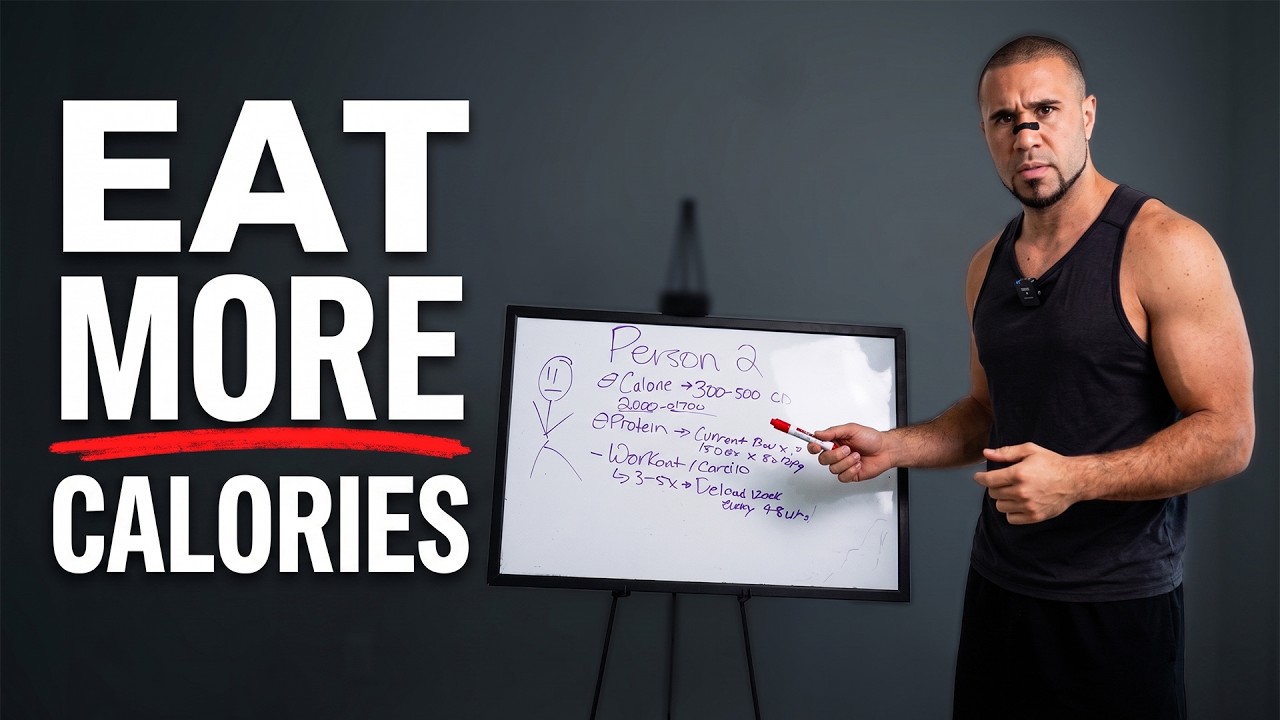
In this 30‑minute tutorial Eric Roberts argues that losing fat while building muscle is possible for anyone and outlines four distinct client archetypes that determine how to structure a recomposition program. He first debunks the myth that a calorie surplus is required for muscle growth, explaining that excess body fat or a recent training hiatus can provide the energy needed for muscle gain even in a deficit. For each archetype—(1) overweight or recently detrained individuals, (2) intermediate lifters with modest fat to lose, (3) advanced lifters with very low body fat, and (4) elite long‑term trainees—Roberts provides specific calorie‑deficit ranges, protein calculations (body‑weight × 0.8 g), and workout prescriptions (3‑5 sessions/week, 5‑12 rep range, hitting each muscle group twice weekly). He emphasizes heavy, progressive overload, the use of deload weeks for intermediates/advanced, and cardio primarily through daily step counts (7‑10k steps) with optional zone‑2 sessions for more experienced clients. Tracking methods include weekly weight averages, bi‑weekly waist measurements, monthly progress photos, and strength logs. When progress stalls, he recommends modest calorie reductions (100‑150 kcal) or increased step volume/zone‑2 cardio, and for advanced clients, occasional short‑term calorie increases to preserve performance. Throughout, Roberts stresses that scale weight alone is misleading because muscle is denser than fat, and he encourages using body‑composition metrics to gauge success. The video concludes with a call‑to‑action for his 8‑week fat‑loss challenge and links to related content.
Chapters
You can lose fat and build muscle at the same time, and anyone who tells you otherwise is lying to you. After coaching over 25,000 clients, I have found there are 4 types of people who can lose fat and build muscle at the same time. And once you know which one of these you are, you're gonna need the exact plan to follow built for you. So in this video, I'm gonna tell you which of these 4 people you are, And which exact plan you need to follow to start seeing progress today. But before I do this, I want to talk about why some people say you can't lose fat and build muscle at the same time. It is thought that to build muscle, you need to intake an excess amount of calories. This is what most people in the fitness world call a bulk or a calorie surplus. And then to to lose fat, you need to intake a deficit of calories. This is what is called a cut or a calorie deficit. And these 2 goals obviously look like they're conflicting each other, because how can you eat more calories to build muscle but then eat less calories to lose fat? People will say you have to choose between one or the other, but the problem is this is only Somewhat true because your calories are only one part of the equation when it comes to losing fat and building muscle at the same time. Because just like I'm going to show you with person 1, there could be some other factors at play that would determine if you can lose fat and build muscle at the same time. And person 1 is actually kind of 2 people combined into one. But they have the same principle. So the first, 1A, that looks like a weird— okay, that looks weird. But 1A is going to be if you have an extra 30+ pounds of body fat that you need to lose, this is you. I'm going to be talking directly to you. Or person 1B is if you have taken extended time off from lifting weights. And I mean like structured, pushing yourself, progressive overload lifting weights. And when you ask me how much is time off, typically at least 8 to 12 weeks. And this could be because you got sick, you got injured, you were traveling, you just fell off for a bit. And here's why each of these scenarios would allow you to build muscle while still losing fat. Because the person who has 30 extra pounds of body fat that they need to lose— because the extra body fat is on you, that is extra energy. That's all body fat is, it's energy for your body. So even though you would be in a calorie deficit eating less calories, the extra energy would still allow you to be put towards building muscle without taking away from your fat loss because you have the excess storage. And then person 1B, who has taken some time off from strength training, when you get back to it— you may have heard something called newbie gains before, where when you first start working out, your body almost like sees progress and results every single week. You're lifting heavier, you're noticing changes. Well, when you take time off, there is a certain period of time where your body is Not used to the strength training. So because it's such a new stimulus, your body's going to build muscle no matter what, even if you're in a calorie deficit. So these are the people who it's possible for, but you still have to make sure that your plan is set up in a way that is going to be conducive for losing fat and building muscle. And there's a couple of key points here. here that we're going to cover with your plan. I need to get a real eraser, hold on. And that is going to be your calorie and protein goals, your workouts/cardio, and the adjustments you need to make throughout. So let me erase this and we're going to go more in depth. All right, so for your calorie and protein goal, for somebody who is overweight, 30+ pounds to lose, or coming back from taking time off, Remember, your body's going to build muscle no matter what, so you're going to be able to be a little bit more aggressive in the calorie deficit that you are trying to create to lose body fat. This typically goes to a 500 to 750 calorie deficit per day. So that means if your maintenance calories are 2,000 per day minus 500, You would eat 1,500 calories per day. And by the way, if you need to know exactly what your calories should be for your age, your height, your weight, your activity level, I have a free calorie calculator in the description below. So feel free to click that below. It's the same one I use with my online coaching clients. And then for your protein goal, because you have the excess body fat or because you took the time off, you don't need as much protein as You probably think. So you're going to take your goal body weight times 0.8, and that's going to give you your daily grams of protein. So if you wanted to weigh 150 pounds, you're going to multiply that by 0.8, and that's going to get you 120 grams of protein per day. And really, for your nutrition, I promise it can be that simple. One of our clients, Michael, followed this exact structure. He was able to make the progress you see here. So now that we got your calorie and protein goals set up, let's now talk about the workout side of things so you'll be able to still give your body the stimulus it needs to build muscle. So for workouts/cardio, you're going to lift weights 3 to 5 times per week. In these weightlifting sessions, you are not going to lift lightweight for high reps. You're going to try to lift heavy in the 5 to 12 rep range. Because remember, you still need to give your body that stimulus it needs to build muscle. And what is heavy? This is going to be different for every single person. But let's say you're doing a set of 10 reps. Your 8th rep, your 9th rep, your 10th rep should be heavy, hard, challenging reps. If the last couple of reps of your set are not difficult, You are not lifting heavy enough and you need to bump up the weight. Now, how would you set up this 3 to 5 day a week workout plan? I'll just do 4 days a week. It'll be in the middle. I am a proponent of hitting your muscle groups 2 times per week because that's 2 stimuluses you can give— stimuli you can give to your muscles, and 2 times throughout the week to give muscle protein synthesis signals to your muscles to be able to build more muscle and You can get more total volume of sets per muscle group per week if you split it up into 2 times per week. So if you were to follow a 4 times a week, it would look like lower body A, upper body A, lower body B, upper body B. So you have lower, upper, lower, upper, but each of these workouts are different workouts. You don't want to do the same exact workout. Every single week. That would be for the workout side of things. Very simple, to be honest with you. Doesn't need to be overly complicated. And for the sake of this video, I could go through exactly how to set up a workout, but I have other videos on my channel if you'd like to learn that. Or if you'd like me to take out all the guesswork for you and build you an exact plan, I can do that as well. Click the link below. Now, when it comes to cardio, remember, because either you have excess body fat or you've been taking some time off, really the The most important cardio that you can do is your daily steps. So setting a step goal of at least 7,000 per day, if you can bump up to 9,000, 10,000 per day, it's only going to be better. But if all you can do, if realistic for you is 7,000 steps, that's perfect because this will be one of the biggest proponents to increase your metabolism and increase your calorie burn for the day. Without negatively impacting your ability to build muscle. One of the biggest problems I see with people who are trying to lose fat and build muscle, they do way too much cardio or they do higher intensity cardio that then ruins their muscle building progress. So daily steps. If you want to add more cardio, I will tell you exactly how to do that when we get to person number 3. 2, 3. 3 techniques. So we got that. And the last part would be making adjustments because you're going to have to make some adjustments to your plan along the way. And there's 2 main things, really 3 main things that I look at when I'm coaching somebody through a losing fat and building muscle phase. And the first part is going to be your weight average. And I say average because I don't care what you weigh on Tuesday, versus Friday. But over the course of 7 days, you take all of your weigh-ins, you add them up, you divide by 7. That would give you your weekly average for your weight. And then from week 1 to week 2 to week 3 to week 4, you look at the averages and compare those on a weekly basis. So you're looking at your weight average, and a good range I like to go by is 2 weeks. So if 2 weeks goes by and your weight average is trending down, don't need to change anything, you're good. If 2 weeks goes by and your weight average not trending down, this would be you need to make an adjustment, and I'll tell you exactly what that would be in a second. So that's the first part. The second part is your measurement, specifically your waist measurement, and I'll talk about this a bit later in the video, but you can't just go by The number on the scale, especially when you're losing fat and building muscle at the same time. So taking your waist measurement right below your belly button is a great way to know if you are losing fat specifically in your waist area. So every 2 weeks you should be taking your waist measurement as well. And if your waist measurement is trending down, good, don't change anything. If it's not trending down, you might need to make an adjustment. And the last part is taking everybody's favorite progress pic. So I like doing these every 4 weeks. Some people do it every week. I think that's a bit like OCD and creates body dysmorphia. You're not going to see that much difference in a week-to-week basis, but on a monthly basis, you can put your progress pictures side by side, look at them, and then you can clearly tell, hey, maybe my stomach is a bit closer to my body. I can tell my love handles are a bit less. My face, my arms are looking A bit more defined. So if your progress pictures are looking better, keep going. No adjustments need to be made. Now, if let's say none of these are happening, this is when you would make adjustments. And there's 2 adjustments that we will typically make for our online coaching clients if they get into this predicament, and they have to really do around calories and cardio/insulin. energy expenditure, because remember, calorie deficit needs to be created. So the first adjustment would be around nutrition, and this would be simply decreasing— that's not what I wanted to draw— decreasing your daily calories by 100 to 150 per day. So if your goal was 750, maybe you drop down to 1,600 per day. I don't like to drop more than that because number one, you don't need to, And number 2, if you start dropping more than that, your metabolism will adapt with it and you'll just have to keep eating lower calories to lose weight, which is not fun. I don't like to do that. Neither do you. So that is the first one. Or the second one would be to increase your cardio/daily steps. So if you are getting 7,000 steps per day, we might say bump that up to 9,000 steps per day. If you're already getting 9,000 steps per day, we might say, let's add in a couple of sessions of zone 2 cardio after your workout, which we will talk about later in the video. But it's really either one of these 2 things. And for our online coaching clients, we typically like to ask them because some people, they say, I do not want to eat any less food. I am willing to do a bit more exercise. So we'll just do that. Some people say, I would love to. I do not have the time to get an extra cardio. I'm a super busy mom or a working professional. I don't have that kind of time. I'll drop my calories by 100 per day. So that's what you would do if you are not seeing progress and/or just being proactive about the progress that you are making. For a lot of the clients that we coach, we take it very personal that they see results because that's why they're coming to us. And so we will often be proactive about making these adjustments so that you can continue to to see progress. So if that is you, that is your exact plan that you need to follow. Now, person number 2 is going to be a little bit different. Person number 2 is going to be that intermediate lifter where maybe you've been, you know, kind of on a strength training journey for the last, I'd say, 1 to 3 years. And when I say a strength training journey, I mean you're actually following a good You're not just kind of going into the gym and doing random exercises or random workouts or doing things like Beachbody, Orange Theory, HIIT boot camp classes. Nothing inherently wrong with any of that. It's better than you doing nothing, but there's a difference between actually following a structured program versus you just kind of going into the gym and working out. So if this is you, then you're going to be falling into this category and If you don't have 30+ pounds that you need to lose, but maybe it's you have 5 to 15 pounds that you're looking to lose. Remember, it's not all about the number on the scale. We'll talk about that later. But this is where you would fall into for person number 2. And this individual does take a bit of a different approach to lose fat and build muscle because your body is in a different place than person number 1 was. But the reason you can— let's, let's balance here— the reason you can still lose fat and build muscle is because your body is still going to be able to adapt to the training stimulus that you give it. All while you might not be a beginner anymore, or you might not have the newbie gains phase, your body can still build muscle. Now, I'll be honest with you, it'll probably be— I didn't even spell that right— it'll probably be a little bit slower. You probably won't see as fast of strength and muscle building progress as person 1 would, but that doesn't mean it's not possible. And this is where people on the internet don't like to talk in nuance. They like to talk in black or white. While the person A may still be able to build 1 to 2 pounds per muscle of muscle per month, you might only be building a half a pound of muscle per month, which is still relatively good from a muscle building perspective, but it's possible it's just slower. And again, if you have 10 or 15 pounds that you need to lose, your body still does have some extra energy to put towards building muscle. And if you combine it with what I'm about to tell you of how to create your plan, you will still be able to lose fat and build muscle at the same time. So let's go ahead and start with your calorie intake. Remember, you don't have that much weight to lose and you are more intermediate, which means you probably lift a bit heavier, push a bit harder in your workouts. So you would create a roughly 300 to 500 calorie deficit per day. And remember, if you need to know exactly what this is for you, there's a free calorie calculator But if your maintenance calories are 2,000, you might eat 1,700 calories per day because you need the extra calories to build muscle. Because you don't have as much body fat on your body, you don't have as much extra energy on your body to facilitate muscle growth. So you need the extra calories through food to be able to still facilitate muscle growth. Now going into The protein goal, similar, because you don't have as much body fat and your weight is lower. Instead of taking your goal body weight and multiplying that by 0.8, you would take your current body weight and multiply that by 0.8. So again, if you currently weigh 150 pounds, you'd multiply that by 0.8, and then you would get 120 grams of protein per day. So wherever you're currently at, take that, multiply it by 0.8, and these 2 things will still allow you to give your body the nutrients that it needs to build muscle while still losing fat. And combined with what I'm going to show you in the workout perspective, you'll still be able to create a big enough calorie deficit to see fat loss progress. And so let's go right into the workout/cardio side of things. Now, to be very frank, the strength training is going to stay pretty much The exact same. There's one caveat though that I think people who are more intermediate should be doing, and that is taking something called a deload week every 4 to 8 weeks. Now, what the hell is a deload? Essentially, it is just a week where you do not lift as heavy, push yourself as close to failure, or do as much volume— exercises, sets, reps. You're probably thinking, Eric, why would I do this? That means I'm not going to see progress. When you are more intermediate, you lift heavier and push yourself harder. That means there's more stress on your body. Just think about if somebody's lifting 10 pounds on a squat versus 275 pounds on a squat, just from a pure weight perspective, they're putting much more stress on their body and more specifically their central nervous system. This means combined with a calorie deficit, which is a stress on your body as well, you're going to be piling up the stress. And if you keep piling up stress and do not recover from that stress, your body will not change because there's a 3-step kind of loop your body goes through to actually build muscle and lose fat. And that is you put stress on your body, you then recover from that stress, and your body adapts to that. If you don't get to the recovery stage, you can't get to the adaptation stage, and then you won't see any progress. So every four to eight weeks, this would look something like if you're normally doing three sets of eight reps at two hundred pounds on squats during a deload week, you might do two sets of five reps at one hundred and seventy pounds. Again, you're not pushing as close to failure. So if the last couple of reps. of your set are usually really hard, the last couple of reps of your set here will not be that challenging. You'll still move some weight, but it won't be like killing you like it normally should be. And I have found this to be one of the most underrated things that we have helped our clients with, because what this also does, this allows your body to kind of do this supercompensation where you almost like over-recover in a really good way. Your body looks way better because when you drop stress, you also drop water weight. And going into the next week after your deload week, your muscles are more full, you're more strong, you're more mentally and physically recovered to be able to push harder. It's almost like a slingshot. You pull the slingshot back and then you let it go farther forward. That's what taking a deload week is. So that's why you should do that. And that's one of the biggest changes. And then from a cardio perspective, perspective, this is where I do like to program a bit more specific cardio. And typically what I, I like to do for our clients is 2 to 3 times a week of zone 2 cardio for 15 to 30 minutes. This can either be on rest days or after your workout, not before a strength training workout, because if our main goal of strength training is to build muscle, we want to go into that workout as fresh as we can. Doing cardio beforehand will not allow you to do that. So what does zone 2 mean? It means keeping your heart rate around 60 to 70% of your target, of your max heart rate. And so this would be basically go on whatever machine you like, whether it's the treadmill, incline walking, elliptical, rower, whatever. You're going to go on there and basically you should be able to maintain a conversation like this right here. And you should still be able to breathe through your nose. That's how you know the intensity is where you need it to be, because if you start doing more higher intensity than that, it's going to take away from your ability to recover from your muscle building strength training workouts. And if you're doing this zone 2 cardio, you'll be able to add a little bit of extra calorie burn, which is why you don't need to drop as low in your calories because you've now added this back in, and you need to add it back in at this stage versus the person 1 who had the extra body fat to lose. Now, when it comes to adjustments that need to be made, we're gonna kind of take the same approach with those 3 kind of results, which is number 1, again, your weight average. This is more or less the same. The only difference I would say here is just expect Expect a bit slower change for a couple of reasons. Number one, you're more advanced, so it's not going to come as fast as someone who has 50 pounds to lose. And number two, the total percentage of your body weight is dependent on your body weight. So for example, if somebody lost 1% of their total body weight at 200 pounds, that'd be 2 pounds. If somebody lost 1% of their total body weight at 150 pounds, That would be 1.5 pounds. It's the same percentage, just the actual number is different. So because you don't have that much more weight to lose, your weight's not gonna go down as much or as quick as somebody who has more weight to lose. So expect a bit slower, and this is where we'll talk a bit later in the video about seeing progress in general. This is also where measurements and progress pictures will become even more important because these will be better indicators of fat loss and muscle building progress than just the number on the scale. So we're still doing measurements every 2 weeks and we're still doing progress pictures every 4 weeks. And again, I would put more emphasis on these 2 things than just your number on the scale. And one little, maybe 4th caveat I'll throw in here is because you're a bit more advanced, I would also just keep track of your strength in the gym. If you are taking the deload weeks like I mentioned, You should be good. But if you're not taking the deload weeks, you may have a problem with the strength in the gym. So if you're finding you're not able to lift as heavy, you're not pushing yourself as much, either take the deload week like I said, or this may be a time where you would actually slightly increase your calories for a week or 2 by 300 to 500 per day. Go back to more maintenance calories. Let your body recover a bit, and then you can get back into the calorie deficit from there. But all of these things will allow you to still lose fat and build muscle at the same time. Now we have person number 3, which is really, I guess, person number 4 because I combined the other ones. But let's hit the last person. And person number 4 is going to be you if you are more advanced and you don't have A lot of body fat that you need to lose. And I'm talking probably the last 5 pounds, you know, 5 to 7 pounds. And this is you if you have been following a proper strength routine with progressive overload. And again, you're not just kind of going into the gym and doing random stuff. 5 to 10 years of consistent training. I'm not talking about I do really good for a couple months and then I fall off. Or I'm not talking about I ran through this one program one time and it was great. I'm talking about consistently 5 to 10 years. And the reason I'm hammering this home is actually because if this is not you, don't do— like, don't do what I'm about to tell you. Do the other stuff I just told you because you're gonna see more progress and it's actually a good thing. But if this is truly you, here's where I will be very honest with you. You have one of two Options, a little triage or a little, little tree here. Option number 1, you can eat in a roughly 300-calorie deficit, which will allow you to lose body fat without negatively impacting your workout performance. Because if you go lower than that, because you don't have a ton of extra energy on your body stored, you're typically going to be sacrificing your workouts. And more calorie deficit than that, is going to be losing muscle. So that's your first option. Or you go into a 500-calorie deficit and you just pretty much decide you're not going to build muscle at this time. Now let me be very clear, and the whole video here is about losing fat, building muscle same time. Again, you can do this if you are more advanced. It is just going to be so slow that you wouldn't really notice a difference. And that's what people talk about when they say you can't lose fat and build muscle at the same time. They're talking about this person, the person who's more advanced. They don't have a lot of body fat to lose. They've been doing this for a while. Even if you were to take this approach, you really wouldn't build that much muscle. So the second option is just take a bigger calorie deficit. Say my goal right now is to lose fat. That's what I'm going to optimize for. You're going to maintain your muscle. You're just not going to build a ton of muscle during this time. And this is where it would make sense to do what we talked about earlier, which is have dedicated cuts and have dedicated bulks. So you have dedicated periods of times where you lose fat. You have dedicated periods of times where you build muscle. If this is not you, you really don't need to do this. And one would argue, even if you are more advanced, you may not need to do this. It's a separate conversation for a separate day. Just if you're this person, this is what I do. If I want to go into a calorie deficit like I am right now, I've lost 11 pounds in the last month. I know I'm not going to build a ton of muscle right now, and that's okay because guess what? After I'm done losing weight, I can go into a more muscle-building phase and I'm going to be able to build more muscle, but I won't lose any fat. And you just make that trade-off knowing you get to control whatever it is that you want to do at that period of time. And to round this out with the workouts for this person, everything pretty much applies what I said to person 3, the last person we talked about. So that's the exact same. Your cardio may have to bump to 3 to 4 times a week instead of, you know, 2 to 3 times a week. And your adjustments should probably be looked at on a weekly basis versus every 2 weeks or even every month because you don't have as much wiggle room, and you probably won't be seeing that much progress. It'll be even slower. So you'll have to make sure on a weekly basis you're doing the right things, kind of push the tide along, as opposed to waiting for 4 weeks to make an adjustment where you could have made that 2 weeks ago or 3 weeks ago and pushed the can down the road a bit more. And there's one last thing I want to teach you that no matter which person you are, this is going to apply to you. And that is if you have 1 pound of muscle that you built, and you have 1 pound of fat that you lose. A pound of muscle weighs the same as a pound of fat. The composition is different. Muscle is more dense than fat, so it takes up less space on your body. Muscle is a bit more hard— that's what she said— and it's not as squishy as fat, so it visually looks different. But That doesn't mean that a pound of muscle weighs less than a pound of fat. They both weigh the exact same. It's just the composition and how it looks on your body is different. So if you are over time gaining muscle and losing fat, your scale may not change that much, especially if you're more of person 3 or person 4. This is why it's so critical to take measurements and progress pictures and your strength in the gym, because those are the only true ways to measure your fat loss and muscle building progress. And some people might get me in the comments and say, well, Eric, you're not going to gain that much muscle in a month. Correct. But especially if you are more beginner and you're kind of really starting to get on a proper strength training routine, what will also happen is your body is gonna store more carbs in your muscle because it's something called muscle glycogen. So it's storing energy in your muscles, which you could argue is building muscle, or like your muscles are more full, so it's holding on to more weight. So even though you might not have built new muscle tissue, your body is storing these extra carbs, which is almost essentially Not the same thing, but from a weight perspective would be the same thing. It would be like if you are gaining muscle and there is going to be some short-term inflammation when you are working out. It's called muscle damage and this inflammation will also lead to some short-term water weight in your muscles as well, which again can affect the number on the scale. So body recomp is what we call it, losing fat and building muscle. same time, should, should not only be focused on the number on the scale. Yes, if you have 50 pounds to lose, you got to get that number down. But as you get to 20 pounds to lose, 15 pounds to lose, 10 pounds to lose, I'd really encourage you, do not get set on one goal weight. If there's something I can, I can just drill into you after coaching tens of thousands of people, get this idea of a goal weight outside of your head. Because what you actually will weigh where you look good, feel good, fit into clothes is usually almost never your goal weight. It'll be 5 or 10 pounds, 12 pounds heavier than your goal weight because of the muscle that you are now building. And one last thing, I know this video was a lot, but if you're someone who's like, Eric, can you just tell me exactly what to do take out all the guesswork and make those adjustments for me on a weekly basis? Yes, we can do that. That's what we do. Click the link below. I have an 8-week fat loss challenge that you can apply to join. Transparently, we do not take everybody. We want to make sure you're a good fit, so there will be an application form below. And if you do qualify, you'll book a call with me and we'll help talk through if it's a good fit to get you started. And You might also have the question of, Eric, how long should I stay in a calorie deficit? Well, I made a video on exactly that. You can click here to watch that coming up next.










