I Lost 27lbs In 12 Weeks, Here's How (So You Can Too!)
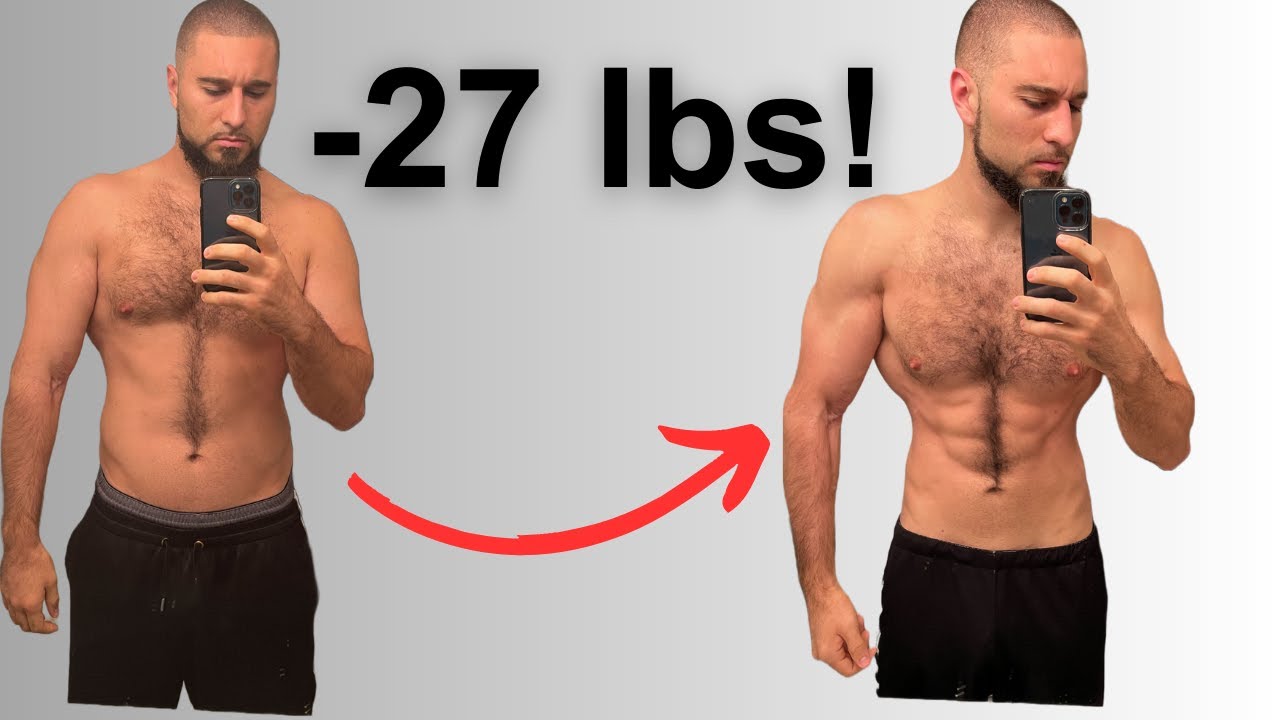
In this 12‑minute instructional video, fitness coach Eric Roberts breaks down the exact routine that helped him shed 27 pounds in 12 weeks and offers a step‑by‑step plan for viewers to replicate. He starts by describing his cardio approach – walking 5,000‑10,000 steps daily, split into three 10‑minute post‑meal walks plus one longer 20‑40 minute walk – and emphasizes that no HIIT or machine cardio was used. He then details his strength‑training protocol: a four‑day weekly lower‑body/upper‑body split (Mon, Tue, Thu, Fri) with 45‑75 minute sessions, progressive overload, and a program change every four weeks to vary rep ranges and exercise selection. The nutrition segment is organized into eight concrete habits: (1) one “big‑ass” salad per day (high‑volume, low‑calorie with protein), (2) two servings of fruit, (3) two servings of vegetables, (4) five meals a day each containing protein, (5) modest portion‑size reductions (e.g., rice, steak), (6) eliminating mindless snacking and limiting alcohol (0‑3 drinks per week), (7) restricting eating‑out to 1‑2 times weekly, and (8) maintaining an aggressive ~1,000 kcal daily deficit (≈2,700‑3,000 kcal intake for his 6’4”, 250‑lb baseline). He stresses that the deficit was tailored to his high maintenance calories and may need scaling for others. Throughout, Roberts adopts a conversational, enthusiastic tone, encouraging viewers to adapt the plan to their own lifestyles, and promotes his Clubhouse app for additional resources.
Chapters
I was able to go from this to this, losing 27 pounds in 12 weeks. And in this video, I'm going to lay out everything that I did so you can do it as well. We're going to break down everything I did with the exercise portion, and then we're also going to break down everything I did with the nutrition portion in the second half of the video. And by the way, if you stick around till the end of the video, I'm going to give you the exact special diet that I did in order to make this happen. Let's first start with talking about how much cardio I did during this 12-week period of time. And I promise you, I'm not lying when I say this— the only cardio that I did was getting my ass outside and walking 5,000 to 10,000 steps per day. As close to 10,000 as I could, but I usually ended up somewhere around that like 7,000 or 8,000 step per day mark. So let me reiterate, I did not do any HIIT cardio. I did not do any stair stepper or treadmill or bike. I'm not saying you can't do those things. I'm just saying that's what I personally did. Here's how I broke up that 7,000 to 8,000 steps per day and then how long it took me each day. Since I sit behind a desk all day, I made sure I did 10-minute walks after each one of my meals. So breakfast, lunch, and dinner, I just simply went outside, walked around my apartment complex, and made sure I got those 10-minute walks in. Because if you can do math correctly, that adds up to 30 minutes per day. It's not all at once. It was 10 minutes broken up throughout the course of the day, which goes to show you these little things that you think aren't enough or you think they're not good enough. Most people hear 10-minute walk, that's nothing. Well, if you do it 3 times a day, it's like you doing a 30-minute walk in a row. So don't underestimate getting smaller walks more frequently throughout the day. And then number 2, I did do one longer dedicated walk, usually somewhere around 20 to 40 minutes. And so in total, this would usually run me about 60 to 90 minutes Depending on what else I was doing that day. And by the way, I am counting steps that aren't like from dedicated walking. And so if you're somebody who you're like, well, what if I'm in the grocery store? What if I'm running errands? What if I'm a teacher and I walk a lot? Those count as steps. I just don't do that because I sit behind a desk all day. But that's what I did. And that's how long it took me for my cardio. Now the second part of my exercise is going to be my strength training routine. I followed a 4 times a week lower body, upper body, lower body, upper body workout split. That was on Monday, Tuesday, rest Wednesday, Thursday, Friday. These workouts were meant to get stronger, to try and still build muscle, to lift heavy. I did not do maybe what you've heard before, which is like the go lighter weight to tone the muscle and higher reps. Not what I did. I still tried to go close to failure. I still tried to push myself. I actually have my own app where I write workout programs, and you can join it if you'd like to. But I just followed the same workout programs that I was putting inside of my Clubhouse app. And these workouts generally took me anywhere between 45 to 75 minutes depending on, you know, what the, what the exact workout was, how long I was maybe Dicking off in between sets and so on and so forth. But 4 times a week, 45 to 75 minutes with the intention of still trying to lift heavier week to week, still get stronger week to week. A lot of people mess this up because they try to change up their workouts when they get into like a weight loss, a fat loss phase. Your workouts should still be focused on getting stronger, building muscle, and pushing yourself. You shouldn't massively try to overhaul your exercise and weightlifting routine just because you're trying to lose body fat. And this style of training is really important because number one, I think it's way more fun to keep pushing yourself and keep trying to get stronger and lift heavier. But number two, it will aid in your fat loss for a few different reasons. You could potentially still build some muscle even when you're in a calorie deficit trying to lose body fat. And so if you build muscle, that will help your metabolism speed up and you'll be able to lose more body fat from that. And then number two, If you are still lifting heavier, pushing yourself harder in your actual workouts, you're going to end up burning more calories in your workouts. Think about it. If you are not pushing yourself that close to failure, you're just kind of like lifting more weight and not really, you know, uh, not really going close to failure, you won't burn as many calories. But if you're pushing yourself in your workouts still, you're going to burn that much more calories, which again will help you lose more body fat. And last, I changed up my workout routine every 4 weeks. And so I still kept the same 4 times a week, lower body, upper body, lower body, upper body, but I changed up the exercises and I changed up the, the rep ranges and the routines and so on and so forth. Again, that's also what I do inside of my clubhouse because number one, I think it keeps people a bit more engaged. We're not just doing the same thing over and over and over. But number two, it also allows you to work different parts of your muscles, different parts of your body. Hit your muscles from different angles and ranges of motion. It also helps prevent against overuse injury from just doing the same exercise over and over and over. That's how people usually end up hurting their elbows or their shoulders or their knees or their back. So I like changing up the workout program every 4 weeks. And really quickly, I don't know if you want it or if you need it, but I do have 45 totally free muscle building, strength building workouts. I want to give you for free. All you gotta do is just put your email in and I'll just shoot it right over to your email. The link is in the description of this video, so if you wanna go ahead and grab those, you certainly can. If not, that's fine as well. Let's get back to the video. All right, now for the nutrition part of things where I know a lot of people struggle with, so stick with me. There's gonna be 8 total things I'm gonna give you. We're gonna do the first 4 here in my bedroom. We'll do the second, uh, the second 4 in a different part of the apartment. But I only have like a 700 square foot apartment, so, um, there's not many places to film. And remember, be sure to stick around to the end so I can give you the exact diet that I did, the special diet that I did in order to make this happen. Now, the first thing I did with my nutrition is have 1 BASS per day. What the hell is BASS? Bass is big ass salad. I had one big ass salad per day. I had this at lunchtime, and the reason I had one big ass salad per day was when you have something like a big ass salad, it is a lot of food volume for not that many calories. You may have heard, and you might be this person who you're like, "Oh, I don't eat anything and I still gain weight," or "I can't lose weight." Remember, there's a difference between food. Food volume and food calories. For example, 2 tablespoons of peanut butter is roughly around 200-ish calories. We'll just say that. You could get a big-ass salad for 300, 200 calories, and this big-ass salad is this massive bowl of food which helps fill up your stomach, whereas 2 tablespoons of peanut butter is next to nothing. And I'm sorry for all you peanut butter lovers, I enjoy it too. It's just really high in calories. So this is why incorporating one big-ass salad per day, and it doesn't have to be anything like super special. What I literally did was there's a Trader Joe's across the street from me. So I go to Trader Joe's, I get their, I think it's like their Asian salad kit or whatever it is. I pour it into a big bowl. It comes with like, you know, the croutons and the dressing and so on and so forth. Here's what I did. I just used half of whatever was in that little like a condiment package. So if it had like, I think it had cheese, I think it had croutons, it had the dressing, and so it had like some sesame seeds or something. And so I just used half of it, and that way I can have the big-ass salad with all the lettuce and all that good stuff. I used half of the condiment to keep mindful and keep track of the overall calorie intake, and then I just put some sort of protein on top. Sometimes it was grilled chicken, sometimes it was salmon, sometimes it was ground beef, whatever I was feeling, whatever I had, you know, kind of worked up for that day. You could even do something like— I've seen people do tuna packets, for example. That way you don't have to cook any of this at all. You buy a salad pack, you buy a tuna pack, you mix those things together, you have your one big-ass salad per day. So I did that every single day, and I would encourage you to do it as well. Next up, and if you're familiar with the channel or my content, you've probably heard me talk about some of these before, but I had 2 servings of fruit per day. I had 1 banana in the morning with my breakfast, and then after my breakfast, my second or third meal, I had either strawberries, watermelon, or raspberries. Reason being, strawberries and watermelon— for a whole pound of strawberries or watermelon, it's like 140 calories, which is Again, a lot of food volume for not a lot of calories, which we're trying to be mindful of our calorie intake. And then raspberries, same deal, very low in calories, also very high in fiber. Fiber helps keep you full as well. So I made sure I had 2 servings of fruit per day. I had 2 servings of vegetables per day. Personally, what I did was, again, I had my big-ass salad at lunch. And then at my dinner meal, my last meal of the day, I had sautéed spinach and sautéed red peppers. I love both of those 2 vegetables. I don't like all vegetables. Those are the 2 I enjoy, so I just kept rocking those 2 out. And again, the reason we're incorporating vegetables is because low-calorie, high-volume foods keeping you full, giving you good micronutrients, making sure you can keep your overall calories in check for the day. The 4th thing I did, I ate 5 meals a day. It was really kind of like 3 meals and 2 snacks, but I ate my 5 meals a day and I made sure I had protein at every single time I ate. Sometimes it was Greek yogurt, sometimes it was chicken breast, sometimes it was protein shakes, but I made sure no matter what, I had protein every single time I ate something, which is something I would encourage you to do as well. When you go to eat something, ask yourself, Where's my protein? Is it Greek yogurt? Is it cottage cheese? Is it a shake? Is it eggs? Is it chicken? Is it tofu? Is it edamame? Every time you eat something, I really want you to get in some sort of protein. By the way, you might ask me, well, Eric, you ate 5 meals a day. You're kind of telling us what's going on. Do you mind showing us your meals? I actually did a video on me, my exact full day of eating. If you want to check it out, I'll put it in the description of this video. You can feel free to watch it. After this video is done if you'd like. All right, we are on to the 5th thing I did with my nutrition. I simply just cut back on my portion sizes. Let me give you some examples. Number 1, I would go from having 2 cups of rice at a meal to having 1 cup of rice at a meal. Every single morning my breakfast is I pour a bowl of Rice Krispies cereal and I pour my— I make a protein shake and I Pour the protein shake over the Rice Krispies cereal, and I know I've mentioned protein shakes a few times. This is the company that I work with if you want to try out their protein. It's called Legion Athletics. It's very low calorie, very high in protein. It tastes amazing. I my favorite is the cookies and cream or the cinnamon cereal. Both of them are really, really, really good. You can actually just use my code at checkout if you want to try it out. It's just. E-R-I-C. Eric, my name. You'll get 20% off if you want to try it. You don't have to get this one, but this is just the one I use. People always ask me. So I would pour that protein shake over the Rice Krispies, and let's say if I had a bowl, I was doing 100 grams of Rice Krispies, I would back down to about 70 grams of Rice Krispies because I just simply cut back on the portion size. The same thing if I was doing a 12-ounce steak, for example, I would cut back to an 8 or a 10-ounce steak because little cutbacks on portion sizes throughout the course of your day, that's going to save you and cut back on 50 calories here, 75 calories there, 50 calories here. And if you do that through the course of your day, you're going to end up, you know, reducing your calorie amount by 50, 100, 200, 300, 500 sometimes just from simply changing up Your portion sizes. Next, we're going to talk about snacking and alcohol. I kind of mix these 2 because number one, snacking. I'm not a huge snacker. I usually just eat my meals. But what I will sometimes do is while I'm cooking my food or while I'm waiting for my food to be reheated up or so on and so forth, I love rice cakes, for example. So while I'm like waiting for my food to heat up or cook, I'll have like 1, 2, 3, 6 rice cakes sometimes because I just, I really like rice cakes, especially the white cheddar or the caramel. Love those 2. Um, but if I'm doing that, that's 50, 100, 150 calories, 300 calories sometimes that I'm having on snacks where it's a bit mindless. I'm just kind of doing it because, I don't know, I just want them, right? My food's gonna be ready in 4 minutes, but yet I'm sitting there chomping on rice cakes. But now, and if I do that 1 time, 2 times, 3 times a day, You can see how those calories add up and they may be adding up for you as well. So I cut out all of the extraneous snacking. I only had, I told you I ate 5 times per day, that's when I ate. I didn't eat at other random times of the day, random snacking, I stuck to that. And then the alcohol portion, I personally don't drink alcohol anyway, so that's kind of like, I had zero alcohol, that's just because I don't drink alcohol. But for you, I would massively encourage you, if you are somebody who does drink alcohol, probably got to cut back, man. And you probably know that, and you probably just need me to tell you that for you to actually fucking do it, because you know you got to cut back. Because not only does the alcohol have calories, but you know, like, when you're drinking, you have much less willpower, your inhibition lowers, you're gonna snack here and there. When you snack, you're not snacking on celery and carrots and, you know, this, that, and the other. It's nachos, it's wings, it's pizza, it's chips, you know, you know, at the end of the night, you're not going to like, oh, I want to get a nice nutritious meal. You're like, oh, where can I get some greasy food to, you know, absorb all this up? Those calories start to rack up the next day, you're hungover, you're tired, you want some more greasy food. Like, it's tough. So I would massively say reduce your alcohol intake. If what I tell all of the members inside of my clubhouse, what I tell them is like 1 to 3 drinks per If you're really serious about losing body fat, 1 to 3 drinks per week. That's just my 2 cents to you. Number 7, eating out. Personally, the transformation you saw from me in that 12 weeks, I think I only ate out 2 times. One of them was a wedding and one of them was— I think I just went out to eat with my parents. But beyond those 2 times, I didn't go out to eat. I'm not a big going out to eat person anyway. If I do, like when I'm filming this, I'm filming this on a Saturday. I might go out to eat tonight. I might go to like Chipotle or Chick-fil-A or something just to kind of like, you know, just because I want to. But 1 to 2 times a week max is all I eat out anyway. But during that period of time where I was really, really, really pushing for some fat loss, I was not going out to eat. All of the food that I was making was from my— or all the food I was eating was made from my house. Now I'm not saying you have to do that inherently because remember, you know, I I don't have kids, I don't have a family. I get it, right? Sometimes you might have to eat out, or sometimes you might like going out to eat with your spouse or whatever it is. But if I were to— again, what I tell people inside of my Clubhouse, which is again just my online coaching program, what I tell people is 1 to 2 times a week max. And when you do it, you've got to be mindful of, you know, what you're ordering. You have to be mindful of your portion sizes, for example. You have to be mindful of if you're going to the Mexican restaurant, the chips that we talked about earlier, right? You have to be mindful of all these things. I have a video here on YouTube as well if you'd like to check it out after this video. I kind of talk about how I handle eating out, but 1 to 2 times a week max is what I'd recommend to you. And then last but not least, number 8, the special diet that I was doing during this time. I can assure you it wasn't low carb because if I was doing low carb, I would shoot myself. It wasn't intermittent fasting because I wake up at 4:30 and I eat right away. I have my breakfast that I told you about. It wasn't carnivore because I was eating fruits and vegetables and getting my fiber. It wasn't any of those crazy— it was no detox, it was no nothing. It was simply just eating in a calorie deficit. I was not over-restricting any foods. I was not saying I couldn't have this, I couldn't have that. I just made sure my overall calories were in the calorie deficit. I was in a pretty aggressive Calorie deficit. I was in roughly about a 1,000 per day calorie deficit. Now you have to, you have to keep this in mind. I'm 6'4. At the time I was about, uh, when I was first starting that fat loss, I was about 250-ish pounds, I believe 257-ish pounds. So my maintenance calories are, are pretty high, right? So like, if let's just say my maintenance calories are about 4,000 calories per day, I was probably eating about, you know, 3,000, maybe at the tail end of it, maybe around that like 2,700, 2,800-ish mark per day. Um, and so it was a pretty aggressive calorie deficit. That's not sustainable for everybody, and I want to make this very clear. Like, the title was like losing 27 pounds in 12 weeks. I don't need you to lose 27 pounds in 12 weeks. You don't— again, my lifestyle might be very different than your lifestyle. I I live and breathe fitness. It's what I do for a living. I have an entire business around it. It's what I do, right? You don't have to. You might not have that. You might have kids, you might have a job, you might go to school. Like, you might not live the lifestyle I live. And so, for example, going out to eat or no alcohol or whatever it is, you might not do that, and that's fine. Or you just might not be able to sustain a 1,000-calorie deficit per day. That's a pretty aggressive diet. And again, I can, I can sustain that because number one, I, this is what I do. My lifestyle is very conducive to it and I have a pretty good grip of my nutrition. You might take a 500 calorie deficit per day or a 250 calorie deficit per day instead to make it a little bit more sustainable along the way. You do not have to lose 27 pounds in 12 weeks like I did. If you're losing anywhere from 0.5 to 1.5 pounds per day, 0.5 to 2 pounds per week on average. And I say on average, if you lose 0 pounds one week but 2 pounds the next week, that is 1 pound per week average. That makes sense, right? If you're losing anywhere in between that range, you're good, man. You don't have to think about, oh my God, well, Eric lost this amount in this time. No, you do you. This is your journey. You don't— if you're anywhere in between that 0.5 5 to 2 pounds per week mark, you're good. And just make sure you keep it slow, steady, and sustainable. If you follow all the things I give you here— I'm probably— again, I didn't do any cardio. I only lifted 4 days a week. Like, I didn't do anything crazy. But if you follow what I give you right here, you're going to see some great progress, I promise. And if you'd like some more help in your journey with your workouts, with your calorie deficit, how many calories to eat, helping you create a meal plan. Again, you can head to my Clubhouse, my new app, erfclubhouse.com. Everything is inside for you. You'll gain immediate access to everything, and you can start working towards your journey. Hope this video helped, and we'll chat soon.










