If You Need To Drop 30lbs FAST in 2026, Copy This
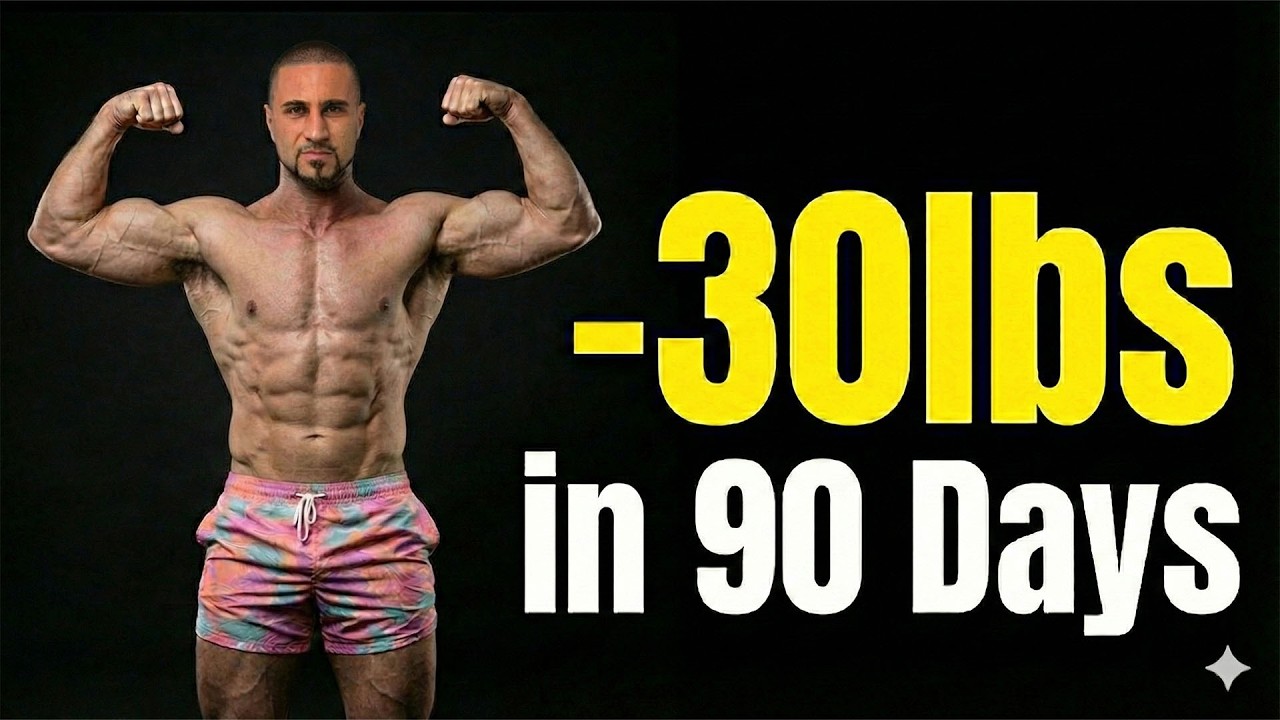
In this 90‑minute weight‑loss coaching video, Eric Roberts shares the exact five‑step system he uses with over 25,000 clients to lose roughly 30 lb in 90 days. He begins by emphasizing the importance of accurate calorie tracking (Step 1) and provides a free guide for precise food weighing. Step 2 focuses on “filling the plate” with protein, vegetables, and water to naturally crowd out junk food. Step 3 addresses plateaus, recommending tiny calorie or cardio adjustments rather than drastic cuts. Step 4 stresses preserving muscle through heavy resistance training 3‑4 times per week. Step 5 ensures long‑term success by building a sustainable, enjoyable eating and exercise plan that can be maintained for a year or more. Throughout, Roberts intersperses persuasive calls‑to‑action for his free tracking guide and paid online coaching program, and he links to a follow‑up video on belly‑fat loss timelines.
Chapters
If you want to drop 30 pounds in the next 90 days, I've coached over 25,000 clients through this exact process, and in this video, I'm going to give you the same 5 steps I give my paid clients so that you can see the same results. Let's start with step 1, and this is where 90% of people get it wrong before they even start. Step 1, find your starting line. When most people want to lose 30 pounds, the first thing they do is pick some random calorie number and they start dieting on Monday. 2 weeks later, nothing's happened, and they think, I'm hitting my calories, why am I not losing weight? So I look at their food log, and in 10 seconds I can tell they think they're eating 1,800 calories, but in reality they're eating 2,600 calories. And it's not because they're intentionally tracking wrong or eating more, but they're eyeballing portion sizes, they're forgetting oils, they, they're not tracking their calories on the weekends. So they have no idea what they're actually eating. It's like driving a car with a broken speedometer. You look down and it says 55 miles an hour. You're cruising, everything feels fine, but you're actually going 85 miles an hour and you don't realize it until you see the red and blue lights behind you because you get pulled over for speeding. That's what bad tracking does. Your food log says 1,800 calories, But you're really at 2,600 and you don't find out until you step on the scale 3 weeks later and nothing's moved. The problem isn't your diet, it's the way you're tracking your diet. So step 1 isn't just picking a calorie target. Step 1 is fixing your speedometer, AKA fixing how you're tracking your food. So for 1 week, 7 full days, I need you to track everything you are eating. And I mean everything. The weekends, the bad foods, the handful of chips off of your kid's plate or little snacks throughout the day. Don't try to be perfect. Don't try to eat clean. Don't even care about how many calories you're eating. Just log your food accurately because without this step, everything else after this is a waste of time. And if you've never tracked properly or just want to make sure you're doing it correctly, I made a free guide that shows you exactly how to track your calories the correct way, of how to weigh your food, how to handle eating out, why you should be weighing in grams and not cups, tablespoons, or ounces. And you can click the link in the description below of this video to get that free guide. Because once you know you're tracking your food accurately and actually eating the calories you think, that's going to get you results faster and save you time and frustration in the future. But once you know that, the next question is What should you actually be eating? And most people overcomplicate this. Step 2: Fill the plate first. When people start a diet, the first thing they do is start cutting. Cut the carbs, cut the sugar, cut the junk food. And it works for a little while until they're white-knuckling through every meal, thinking about pizza 24/7, and eventually they snap and eat everything and have to restart on Monday. The problem isn't that they or you lack discipline. The problem is you build your entire diet around what you can't have. Think of your stomach like a parking lot. It only has but so many spots. Right now, most of those spots are taken up by junk— the drive-through, the snacks, the random stuff you grab throughout the day. Now, most people try to lose weight by just blocking off the junk food spots. But the problem is the parking lot is still empty. Now you're just walking around with an empty parking lot, hungry, staring at all these open spots that eventually you'll want to fill. That's what a restriction diet looks like. And here's what works instead. You don't block off all of the bad spots. Instead, you fill the good spots first. This is like the valet parking. You pull in protein to the valet. You pull in fruits and vegetables first in the valet. You pull in foods that will actually keep you full and satisfied. And by the time you fill all of these spots, there's only but so many other spots left open. So the junk food or the bad food only has so many spots it can go in. Not because you cut it out, you just filled the other spots first. You don't have to fight it, you don't have to ban it. There's just not that much room left over. So step 2 is simple. Before you cut out a single thing from your diet. I need you to add 3 things. 1, a palm-sized portion of protein at every meal. This could be chicken, beef, fish, eggs, Greek yogurt, protein shake, whatever you want. Number 2, a fistful of vegetables at every meal. And number 3, drink half of your body weight in ounces of water per day. That's it. Don't remove anything yet. Just add those 3 things, because what's going to happen is you're going to be so full from the protein, the veggies, and the water, the junk food starts falling off on its own, and you won't feel restricted or like you're missing out on anything which causes you to go off track. Most of our clients who start this process drop 4 to 8 pounds in the first couple of weeks, and it almost feels easy for them. And not because we put them on some crazy diet, but because we're filling the parking lot with the right cars first. And if you're interested in learning more about my online coaching program, you can click the link in the description below of this video. Now steps 1 and 2 are going to carry you for the first couple of weeks. But somewhere around week 3 to 4, you're going to hit a wall, the scale stops, your body adapts. And if you don't know what to do when that happens, you're going to end up quitting like everybody else. And so step 3 is how you break through that. Step 3, the tiny adjustment, the scale is going to stall when you're doing everything right, you're tracking, You're parking the right cars, eating protein, drinking water. And then one morning, nothing happens. The next morning, nothing happens. A week goes by, nothing happened. This is where most people ruin their progress. And they do that by slashing their calories down to 1,200 per day, adding in hours of cardio per week. And yeah, maybe the scale drops for the first couple of days they do that, but now they're exhausted, starving, and running on fumes. Within a couple of weeks, they can't sustain it. They end up overeating on the weekends or at night when they get home from work, and they're right back where they started. They didn't just fail the diet; they made it ten times harder to start again. It's like if your car's gas light comes on. You have like a quarter tank left. A normal person would just stop and refill the tank. You're back on the road in five minutes. But what most people do with their diet is equivalent to ripping out the entire engine when the gas light comes on. You didn't need an engine swap. You just needed a little bit more gas. A plateau is not an emergency, it's a nudge. Your body is saying, hey, I've adjusted, I need a small change. Small, not a nuclear meltdown. So when the scale hasn't moved in 10 or more days and you've been tracking accurately and consistently, here's all you need to do. Either decrease your daily calorie intake by 100 to 200 per day, or increase your cardio by 2 to 3 sessions per week of 15 to 30 minutes per day. That's it. Don't do both. Pick one or the other. And for your diet, that's like 1 tablespoon of peanut butter or 1 slash of oil. You'll barely notice it. Or 2 to 3 cardio sessions at 15 to 30 minutes per week. That could be an extra incline treadmill walk after your workout. That could be an extra bike ride with your kids at night. You don't have to do anything crazy because either one of those will recreate calorie deficit that you need. And you want to make the smallest change possible because what people— because what most people don't realize is you only have so many adjustments you want to make or can make over the next 90 days. If you make a big adjustment in the beginning, what are you going to do later if you plateau again? So if you go 1,200 calories in the beginning What are you going to adjust to if you plateau? 1,000 calories? So keep the adjustments small. You might need them later on again. Now, steps 1 through 3 are mainly on the nutrition side, but there's one thing that most people either completely skip or do entirely wrong that makes the difference between losing 30 pounds of fat versus losing 15 pounds of fat and 15 pounds of muscle. So step 4 is to make sure You lose the fat and keep or build the muscle. Step 4, protect the muscle. When most people are trying to lose 30 pounds in 90 days, they think exercise means tons of cardio. So they start running, they start doing the treadmill or the elliptical for an hour a day, and the scale goes down, so they think it's working. But here's what most people don't realize. You're not just losing fat if you do that, you're losing muscle. And you won't notice it at first because the scale's moving, the clothes fit different, you're feeling better. But fast forward to the end, maybe you've lost 30 pounds, but you look in the mirror and you still look soft, still no muscle definition. They went from a big doughy version of themselves to a smaller doughy version of themselves. This is what happens when you lose weight without protecting your muscle. Think of your body like renovating the inside of your house. You've got too much stuff in it. That's the body fat. So you need to clear things out. But you also have the walls in house that are the structure of your house, and that's your muscle. Those walls give it the shape, give it the structure, give it the stability. It's the architect that actually makes your house look the way it does. So if you just start ripping things out with no plan, you're tearing down the walls and you're throwing everything out. Yeah, you'll have less stuff, but the house isn't going to look any better. It's either going to look worse or it might even collapse. That's what a cardio-only exercise plan does. Strength training is saving the architecture of the house so it still looks strong and intact, but you're renovating the inside, getting out the stuff you don't want, put in the stuff you do. So step 4, you need to be lifting weights 3 to 4 days a week. And I don't mean lightweight dumbbells for 30 reps. I mean real resistance training movements like squats, deadlift, hip thrust, shoulder press, chest press, lat pulldown, most people's favorite Bulgarian split squats. And you need to push yourself to lift heavy weight in the 5 to 10 rep range. Remember, heavy is relative for everyone, but you should be finishing your set saying, man, the last 1, 2, 3 reps of your set should be challenging, heavy, close to failure sets. Sets. So if you have 3 sets of 8 reps for your workout, the 6th rep, the 7th rep, and the 8th rep should be very difficult. And that goes for every set, not just the last one, because when your body is in the calorie deficit, it's gonna be looking for fuel and energy. Muscle is a very expensive energy source, so your body will get rid of that first if you do not strength train and lift. And that's the difference between losing 30 pounds versus actually looking like you've lost 30 pounds. And if you want a personalized workout program built specifically for you, you can click the link in the description below to learn more about my online coaching program. Now, steps 1 through 4 will get you results, but there's a reason that most people can lose 10, 20, even 30 pounds And then completely fall apart somewhere along the way. And step 5 is what nobody wants to talk about, but the reason 90% of people end up gaining their weight back. Step 5, build it to last. Most people do the work. They track their food, they lift the weights, they eat the protein, and then either one of two things happen. Either they hit their goal and say, thank God that's over, and go right back to eating how they were used to. Or they burn out at week 8 because eating chicken, rice, and broccoli at every single meal makes them not even want to look at food again. So they say, fuck it, I'd rather be fat. And 6 months later, all of the weight they lost is back and then some. And it's not because they're lazy. It's because they built a plan they couldn't wait to stop. It's like holding your breath underwater. You can do it. You can be really good at it. You can train yourself to hold it for a long time, but eventually No matter how disciplined you are, you are coming up for air. That's what an unsustainable diet is. You're holding your breath, and the longer you hold it, the bigger the gasp for air is when you come back up. That's the binge. That's the rebound. That's the overeating that gains all the weight back. You didn't fail because you're weak. You failed because no one can hold their breath forever. So step 5 is this: ask yourself one question. Look at your plan and ask, could I do this a year from now? Not do I want to, could I? Is the food you're eating food you actually enjoy? Are the workouts you're doing actually realistic for your lifestyle? Are you able to go out to dinner with your friends, family, spouse, and actually enjoy it? Or are you bringing Tupperware to every restaurant you go to? Here's what I tell all of our online coaching clients: if your diet requires you to be perfect, It's a bad diet. You need to eat foods you actually like. You need meals that fit into your real life. You need a plan where you can have pizza on Friday night and still lose weight. That— because that's how the plan works long term. Not perfection. Consistency with a plan that you don't hate. The people who keep the weight off, every single one of them, they're not more disciplined than you. They just built a plan they didn't want or need to escape from. And I promise you, every single one of our online coaching clients who has lost the weight and kept it off has followed these 5 steps, not because they're complicated or it's some secret, but because it's sustainable. And now you've got the 5 steps, but here's what I've learned coaching over 25,000 clients through this: knowing the steps and executing them when life gets busy, when motivation drops, When the scale stalls out a bit, that's a different— that's where having someone in your corner who's done this thousands of times makes the difference. If you want the 5 steps built around your life, your schedule, your body, with a coach checking in on you every single week, my coaching program is linked in the description below. That is exactly what we do for our online coaching clients. And if you're sitting here thinking, okay, I'm in, I got the 5 steps, But how long is it going to take for my stomach specifically to go away? I made a video that gives you the brutally honest timeline for losing your belly fat. You can click this link right here because I think you'll want to watch this video next.










