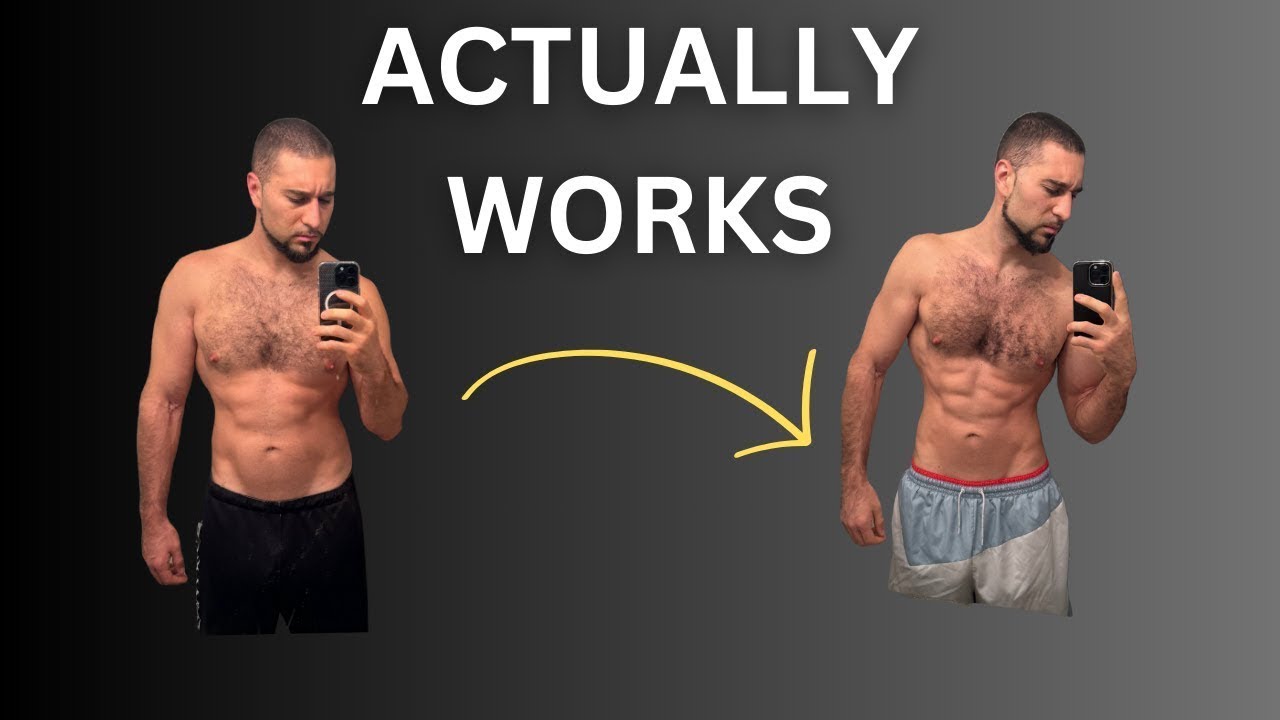
In this instructional video, Eric Roberts explains how to achieve a toned, defined physique without becoming bulky. He first debunks common myths: losing fat alone isn’t enough, there’s no special “toning” exercise, and building muscle doesn’t automatically make you large unless you’re on a long‑term surplus or using performance‑enhancing drugs. He then outlines a simple, evidence‑based program: Workouts – Focus on the 5‑10 rep range, progressively add weight or reps each week, and train every set close to failure. This builds lean muscle efficiently. Nutrition – Eat in roughly a 500‑calorie deficit to lose fat while still supporting muscle growth. Calculate protein needs as 0.8 g per pound of your goal body weight and distribute that protein across 2‑5 meals per day. Cardio – Minimal cardio is needed; aim for 5,000+ daily steps and optionally 1‑3 low‑intensity steady‑state sessions of 10‑30 min per week, keeping heart rate at 60‑70 % of max. Mindset & Tracking – The scale may not move much when you’re simultaneously losing fat and gaining muscle; instead monitor progress with photos, clothing fit, and confidence levels. Roberts also offers free workout and calorie‑deficit calculators in the video description and invites viewers to apply for personalized coaching.
Chapters
If you're somebody who's looking to get that toned physique and right now maybe you are working out, you're trying to eat healthier, but you don't really look like you're working out and eating healthier, I'm going to tell you exactly what you need to do for your workouts, nutrition, cardio, and I'm going to give you a little magic secret that a lot of people in the industry won't tell you, but I will because I actually want you to see results. First and foremost, we're going to start with your workouts because Quite transparently, if you don't get this part right, you are never going to get that toned, defined look that you are going for. So I first want to cover some common myths and misconceptions that people will throw around that I don't want you to fall into so you don't waste your time and you see progress faster. First and foremost is this theory, this concept that if you just lose more body fat, you will end up getting that toned, defined look. Defined look, which is partially right but partially not. Because what gives you that toned, defined look? Like, if I were to flex my bicep right now, you see my bicep. Why? Because there's muscle there. You can lose all of the body fat that you want, but if you don't have enough lean muscle, then you're never going to visually get that toned look that you are going for. Does that make sense? The second thing people say is there are specific toning exercises, toning rep ranges, toning workouts to tone the muscle. And you know, you might've heard like if you do lightweight for high reps, you can tone the muscle more. Um, if you do, you know, shorter rest periods, you tone the muscle more. All of this is going to be a lie and stick with me. There is actually no such thing as toning. Toning a muscle. Now stick with me. I understand what you mean when you say you want to get toned. You want to get that defined look. You want to be able to like maybe see some of your shoulders. You don't want to get too big and bulky, which I'll talk about here in a second as well. But there's no such thing as actually toning a muscle. You just build muscle. And it's important to understand this because when you're talking about what do you need to do in your workouts, You don't need to do special things to tone the muscle. You need to work on building that muscle because like we said earlier, if you don't have the muscle mass, you're never going to visually see that tone defined look that you are going for. And don't worry, a little bit later we're going to talk about what, how many reps and how much weight you need to lift and all that stuff in order to best build muscle. But please just know there's no special toning things you need to do, so please don't fall for that. And the third thing is what I want to come around to, which is not getting too big and bulky. Let me ask you this. If let's say you right now, you don't run at all, you go out and buy a pair of running shoes and you go out for your first run. Are you like, oh my God, in a month I'm going to be an ultra marathon runner? Hell no. You and I both know that ain't happening, right? Why are you so afraid to get big and bulky when you start lifting weights? But you're not afraid to become a marathon runner when you first start running. So when you're trying to build muscle, like we talked about earlier, that doesn't automatically mean you're going to get big and bulky. It takes a lot of time. It takes a lot of strength, progressive overload. It takes a lot of calories. We talked about this earlier, which again, we will touch on your nutrition a bit later in this video, but you do not have to worry about getting big and bulky. The, the, the men or women that you see that are big and bulky have either been training for a very long time, they either have, uh, are taking performance-enhancing drugs, or they have been on a calorie surplus. They're trying to gain weight and gain a ton of muscle. If that's not you, you do not have to worry about getting big and bulky when you're going to build muscle, because I'm telling you, that's how you get that toned, defined look. And so you're asking, okay, Eric, what's the best way to build muscle then for my workouts? Don't worry, I will keep it very simple. There's 2 main things you need to do. Number one, first and foremost, you are going to get stronger in the 5 to 10 rep range. So when you're doing your exercises and your sets, the majority of your reps should be in that 5 to 10 rep range. And then week over week, you should be trying to either add to the amount of weight that you are lifting, or you should be, you should be trying to add the amount of reps you are doing. So if let's say, you know, week 1 you're doing 50 pounds for 5 reps, maybe the next week you do 7 reps and then 8 reps, and then you work up to 10 reps for that 50 pounds. At some point you need to then increase the weight and decrease the reps back down to about that 5 rep mark. And you keep just kind of going through that cycle. Basically until you die. So that's the first part of it. The second part is going to be you need to push close to failure in your workout. So this means if you're doing 3 sets of an exercise, all 3 of those sets should be hard, heavy, challenging sets, not just the last one. This is really important. It'll really, really change your progress. I'm telling you, we've done this with a lot of our online coaching clients. and it's really transformed their progress. And by the way, if you need a free workout program you can follow, click the link in the description of this video. There will be a free program that I can send right over to you because I love you. Now let's go ahead and turn it over to your nutrition, and we're going to talk about what you need to do with that in order to get that toned, defined look you're going for. So first and foremost, as previously mentioned earlier, you are usually trying to drop some body fat. And the way you do that is by— drum roll please, you're tired of me saying it by now I'm sure— but eating in a calorie deficit. And so, but there's a really important point here to make. You don't want to take your calories too low because if you take them too low, you will not be able to build the muscle you are looking to build. So usually I recommend being in roughly about a 500-calorie deficit. And so what that means is 500 calories minus your maintenance calories. So if let's say your maintenance calories are 2,000, your calorie deficit is going to be 1,500 calories. And if you're like, Eric, how do I know my maintenance calories? How do I know my calorie deficit? Don't worry about it. There's a link in the description of this video. I have a free calorie deficit calculator you can use as well. It will give you the calorie deficit. With a 500-calorie deficit already worked in. So you can use that calculator below, but it's really important you don't go too low in calories when you're going into that calorie deficit because you want to be able to still fuel the muscle growth. Which, by the way, yes, you can still lose fat and build muscle at the same time, especially if you're somebody who maybe you're newer to following a strength training program. Maybe you haven't really done a structured program before. You just kind of go into the gym and do whatever, or you do some home workouts or Beachbody, Orange Theory, whatever. And nothing against those things, but they're just not a structured program. So if you're new to following that, you'll definitely be able to lose fat and build muscle at the same time. So that's the first part. And the second part is going to be your protein goal, which obviously is important for that muscle growth, right? Getting that muscle definition. So here's how you're going to find your protein goal. Take your goal body weight in pounds. So for all my lovely people that are outside of the US, I apologize. So let's do some conversion, but goal body weight in pounds multiplied by 0.8. So if let's say for example, you want to be 150 pounds, you would try to eat at least 120 grams of protein per day. And if you have a lot of body fat that you are looking to lose, maybe let's say you're 250 pounds right now and maybe you want to to 150 pounds. Use your end goal body weight that you're looking for. And if you're like, Eric, I don't really know my goal body weight, just pick one. It's not going to be the end of the world, but trying to get a rough estimate of what your protein goal should be is the most important part here. And with this, generally speaking, you're trying to split up your protein goal throughout the day between, I'd say, 2 to 5 meals. You don't want to just have one meal per day because that's not going to be what is the most Optimal for building muscle, so try to split your protein goal up into about two to five times that you eat protein throughout the day. And then when it comes to your cardio, basically fuck that. Half kidding, not really. I hate doing cardio. But really though, the cardio is not going to have that much of an impact on you getting that toned look that you're going for, other than it could potentially help you get into a calorie deficit, right? So what I usually recommend doing for a lot of our online coaching clients is going to be. First and foremost, trying to make sure that you walk 5,000+ steps per day. So that would be the first goal. And really, that's all you really technically have to do. So if you don't like cardio, just get at least 5K steps per day and you'll be good. If you want to add in some other stuff, or if maybe you're like, I can't always hit that number or whatever, I would say 1 to 3 times a week of 10 to 30 minutes of low-intensity steady-state cardio. So this is where like maybe you're on the bike, on the elliptical, stair stepper, You know, whatever cardio machine you hate the least, to be honest with you. And you would do that basically with low intensity, so your heart rate stays around 60 to 70% of your target heart rate. You don't need to do a lot of high-intensity cardio because that can again take away from your muscle building that you're trying to do to get that toned, defined look. So those are the 2 main things you can focus on for cardio. And the magic secret I just want to make sure you know of because This is what messes most people up, to be honest with you. Please remember, if you're somebody who you are losing fat and building muscle at the same time, the number on the scale might not go down, especially at first. It might not go down at all because a pound of fat— wait a minute, this is 1 pound of fat and this is 1 pound of muscle. This is actually what they look like. If you put these on the scale, they both weigh a pound. So this is where if you're losing fat and building muscle at the same time, the number on the scale is not going to change that much, but your clothes will fit different. Your body is going to start to look different. And isn't that what you care about? You care about your clothes fitting better. You care about yourself looking better in the mirror. You care about your confidence. It doesn't really matter what this number on the scale says. So please don't let the number on the scale ruin your mental psyche for that day. If it's not going down as fast as you want to, make sure to take some progress pictures. Make sure to take a peek at how your clothes are fitting. Those are better indicators of if you're going in the right direction versus living or dying by this scale. I hope this video helped you, and if you want some more personalized help, click the link in the description of this video. You can apply to work with our team one-on-one, and we can create a program specifically for you. We'll chat next video.