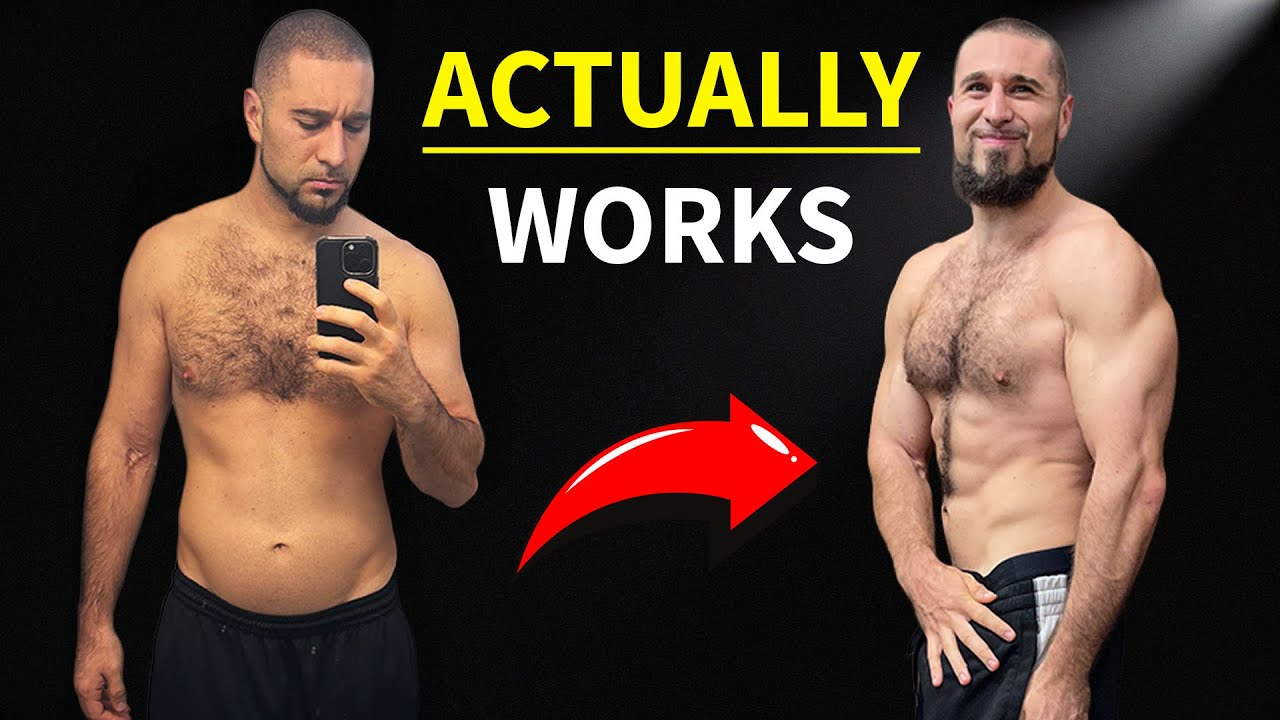
In this instructional video, fitness coach Eric Roberts presents a three‑step system for rapid yet sustainable fat loss. He begins by explaining why losing weight too quickly can cause muscle loss and the “skinny‑fat” appearance, recommending a safe weekly loss of 0.5‑1.5 % of total body weight (≈0.5‑2 lb for most adults) and estimating the timeline for a typical 50‑lb goal. The first step is exercise: a three‑part routine consisting of 3‑4 weekly resistance‑training sessions (upper/lower split, 4‑8 exercises, 2‑3 sets of 5‑12 reps), low‑intensity cardio (15‑30 min, 3‑5 times/week, conversational pace), and daily steps (≈8,000, broken into short walks). The second step is nutrition: short‑term calorie tracking to reveal true intake, a protein target of at least 100 g per day (spread over 3‑5 meals, with ≥20 g at breakfast), and a simple “2 fruits, 2 veggies” rule for food quality. Roberts emphasizes that without proper nutrition, exercise alone cannot create a caloric deficit, illustrating this with client examples (Holly’s 100‑lb loss, Allie’s 7‑lb loss in four weeks). The third step focuses on sustainability: adopting a slower, steady‑state approach (≈4 lb per month) that yields lasting results, versus rapid, restrictive diets that cause weight cycling. He argues that consistency and habit change are the true accelerators of long‑term fat loss. Throughout, Roberts intersperses calls to action for his low‑cost 12‑week workout program, a free calorie‑counting guide, and personalized one‑on‑one coaching, positioning these services as tools to implement the three‑step plan.
Chapters
If you need to lose fat fast, this is the exact 3-step plan I would follow. And by the way, this is the exact plan that I used along with thousands of others to produce results. Before we get into step number 1, let's talk about how long it's going to take you to reach your desired level of body fat. If you lose weight too fast, this is actually a bad thing because you won't just be losing fat— that's a terrible fat, you will also be losing muscle. And this is not good because this is what makes you end up as that skinny fat where maybe you don't have a ton of weight you need to lose, but you don't look the way you want to look— toned, defined, lean. And this is why to get lean as fast as possible, you actually don't want to lose weight too quickly. For example, this is one of our online coaching clients, Holly, who has lost over 100 pounds and built her body into a toned, lean, defined body. Most people will try to think about how many pounds should I be losing per week, or kilogram if you're somebody outside of the US. But this is not the most accurate way to think about this because everybody's starting weight is different. Somebody who has 100 pounds to lose might lose weight at a different rate than somebody who only has 15 pounds to lose. And so that's why a more accurate expectation and what to go by is losing anywhere between 0.5% and 1.5% of your total body weight per week. So if let's say somebody's 200 pounds and they lose 1% of their total body weight per week, that would be like losing 2 pounds per week. Or if somebody's 150 pounds and they're losing 1% of their total body weight per week, that would be a pound and a half per week. And again, both of them lost the same amount of total body fat percentage, but the number is different because of where they start from. So now knowing that, let's say you're somebody who are right now 200 pounds and you want to get down 250 pounds. That is 50 pounds. And if you lost 1% of your total body weight week over week, that would take you roughly about 25 to 50 weeks to lose 50 pounds. Now, I know this might seem like a long time, but please stick around until the end of the video. You will realize this is not long at all. And now that you know how long it will take, let's talk about step number 1 in the 3-step plan To lose fat as fast as possible. Most people trying to lose fat actually end up doing the wrong exercises that backfire on their fat loss. When we talk about burning calories, you often think I need to do high-intensity cardio, I need to be sweating, out of breath, pushing myself really hard. But like we said, if you do this, the majority of your weight loss is going to be from muscle loss, which is not what we want. And this style of cardio increases your appetite and cravings, which makes it harder to stick to your diet, which we're going to talk about later in the video. So instead of HIIT classes or boot camps or endless running on the treadmill, I want you to follow this 3-part system for your exercise that we're going to lay out right now. Part number 1 is going to start with the foundation of your exercise, which is lifting. Weights. And with this, 3 to 4 times a week for 30 to 60 minutes is more than enough. You're going to follow an upper/lower workout split. You're going to have 4 to 8 exercises per workout, and you're going to do 2 to 3 sets of 5 to 12 reps for those exercises. This is the most simple way I can explain this to you. But if you're like, Eric, I need to know what exercises to do, and I just want a whole program written for me, click the link in the description of this video. I have some very low-cost Full 12-week workout programs you can check out if you'd like. This will help you build that muscle mass we keep talking about to give you that lean, defined look. Now the second part is your cardio. And again, we're going to stay away from the high-intensity cardio. And instead, we're going to opt for low-intensity cardio. This is where your heart rate doesn't get that high, and you should be able to maintain a conversation when you're doing it. And you're going to do this for 15 to 30 minutes, either after you lift weights or on rest days from lifting weights. Doing this cardio 3 to 5 times a week is more than enough. So however you want to split that up, it's up to you. And the last part of the system is probably the most important part, which is your daily steps. Your daily steps take up 15% of your total calorie burn for the day. So increasing this can very much increase your daily calorie burn, which will help you lose the fat. I like to set a goal around 8,000 steps per day, and I like to break this up into mini walks so you don't have to take one long walk every day. I like to do 10 to 20 minute walk after breakfast, 10 to 20 minute walk after lunch, 10 to 20 minute walk after dinner, and then just throughout the day, maybe I'll try to walk on some phone calls. I'll park far further away at the gym or the grocery store to be able to get some extra steps to add up to 8,000 per day. But here's the thing, even if you complete this 3-part system, unless you follow step number 2 in the plan, you will not burn any body fat. Some people think they can just exercise their way to losing fat by burning as many calories as they can, and that's never going to work out for you. Let me show you why. It takes on average 50 minutes to burn 500 calories. It takes on average 5 minutes or less if you're like me to eat 500 calories. Unless you have all the time in the world to do endless amounts of cardio, this math is never going to add up. You're always going to eat more than what you're burning if this is the approach you take, especially because like we talked about, a lot of exercise and cardio increases your appetite. And the most frustrating part is people work so hard in the gym, in their workouts, and they just don't see any fat loss progress. Does that sound familiar? And this is because your nutrition and how many calories you eat is the biggest factor in your fat loss. For example, this is one of our online coaching clients, Allie, who's only 4 weeks into coaching with us, but she's already lost 7 pounds and her stomach fat is shrinking significantly. When she joined, she was doing all of the exercise but not seeing the fat loss progress she wanted to see. And it wasn't until we implemented this 3-part plan for her nutrition that allowed her to start seeing progress almost immediately. In part number 1, we have to start with calories. For a brief period of time, we have all of our online coaching clients track their calories. And does this take extra time each day to do this. Yes, it does. But you know what also takes extra time? Having to go into the shopping mall and search for clothes that you don't even like, but you can't fit into the clothes that you want to. Or what takes extra time is having to hold up the family trip or vacation because you're not able to keep up with the pace because of your weight and you're out of shape. Not trying to be mean, just giving you the reality of it. So it's an investment to make it pay off later. Everything is going to take time. It's just how you invest that time. And I promise you, even if you just track calories for one week, you weigh your food, you track your calories, you figure out how much you're eating. Number one, you'll learn more about nutrition in that one week than most people do. Their entire lives. And number 2, you will be shocked at how many calories you are actually eating. And then you won't wonder why you're not losing weight. You will understand why you're not losing weight because you're eating too many calories. And if you want to know exactly step by step how to track your calories and how many calories you should be eating, click the link in the description of this video below. There will be a free guide on how to count calories and how many calories you should be eating. Now, part number 2 in this system is something you may have heard before— protein. Most people struggle with their diet because they get hungry. Protein is the most satiating nutrient, which just means it is going to keep you the most full for the longest period of time. It's also going to help with that muscle mass that we talked about to give you that toned, defined look you're going for. And a goal I like to give all of our online coaching clients is at least 100 grams of protein per day. If you get more, you're a rock star, but at least triple digits. And this is best broken up into 3 to 5 meals or snacks throughout the day. And a pro tip with this: start your day with at least 20 grams of protein. Number one, it's going to make the rest of the day so much easier to hit your protein And number 2, the rest of the day you will not be as hungry, especially at night, if you get protein earlier in the day. And part number 3 is going to be a rule of 2 fruits and 2 veggies per day. Yes, your calories and your protein are important, but the food quality within those calories and protein are also important. So a very simple rule that you can follow is check off that you have 2 fruits per day and 2 veggies per day. With the fruits, I like to do at breakfast and at lunch or a snack. And then for veggies, I like to do at lunch and at dinner. And now you might be thinking, okay, cool, I got my exercise and I got my diet. I'm good to go to start seeing progress. Actually not, because if you skip step number 3, it doesn't matter how good your workouts are or how dialed in your nutrition is, you won't end up losing fat. Everybody wants to lose weight yesterday, and I get it. But the issue this causes is it makes most people go into unsustainable, over-restrictive plans to try to lose weight as quickly as humanly possible. And here's the thing, you might lose 10 pounds in one month, and maybe you lose 8 pounds the next month. But what happens in month 3, 4, 5, and beyond? Because you're doing such unsustainable and over-restrictive things, you start to not only not lose weight anymore, but you start to gain the weight back that you lost and then some because you can't stick with it. So in 6 months, you've either lost no weight Or you've gained weight in 6 months. Versus if you've been following what we've been saying and taking a slower and steadier approach, you might only lose 4 pounds the first month and then another 4 pounds the second month. But then in month 3, 4, 5, you continue to lose 4 pounds. So at month 6, you're down 20 pounds. As opposed to either not losing weight at all or being up in weight because you couldn't stick with it. And not only would you be down 20 pounds, you can also know because you're doing things in a slow, steady, sustainable way, these 20 pounds will be gone forever. And this goes to show sustainability equals speed. The slow way is actually the fastest way to in the long run, because you're not going to keep losing and gaining the same 10, 15, 20 pounds over and over. In our online coaching program, almost all the clients we work with have tried to lose weight but couldn't been able to keep it off because they didn't change their habits. They didn't change their nutrition. They weren't doing the right exercises, and they weren't setting themselves up for long-term And so if you're watching this and you have lost weight, gained weight, lost weight, gained weight, it's not that you suck and it's not your fault. The plan and the approach that you were taking was not set up for sustainable progress. So if you follow what we talked about in this video, this time around you will not only lose the weight, but you'll keep it off forever. And if you want some personalized help with your specific life and situation to lose the weight and keep it off forever, and you want a personalized plan built for you and somebody to hold you accountable and check in with you, then click the link in the description of this video to learn more about our online coaching program. You'll get paired up with a one-on-one coach on my team to not only build you a plan, but check in all throughout the week, answer questions, and hold you accountable so you actually stick with it. And after you do that, you can watch this video here to learn why 90% of people who even try to lose weight aren't ever actually successful with it.