Lose 50% Of Your Visceral Belly Fat in 30 Days (Copy This)
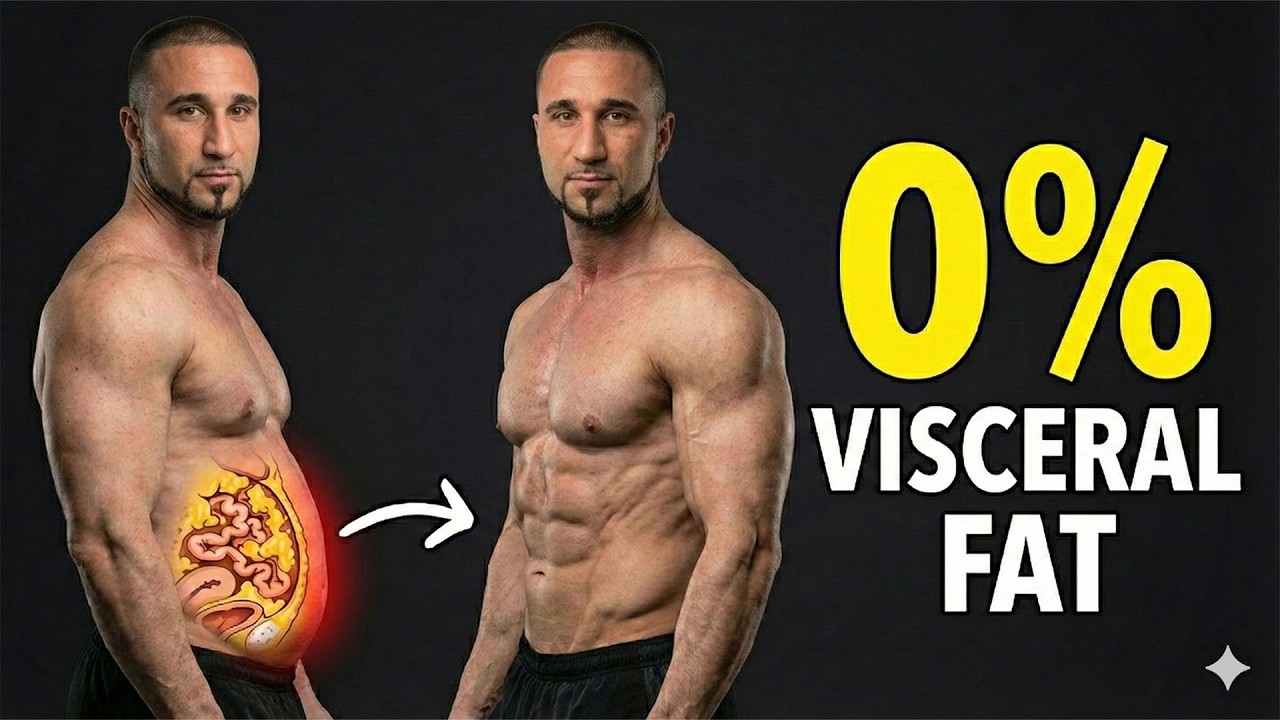
In this 30‑minute YouTube presentation, Eric Roberts explains why conventional calorie‑deficit diets and high‑intensity cardio often fail to reduce visceral (organ‑wrapping) belly fat, and he offers a three‑step protocol that he claims can cut visceral fat by half in a month. The protocol consists of: (1) Nutrition – “clean the filter” by eliminating alcohol, cutting processed foods, emphasizing nutrient‑dense whole foods (leafy greens, berries) and maintaining 1 g protein per pound of goal body weight; (2) Training – replace HIIT cardio with strength training 3‑4 times per week, low‑intensity walking (7‑10 k steps) and occasional low‑intensity steady‑state cardio to avoid cortisol spikes; (3) Recovery – prioritize 7 hours of sleep, incorporate calm breaks, and stop caffeine after noon to lower cortisol. Roberts supports each step with client anecdotes (Michael, Brian, Natalie, Michelle, Jane) who reportedly lost 50 % of visceral fat in 30 days. He frames the advice as a “visceral fat protocol” and promotes his one‑on‑one online coaching program throughout, directing viewers to a link in the description. The tone is instructional with persuasive marketing elements, and the sentiment is enthusiastic and confident about the protocol’s efficacy.
Chapters
There's a specific type of belly fat on your body that most people don't even know they have, but it's the most dangerous one. It wraps around your organs, it drives inflammation, and here's the part nobody tells you: it can actually be the fastest to lose if you stop doing these 3 things that are keeping it there. My client Brian and Natalie both lost 50% of their visceral belly fat in 30 days. And the change that made the biggest difference actually had nothing to do with their diet. I'll get to that in step 3, but first let me show you why everything you've been doing to lose your visceral belly fat has actually been targeting the wrong thing. Step number 1, nutrition. Clean the filter. When most people want to lose belly fat, the first thing they do is cut their calories. And look, a calorie deficit matters, yes. But here's what most people don't know: visceral belly fat, the fat that wraps around your organs, doesn't care about a calorie deficit the way regular fat does. We had a client, Michael, come to us after losing some fat on his own, and he was pumped about that because he started to see the scale go down. But when we looked at his body composition, his visceral belly fat hadn't moved. And when I looked at his diet, I immediately saw the problem. He was in a calorie deficit, but he wasn't eating the right foods. He was having a lot of fast food, processed snacks, not enough protein, drinking alcohol. The calories were right, but the food was wrong. Think of your body like a house with a water filtration system. Your liver and your gut, that is the filter. If you want clean water coming out of the tap, you need 2 things. Number one, you need the right amount of water pressure That is your calorie deficit. But you also need a clean filter. If the filter is clogged with junk, processed foods, alcohol, a bunch of inflammatory foods, it doesn't matter how perfect the water pressure is, what comes out the other end is still gonna be dirty. And the visceral belly fat? That's having the water come out with a dirty filter. To clean it out, you have to stop putting junk through it. So step one with nutrition is not about eating less; it's about cleaning the filter. So for the next thirty days, here's what I need you to do. First, cut out the alcohol, or at the very least, you have to majorly cut back. I know you don't want to hear that. Thirty days—that's it. Alcohol is one of the single fastest ways to inflame your gut and signal to your body to keep that stored visceral belly fat. Why do you think you often see? Hear people talk about the beer belly, and it's not even about the calories in the drink. It's about what it does to your system that also processes everything else you eat. Second, cut back on processed food. If it didn't fly in the sky, grow from the ground, roam and walk the earth, or swim in the ocean, then limit it for the next 30 days. You're giving your gut a chance to reset. Third, once you limit the processed foods, replace it with nutrient-dense whole foods, especially foods like dark leafy greens— kale, spinach— and add in berries, whether raspberries, blackberries, blueberries, because these foods contain fiber, which will improve your digestion and reduce your gut inflammation, which is what's feeding your visceral belly fat. And fourth, keep your protein at 1 gram of protein per pound of goal body weight. This protects your muscle, keeps your metabolism high as your visceral belly fat starts to melt off. These are the exact changes we made with Michael, and we really didn't change his calories a ton. We changed the type of food he was eating, and you can see the results speak for themselves. And by the way, if you're interested in getting a personalized workout and nutrition plan made just for you to take out all the guesswork and tell you exactly what to do, you can click the link in the description of the video below to learn more about our online coaching program. Now, step 1 was to clean the filter, but there's something most people are doing in their workouts that is actually making their visceral belly fat worse. And it's one of the things our client Natalie was doing every day before she started Working with us. Step 2, training. Stop feeding the fat. Step 2 is the mistake I see most people make and the mistake Natalie was making, making their visceral fat worse. She was doing high-intensity cardio, whether running on the treadmill, hours on the stair stepper, taking high-intensity boot camp classes 5, 6 days a week for 45, 60 minutes at a time. And the problem is most people are proud of this because you feel like you worked really hard during that workout. So you must be getting results. But here's what nobody actually tells you. Visceral belly fat doesn't respond to how hard you work. It responds to your hormone. And the hormone that controls where you store your visceral belly fat is cortisol, your stress hormone. And do you know what high-intensity cardio does? It spikes your cortisol through the roof. So every time Natalie was crushing a HIIT workout, she was flooding her body with more cortisol. And even though she was doing the hardest workouts of her life, she was signaling to her body to hold on to that visceral belly fat. Think of it like trying to put out a fire with gasoline. Even when I just said that, you're like, that makes no sense. You see the fire, that's the visceral fat, so you want it gone. You grab the thing that is the most powerful, that's the HIIT workouts, And you pour it on top of it. But instead of putting the fire out, it gets bigger and you make it worse because what you grabbed isn't water, it was gasoline. You had the right idea, but you had the wrong substance. So here's what we changed with Natalie and what you should change as well. We pulled the high-intensity cardio workouts out completely and we replaced it with 3 things that actually fight visceral belly fat. Instead of feeding it. First, we got her lifting weights on a proper strength training program 3 to 4 days a week, doing exercises like bench press, hip thrust, rows, shoulder press, lat pulldown, Romanian deadlifts, going heavy enough that she was challenging herself and week over week trying to add more weight or add more reps. And here's why this matters for visceral fat specifically. Muscle is metabolically active tissue, and this just means it burns more calories the more you have. And the more calories you burn, the higher your metabolism is, which means your body has the ability to burn more fat around the clock, as opposed to just burning calories when you're killing yourself in your HIIT work. Second, instead of doing HIIT cardio, high intensity, we replaced it with low intensity movement, specifically walking. And I know this sounds crazy because you're like, how did she see more progress doing less intense workouts? Because walking 7,000 to 10,000 steps per day burns calories without spiking cortisol. And I know walking doesn't maybe feel like you're exercising, but that's the point. If your cardio is making you feel like you're going to die, that is the wrong kind of cardio. And third, if she wanted to do extra cardio other than walking, we would add in 2 to 3 sessions per week of low-intensity steady-state cardio, which was either an incline treadmill A 5-mile walk, a low-intensity bike ride, or low-intensity stair step. And she would do this for 15 to 30 minutes after she lifted weights or on rest days. And you're going to ask, how do I know if it's low intensity? The threshold is simple. If you can hold a conversation like this with maybe taking 1 or 2 breaths in between, that is low intensity. If you're doing your cardio like this, that is too high intensity. And with these changes, she was actually working out less. She felt less exhausted and burnt out, and she lost 50% of her visceral belly fat in 30 days. Better results from less work. And now, steps 1 and 2 will get your visceral fat moving, but there's one thing that can undo that overnight. And it's the thing in fitness that nobody seems to talk about because it's not that sexy and you can't sell a program around it, but it could be the single biggest reason that your visceral belly fat can finally melt away. Step 3, recovery. Break the loop. Step 3 is what I mentioned earlier at the beginning of the video, the thing that can make the biggest difference for your visceral belly fat, and it has nothing to do with the gym or your diet. The thing about visceral belly fat is it feeds itself. The fat around your organs produces cortisol, your stress hormone, and the cortisol will tell your body to store more visceral fat, which then produces more cortisol, which stores more fat, and it's a loop. And here's why that matters. You can eat perfectly and train perfectly. But if your stress is high all day, every single day, that loop is going to be very hard to break. And your body will almost act like it's fighting against you, even if you're doing everything right. And this is what was happening to one of our clients, Michelle. She was dialing in her nutrition, she was doing the right workout, but she wasn't really getting that much sleep. She had to slam caffeine throughout the day to stay awake and alive. She was never taking a break with her workouts, and it was making it much harder to get rid of the visceral belly fat. Think of it like a factory with an alarm going off. When the alarm is ringing, everything else shuts down. No cleaning, no repairs, no taking out the trash. Everything goes into survival mode to take care of the emergency. Now imagine That alarm has been going off for months. Trash is piling up everywhere. That's your visceral fat. You can hire the best cleaning crew in the world. That's your diet and your exercise. But if the alarm is still ringing, the cleaning crew can't get into the building. Until you turn the alarm off, it's going to be very hard to get rid of your visceral belly fat. So step 3 is turning off the alarm. There's 3 changes that you should make today that can help you do that. First, sleep 7 hours. I know it's hard. I know you might have young kids. I know you're up late scrolling on your phone. But get this, one scientific study showed that sleeping 5.5 hours versus 8 hours, the people who slept 8 hours lost 55% more fat. And the only difference was sleep. So this isn't even lifestyle advice. This is a visceral fat protocol. Set yourself a bedtime, dim the lights 60 minutes before that, make sure your room is cold, around 66 to 68 degrees Fahrenheit, and repeat this routine every single night to set yourself up for at least 7 hours of sleep. Second, build in 2 to 3 calm breaks during your day. This could be a 10-minute walk at lunch without the stimulation of your phone. This could be 5 to 10 of slow belly breathing before a workout or before you go to bed. This could be something as simple as just standing outside in the sun in the morning for 5 minutes. But each of these small things tells your nervous system the emergency is over, and it will help very least dim that alarm. And third, stop having caffeine after 12 PM. The 2 PM, 3 PM, 4 PM coffee you are having is still in your system at 8 PM, 9 PM, 10 PM. And even if you get to You won't get into the deep sleep that is necessary to repair and recover your body. And deep sleep is where cortisol also resets. And this is what happened with one of our clients, Jane. Not only did we change his training and nutrition plan, but we really focused on getting his stress levels down and implementing these recovery habits in his day to get his belly fat down. And now you've got all 3 steps, but here's what I've seen coaching over 25,000 people in The last 10 years, the people who actually get rid of their visceral fat aren't the ones who know what to do. They're the ones who have someone actually making them do it, because knowing what to do is worthless unless you're actually doing it consistently week over week. And that's exactly what we do with our clients in our one-on-one coaching program. There will be a link in the description below of the video if you want to learn more about our program. And if you're sitting here thinking, okay, all this makes sense, Eric, I'm in, but how long is it actually going to take me to lose the visceral belly fat? Well, don't worry because I recorded this video here that gives you the brutally honest timeline for how long it's going to take to lose that visceral belly fat. I'll see you in the next video.










