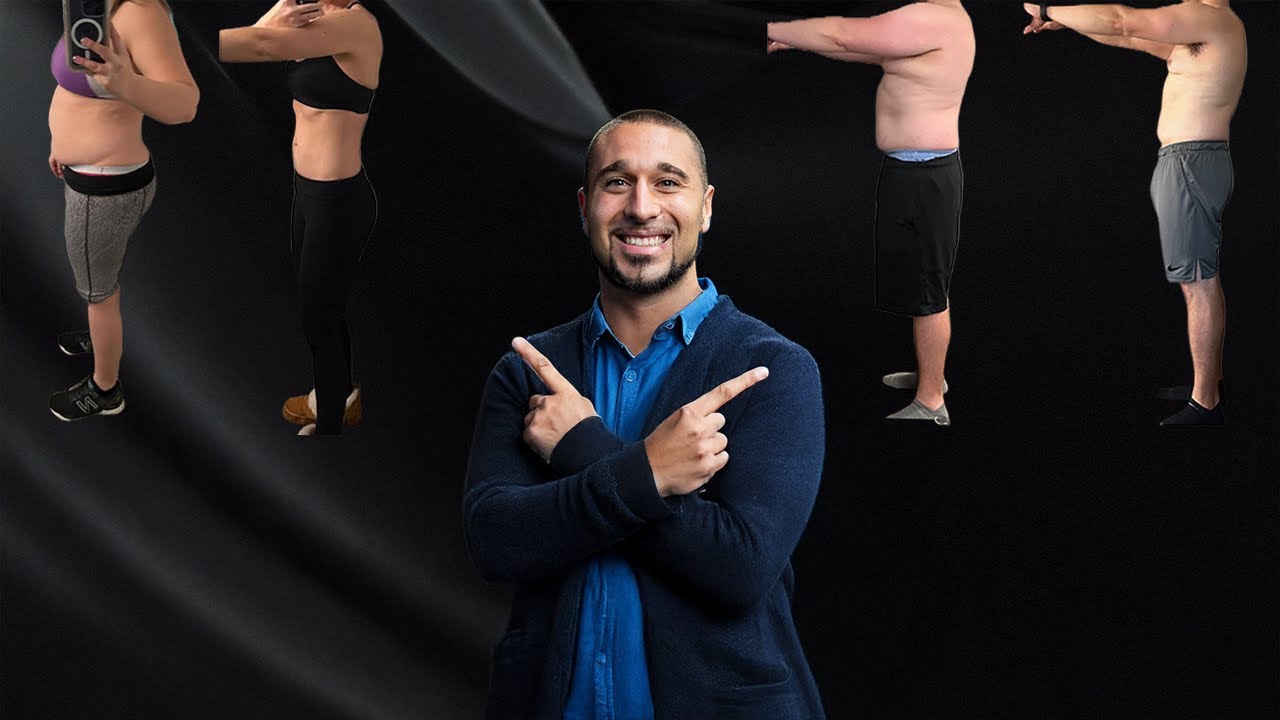
In this YouTube video, Eric Roberts walks through three real‑world client case studies—Maritza, Rob, and Yolanda—to illustrate common diet pitfalls and simple, actionable changes that can jump‑start weight loss. For each client he outlines their current stats (age, weight, daily steps, calorie and protein intake) and their biggest struggles (snacking, restrictive eating, cheat‑day bingeing, plateauing). He then prescribes three concrete adjustments: 1) Maritza: raise daily steps to at least 5,000‑10,000, boost protein to ≥100 g (using protein‑packed coffee, snacks, and a protein‑rich breakfast), and allow a modest 200‑700 extra calories during her menstrual period. 2) Rob: stop “clean‑eating” only on certain days and instead incorporate enjoyable foods daily, raise his daily calorie target from 1,800 to about 2,100 to eliminate a high‑calorie cheat day, and increase protein to ~150 g to improve satiety and thermic effect. 3) Yolanda: choose between a stricter, faster route (increase steps to 8,000‑10,000, cut alcohol, lower calories to 1,300‑1,400) or a slower, composition‑focused route (maintain calories, improve strength training, be patient). Throughout, Eric emphasizes mental benefits of movement, the importance of protein for fullness and metabolism, and the flexibility of occasional calorie adjustments. He closes with calls to action: a free calorie calculator link and options for paid coaching services.
Chapters
I helped 3 people fix their diet to lose weight, and in this video I'm going to show you exactly what they were doing wrong and how to fix it so that you might be able to take it and put it into your diet as well. I'm going to go over each person's scenario, what they were currently doing, and then what we are going to change. First off, we're going to be starting with Maritza. Maritza is a 45-year-old female. She wants to go from 107 kgs to 80 kgs. I'm 45 years old. 70 kgs, and for us in America, they'll be losing about 70-ish pounds. Now she gets about 2,000 to 4,000 steps per day, and she sometimes tracks her calories, eating around roughly 1,600 per day with 60 grams of protein per day. Marissa's biggest struggles are snacking, starving herself and eating too few calories, and getting really bad cravings when it's her time of the month and she's on her period, for all you ladies out there. I'm gonna help Maritza make 3 changes to her plan that is gonna help her see progress. And so first and foremost, I am going to want her to get more steps. And you might be thinking, Eric, well, she's struggling with nutrition, why would you recommend getting more steps first? Here's the thing, anytime somebody's getting 2,000 to 4,000 steps per day, If one of the main goals is weight loss, which was one of her main goals, immediately increasing that step count is not only going to burn more calories, which is going to help her be in a calorie deficit, but also it's going to help her mentally. Number one, get outside of the house and not be in the kitchen surrounded by food. She also mentioned she struggled with snacking and, you know, snacking on crap actually was her main words. And so getting out of the house can help you de-stress, get away from food, burn more calories, and overall help your weight loss. So anytime somebody's around that 2,000 to 4,000 step number, we really want this number to be at least 5,000 per day, if not getting to that 7,000 to 10,000 step per day. But you don't have to go from 2,000 to 10,000. Slowly work your way up. Now the second change she is going to make is eating more protein. She mentioned she struggled with starving herself, and yes, I do think she can eat a ton more calories than 1,600. In fact, if you want to have a free calorie calculator, there's going to be a link in the description of this video. You can check it out after this video if you would like. But yes, she can eat more calories, but especially more protein. Right now she's currently around that grams per day. So if we can get to at least 100 grams per day, that would massively help her be much more full, which would have her have less cravings, less cravings for snacking on crap food, as she mentioned. And the way she can do this is she mentioned in the morning she starts off every day with coffee and creamer. So one of the ways that we have helped our clients with getting more protein during the day is instead of loading the coffee with creamer, maybe you pour in like a pre-made protein shake, or even if you put in some protein powder, super easy way to not have to change a bunch of what you're doing but immediately add 15, 25, 35 grams of protein. The second way is going to include a high protein snack during the day, at least one high protein snack. And my favorite high protein snacks are going to be this list right here, which is hard-boiled eggs, tuna packets, beef jerky, Greek yogurt, cottage cheese, protein shake or protein bars, and edamame. Just eat one of those per day and you could easily increase your protein by 15 to 30 grams per day. And the last way she can eat more protein was she said she didn't eat a lot of protein at breakfast. One of the best ways to decrease your snacking and decrease your cravings is make sure to eat 25 grams of protein by 10 AM. And the third change she is going to make to her diet is to just simply increase her calories by about 200 to 500 during her period. We work with a lot of women in our coaching program, and oftentimes we just say, hey, if you need a little bit more food that week or couple of days. Everybody's different, and we've found this coaching thousands of women. But if you want a little bit more calories, that's okay. And hell, it might even be a little bit more than this. It might be 600 or 700. The point being, if you slightly increase your calories, then it's okay. Do it for a couple of days and then just get back on track afterwards, because that is the most important part. It doesn't matter what you do 3 days out of the month. It matters what you do the other days. And so just get back on track to your regular calories after. If you read Resonate with this, I hope you wrote at least one of these down. Now let's go to the second person we're going to help. His name is Rob. Rob is a 37-year-old male. He's currently 5'7, weighing around 215 pounds, and he would like to get down to 170 pounds. He gets about 6,000 to 8,000 steps per day, which is pretty good, and he eats about 1,800 calories a day that he tracks consistently. With an asterisk, and we'll talk about that in a second, along with 100 grams of protein per day. And the reason there's an asterisk is because Rob's biggest struggle is overeating on his cheat day. So the 3 changes we're gonna make to Rob's diet are: Number 1, stop eating so clean. Rob wrote in and he talked about his day of eating, and it was pretty much like, I eat vegetables and chicken breast and mushrooms. And I'm like, that sounds fucking lame and boring. And what happens a lot of times is you think to lose weight you have to only eat clean foods and you can't eat foods that you enjoy. And what's happening is you might eat clean for 6 days or 5 days, but the other 1 of— 1 or 2 days during the week, you know that's your only time to have those foods. So not only have you over-restricted yourself and not allowed yourself to have it the entire week, But by the time you get to when you are allowed to have it, you're going to say, I have to eat all of it right now because I'm going to go back to not being allowed to have it. Not to even mention your hunger hormones. Because you're eating so clean and such few calories, your hunger hormones are going to be all out of whack by the time the weekend rolls around. So stop eating so clean and just incorporate foods that you enjoy throughout the course of the week. So you don't need a fucking cheat day. You just eat the foods you like in moderation within your calorie limit. And number 2, talking about the calorie limit. So right now Rob is eating 1,800 calories 6 days out of the week. If he's eating 4,000 to 5,000 calories on his cheat day, which by the way is Much easier to do than you would think. He's actually eating about 2,300 calories per day over the course of the week. So, and again, you can use my calorie calculator. It's the exact calorie calculator I use for my own weight loss journey, but also all of our clients. I put in his information and it came out to about 2,100 calories per day. So. He can just eat 2,100 calories per day, 7 days a week, and you would actually end up eating less calories over the course of the week if you just ate more calories on a daily basis. And more calories per day would also help you not feel so over-restricted and not feel the need to have a cheat day. And the third change Rob is going to make is increasing his protein per day. So right now he's around 100 grams per day. And again, via the calorie calculator that I have, it also gives you macros. So I would love to see that number go up to about 150 grams of protein per day. This will also help him stay more full and be more satisfied, but also increase his metabolism, because for every 100 calories of protein that you eat Your body actually has to burn 20 to 30 of those calories. And so yes, he'll be eating more protein, but he'll also be burning more calories, which will help with weight loss. Now let's talk about Yolanda. Yolanda is a 40-year-old female. She's weighing roughly around 135 pounds, 134, and she wants to get down to 124 pounds. She's currently 5'2. I don't think that will Probably change. She's currently getting 4,000 to 6,000 steps, which isn't bad. And she's currently getting around 1,500 to 1,600 calories with 125 grams of protein, which is very good. Yolanda's biggest struggle is she is looking to lose the last 10 pounds and she has been for the past 2 years. So there are going to be 2 main options here. Essentially, when you get down to losing the last 5 or 10 pounds, you are either going to have Do what is required to lose those last 5 or 10 pounds, which we will talk about in a second, or you say fuck the scale and you focus on something else instead, which we'll talk about in a second. Let's say she does go for option A, and by the way, I'm not saying either one of these is right or wrong. I'm just gonna tell you what each one would require. If she does go for option A, She's gonna have to be more aggressive and more strict and restrictive with her diet and her overall fitness plan. And I know this. I'm somebody who I just lost 21 pounds in 10 weeks on a calorie deficit, and I got very lean. And what you have to do to lose the last 5 or 10 pounds is just fucking hard. It's gonna require a little bit more sacrifice. And so here's what she will have to do. Right now she's getting 4,000 to 6,000 steps per day. She's gonna have to increase to 8,000 to 10,000 steps per day. Number 2, I didn't say this earlier, but she is currently drinking 1 to 3 alcoholic drinks per week. She is more than likely gonna have to cut that out and go to 0 alcoholic drinks per week. And number 3, she's currently eating 1,500 1,500 calories, she will probably have to drop down to 1,300 to 1,400 calories per day. Now, Yolanda, or you watching this, there's a reason you've probably been trying to lose the last 5 or 10 pounds for the last 2 years. This, to you, what is required to lose the weight is probably just not worth it, which is why you haven't done it yet. Now again, maybe you look at this and say, I can do this. I'm going to do this because I want to see that lower number on the scale. I'm not telling you what's right or wrong. You just need to understand what is actually required of you to lose the weight. You're already very lean. You're already at a low body weight and a low body fat. To get even lower, it just requires more. So that's option A or option B. Like we talked about, you could just say F the scale. And focus on decreasing your body fat percentage. And most people don't know this, but your body fat percentage is not just your body fat, it's also your muscle mass. So if you increase your muscle mass but keep your body fat the exact same, your body fat percentage will actually go down. And I reckon— correct me if I'm wrong— You might not really care that much about a number on the scale. Maybe you do. We can talk about that in a different video, but you probably care about how you look. And to change the way you look, you get a lower body fat percentage. One way to do that is by lowering your body fat. Another way is to build more muscle. So what you can do is you can dial in your strength training program and get on a scienced Based program, you'd be surprised. The clients that we work with, we get them on a science-based training program where we're lifting heavier, we're building muscle, we're having progressive overload, and their bodies start to change just from changing up their training program. So I would probably reckon Yolanda's not on the best strength training program. She said she's working out, but she's probably not on an optimized lifting program. To be able to optimize changes in her body. So that would be number one. By the way, if you're interested in getting on a proper training program, click the link in the description of this video. You can check out some of our options that we offer. And then number 2 is just something most people don't want to hear or they don't want to talk about, is patience. This way might take a little bit longer, whereas this way is a bit faster. But if you don't want to cut out all these things and have to sacrifice these things in your life, this way works. It's just going to take a little bit longer to see the progress that you want to see. So it's up to you to decide which one is worth it. I hope you found this video helpful and maybe resonated with one of the scenarios there. And if you want some more personalized help, like I said, this is what we do for a living, which is why I can talk about it in this video. We coach people in real life every single day. So, click the link in the description of this video to check out our coaching options. I hope it helped and we'll chat next time.