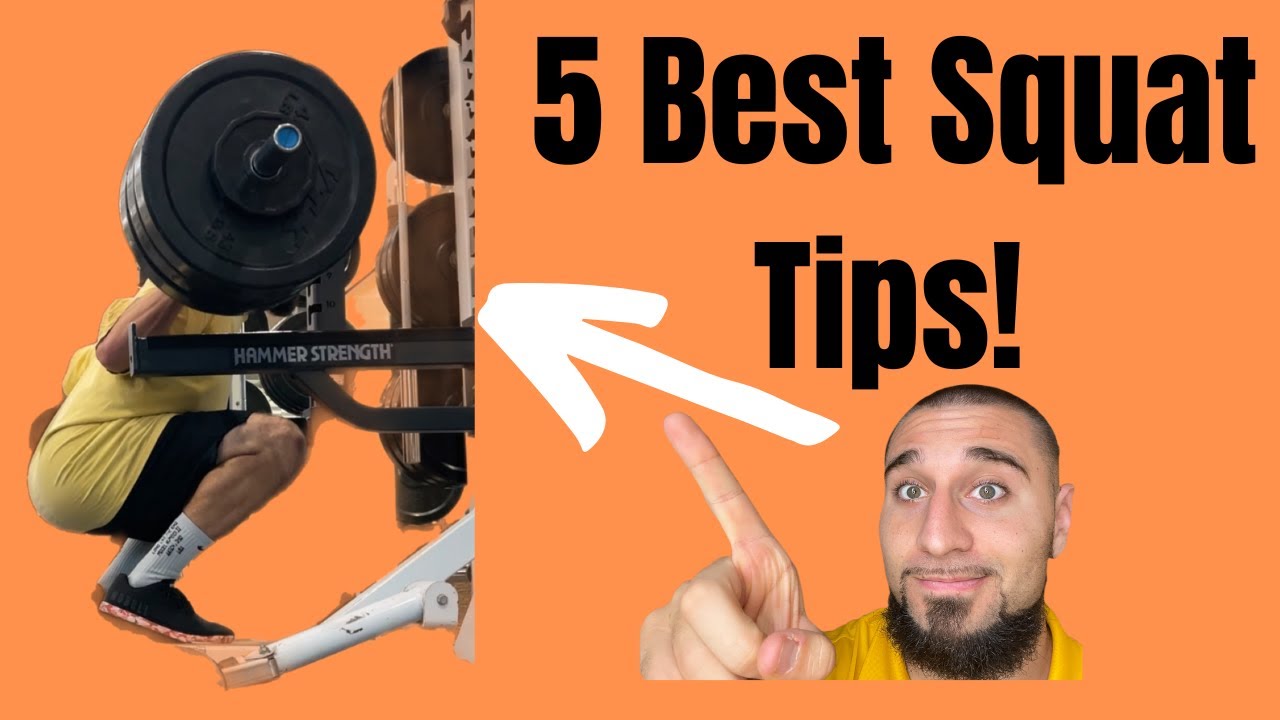
Eric Roberts shares five squat tips: wear flat shoes instead of running shoes, push the ground away rather than standing up, use tripod foot contact through your mid-foot, squeeze a tennis ball between your armpits to brace your lats, and allow a slight forward lean instead of forcing an upright chest.
Chapters
YouTube, what's going on? In this video, I'm going to give you 5 tips to immediately improve your squat, and we aren't wasting any time, so let's dive right in. The first one actually has nothing to do directly with your form. It has to do with the shoes you are wearing. A lot of people try to go into the gym or go into their workouts and squat in shoes that are like these foamy bottom shoes. These are more like running shoes more so than anything else. And the reason these could potentially be bad for your squats is because since they are so foamy, they're meant to brace for impact when running. So they're meant to be this like shock-absorbing foamy bottom. The issue is when you try to take this and then go squat, where for you to safely and maximally, maximally lift the most weight, you don't want some unstable foamy surface, because what this is going to lead to is the instability could potentially lead to injury. Because for example, if where you are connected to the ground is not stable, then every other joint after that isn't going to be as stable as well. So I see a lot of people going into the gym and their knees are caving in when you're doing squats. Well, one of the reasons could be if you're wearing these shoes, your knees are going to be unstable, which your knees have to be a stable joint. But if you are working off an unstable— if you are working off an unstable surface, you are not going to have stable, strong joints to then work from. And then number 2, the less stability you have, the less ability you have to produce force. So when you're trying to lift heavier weight, but you have this unstable surface, but you have this unstable surface, You are inherently going to lift less weight because you don't have the stability. So as opposed to running shoes like these, get some flat surface shoes like these that don't have this foamy kind of soft bottom to it. So look at the difference here. Notice how this shoe has a flat solid surface. This shoe is very bendy and flexible. This shoe is not very bendy and flexible. You want flat surface shoes like these right here. These are called Nobulls. I have nothing to do with this company. My assistant coach got me a pair for Christmas one year, and I still have them. I think it was like almost a year and a half ago, 2 years ago now. I still have them. I love them. They're great. But I know Nike makes some, Adidas makes some, Converse, whatever, you know, just any flat surface shoe that is going to give you this strong, stable surface to then be able to work from When you are doing your squats, because again, you will have more stability, which will lead to decreased risk of injury. It will lead to better form because you actually have more stability. So, so many people are like, oh my God, my form sucks. But again, they're wearing shoes like this and their knees are all over the place and their ankles feel very unstable. That could absolutely be why. So it's going to give you better form. And like I said, you're going to be able to connect with the ground better, which we'll actually talk about later in the video. You're going to connect with the ground better to have better stability, To produce more force, to lift more weight in the long run. So before you do anything with your actual form, make sure you're setting yourself up for success by having these flat surface shoes, not these kinds of shoes right here. All right. Now that we have the flat surface shoes on, let's go into the second tip for how to get better squats. This is in no particular order, by the way, but this next tip is actually going to be what you should think about when you're at the bottom of a squat. What do most people think about when they're in the bottom of a squat? They think about Standing up. I don't want you to think about standing up. Here's what I want you to think about instead. When you get to the bottom of this squat, I want you to think about pushing the ground away from you. And then that is how you are going to stand up. Because if you think about just standing up, number one, you're not going to have a lot of force output. You're not going to be as strong as you possibly could, which means you're not going to lift as much weight as you possibly could. And the movement might just seem harder because your intent is wrong. See, what most people don't understand is the intent The intent at which you do a movement with— this could be anything, squats, deadlifts, chest press, shoulder press, whatever. The intent that you have with an exercise is going to normally dictate how that exercise is going to end up. So if you're just thinking about standing up out of the bottom of a squat, the exercise is inherently going to be harder, feel harder, and you'll lift less weight with it. Whereas when you get to the bottom and you think about pushing that ground away from you, you are inherently going to use more force To push that ground away from you. Think about if you were going to push somebody, aren't you going to have more force when you push somebody versus like when you just kind of like tap somebody? If you actually put all your force into it to push them as opposed to just kind of like shrug them with one arm. So if you're trying to get the most out of your squats and be as strong as you possibly can, and again, be more stable, have better form and be and feel more in control of the movement, don't think about just standing up out of the bottom of a squat, think about pushing the ground away from you. Now, 3rd tip you might have heard before: you should be trying to push through your heel when you're doing squats. And while I somewhat agree with this, I also somewhat disagree with this, and here's why. Like I talked about when I was talking about our shoes, you want a flat surface shoe so that you can connect with the ground better. What does connect with the ground better mean? Essentially, think of your foot having 3 major parts: your big toe, your pinky toe, and your heel. Think of this as kind of like a tripod would be, or I sometimes call this, or I sometimes coach this in a way of thinking about if you have like a hawk's foot or a monkey's foot that is trying to like grip the ground. You want those 3 main points of contact trying to grip the ground. So when you connect with the ground better by doing that right there, you don't just want to think about pushing through your heels. Because for a lot of people that kind of forces them to do this thing right here where they kind of like shoot their knees back too early, shoot their hips up too high, and then make the movement number one, more pressure on their lower back. But number two, they make the movement harder by doing this like 2 separate moves where they're like kind of kicking their butt back and then they have to use their lower back to stand up. As opposed to thinking about pushing with your heels, you should first and foremost try to connect with the ground with your big toe, pinky toe, and heel. And then combined with pushing the ground away from you, you should be thinking about pushing through the middle of your foot because you want to use that strong, stable base that you created. If you're just pushing through your heel, you're not using this strong, stable base that you are creating at the bottom. And while no, you don't want to be rocking forward on your toes and lifting your heels off the ground, you won't do that if you learn how to grip the ground with your feet and connect the ground better. So try to push through your mid heel. So try to push through your midfoot, not just your heel. The 4th tip, I want you to imagine this. See this tennis ball? I'm just— damn it. Take 2. See this tennis ball I'm just throwing around right here? When you are going into your squats, I want you to think about taking this tennis ball, putting it between your armpit, and then trying to squeeze the air out of this tennis ball. Because what this is going to do is activate and brace your lat muscles right here. Your lat muscles are your big back muscles right here that help keep your spine in place because they run across both sides of your body and they help keep your spine where it should be. So most people don't think about bracing their lats when they go down into a squat and it looks something like this right here. They'll either round their upper back, Or once they get down to the bottom, they'll kind of do this thing where they round their back on the way up. So to avoid all that, get a tennis— think about getting a tennis ball, putting it between your armpit, trying to squeeze the air out of that tennis ball. You're going to see I create space between my ear and my shoulder. My shoulders stay low away from my ear, and I'm actively trying to almost push my elbows into the side of my body, trying to squeeze the air out of this tennis ball. Watch now how I go down into my squat. Notice how I'm in a much more stable, strong position, as opposed to if I let this ball drop, you are going to see my upper back starts to round and my whole back starts to round. As opposed to if I put this back in and I got to try to squeeze it, Now, there is no way my back can round because I'm so tight, I'm so braced, and I'm just so strong. And I want you to be strong too. So make sure you think about that when you're going down into your squats, alright? And the last one, number 5, the one that people have been taught their entire lives, stop trying to keep your chest so upright as you go down into your squat. You can already probably see, look at my lower back right here. When I'm trying to keep my chest up as high as I can, automatically I am going to arch my lower back. When people tell me, oh, my lower back hurts, and I watch their form, which by the way, you can send me your form videos so I can look over them. I have an entire series on my YouTube channel about this, but when I look at people's form and they're trying to keep their chest up and arching their back, well, that's why your back hurts. What we want to do instead is Simply think about somebody is karate chopping your hips back ever so slightly. If there was like a chair behind you, ever so slightly try to tap that chair. You saw how the chair moved when I hit it with my butt? Because ever so slightly tap it back, bam, the chair is going to move a little bit. Have it a couple of inches away from your butt. And what you do is just karate chop the hips back. Once you hit it, that chair is going to move, and then you can go down into your squat. You can have, and you should have, a little bit of a lean forward as you go down into your squat. If you try to stay so upright, your spine is not going to stay neutral. Now I need to be clear. I know some of you out there who are going to watch this, this is the kind of thing you do in the club on Saturday night. We don't want to do that here because you're not in the club doing squats. And if you are, respect to you, girl. But we want to make sure we slightly throw it back Maybe like you're on a Tuesday or a Wednesday night, not like a Friday night. Maybe like a Tuesday or a Wednesday, a little bit more modest for the kids. And then think about sitting down into your squat with all of the other tips we just learned. And I hope this video helped. If you enjoy videos like this, drop a comment below and let me know because I will try to do more of these kinds of videos on my YouTube channel. I'm trying to put more content out on YouTube. So let me know what kind of stuff you like. If you enjoyed it and you want to share it with somebody, go ahead. If you have any questions, drop them below. Hope it helped.










