The EXACT System to Transform Your Body in 93 Days
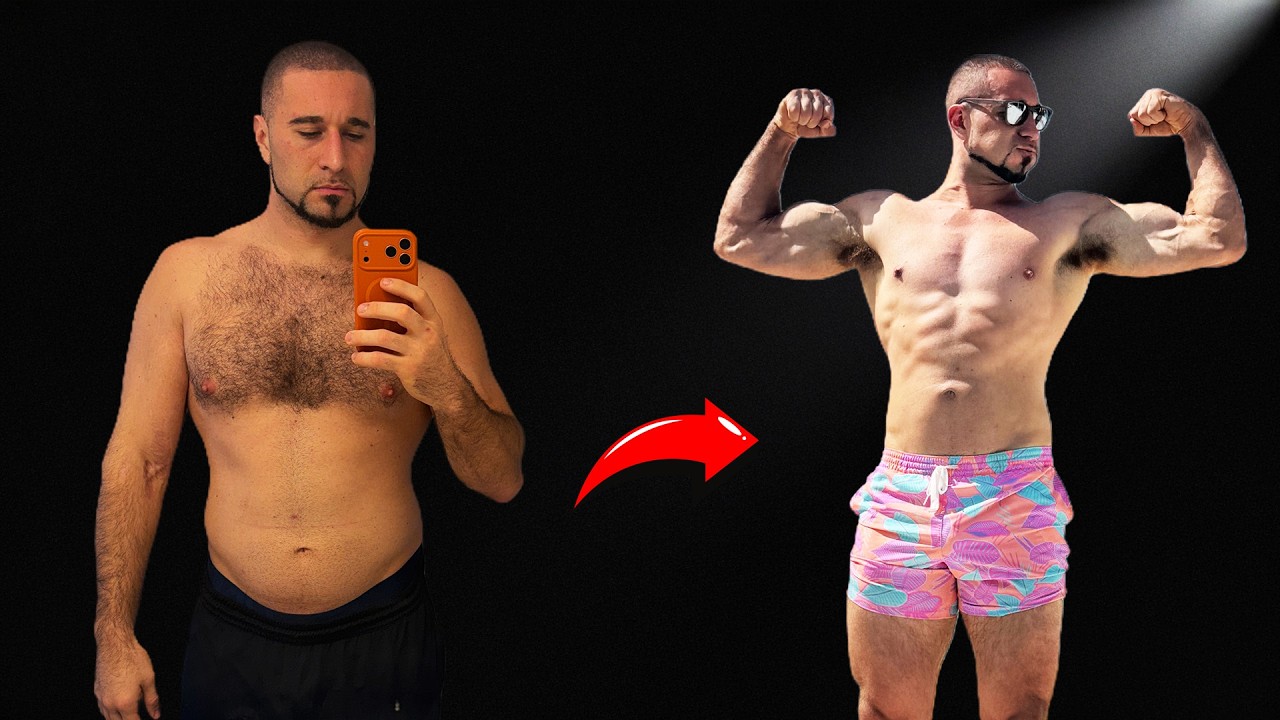
Eric Roberts presents the 93 Protocol, a five-phase system for body transformation: calorie deficit without drastic cuts, 0.7-0.8g protein per pound of goal weight, 3-4 weekly strength sessions, 6,000-10,000 daily steps, and 7-8 hours of sleep. Client examples show the approach works.
Chapters
There's a system I use with every single one of my online coaching clients to transform their body, and it's called the 93 Protocol. It has 5 parts. Each one builds off of the last, and if you skip one, the whole thing falls apart. But if you do all 5 in order, your body will transform in 93 days. I've used this system with over 25,000 clients and for myself, so I know it will work for you too. And today in this video, I'm breaking down the whole thing for free. This will be the exact blueprint, and the first part of the system is the most important because without it, everything else fails. Part 1, the squeeze. Here's what happens. You decide you want to lose weight and you know you need to eat less calories, And you think the lower calories you go, the faster you will lose weight. The harder you squeeze, the more will come out. And maybe for a week or two this works because you see that scale drop fast. You think it's working, but then inevitably you get starving. You're thinking about food all day because your calories are so low. By the time the weekends roll around, you haven't had any of the foods you enjoy and you're starving. Your willpower is low, and then you overeat and ruin all of your progress. You didn't fail because you're lazy or you lack discipline or willpower or you have bad genetics. You failed because you're trying to squeeze too hard. Think of it like a tube of toothpaste. You want toothpaste on the brush, so you squeeze the tube. But how hard you squeeze matters. If you grab the tube and crush it with your whole fist, The toothpaste goes everywhere. On the counter, on your shirt, on the mirror. You got the toothpaste out, I guess, but you also made a mess with it. And now half the tube is wasted. That's a 1,200-calorie crash diet. You squeezed so hard that everything blew up. Yeah, you lost weight the first week or two, but you also lost your energy, your willpower, your workout performance, your will to live. Now, what if you just use your index finger and your thumb? To squeeze the toothpaste out that you need on the brush. The perfect amount comes out. There's no mess, there's no waste, and that's the squeeze. You're not cutting your calories in half, you're trimming them. You're squeezing out the extras. The extra snacks throughout the day you know you're eating. The extra drinks on the weekend you know you're indulging in. The extra servings or portion sizes that you know are probably a bit too much. You squeeze the stuff out that doesn't need to be there. And one of our clients, Michael, came to us wanting to transform his body. When we started his plan, we didn't slash his calories to 1,500. He was eating 2,200 to 2,500 calories per day to consistently drop 1 to 2 pounds of fat per week. He wasn't starving, he didn't hate his life on a diet, and he was still able to have great workouts. He just Squeezed out the extra chips, the extra drinks, the extra bites and snacks, and he didn't explode the toothpaste in his hand. So here's how the squeeze works. Step 1, get the correct squeeze calorie deficit goal. To do this, I have a free calorie calculator in the link in the description below. It is the same one that we use for our online coaching clients for free. So click below and use it. And step 2, with that goal, find the extras to squeeze out. That could be the late-night snacking you're doing. It could be the treats at work in the desk. It could be the extra drinks on the weekends you're overindulging in. But you don't need to starve yourself. And here's why this matters for the next 93 days. If you squeeze too hard in phase 1, you won't be able to sustain phases 2 through 5, and the whole protocol falls apart. The squeeze has to be sustainable because you need to keep doing it for 93 days straight. And now the squeeze will get your calories right, but there's one thing inside of those calories that cannot be negotiable, and that's phase 2. Phase 2, the non-negotiable. Here's what happens. You watch videos online that tell you you need to eat 1 gram of protein per pound of body weight. So if you weigh 220 pounds, your protein target is 220 grams per day. Do you realize how much food that is? That's like 6 chicken breasts per day, on top of the other food that you need to be consuming while staying under your calories for the squeeze calorie deficit. And maybe you do it for a couple of days, a couple of weeks if you're lucky, but eventually eating that much protein is going to make you say, fuck this, I'd rather be fat. And you didn't fail at eating protein, the protein target you set failed you. And that's the mistake. People set a protein target that is way too high that they can't sustain for the next 93 days. And then they think, well, I already failed. What's the point of keeping going? And they quit the 93-day protocol. Think of protein like a foundation for a house. You're building the house and the foundation needs to be solid. Without it, the walls will crack, the roof will sag, everything will fall apart. That's protein. It holds the structure together. Your muscle repair, your recovery, your hunger. But here's what most people do. They try to pour a 10-foot foundation for a one-story house, and it's overkill because a one-story house would do fine with a 6-inch foundation. But because someone told them they need 10 feet, that's what they try to pour. And then halfway through, they run out of concrete. So now they have a half-built foundation where half of it's there and half of it's completely empty, and they can't sustainably build ever everything else with the house, so they never put the house up. And that's what happens when your protein goal is too high. A slightly lower target is better that you can hit for 93 days consistently. We had a client, Leanne. She started with us around 220 pounds, and she read online you need 1 gram of protein per pound of body weight. So she was trying to eat 220 grams of protein. She was struggling to hit that number consistently, and even when she did, she felt like eating protein was her full-time Not to mention the digestive issues that come along with eating that much protein, and the feeling of being over-restricted because you can't really eat anything else. You have to eat 400 grams of chicken breast at a meal. So we switched it up, and here's how the non-negotiable works in the 93 protocol: set your protein target to 0.7 to 0.8 grams times Your goal body weight. So if you weigh 220 pounds and you want to weigh 150 pounds, you would take 150 and multiply that between 0.7 and 0.8. So that would be 105 grams to 120 grams of protein per day. Not only is that a target you can actually hit, but that is what the research shows us. You'll still get all of the benefits of building muscle, keeping yourself full, recovering from workouts. And if you end up eating a little bit more, fine, but you don't need to as long as you hit that goal. This is something you'll be able to stick with consistently over the next 93 days, and that's more important than having a higher protein goal. So now you have the squeeze calories right, you have the non-negotiable locked in, and phase 3 is where your body actually starts to change. Phase 3, the iron. When most people are going to start a transformation, they know they have to work out and they're super motivated, they're fired up. So they go and hit the gym 6 days a week, they do an hour and a half, 2-hour workouts, they do lightweight for high reps to try to tone the muscle and feel the burn. And week 1, they're sore everywhere. So they think that means it's working. Week 2, they're still really sore, their energy is kind of starting to drop a bit, but they keep pushing through because That's what they think they should do. Week 3, they're exhausted. They're barely able to get workouts in, or they start skipping workouts. And then by week 4, they've only worked out 2 or 3 times. They feel like a failure. Their nutrition starts to suffer. And they say, well, I ruined everything. I might as well quit. And they didn't fall off because they're weak. They fell off because their workout routine made no sense. In a calorie deficit, your body has less fuel to recover. You're already asking it to do more with less. If you also destroy it 6 days a week in the gym, it can't rebuild. It just breaks down. Think of your muscles like a construction crew building a wall. You go to the gym, you lift weights, you break the wall down a little bit on purpose. Then you go home, the construction crew shows up, and they repair the wall. But they don't just fix it back to where it was. They make it a little bit thicker, a little bit stronger. That's muscle growth. But the crew can only work so fast. They need time. They need supplies. The supplies are your food, your sleep, your recovery. Now, if you come back the next day and smash the wall again before the crew finished repairing it, what happens? The wall gets weaker, not stronger. And that's what working out 6 days a week for 2 hours in a calorie deficit does. Versus if, let's say, you worked out 3 to 4 days a week, that would give the crew more time to finish repairing the wall. You smash the wall on Monday, the crew repairs it on Tuesday, and by Wednesday or Thursday, you now have a stronger wall. You break that down a little bit, wait a couple of days, and that's how muscle is built. It's not by smashing the wall completely more often. We had a client, John, who was working out 6 days a week for 2-hour sessions. And he was doing a lot of exercises, high reps, a ton of volume, but he was exhausted, losing strength, and looked the same 6 months later. So we cut his workouts in half and he thought we were crazy. He was like, I'm not seeing results doing all of this. How am I going to see results doing less? But 93 days later, following the 93 Protocol, he was stronger than he had ever been and his body changed more in those 93 days than the previous 9 months. And so here's how the iron works in the 93 Protocol. Rule number 1, you work out 3 to 4 days a week with weights. I'm going to talk about cardio in a second. Pick those days and don't add extra. Number 2, those sessions are going to be somewhere between 45 to 75 minutes. You're going to focus on compound exercises like squats, bench press, shoulder press, lunges, Romanian deadlifts, and you're going to do 5 to 12 reps max. The last couple of reps in your set should be heavy, challenging reps. And week to week, you should keep the same workouts and look to either add weight or add reps. And that's really it. Remember, you're in a calorie deficit. You have to respect that and not overdo it, or else the crew is not going to be able to help you change your body. And by the way, if you're interested in getting a personalized plan made specifically for you, you can click the link in the description below of the video to learn more about our online coaching program. Now you have the squeeze, the non-negotiable, and the iron set in place. The next 2 phases are the ones most people skip, and they're the reasons most transformations stall. Phase 4, the floor. Now that we've covered your weightlifting, most people who start a transformation focus on cardio, and with this cardio, they focus on trying to burn the most calories during spin class, during a high-intensity boot camp class, running on the treadmill, because they think something that makes them sweat and have a high heart rate is going to lead to more fat loss. But here's what the science actually says, and it's going to change the way you think about calorie burn. Your workout— the spin class, the stair stepper, the running— that's called your EAT, your exercise activity thermogenesis. This takes up 5 to 10% of your daily calorie burn. Now there's something called your NEAT, your non-exercise activity thermogenesis, and that is just everything you do that is not a dedicated workout. And this is walking, fidgeting, talking with your hands, pacing while you're on a phone call, taking the stairs, and that accounts for 15 to 30% of your daily calorie burn. So I'm going to say that again: your movement outside of your workout roughly doubles triples the calorie burn than your workout. And here's the part that changes everything: when you do higher intensity exercise where your heart rate is elevated, you increase your cortisol, which is your stress in your body. And this increase in cortisol leads to more appetite, more hunger, and more cravings. And so while you might burn more calories in the spin class, Because you are now hungrier, you end up eating more calories, taking yourself out of the calorie deficit. But when you increase your NEAT, because your heart rate is not elevated, your appetite doesn't change, but you end up burning more calories. We had a client, Mallory, who was doing a ton of cardio to try to burn the extra body fat, and she was exhausted. She was starving by 3 PM. She couldn't stick to her calories at night. The weekends ended up always overeating. And when we switched from doing the high-intensity cardio to focusing on her daily steps, she found it so much easier to stick to her calorie deficit. She noticed the scale was actually moving faster, and she was building more muscle and getting stronger in her workouts. So here's how the floor works in the 93 protocol: set a daily step minimum. That is your floor. You never go below this. For most people, I recommend at a minimum 6,000 steps, but really I would like for you to push towards 7,000 to 10,000 steps per day. And this is not a workout, it's just movement. Walking in the morning, walking at lunch, walking after dinner. If you need to go to the gym or hop on a treadmill to get your steps, that's okay. But again, these should not be high-intensity steps. I also recommend not doing it all in one time, so split this up throughout the day so you're moving constantly throughout the day. The floor is your silent fat burner. It's gonna burn 2 to 3 times more calories without increasing your appetite, stress, or hunger, which is great to help you stick with all of the other 3 phases we just mentioned. And now that we have 4 phases down, the last one is secretly controls all of the 4. And if you do not pay attention and get this one right, everything else I have said in the video will not matter. Phase 5, the switch-off. I'll be honest, most people can nail phases 1 through 4. And then at night, everything falls apart. They eat dinner late at 8:30 PM. And then they have some snacks while they're sitting on the couch. And then they go into bed and scroll on their phone for an hour. And they only get 5 to 6 hours of sleep, and then they wake up starving. They're tired by noon. Their workouts suck. They're fighting cravings at 3 PM and beyond. And they try to blame their discipline or their willpower or their calorie deficit, when in reality nothing is wrong with the plan that they have. Their sleep quality sucks, and sucky sleep quality makes everything else not work. And here's what the research shows. When your sleep quality drops, your 2 hunger hormones flip on you. The first hormone is ghrelin. This is the hormone that makes you hungry. The second hormone is leptin. This is the hormone that keeps you full. When you don't get adequate sleep quality, your ghrelin increases and your leptin decreases. So no matter if you're doing everything else right that I just mentioned, you're still going to be hungrier, have more cravings, and less likely to stick to your calorie deficit. And on top of that, a study found that people who had sleep deprivation, which is anything less than 7 hours of sleep, ended up eating almost double the amount of calories than somebody who just slept more. You can think of sleep like a dishwasher. Every day you create a mess— stress, muscle damage from your workouts, mental fatigue— and by the end of the day, the kitchen is trashed. Sleep is the dishwasher. You You load it up, you hit start, and it cleans everything overnight. Your hormones get reset, your muscle gets repaired, your hunger hormones reset, and you wake up with a clean kitchen. But here's the thing. The dishwasher has cycles. There's a quick rinse and there's a deep clean. The quick rinse is light sleep. It's fine. It gets the surface level stuff. But like the burnt-on grease on the plates, the hormone repair, the muscle recovery, the hunger reset That only happens in the deep clean cycles. So if you're eating right before bed and scrolling on your phone, your body can't run the deep sleep, the deep clean cycle, because your heart rate is elevated, your body is processing the food that you just ate, your cortisol is high from scrolling on your phone. And even if you get 7 to 8 hours of sleep per night, it only got a quick rinse. It never got a deep clean. So here's how the switch-off works in the 93 protocol. Rule number 1: stop eating 3 hours before bed. If you go to bed at 10, have your last bite at 7. Set a cutoff and treat it like a wall. This one rule does 3 things at once. Number 1, it lowers your resting heart rate at night, which number 2 will increase your deep sleep, and it resets your hunger hormones so the squeeze feels easier the next day. Rule number 2, try to aim for 7 to 8 hours of sleep per night, not 5 with 7 coffees to compensate. Yes, I'm calling some of you out. And rule number 3, make your room cold and dark at night. What is cold? 66 to 68 degrees. That's the switch-off. It's not the most exciting phase. Nobody will post about it on social media, although I do get pretty stoked when I have a good sleep score. But it's the phase that makes everything else work. That's the 93 Protocol. 5 phases: the squeeze, the non-negotiable, the iron, the floor, and the switch-off. Do all 5 and your body will transform in 93 days. And if you want the 93 Protocol built specifically around your body, your schedule, and your life with someone checking in and holding you accountable to all 5 phases, that's exactly what my online coaching program does. You can click the link in the description below to learn more. And if you're thinking, okay, Eric, but is 93 days really long enough for me to lose that stubborn lower belly fat? Well, that's a great question, and I actually answered it in this video here that you can watch coming up next.










