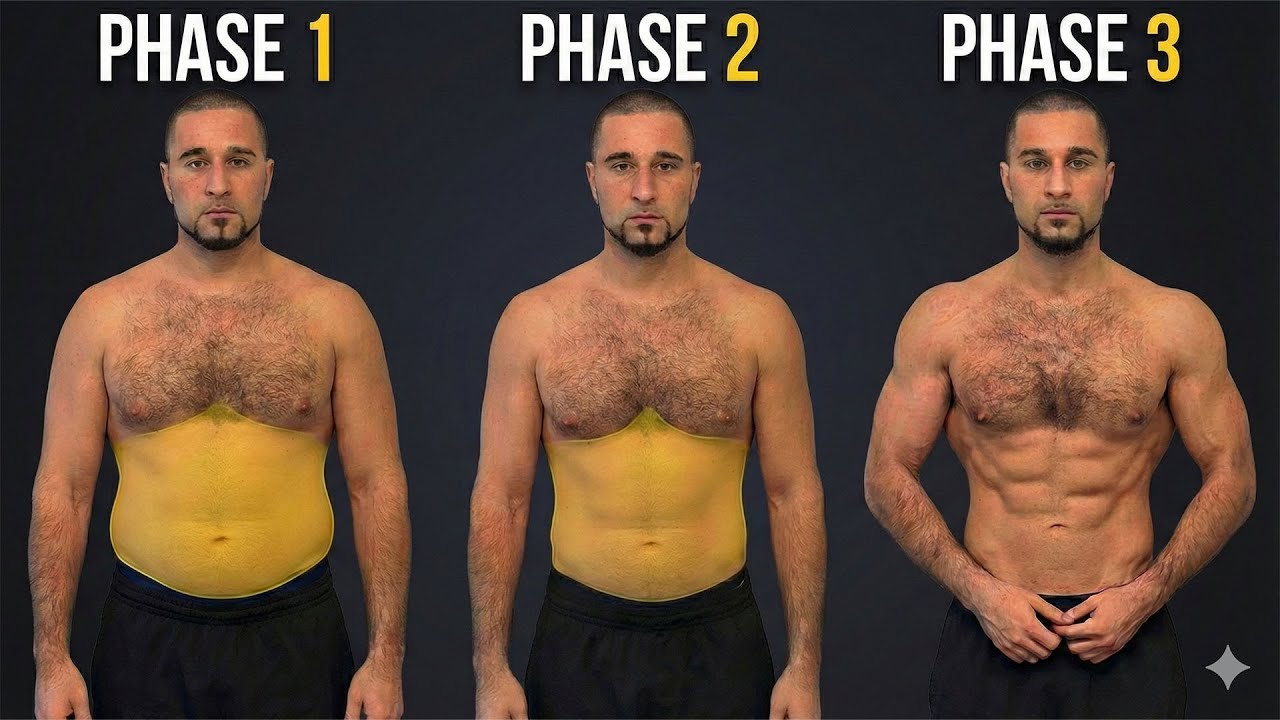
In this video Eric Roberts argues that most fitness advice for belly‑fat loss is inefficient and proposes a three‑phase, low‑effort system. Phase 1 focuses on increasing daily calorie expenditure by maximizing NEAT (aim for 8,000‑10,000 steps per day) and the thermic effect of food (eat high‑protein diets, where 100 kcal of protein burns ~30 kcal). He downplays the exercise bucket (EAT), noting it only accounts for ~5 % of total daily burn. Phase 2 is the “passive income protocol”: build muscle through heavy, compound resistance training 3‑4 times per week (squat, deadlift, bench, shoulder press, rows, lat‑pulldown) in the 5‑12 rep range for 2‑3 sets, thereby raising basal metabolic rate (BMR) and creating a continuous calorie‑burn “rental property.” Phase 3 introduces the “cruise‑control mindset,” urging consistency (80‑90 % adherence) over perfection and rejecting all‑or‑nothing thinking. He uses metaphors (iceberg, bank account, road‑trip) to illustrate why focusing on the larger metabolic components yields the biggest, lazy‑friendly results. The video ends with a call‑to‑action to watch a follow‑up on realistic timelines.
Chapters
The majority of fitness professionals are teaching you the wrong way to lose belly fat. I got down to 8% body fat and have helped tens of thousands of clients lose their belly fat as well without doing hours of cardio, cutting your calories to 1,200 per day, or drinking diarrhea detox tea. It comes down to 3 phases. In this video, I'm gonna show you what each phase consists of and the lazy way to get through each so you don't have to suffer and can lose belly fat almost effortlessly. Let's start with phase 1, increasing your metabolism. If you look like this picture, you likely have a slow metabolism, but slow just means you aren't utilizing the right system. To understand this, you need to know how your body actually burns calories. Your total daily calorie burn comes from 4 buckets. First is your BMR, and this is the calories you burn just to keep your body alive every day. Second is your NEAT, and this is all the daily movement you do— walking, fidgeting, moving around. Third is your TEF, your thermic of food, and this is how many calories your body burns digesting food you eat. And fourth is your EAT, exercise activity thermogenesis, and this is your gym and your cardio. The biggest mistake people make in phase 1 is over-obsessing over the exercise bucket. You think the only way to lose fat is to sweat it off on the treadmill for an hour. But here's the reality check: this only takes up 5% of your daily calorie burn. So if you bust your ass on the treadmill for an hour, you might burn 300 calories. But if you sit the rest of the day, or if you don't eat the right foods that burn the most calories, it's not gonna matter. I want you to think of your metabolism like a floating iceberg in the ocean. The tip part that's above the water is the gym and the cardio, but the base, everything that's underwater, that's the mountain underneath that takes up 95% of the iceberg. And so you're only focusing on this when really you should be focusing on this to get the biggest return. So the lazy way to clear phase 1 and focus on what matters the most is maximizing 2 levers. First is your NEAT. So the way you increase is aim to walk 8,000 to 10,000 steps per day. This does not have to be all at once. It doesn't have to be at a certain This could be steps walking around while you're waiting for your dinner to cook, steps walking around while you're on the phone, parking farther away at the grocery store—anything to get your daily step count up. And the second part is maxing out your thermic effect food. You do this by eating more protein because for every 100 calories of protein you eat, your body burns up to 30 of those calories. So really, for every 100 calories of protein you eat, you're really only eating 70. Whereas As compared to carbs or fats, those only burn like 2 to 5% of the calories that you eat. So by maxing out these 2 things, you basically put fat burn on autopilot. And once we start to get your metabolism sped up, we can move on to phase 2, where we attack the biggest part of the iceberg, your BMR. And phase 2 is what I call the passive income protocol. The biggest mistake that people make during this phase is the hourly rate mentality. Most people treat their fat loss like it's a 9-to-5 job. They think, if I wanna burn more calories, I have to do more cardio, or I have to cut my calories super low. But both of those 2 things are manual labor. You only burn calories while you're doing the cardio, and you can only keep up cutting your calories so low for so long. And the second you stop doing cardio, or when you realize, I'm not cutting my calories any lower. Fat loss stops. And that's the hardest, least lazy way to lose belly fat. So I want you to think of your metabolism like your bank account. Cardio and cutting your calories is like a daily wage. You have to show up and work to get paid, aka burn fat. If you get sick or take a vacation, your income goes to zero. But building muscle and lifting weight, this is like buying a rental property. It costs some effort upfront to buy it, aka lifting weights. But once you own it, it pays you back without you doing any extra work. So someone with more muscle will burn more calories just sitting in a chair watching Netflix than someone who tries to go out and run a 5K every day. And this is the ultimate lazy hack— building a machine that burns fat for you all day. So it's a clear phase 2. We need to stop working for our calories, start investing instead. And the The first way you'll do this is by lifting heavy weight three to four times a week. Prioritize movements like squat, deadlifts, bench press, shoulder press, rows, lat pulldown thrusts because this will send the signal to build the rental properties that you want. And aim to stay in the five to twelve rep range for two to three sets. Once you start doing this, you'll increase the biggest part of your metabolism. So by the time you hit phase three, you have a fat burning furnace even while you're doing nothing. So now that you have this system, you've increased your metabolism, you've bought the rental properties to burn fat even when you're not working. The truth is, none of that will matter or get you results if you fall into the trap of not getting past phase 3. And phase 3 is what I call the cruise control mindset. The mistake most people make, which I'm sure you probably make as well, is what we call all or nothing mindset. And this comes from unrealistic expectations. You expect the weight just start falling off in a straight line, 1 to 2 pounds every day, and you expect to be 100% perfect on your diet. So the moment you have a bad weekend or the scale stalls out for a few days, you tell yourself, I blew it, this isn't working, I might as well quit altogether. You're treating your fat loss like a sprint. If you trip in a sprint, you're going to lose the race. But fat loss isn't a sprint. Think of this journey like cross-country road trip. Your goal is to drive from New York to California. The hard way, taking the all-or-nothing, is trying to drive 100 miles an hour without stopping. Eventually you're gonna run out of gas or you'll crash. The lazy way is putting the car on cruise control at 60 miles an hour. And now imagine you hit a pothole and blow a tire, aka you overeat one day. The all-or-nothing The anxious person gets out of the car, looks at the tire, and says, well, the trip is ruined, and they slash the other 3 tires. They turn one minor bump into a total breakdown. Versus the lazy person who's on cruise control fixes the one tire and they just keep driving. They know as long as the car keeps moving forward, even if it's slower, they will get to California eventually. It's mathematically impossible not to. And I see this with clients who come to us for coaching all the time, where they've had good days for 10 days in a row, 2 weeks in a row, and then one bad day makes them spiral into a 3-day binge, which then turns into a week, which then turns into a month. They never reach the destination because they keep turning the car around every time they hit a bump. So the lesson to get out of phase 3 Is stop trying to be perfect and just start being consistent. The lazy way is the effective way because you just choose to not quit. If you stick to the plan 80 to 90% of the time and you simply refuse just to not slash your other 3 tires, time will do the work for you. You will lose the belly fat, and not even because you had to work so hard, but just because you didn't stop your car and you stayed on the road. The longest. And now that you know how to get through all 3 phases, you should probably know exactly how long the drive will take so you don't quit early. So you can watch this video here next to have me break down the brutally honest timeline for how long it will actually take for you to, for you to lose your belly fat.