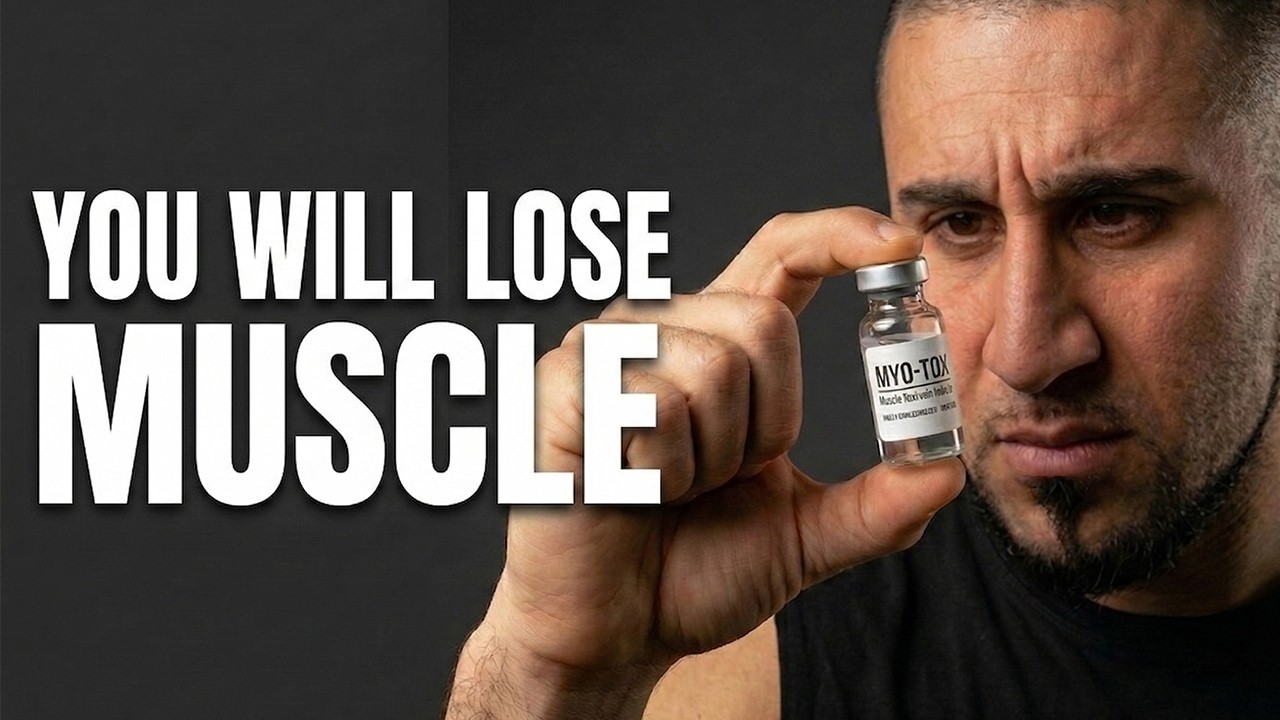
In this video, Eric Roberts critiques a 2025 study that claimed 40% of weight loss on GLP‑1 drugs like Ozempic is muscle, explaining that the study actually measured lean body mass—a mix of water, organ tissue, glycogen, and some muscle—making the headline misleading. He argues the real drivers of muscle loss are (1) the absence of resistance training and (2) insufficient protein intake caused by the appetite‑suppressing effects of GLP‑1s. Roberts outlines a concrete solution: lift weights 3–4 times per week focusing on compound movements with 2–3 sets of 5–12 reps and adequate rest, and consume 130–150 g of protein daily spread across 4–5 meals, prioritizing protein before carbs/fats. He offers a free calorie/protein calculator, promotes his online coaching program, and points viewers to a follow‑up video on setting up a proper calorie deficit.
Chapters
40% of the weight you lose on Ozempic or any GLP-1 is muscle. At least that's what a study published in October of 2025 showed us. Except there's just one problem. It's not true, at least not in the way that it's presented. So after diving into the actual paper to the best of my ability and coaching over 25,000 clients, including clients who were on GLP-1s, I can tell you the real reason people are losing muscle on these drugs. And it has almost nothing to do with the drug itself. So here's what the study actually said, what it left out, and the 2 most important things that you need to do so you can lose fat on a GLP-1 without the negative side effects of losing muscle. But first, I need to show you exactly where this 40% muscle loss came from, because once you see how they actually measured it, you'll have the inside look on what the study actually showed. The study actually claimed that 40% of the weight loss came from lean body mass. Most people see those words and correlate that to muscle mass, like 40% of the weight you lose is just pure muscle disappearing. But lean body mass and muscle mass aren't the same thing. Think of it like this: let's say you spend $40 on groceries. But within those groceries, you bought different things. $10 on chicken, $10 on fruit, $10 on veggies, and then $10 on junk food. Imagine someone looks at your receipt and says, oh wow, you spent $40 on junk food. You would say, no, I didn't. That was $10. The rest was chicken, veggies, and fruit. And that's exactly what was happening with this study. Lean body mass means everything in your body that isn't fat. So that's water weight, that's organ tissue, that's connective tissue, muscle glycogen, and yes, some muscle mass. When you lose weight on any plan, drug or not, some of that is going to drop. You hold less water, your muscle glycogen shrinks, your organs don't have as much body to support. And so in the study, they measured the entire $40. They told you it was all the junk food. But the actual muscle was just a small portion of that. So that headline and number is already kind of misleading. But here's what makes it worse. The people in that study were set up to fail, and nobody's really talking about why. The participants in that study that produced that muscle loss headline, they weren't lifting weights at all. So they were on a drug that slashed their calorie intake by eating 16 to 39% fewer calories. And with that, they had no resistance training, no signal to their body to keep muscle. Of course they lost it. Anybody would. It's like renting a parking spot for your car. Every month you pay it, the parking garage keeps your car spot. But if you stop paying, they give your spot away. It doesn't matter how nice your car is. You stopped paying. So lifting weights is the rent. It tells your body, I still need to keep this muscle. So the drug didn't take the muscle. The body gave it away because nobody was paying the rent. So if you drastically cut calories, from a drug or not, and you don't lift weights, you're gonna lose the muscle, and it's not the drug's fault. And the study had one study it reviewed in there where the patients actually did follow a resistance training program, and the results of that was 15.6% was fat loss, And only 4.8% was muscle loss. And that's a great result. So no lifting was problem number one, but there was a second thing this study completely ignored. And honestly, this one might even matter more. In those same studies, nobody ensured the patients were eating enough protein. So think about what's happening. This drug is crashing your appetite and you're essentially slashing your calories in half, And when you do that, inevitably your protein is going to fall with it. So now you've got people eating 40, maybe 50 grams of protein per day, and that's not even half of what they need to maintain their muscle. Imagine your body is a dishwasher. Every day you get dirty dishes and you put them in the dishwasher, and the dishwasher will run, it'll clean your dishes, and everything's okay. But if you don't have enough dish detergent, enough dish soap, then the dishwasher will have nothing to clean it with, so then you won't clean the dishes and they'll stay dirty. So if your body doesn't have enough protein, you won't be able to maintain the clean dishes, aka your muscle. And this is why it's critical you have to eat enough protein, whether you're on a weight loss drug or not. And how much protein should you eat? Well, right before I tell you that, I want to fix the first problem of not lifting weights. The biggest mistake I see people make who are on GLP-1 drugs is thinking that, okay, the drug is doing the fat loss work, I'm gonna speed it up by doing even more cardio. And because they want to see that number on the scale drop as quickly as possible, they forego lifting weights, lose muscle, and just end up as that skinny fat. But remember, this isn't just about losing weight as quickly as possible. We want to lose fat while keeping the muscle. And you can think of muscle like a building under construction. Every time you lift weights, you're telling the construction crew, hey, we need this building, keep working. But if you stop lifting, you're telling the crew the project is canceled. And when your body is already in a calorie deficit from the drug, it's looking for things to tear down. If you're not sending that signal to your body, your body starts ripping apart from its own materials. And cardio won't send that signal to your body, only weightlifting does. So here's the very simple play. You're going to lift weights 3 to 4 days a week. If you do 3 days a week, I like lower body, upper body, full body. And if you lift 4 days a week, lower body, upper body, lower body, upper body. Focus on compound exercises like squats, hip thrusts, deadlifts, bent-over rows, lunges, Bulgarian split squats, chest press, shoulder press, and do 2 to 3 working sets of 5 to 12 reps where you're lifting heavy in the last couple of reps in your set should be difficult, challenging, close to failure sets. Rest at least 90 seconds, if not 2 to 3 minutes, in between each set. And remember, your job in your workout is not to burn calories. Your calorie deficit is putting you in that through your nutrition. Your job is to do one thing: tell your body to keep or build muscle. But lifting is only half the equation. You can train perfectly and still lose muscle if you mess up the next part. And if you are taking A GLP-1 crushes your appetite. That's the point. But when your appetite falls off a cliff, so does your protein intake. You go from eating big, full meals to kind of just like picking at plates and snacks throughout the day. And typically the last thing you want is a huge chicken breast or a huge steak. So your protein drops and your body starts using muscle for energy. Think of your appetite like a gas pump. Before the drug, the pump worked fine, maybe too well. You could fill up the whole tank in 5 minutes. I'm not sure I like that analogy. One stop. But now the gas pump barely trickles. You can't just stand there and force a full gas tank at once. It's gonna take longer. You might have to fill a little bit up at a time, multiple stops throughout the day. Your tank still needs the same amount of gas, the same amount of protein. The pump is just slower now, so you have to change how you fill it. So here's what we do with a lot of our clients who are taking GLP-1 drugs. We don't try to have them hit their protein goal in 2 big meals because their appetite won't allow it. Instead, we try to spread it across 4 to 5 meals or snack times. That way they can get smaller protein hits with a protein shake in the morning, Greek yogurt as a snack, chicken at lunch, some frozen edamame they warm up as a snack, and then some sort of salmon or whatever protein source they like at dinner. None of those are huge meals. None of those require you to eat 70 grams of protein at once. But by the end of the day, through adding in these little small protein hits, they've gotten up to 130, 140, 150 grams per day, and it seems much more realistic and doable for them. And at every meal you do eat, you want to prioritize eating all of the protein before you eat any of the carbs or the fats. This way you don't fill yourself up first before you get to the protein. And by the way, if you need to know exactly what your calorie and protein targets should be personalized to you, I have a free calorie calculator that is in the link in the description below of this video. So it's not the drug, it's what you do while you're on it. Lift heavy, eat your protein, and the rest will take care of itself. And if you want someone to build the exact training and nutrition plan you should be following personalized to you, whether you're on a GLP-1 or not, that's exactly what we do in my online coaching program. You can click the link in the description below of this video to learn more. And if you're now thinking, okay, I get the protein part, but how do I actually set up a calorie deficit the right way so I don't wreck my progress or hate my life? I made a video exactly about that. You can click right here to watch it coming up next.