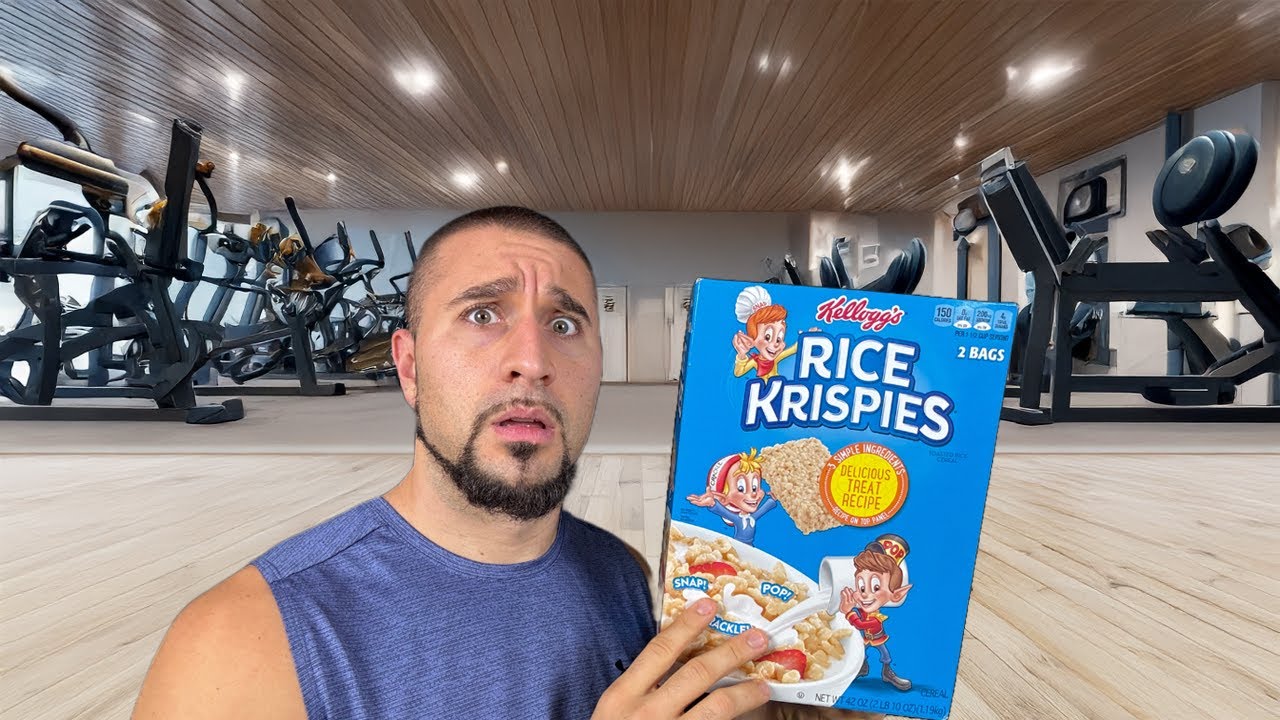
In this instructional video, Eric Roberts explains how pre‑workout nutrition influences performance and body composition. He first debunks the common myth that training fasted automatically burns more body fat, clarifying that fat loss only occurs in a calorie deficit regardless of pre‑workout eating. He then outlines the body’s primary fuel for high‑intensity training—carbohydrates—and argues that consuming carbs before a session maximizes performance. Roberts stresses the importance of pre‑workout protein to supply amino acids, which can reduce muscle breakdown and spike muscle‑protein‑synthesis (MPS) for better strength gains. Timing is covered in detail: larger, complex meals should be eaten 2–3 hours before training, while smaller snacks are best 30–60 minutes prior. He differentiates fast‑digesting versus slow‑digesting foods for both carbs (e.g., fruit vs. oats, honey vs. sweet potato, Rice Krispies vs. quinoa) and proteins (whey vs. whole egg, chicken breast vs. salmon, Greek yogurt vs. egg white). Hydration is highlighted, with a recommendation of 8–12 oz of water plus adequate electrolytes—sodium, magnesium, and potassium—explaining their roles in muscle contraction and fluid balance. Finally, Roberts discusses optional pre‑workout supplements: daily creatine (best taken post‑workout or on rest days) and caffeine‑based pre‑workout powders, noting they are not required but can enhance strength and endurance. He promotes Legion Athletics with a discount code and invites viewers to request a post‑workout nutrition video.
Chapters
What you eat before a workout can either make or break your progress. And so in this video, we're going to cover what you should be eating, how much you should be eating, when you should be eating, and more pre-workout. So let's go ahead and dive right in. Now, before we talk about exactly what you should be eating, I want to cover a common myth you may have heard before, and that is if you don't eat before your workout, or what we call workout fasted, that you end up Burning, damn it. Burning more fat. And while this is technically true, people don't tell the full story, so let me explain it to you. If you don't eat before a workout, your body will use stored fat for energy because it has nothing else to get energy from. I want you to think about this like your laptop. Right now, my laptop is using its stored energy because it is not plugged in. But if let's say I were to plug in my laptop, it no longer needs to use its stored energy because it's getting energy from the charger. So if, let's say, you eat some carbs before your workout instead, your body would then use carbs for energy for that specific workout instead of using stored fat. But here's the thing that nobody tells you: there is a difference between using fat for energy versus actually burning stored body fat. It doesn't matter whether you use carbs, fats, protein, or cocaine for energy for the workout you're going to do, because unless you're in a CFD, a calorie fucking deficit, then you're not going to burn any stored body fat. Because the only way you burn stored body fat is by being in a calorie deficit. So for the goal of burning stored body fat, it doesn't matter whether you eat or not before a workout, because as As long as you're in the calorie deficit, you will lose fat. But it does matter if your goal is to optimize your workouts and lift the heaviest weight you can. So let's go ahead and talk about what you should be eating pre-workout. Let's first understand what is your body's main source of energy for the workout you are going to do. If you're doing any sort of high-intensity exercise, this could be Strength training and lifting weights, this could be like a HIIT boot camp class, whatever, any high intensity, your body's primary source of energy is going to be carbs. So if your goal is to have the best workout possible and your body's main source of energy fuel is going to be carbohydrates, then it would make sense to have carbohydrates before the workout. But that's not all. When you work out, you actually end up tearing the muscle fibers that you are working out. Now, this is a normal process and it will happen during your workouts, but if it happens too much, then it can either impact your performance in that workout or it could impact recovery in a negative way, which means in the long run you wouldn't build as much muscle, you wouldn't lift as heavy, so on and so forth. So how can we maybe minimize this? Good question. There is something called amino acids. These are basically the building blocks of your muscles. If you have some amino acids to build these muscle tears back up, you will minimize the breakdown. Not to mention, if you have these amino acids before your workout, it can actually spike something called muscle protein synthesis, MPS. This spike in muscle protein synthesis can lead to you having better performance and better results. From your workouts. So how do you make sure you get these amino acids? It's quite simple. You just make sure that you eat protein before your workout. So, okay, we know to eat carbs before your workout and we know to eat protein before your workout, but when or how long before your workout should you be eating? Let's talk about it. Now, this is somewhat going to depend on the actual meal and the components of what Yeah. And don't worry, a little bit later in the video we will talk about exactly what foods I recommend pre-workout. But it will depend because if you are having, let's say, a bigger meal that's maybe a bit more complex versus a smaller meal or a snack, it's going to depend. Generally speaking, if you're having a bigger meal, you want to eat that 2 to 3 hours before your workout. If maybe you're having a smaller meal or some snacks, you would have that roughly 30 to 60 minutes before your workout. And don't worry. I know you're gonna ask me, well, Eric, what if I'm somebody who works out super early in the morning one day? Then my advice to you would be either still try to get something small before your workout— that's what she said— or just make sure the dinner the night before is a bigger meal high in carbs and protein. Now, this doesn't just depend on how big the meal is, but it also depends on the type of foods that you are eating. Foods that are faster digesting, for example, these foods you will eat closer to your workout, like sooner, 30, 60 minutes before your workout. Foods that are slower digesting, you typically want to eat them, let's say, 1.5 to 3 hours before your workout. Now let's talk about some examples of slow versus fast digesting foods, starting with carbohydrates. Fruit, versus oats. Fruit, because it has sugar— and no, sugar isn't bad, in this case it would actually be good— but because it has fruit, has sugar, you're gonna actually end up digesting that a little bit quicker than what you would, say, oats, for example, because that is a more fibrous food. Maybe you have a bit more complex carbohydrates your body has to break down. So fruit, fast digesting. Oats, slow digesting. Let's take honey versus sweet potatoes. Again, honey is a Simple sugar, and you would have that would be a fast digesting food that would be taken sooner right before you work out versus a sweet potato. This will be a little bit of a slower digesting carbohydrate. You would have that farther away from your workout. And then last but not least, if we do Rice Krispies, my favorite cereal of all time, and it's not up for debate, Rice Krispies is a fast digesting food. You would have that closer to your workout versus quinoa. For example, that would be a slower digesting carb. You would have that later, you know, an hour and a half, 2 hours before your workout. Go to proteins, for example, whey protein versus a whole egg. Whey protein, very fast digesting. You would have that sooner to your workout. Egg, slower digesting. You would have that farther away from your workout. Or we could take salmon versus chicken breast as an example. Salmon, because the dietary fat, Slows down the digestion. That would be farther away from your workout. Chicken breast, very low fat, quicker digesting protein. That would come a little bit closer to the workout. Or for example, if you take Greek yogurt versus egg white, most people don't know this. Greek yogurt is a slow digesting protein, so that would be taken a little bit farther away from your workout. And then egg white, very fast digesting, that would be taken sooner to your workout. And the reasoning behind this is you want to fully digest the food to avoid that sluggish feeling when you're working out, and you want to be able to use this fuel, use the food as fuel for the workout you're about to do. Now, there's one last thing we didn't cover about pre-workout nutrition optimizing your workout, and that is going to be making sure you are properly hydrated. Most people don't know this, but your muscle is 70% water. So it would make sense to make sure you're properly hydrated. Now, this does come in the form of water. I always tell people, Try to get at least 8 to 12 ounces of water before your workout, whether it's right before your workout, whether it's an hour before, whatever. But also, please remember, hydration doesn't just come down to water. It also comes down to your 3 main electrolytes, which these 3 electrolytes are going to be. Number 1, sodium. Sodium is crucial for muscle contractions, which is actually how you lift the weight that you lift, and so it's very crucial for your workout. And just overall hydration because when you sweat especially, you're sweating out sodium. So you need to make sure you're getting proper sodium. And the way I like to do this is simply just either lightly salt most of your meals throughout the day. If you're somebody who maybe you eat a bit healthier, you're probably not getting as much sodium in your, in your meals. So lightly salt some of your meals or pre-workout, You can have like 1/4 of a teaspoon of salt, either just put into some water and drink it, or you can just like take it to the head and then kind of do it with a chaser, but with water, not alcohol. The second electrolyte is gonna be magnesium. This also plays a major role in keeping you hydrated. And the way I like to get this is before you go to sleep, I just like to take 200 to 400 milligrams of magnesium. Oh, Before bed. And the reason you take it before bed, it can help with your sleep quality, which will also help your workouts. And the last one is going to be potassium. This also helps muscle contractions as well as it helps the fluid balance in your muscles. And again, your muscles are 70% water, so it's important to make sure the fluid within them is properly balanced so you can have proper performance. And the way I like to make sure I'm getting enough potassium is just simply by eating the right foods throughout the day. My go-to potassium food are gonna be banana, sweet potato, spinach, or orange juice. Again, those are just my favorites that I have— or oranges. Those are the favorites I have. You can just do a quick Google machine search of high potassium foods if you'd like. And I actually lied because there was one last thing I want to cover, which is pre-workout supplements. And the 2 main supplements are gonna be creatine and pre-workout, like caffeine, energy, that sort of stuff. Now let me be very clear, you don't need any either one of these 2 things. Let me make that very clear. But if you take it, it can help you with your workout performance. In all honesty, the creatine does not need to be taken pre-workout. In fact, it's usually best if you take it after a workout with carbohydrates or on your rest days with carbohydrates. So again, you don't need to take this pre-workout, but in all honesty, just take it every single day if you're going to take creatine, because that's what's most important. As long as you get it into your system, It really doesn't matter when you take it. If you want the most optimal, it would be after a workout, but it doesn't matter. Just take it every single day. And now the second one is going to be like a pre-workout powder. Again, you do not need this, but it will help you with strength. It will help you with energy, stamina, endurance. There are ones that have caffeine versus no caffeine, and I actually use both. As you can see right here, um, I'll use the caffeine-free version if I'm working out a bit later in the day. Let's say past like 1 or 2 PM, and I'll use the caffeine one if I'm working out earlier in the day. And if you would like to try these supplements, the brand I use, it's called Legion Athletics. You can use my code ERIC at checkout if you want to get 20% off. You do not have to use this brand. There are a lot of brands out there. This is just the one I trust and I work with. So if you'd like to try them out, I highly recommend them. But creatine and pre-workout, can help. There will be a link in the description of this video if you did want to try it out. And if it did help and you'd like a video on a post-workout, what you should eat and information like this, drop a comment below.