When one side of your body is bigger and stronger than the other
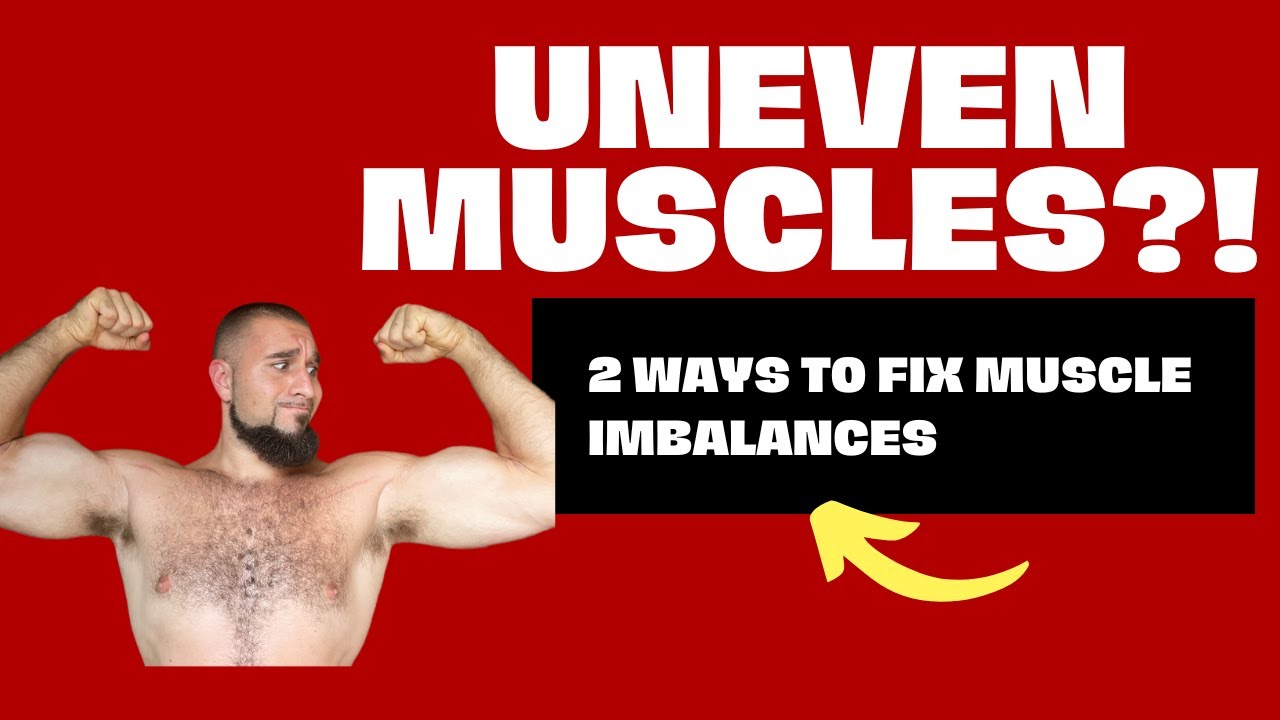
In this instructional YouTube video, Eric Roberts explains why many people notice one side of their body—such as a bicep, glute, or leg—appearing larger or stronger than the other, and how to address these muscle imbalances. He distinguishes two categories of imbalance: (1) aesthetic imbalances, which are purely visual and stem from natural variations in muscle origins/insertions, handedness, or dominant‑side usage, and (2) injury‑related imbalances, which arise from surgery, trauma, or chronic over‑use and can impair daily function and workout performance. Roberts outlines why injury‑related imbalances demand corrective action, then provides a practical programming framework centered on unilateral (single‑side) exercises. He recommends incorporating at least one unilateral movement per muscle group, using the weaker side to set the weight and either matching the stronger side’s reps or adding extra reps/volume to the weaker side. Specific examples (Bulgarian split squat, single‑arm press, single‑leg RDL, dumbbell curls) illustrate how to apply these methods. He also normalizes modest asymmetries, noting they are common unless they cause pain, injury, or significant performance loss. The video concludes with a call to action to subscribe and a plug for his Clubhouse training programs.
Chapters
Fuck you, left bicep. I like you, right bicep. Fucking hate you, left bicep. Why don't you catch up? I'm gonna make sure you get with the program. All right. One thousand reps later. YouTube, what is going on? Welcome back to the channel. Welcome to the video. In this video today, we are going to be talking about muscle imbalances. If you couldn't tell from the intro, my right bicep will be joining us today. My left bicep. Who knows? But we're going to talk about the 2 types of muscle imbalances. And this is very important for the last part of the video. It'll all come together. I'm going to tell you exactly what you need to do in order to fix the muscle imbalance, whether it's on your glutes or your arms or your legs or your quads or your legs or your chest. And then at the very end, we're going to talk about if you need to fix the muscle imbalances that you have. So you ready to dive in? Cool. Let's get into it. First and foremost, there are 2 types of muscle imbalances. The first is going to be purely from an aesthetic perspective, and aesthetic just means appearance. So for example, you saw my right bicep was bigger than my left bicep. Here's what I'll say. Is my right arm a little bit stronger? Yeah, because I'm right-handed. So I'm probably going to be a little bit stronger in my right arm, but is it like noticeably different where like I can't do daily functions or I can't pick something up with my left hand that I could with my right? No. Or anything of that nature? No, not really. Maybe I could do an extra rep or 2 on my right arm. Maybe I have a little bit better mind-muscle connection with my right arm. But is it like impairing my life or leading to like an injury or something? No, it's not. It's purely from an aesthetics perspective, because here's what I'll say most people don't know about. Your muscles can have different origins and insertions. And without getting too in-depth here, where the muscle actually inserts and origins on the bone can be different for every person. But then within the person, It can also be different from side to side. So my right arm has some different origins and insertions to it, my right bicep does, than what my left bicep does. And that's part of the reason why it looks a bit different. Now, does it maybe look a bit different because there's less muscle on this side? Yeah, for sure, potentially. But I could train that left bicep every single day for ends on ends on ends, and it's still going to look different than my right bicep because there are different origins and insertions when it comes to my left bicep versus my right bicep. So for you, if you have a muscle imbalance on one of your sides and it's purely aesthetic, like it just looks different, you can maybe do some of the things we're going to talk about to fix it here later in the video. But just understand, if it's solely from an aesthetics perspective and it's not harming or impacting your life, you might not have it look the same as your other side. Ever. You might, but you might not. And just be aware of that and understand that. And again, this goes for any body part on your body. So your quad or your glute or your bicep, tricep, whatever it is. Now, the second type of muscle imbalance is going to be from or caused by some sort of injury. For example, I will use myself. I had a surgery on the right side of my hip. Before the surgery and after the surgery, the right side of my hip was significantly weaker than the left side of my hip, like my glutes, part of my hamstring and quad, some of my hip internal external rotators. And it wasn't because— and yes, maybe it looked a tad bit different, but it was mainly an injury imbalance because it was affecting the way I lived my everyday life. Or when I would go do bilateral movements, which we'll talk about bilateral movements in a little bit here, but bilateral movements are just working both sides of your body at the same time. So like a barbell back squat or like a barbell shoulder press, for example. So when I was going to do a barbell back squat or any kind of squat that had me on 2 legs, I was always leaning to the left side because when I came down, my right hip was not strong enough to be able to take the weight I was lifting. So my left side had to overcompensate. And this is where, when you have muscle imbalances of this nature, this could potentially lead to injury or it might be caused by So I told you I had it before my surgery and I also had it after my surgery because I just had surgery on my hip. So this side was weaker than what my left side was. So I had to make sure I trained my right side in a specific way in order to get my strength back up so I could improve the quality of my life and the quality of my workout. It wasn't just an aesthetic, like, It wasn't just like, oh, my left bicep is a little bit smaller than my right bicep. It was a, hey, this is impacting my everyday day-to-day life on top of my workouts. Again, let's say I'm doing some sort of like, I don't know, some sort of barbell bent-over row or a barbell shoulder press or even a chin-up. Me having a slightly smaller left bicep is not going to massively impact my workout or my life. It looks a bit different, but that's really it versus the right side of my hip. That was impacting my life. That was impacting my workouts, and I had to make sure I did something to correct that. So those are the two main kinds, and I would just make sure you know which kind you are referring to for why you're watching this video, because it's going to make a difference in what you need to do in the latter part of this video. All right, so we got that down right now. Let's dive into what do you do in order to fix it? Well, the first thing we want to make sure of is we are incorporating unna. Lateral movements in your workouts. What are unilateral movements? We just talked about bilateral movements are both sides working at the same time. So think about a squat, a barbell shoulder press, a barbell bench press, a barbell bent-over row, a lat pulldown with both hands, something where you are using both sides of your body to move one object. Unilateral movements are where you use one side of your body. So think about a reverse lunge, a Bulgarian split squat, a single arm shoulder press, even a double arm shoulder press, but using 2 different dumbbells, doing a one arm row, doing a single leg RDL. Those are unilateral movements. And the best way to help not only fix, but also prevent muscle imbalances From becoming too apparent is to make sure you are incorporating unilateral movements into your workouts. I would strongly encourage you for both your upper body and lower body workouts, which if you don't know how to program a workout, I have a video on that as well. But when you're programming your workouts, I would include at least one unilateral exercise into your strength training program. So let's take lower body for example. Let's say you start off with a squat. And then you go to some sort of Romanian deadlift, and then let's say you do some sort of reverse lunge. That right there is a unilateral exercise because you are working one side of your body at a time. Or let's say you're doing upper body and you start with a barbell bench press or a pushup, and then you go to some sort of one-arm dumbbell bent-over row variation. That is a unilateral exercise. Let's say you're doing bicep curls. Instead of using a barbell, just use 2 dumbbells and do a bicep curl that way. You can even go one arm at a time to make sure you're really working the one side of your body. So the first and foremost thing is going to be make sure you incorporate those kinds of movements. And by the way, this is not to say you can't do bilateral movements. So I'm not saying you can't do a squat or a leg press or a barbell bench press or a barbell overhead press. You can still do those, but you need to make sure you are incorporating at least one unilateral exercise around the muscle group that you need to be working or the joint you need to be working. So again, if your glutes are maybe quote unquote a bit unbalanced, you would need to make sure you're using at least one unilateral exercise for your glutes. Now there's 2 main ways we can go about now doing this with unilateral exercises. The first way is going to be having the weaker side of your body start the movement, take it to a 1 to 2 RIR, Which I'll explain this in a second. And then just having the stronger side of your body match that. So let's say for example, you are doing a Bulgarian split squat and that is a unilateral exercise. Let's say your left leg is weaker than your right leg. What you are going to do is you are going to pick a weight for whatever rep range you're doing. So if you're doing 6 to 8 reps or 8 to 10 reps or whatever the rep range you are doing, let's just say you're doing 6 to 8 reps and you're trying to get 8 reps. You need to pick a weight. that you can do for about 8 reps. And by the time you get to that 8th rep, you need to be very close to failure. So by that like 6th, 7th, and 8th rep, when you are like trying to get back up from that Bulgarian split squat, you should be struggling and it should be very difficult. So let's just say that was 25 pounds and you did 8 reps for your left leg. All you're simply going to do is match that on the right leg. Even if it's easy with the right leg, because we do not want to do 2 separate weights for each side. That is only going to make the imbalance worse. So what you need to do is take the weaker side, go very close to failure, and whatever you end up getting for your weaker side, just match it with your stronger side. Your stronger side is still going to get work done, but your weaker side is going to catch up to your stronger side where eventually your weaker side and your stronger side will be both equally as strong and you'll be able to do 8s for both and it'll be challenging for both sides. Or let's say you're doing a shoulder press with 2 dumbbells. Pick a weight that is going to be heavy for that rep range you're doing. So let's say you're doing 8 to 10 reps and with your right arm you could pump out 30 pounds, but with your left arm it's only 20 pounds. That's fine. Use 20 pounds on both sides and just simply go close to failure. Even if the right side feels like you could do more, that's okay because you're trying to work your left side in this movement a tad bit more. Your right side is fine. It's already really strong. You want to have your left side match and catch up to the stronger side so eventually you can match strengths and it'll be difficult on both sides. So that is one way of going about doing it. The second way is simply going to be doing some extra reps on your weaker side. So let's say, for example, we're going back to the Bulgarian split squat. Let's say for the Bulgarian split squat, you did 25 pounds with 8 reps for your left side, which is the weaker side. And then you did 25 pounds for 8 reps on your right side, which is the stronger side. Let's say you do your left leg first. It was very difficult. You went very close to failure and then you did your right leg. After you do your right leg, go back to your left leg and just do like 2 or 3 extra reps. Because by this time you've worked your right leg, but your left leg got a slight break. So after you hit your right leg, just go back to your left leg and do like 2 or 3 extra reps for that set. And then rest as you should after that. Because what this will do over time, if you're doing 3 sets of a Bulgarian split squat, and you do 2 or 3 extra reps each set, and you do that over the course of 1, 2, 3 workout programs, eventually the extra reps and the extra volume is going to start to add up and you will be able to again build a bit more muscle and build a bit more strength on that side of your body. So hopefully that made sense. Now we're also going to talk about— I want to give you a little secret right here. And if you watched this far, good for you. Here's a secret. Muscle imbalances are 100% normal. Unless you are a competitive bodybuilder where you need to be perfectly symmetrical on each side, you are going to have some muscle imbalances across your body, and that's normal. Number one, for one of the reasons I said earlier, you just have different muscle insertions and origins, so your body might just look a bit different naturally. Not even because you're doing anything wrong in your workouts. And then number 2, again, some of us just have a bit more dominant sides than others for various different reasons. I know, for example, I've coached a lot of people, a lot of moms who like, they carry their kids on one side for 3 years. So their side is a little bit stronger. And you know what, man, again, unless it's taking away from the quality of your life, that's a bit normal. So it's not abnormal for you to have muscle imbalances. And here's what I would say. Really, I would only focus on your muscle imbalances if they are the second type right here, which is causing an injury, or if it's causing you to not live a good quality of life, or it's massively affecting your workouts. For example, my right hip was massively affecting my workouts and it was massively affecting my life because my hips and my glutes weren't strong enough. I couldn't do specific movements in the gym. Even outside of the gym when I would, you know, go, I would walk up the stairs or I would pick something up, I could notice a massive difference. So in that instance, it made sense for me to focus on the muscle imbalance and do all of these things I kind of talked about right here to make sure I got that strength up on that side so I can improve the quality of my life. But you just saw my left bicep is a little bit smaller than my right bicep. It's okay. We all have favorites. I know you have favorites with your kids. But seriously though, my left bicep is a bit smaller. Who fucking cares? I personally am not stepping on a bodybuilding stage. I'm not trying to be a bodybuilder. I'm not going to be 100% perfectly symmetrical on each side. And I don't care about that because it's not impacting the quality of my life. And I know it's normal. There's— I didn't do anything wrong. Again, could I maybe do some of these scenarios to bring my left bicep up? Yeah, for sure I could. And who knows, maybe I will one day, but for right now it's just really not that big of a deal to me because it doesn't negatively impact my life. And I know it's normal to have some imbalances throughout your body. So my 2 cents would be, if you have an imbalance that's not taking away from the quality of your life, or it's not causing an injury, I really wouldn't worry too much about it. Now I would make sure you are continuing to incorporate unilateral exercises into your workout programs, because I believe that is a staple you should be having in your workout programs. For example, every single workout we have inside of my clubhouse where I have all of my training programs each month, we have unilateral exercises every single month because there is some merit to making sure you don't continue to develop or facilitate a muscle imbalance. If you're only doing bilateral exercises like a squat or a barbell bench press or a 2-leg leg press, If you're only doing bilateral, you're probably going to develop some imbalances over time that are going to tighten themselves because you never do unilateral work. But as long as you are doing unilateral work and you feel good and you're injury-free, and maybe one arm is a bit smaller than the other, or one leg is a bit smaller than the other, I really wouldn't worry too much about it because it's normal. That was the video for today, guys. Hope you enjoyed it. If you did, please feel free to give it a thumbs up. Make sure you subscribe to the channel. I looked at my channel analytics the other day and a lot of you are not subscribed. Please subscribe to my channel. And last but not least, if you are interested in joining the Clubhouse and getting all of my workout programs, I will put a link here in the description of this video. Hope it helped.










