
Another Hashtag to Follow and Facebook Ads Update
Eric Cook shows community bankers how to track event hashtags with TweetBinder, measure impressions and engagement, and build Twitter lists to filter information overload. He also warns about Facebook's new restrictions on targeting for housing, credit, and employment ads.
Chapters
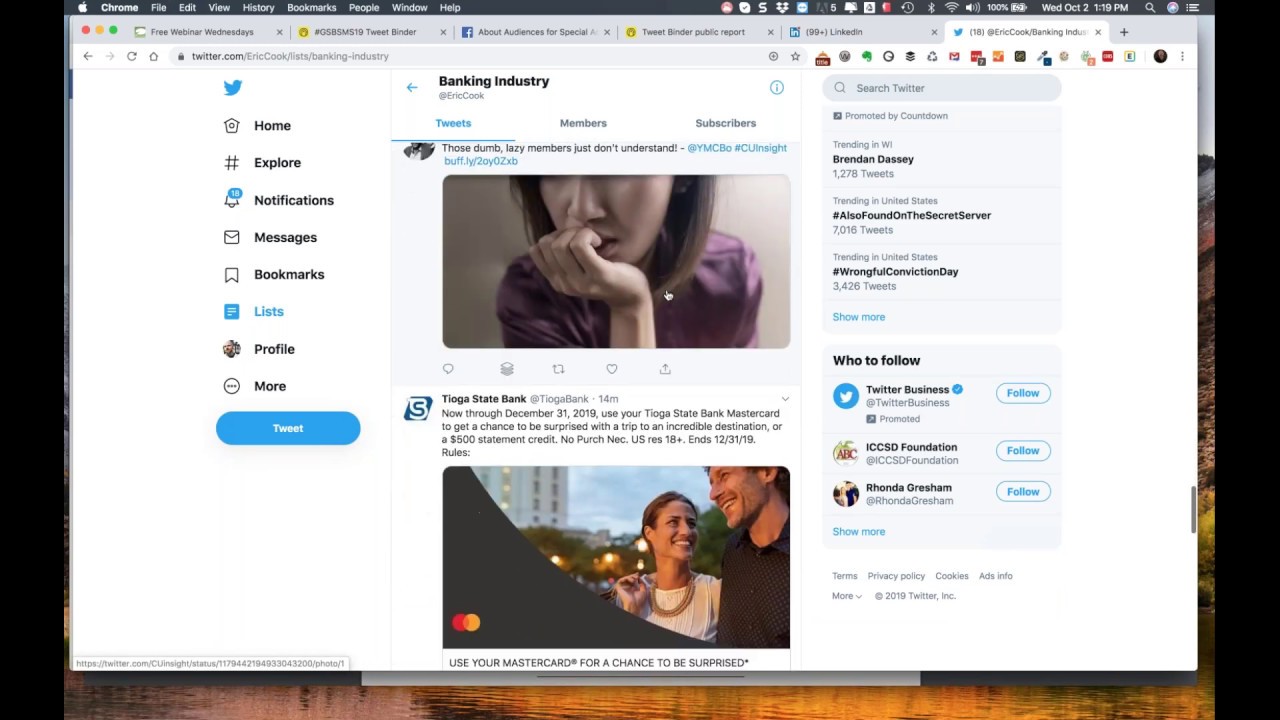
Greetings everybody, welcome to the Wednesday, October 2nd, 2019 episode of Free Webinar Wednesdays. This is Eric Cook over at WSI Digital where we're helping our clients and customers connect and engage with their customers online. You can learn more about us at Over at www.poweredbywsi.com. We're still wrapping on putting together the recap for last week's show, so that should be available here very shortly. Apologies for the delay in that, but I am excited to be back now 2 weeks in a row with a live show. Joining you from lovely Madison, Wisconsin, where I'm attending and presenting for the Graduate School of Banking at their sales and marketing school tomorrow morning. So we're going to talk a little bit about that, um, some of the stuff that I'm going to be chatting about with those folks, some of the other things that are being covered in the school, um, and a handful of other little topics that are top of mind for me. Um, before we officially kick things off, just want to remind everybody today's show and all shows are recorded, and when I actually get the summaries done and videos uploaded to YouTube. They're made available here at freewebinarwednesdays.com. So you can always check out other shows and the archive and the history there as well. And then if you are joining the show live, certainly feel free to chime in. Would love to hear what you have to say, any questions, comments, thoughts. One of the nice parts about doing a live show is you get that feedback and interaction from everybody. One of the challenges is obviously if I'm traveling, presenting at a conference, or not available, live show just doesn't happen. And as oftentimes I do, you'll hear a slip of the tongue or a little misstep on my part. But, you know, I chalk that up to personality, and that just makes the show that much more genuine and unique, right? Can I get an amen? Amen. So there's, uh, actually it looks like somebody has their hand raised. We actually don't use the raising of the hand in, um, the live shows. If you are interested in asking a question, feel free to go ahead, toss it into the chatbot. I got an amen. Thank you there. Much appreciated, Sean. Um, so we don't use the actual, uh, hand. So if you do have a question or a comment, just go ahead and type it into the chat area and I'll go ahead and keep an eye on that and respond back to it accordingly. So let's kind of dive in a little bit. So I am, we talked a little on the last show about the hashtag battle with Pacific Coast Bankers School. I'm at another school, I actually teach at 6 banking programs, actually 5 banking programs, but GSBA I teach twice. One at their general banking school in August, which is a 2-week program, very similar to what the PCBS does. And then they've now, in their second year, Sales and Marketing School, which is just a 1-year, 1-week program here in Madison, Wisconsin. So the GSP Sales and Marketing School has kicked off. I flew in early this morning from Michigan and I'm settled into my hotel here at the Fluno Center. And tomorrow I present on digital marketing and social strategies. For today's community banker. They've had sessions on the basics of banking to teach marketers some of the elements that go on in banking in general, as far as how a bank actually makes money and profit and loss and net interest income and fees, all those different sorts of things that sometimes marketers may not be exposed to, but certainly are important components to having an appreciation for how the general business of a bank actually works. There's sessions on identifying a target audience, market analyses, leveraging data, retail. We're actually having one of the CEOs that graduated from last year's program come back and do a culmination presentation on Friday morning, reinforcing the importance of sales and marketing from the CEO's perspective. One of the things that we're gonna hear on Friday is after they attended the Sales and Marketing School, they actually went back to their institution and completely rewrote their marketing plan, gave them a whole other perspective on really the whole concept of marketing, traditional, digital, market analysis, customer segmentation, and so really transformed their organization. So we're going to hear her story, and I think that'll be pretty exciting because it's always good when what you do as a marketer is supported from the top down. And the fact that there was a CEO along with their marketer, and I think they even had one other person All 3 of them went through the program last year. They were able to really take some hands-on lessons back to their institution and make a difference. So you may recall from last week's show the tool that we've used in the past called TweetBinder. If you were not on the show or maybe didn't catch the replay, just to give you a quick little synopsis of what TweetBinder does. And why we like it so much. In the world of social media, you've got things called hashtags, which are really nothing more than a label to a conversation or a way to categorize a discussion topic to make it easy to find what people are talking about. You can make those either specific to a particular event, which is what we've done here. You can see we have a unique hashtag that we're using for the School of GSB SMS. 19, and the only time that that hashtag is really being used is when it's being used by either a faculty instructor or student that's out here actually attending the program. You've also got the ability to take a look at hashtags from a general perspective and follow bigger topics, and LinkedIn, Instagram, at least at this point, allow you to subscribe to those particular hashtags or any hashtag. So it can give you the ability to say, hey, I'm interested in fintech, or I'm interested in banking, or I'm interested in legal advice. Anything that there's a hashtag that people are talking about, you can add those, and that'll give you the opportunity to see when people are talking about those particular topics. But in the instance of using the GSB or what we did with the PCBS, being able to create a unique hashtag that allows for us to categorize and the conversations that are unique to this particular event. Really the biggest advantage of using a hashtag that nobody else is really using at this point. So we can see the, the number of tweets that have happened over the last, and I think we just really started tweeting about this not even a week ago. Bankers arrived on campus here on Sunday and jumped right into some programs, and it continues until Friday morning. Ending right before lunch. So you can see 46 total tweets created by 9 original contributors, and one other individual jumped on board that wasn't a contributor but reshared or engaged to gain a little bit more exposure. Again, one of the cool parts about TweetBinder is it takes the amount of visibility that a tweet, or I guess I should say a hashtag, is generating, and it assigns a numerical value in dollars and cents to that to give you an idea of the, the value of that hashtag, that conversation, that exposure. Because otherwise, if you wouldn't have been able to generate that exposure organically, you would have had to have paid to, to get that through some sort of a social advertising program. So we're going to watch that number continue to go up and up and up. And then for users that are part of this this platform. You can dive in and see some additional detail with who's actually doing it. So you can see Jack Hubbard from St. Meyer and Hubbard. He's one of the actual chairs of the school, so it doesn't surprise me that he's tweeting up a storm. You can see a handful of other students that are part of this. You can see me sprinkled in there. So this is giving you some really nice behind-the-scenes data. One of the things that the platform gives us the ability to do is we can actually grab a public URL And what I've done is I've created a shortened link to make it easier to remember. So bit.ly/GSBsms19-live. Now the difference between a live public report and the actual report that you get as a paying customer is the live public report gives you some basic info, shows you kind of who's tweeting. You can show more. Kind of get a little bit more detail, but it really doesn't go into the actual tweets themselves. And that's one of the things that a platform like TweetBinder provides. And I honestly don't think that I dove into this when I was talking about the PCBS recap, so this is going to be new. Even if you sat through the recap for PCBS, this is going to be some new stuff here. So if you're using the actual paid version of TweetBinder, You have the ability to go into some of these other tabs. And the Classify tab is one of the tabs that gives you the ability to jump right in. And not only do you see who the people are, but you can actually see what the actual tweet is. So this gives you an idea of original tweets, responses. This is going to give you, as a marketer, let's say you are the education director or the program manager for GSB. Or maybe this is your organization, whether you work for a bank or a nonprofit or any other type of business. If you've got a hashtag that you're using that's unique to your organization, or you just want to throw in a hashtag and see who's talking about a particular topic like fintech or cryptocurrency or cybersecurity, you can go through and this gives you that listing. You can do the exact same thing directly in Twitter where you can type in the hashtag and Twitter will give you the list. But this gives you the ability to actually see who the people are. You can go through. So let's say Beth, I could click on the 16 hours ago. You could see Beth is actually from Indiana. So she was at a local beverage establishment, i.e., Wisconsin bar. I'm sure she probably had some cheese as well because, you know, Wisconsin's known for their cheese and their beer. But she's sipping on a Stella, but she actually found an Indiana bar stool at one of the bars here that actually has license plates from around the country. So she posted this. Now directly from here, I could go through, I could check out other tweets, I could click on the like button directly here, I could follow her directly from here. It gives me the ability to engage and interact right from the actual TweetBinder platform. So as the event becomes larger and larger and larger, you can see we've got 60 tweets per page is the maximum, so we can get a full list of everything that's going on. And then we've got the ability, I believe, where we can actually select all of these. We can go through, we can do some sorting, we can say show me only individuals, you know, so show me just, just Tom Hershberger or just mine or just those that have got the hashtag of community bankers listed in them. So there's all sorts of really cool opportunities to be able to slice and dice this. Now, I talked in the last webinar about the fact that because— and it's not to say that Twitter is the best social media platform out there. In fact, I talked to a lot of people that just get overly confused and, and probably overwhelmed with Twitter because there's so much information. It goes very quickly, and there's different strategies that you can use as a marketer and a user of social media to help you tame that. Tweet beast, if you will. One of those is a tool that Twitter provides called lists, which are very, very powerful. Maybe if we've got time, I can kind of go off on a little tangent and show you what a Twitter list does. But Twitter gives us access to their API, so all of the tweets that they are responsible for, as long as they're public, are made available to third-party services like TweetBinder and TweetReach and AgoraPulse and some of the others. So it gives us the ability to data mine this, but it doesn't mean that this is the only platform that you can leverage the power of a hashtag. If you are posting on LinkedIn and have good engagement with your followers, you can post and share information with hashtags on LinkedIn. And even though you can't pull that data into a third-party service like a TweetBinder to analyze it, the fact that TweetBinder reveals what is going on with Twitter The assumption could very easily be made that that very same engagement and visibility is also happening on the other platforms, and you just don't have the ability to measure it as well. But you certainly have the ability to take a look and, and see what's going on in Twitter and then assume that that same engagement and visibility is happening over in the world of LinkedIn or Facebook or Instagram or other places. So I'm going to hit the pause button here for just a second and see if there's any questions from the audience related to hashtags. I'm going to pop over to LinkedIn and show you a quick example of searching for a hashtag. And also I'm going to maybe draw attention to the ability to create a list over in Twitter as well, as I think that's something that'll be pretty important. But if we are taking a look at a hashtag, you can simply go into the search GSB SMS 19, which is the example that we're talking about today. Click on the search results, you can see GSB SMS 19. Click on that, you can see that I'm already following this hashtag. So it shows up over in my followed hashtags area here in LinkedIn, which means there's a higher likelihood that if somebody posts something, LinkedIn and they include the hashtag, it will show up or has a higher chance of showing up in the organic feed. Plus I can go in and I can search for it. So here's my good friend Jack, Jeff Meyer, Retail Banking Officer at Wolf River Community Bank. My assumption is Jeff is probably present here at the GSB and I'll get a chance to meet him and several others tomorrow. But you can walk through and see here's where all of the hashtags are. Hashtags are pulling in a stream of information. There's Tom with his data nerd, nerd t-shirt, group of bankers here. So just a great way to follow. And you can see again with the followed hashtags, it's very easy for you just to pop over and click on any of the other hashtags that you're following so that you can just jump in and see exactly what's going on. Online. The other thing that I'll mention is if you wanted to, and let's go ahead and we're going to do a search up here, GSB SMS 19. We're going to do a search and we're going to maybe browse through and take a look. Now there's a sponsored ad that's jumped out here that doesn't have anything to do, but let's take Laura. Or Lauren. So Lauren is a banker and she is here. So what I could do, if I'm interested in engaging with Lauren, I could go to her profile and I could take a look. Doesn't look like she's actively tweeting cuz she's only got one tweet. So maybe she actually created her Twitter account so she could participate in the GSB SMS hashtag. But if I wanted to maybe include her with other bankers that I have met, maybe you could include clients of yours, prospects, community members. I can go ahead and I can click follow so I can make sure that I'm following her. She follows me back. That then provides us with the ability to direct message one another for private conversations. But the other thing that I also can do is I can click on the little dropdown here and I can add, remove from lists. And let's say I decide I want to add Lauren to my banking industry list because she's part of the banking industry. That adds her to the list. And then what I can do is on my profile, if I go over to my lists and I scroll down to my banking industry list, this gives me the ability to actually see all of the individuals. And there's, uh, several hundred of them that are part of my list. And rather than my stream seeing information on golden retrievers and bicycling and fitness and maybe some cybersecurity stuff, this gives me a very quick and easy way to see about what people in the banking space or people that I've met as part of the banking, my banking travels, are actually talking about. So unless the banking connections are tweeting things that have political or sports or other sorts of content related to them. A vast majority of what is going to be in this banking list is going to be just banking-specific information. Now the other cool part about a list is you as a user on Twitter have the ability to actually subscribe to my list. And so you can see these are the individuals that have said, you know what, I think Eric's building a pretty awesome list of banking info and following people for me, so I'm just going to go ahead and subscribe to his list and I'm going to let him do all the work for me. So I'm happy to curate that list. You can see that there's people in here that I am not following, there's people in here that I am following, so I can kind of roll through here and if there's people that I see, well, Riverview Bank, maybe I should follow them. They're part of my list, so I can go in and I can click follow there. And maybe I'm going to want to make sure, for example, and I can hold down my Command button, open up a new tab. Actually, I didn't do that because I clicked too fast, but I can go directly to the add/remove lists and I can scroll down and make sure that I add them to my banking list so that any of the tweets that they post will show up. So there's a little bit of care and maintenance that goes on in this. It's not a tremendous amount. But one of the things that's nice about this is, as a user on Twitter, if you develop some lists that other people that you're trying to influence may be interested in checking out, you have the ability to be that curator. And so it's not to say that everybody in this list is going to remember exactly me being the actual poster or the creator, but when they go to this list, they're gonna see my Eric Cook Lists Banking Industry. My name shows up, I'm part of it. As I add more information, it just makes that better. It's one way that you can create top-of-mind awareness and weave yourself into a position of providing value to those folks that you're interested in actually having influence on. So I'm going to go ahead and just quickly check here and see if we have any other questions. It looks like we've got a little note here. I'm going to go to the questions page. Nope, looks like that was just the amen from Sean. So question box is clean. Instagram also gives you the ability to follow hashtags and you can add those to your list. So if people are posting on Instagram of a particular hashtag, you can follow those as well. So a couple of different ways that you can engage and try to manage that. There's an author out there by the name of Clay Shirky, and he's got a quote that I oftentimes will use in my presentation. Is it's not so much a case of information overload as it is filter failure. And if you think about that, most of us feel information overload on a daily basis because we don't have a way of filtering out stuff that matters to us. We try to take it all in. It's eating that elephant, and you're going to choke if you try to shove the elephant all in your mouth at one time. So if you can figure out a way that you can filter things down so that when you need to know them or how you can only look for specific topics that you're particularly interested in at that given time with things like lists and hashtags and other ways that gives you the ability to have that, you know, filter failure issue resolved and make it not seem as overwhelming when you jump into social media and try to catch up and see what's going on with everybody else. So the other thing that I wanted to mention for those of you that are out there in the financial marketing space But it's also important to note as it relates to just Facebook in general. I made reference to this, I think, last week as well, but I wanted to make sure to draw attention specifically to this. Facebook has come under scrutiny, no surprise to most of you, for some privacy-related items, making sure that it's maybe doing a better job of restricting all of the data that people have access to. One of the things that always, I guess, excites and freaks our customers out at the same time is in Facebook and other platforms, the ability to go in and really target an audience specifically on variables like age, gender, marital status, household value, propensity to own a home, income level, profession, education, you know, all those different variables. And one of the things that has recently been introduced by Facebook is some restrictions in the areas that special category— and this impacts the banking space— special category advertisers have to pay attention to as it relates to advertising online for things like housing, the extension of credit, uh, and employment are the, are the 2, are the 3 elements that are, um, specifically mentioned here. So it used to be for any of the areas that you wanted to go advertise, you could whittle down based off of all of these different areas. And some of these are now being restricted. So locations, age, gender, and detailed targeting such as demographic and interests and all those other sorts of things, they're no longer available to us to be able to use. So we just need to be a little bit more creative in our ways to be able to, I guess, go out and target those individuals, or maybe looking for other platforms that would give us the ability to get a message in front of those individuals, especially if you're out advertising for things like home loans or mortgages. I know we've experienced a little more pushback, not just from Facebook, but even some of the other ad platforms, almost like there is an overcompensation going on with the amount of restrictive covenants that are being added to advertising and the use of data. So like with anything else, when something bad happens and there's a reaction, the reaction is oftentimes in excess. And not to say that it's not important, But it likely is going to be coming backwards and maybe loosening up a little bit down the road. But for the most part, I just want to make sure everybody out there, especially if you're going after any of the, the clients or prospects in ad categories that cover— and I mentioned them earlier, but here's the reference to that— credit, So, you know, something that would be maybe even credit card related, but certainly installment loans, personal loans, business loans, employment opportunities where under the EEOC we have to be careful what sort of information we have access to and collect when we're taking job applications. That's now being reinforced a little bit more proactively from an advertising perspective. And then obviously a housing opportunity. So that could not just be buying a home, but even landlords interested in promoting their rental properties and making sure that, you know, you're not being discriminatory or predatory in your advertising efforts. So again, if you are not the individual that manages advertising within your organization, but you do advertise and maybe even in Facebook, probably not a bad idea to share the information in today's webinar with that individual, or at least keep it on your radar screen if you're not part of these industries, but you may start seeing some restrictions in other areas. That's certainly something to keep an eye on. So with that, I just looked at the clock, and my goal, as you all know, is to try to keep these at 30 minutes or less. Quick little nuggets of information. If you'd like to follow along and check out what's going on with GSB over the next few days, again, that URL, bit.ly/GSBSMS19-live for livestream. Go ahead and visit that. That'll redirect you automatically to the TweetBinder report. And you can kind of check things out, see who's actually doing some tweets, or better yet, just follow me on Twitter and I'll likely be ramping up the tweets here in just a little bit now that I'm actually arrived here at the Fluno Center and in Madison. Looking forward to be back here for a couple of days and then returning back to Michigan on Friday. So with that, we're gonna go ahead and put a bow on today's show. Thank you so much for those of you that attended live and looking forward to joining you Again, uh, next week and on future weeks right back here at freewebinarwednesdays.com. Until then, have a great week, everybody, and we'll talk to you soon. See ya.







